Abraham’s Three Visitors at Mamre: Who Were They?
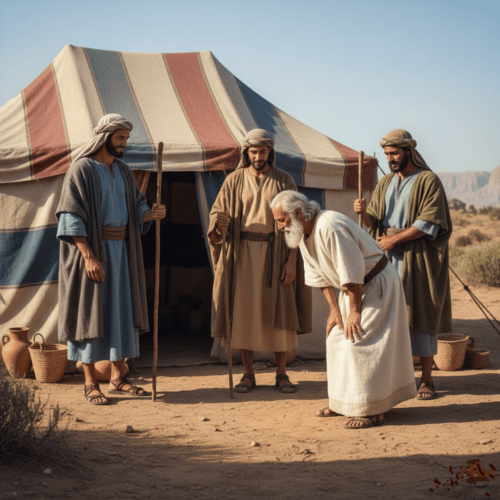
The scene unfolds with stunning simplicity: Abraham is seated at the entrance of his tent in the heat of the day when he suddenly looks up to see three men before him. His response is remarkable—he runs to meet them, bows to the ground, and addresses one of them as “Lord.” Yet the passage begins with these words: “The LORD appeared to Abraham near the great trees of Mamre” (Genesis 18:1).
Something extraordinary is happening here. Abraham sees three figures but worships one. The text identifies the visitor as YHWH yet describes three men. Who were these mysterious visitors, and why does this encounter matter for our understanding of Scripture?
WHAT THE TEXT ACTUALLY SAYS
Genesis 18 rewards careful reading. The passage opens by telling us “the LORD appeared to Abraham,” but verse 2 immediately says “Abraham looked up and saw three men standing nearby.” This isn’t a contradiction—it’s a clue.
Watch how Abraham responds. He addresses one figure in the singular: “If I have found favour in your eyes, my lord, do not pass your servant by” (v. 3). Throughout the conversation, one visitor speaks with unmistakable divine authority: “I will surely return to you about this time next year, and Sarah your wife will have a son” (v. 10). When Sarah laughs at this impossible promise, the speaker asks, “Is anything too hard for the LORD?” (v. 14)—a question only God can pose.
The plot thickens in verse 22. As the narrative shifts toward Sodom’s judgement, two of the visitors depart while “Abraham remained standing before the LORD.” When these two arrive in Sodom, Genesis 19:1 explicitly identifies them: “The two angels arrived at Sodom in the evening.”
The math is clear: three visitors, but two angels. The third visitor is someone else entirely.
THE REFORMED ANSWER: CHRIST BEFORE CHRISTMAS
The Reformed tradition has consistently identified the third visitor as a pre-incarnate appearance of Christ—what theologians call a “Christophany.” This isn’t speculation; it’s letting Scripture interpret Scripture. Consider the evidence.
Throughout Genesis, a figure called “the Angel of the LORD” appears and receives worship, speaks as God, and claims divine prerogatives. This Angel appears to Hagar and identifies Himself as God (Genesis 16:7-13). He stops Abraham from sacrificing Isaac and swears by Himself, something only God can do (Genesis 22:11-18). In Exodus, this Angel appears in the burning bush and declares, “I am the God of your father, the God of Abraham, the God of Isaac and the God of Jacob” (Exodus 3:6).
The New Testament confirms Abraham’s encounter was with Christ. Jesus Himself declares, “Your father Abraham rejoiced at the thought of seeing my day; he saw it and was glad” (John 8:56). When did Abraham see Christ’s day? Genesis 18 provides the answer.
John Calvin explained it this way: the eternal Son, before taking flesh in Mary’s womb, appeared temporarily in human form to advance God’s redemptive purposes. The visitor at Mamre exercises powers that belong to God alone—He promises to give life from Sarah’s dead womb, knows the future with certainty, and prepares to execute divine judgement on Sodom. As the psalmist declares, God alone forms us in the womb (Psalm 139:13-16). God alone knows the end from the beginning (Isaiah 46:9-10).
The two angels, by contrast, function as divine messengers. They carry out God’s judgement on Sodom but don’t receive worship. Their role is consistent with angelic ministry throughout Scripture—serving as agents of God’s will while remaining creatures, not Creator.
WHY CAN’T THE THREE BE THE TRINITY?
Some interpreters have seen these three visitors as a veiled revelation of the Trinity. While the impulse is understandable, Reformed theologians have been appropriately cautious about this interpretation.
First, the text itself won’t support it. Two of the visitors are explicitly identified as angels in Genesis 19. Unless we’re prepared to say two persons of the Trinity are angels, this interpretation collapses.
Second, God in His essential being cannot be divided into parts that appear separately. The doctrine of divine simplicity—affirmed in the Westminster Confession and across Reformed confessions—teaches that God’s essence is indivisible. God cannot split Himself into separate pieces that show up in different places. When God appears in visible form in the Old Testament (what theologians call a “theophany”), He’s choosing to make Himself known in a way humans can experience. But these appearances are temporary accommodations to our limitations, not photographs of what God actually looks like in His essential divine nature. God graciously reveals Himself to us, but He does so in ways we can handle, not by dividing up His divine essence.
Third, we must be careful not to read later revelation backwards inappropriately. The full, clear revelation of God’s triune nature awaits the New Testament. Genesis 18 certainly points forward to that reality, and the Son’s pre-incarnate appearances prepare for His incarnation, but we overreach when we claim to see all three persons of the Trinity physically manifested here. John Owen is even sharper: “To make the Father or the Holy Spirit personally appear in human form is neither warranted by Scripture nor consistent with their manner of subsistence.”
WHY THIS MATTERS TODAY
This passage isn’t merely an interesting biblical puzzle. It reveals profound truths about God’s character and His way of working with His people.
- It demonstrates God’s magnificent condescension. The eternal Son doesn’t remain distant but comes near in ways we can receive. He sits with Abraham, eats bread, engages in conversation. This foreshadows the supreme condescension of the incarnation, when the Word became flesh and dwelt among us.
- It shows Scripture’s beautiful unity. The Christ who walked beside Abraham is the same Christ who walks with His church today. From Genesis to Revelation, He is the visible presence of the invisible God, mediating between heaven and earth.
- It reminds us Christ’s mission was consistent throughout redemptive history—bringing life to the dead (Isaac from Sarah’s barren womb) and executing judgement on sin (Sodom’s destruction). These dual themes of resurrection life and righteous judgment culminate at the cross.
- It models the hospitality we’re called to show. The author of Hebrews likely had this very passage in mind when he wrote, “Do not forget to show hospitality to strangers, for by so doing some people have shown hospitality to angels without knowing it” (Hebrews 13:2). Abraham’s eager welcome to divine visitors sets the pattern for Christian virtue.
SEEING CHRIST’S DAY
Genesis 18 invites us to see what Abraham saw: the eternal Son, active in history long before Bethlehem, advancing God’s redemptive purposes alongside His angelic servants. This interpretation honours the biblical details, maintains theological coherence, and reveals Scripture’s unity from Genesis to Revelation.
Abraham looked up and saw three visitors. Two were angels. One was the Lord of glory. Abraham truly saw Christ’s day—and like him, we have reason to be glad.
RELATED FAQs
Did Abraham know he was meeting God, or did he think they were just travellers? The text suggests Abraham recognised something extraordinary immediately. His urgent hospitality—running to meet them despite his age, bowing low, preparing an extravagant meal—goes beyond normal ancient Near Eastern courtesy. Most Reformed scholars believe Abraham sensed the divine presence, though the full revelation unfolded gradually through the conversation. His worship posture in verse 3 indicates he knew this was no ordinary encounter.
- Why did God appear with two angels instead of coming alone? The two angels served as witnesses to God’s covenant promises and as executors of His judgement on Sodom. In ancient legal contexts, two or three witnesses established truth (Deuteronomy 19:15). Their presence also demonstrates how God orchestrates both mercy and judgement—while Christ stayed with Abraham to intercede for Sodom, the angels went ahead to carry out justice. This anticipates Christ’s dual role as both merciful Saviour and righteous Judge.
- What do modern Reformed theologians say about this passage? Michael Horton argues this passage shows “the Son’s mediatorial role even before the incarnation.” Sinclair Ferguson emphasises these Christophanies reveal “the Son as the one through whom God has always related to His creation.” Derek Thomas notes Abraham’s encounter demonstrates “progressive revelation—enough light for Abraham’s moment, with fuller understanding reserved for us who live after Christ.” These scholars see continuity between the pre-incarnate Son’s appearances and His incarnate ministry.
Why does the text switch between plural and singular when describing the visitors? This deliberate literary technique highlights the mystery of the encounter. When all three are in view or acting together, the text uses plural (“they said,” “the men”). When the LORD speaks with divine authority, it shifts to singular (“he said,” referring to YHWH). This grammatical switching isn’t confusion—it’s the inspired author’s way of showing us one of these visitors was fundamentally different from the other two.
- Could this be the Father appearing, rather than the Son? Reformed theology has consistently said no, based on John 1:18: “No one has ever seen God, but the one and only Son, who is himself God and is in closest relationship with the Father, has made him known.” Jesus also states, “Anyone who has seen me has seen the Father” (John 14:9), indicating the Son is the visible manifestation of the invisible God. Whenever God appears in bodily form in Scripture, Reformed interpreters identify this as the Son’s work.
- How does this passage connect to the Angel of the LORD throughout the Old Testament? This is part of a consistent pattern. The Angel of the LORD appears to Hagar, Jacob, Moses, Gideon, and others—always speaking as God, receiving worship, and claiming divine authority. Reformed scholar O Palmer Robertson calls this “the visible Yahweh,” the second person of the Trinity making God known before the incarnation. Genesis 18 fits seamlessly into this broader biblical theology of the Son as mediator between God and humanity.
What does Sarah’s laughter reveal about this encounter? Sarah’s sceptical laughter—and her later denial of it—shows the shocking impossibility of God’s promise. A 90-year-old woman having a baby defies nature. But the LORD’s response, “Is anything too hard for the LORD?” (v. 14), establishes the theological point: this visitor can do what only God can do—create life from death. Sarah’s doubt actually highlights the divine power on display, anticipating how God would bring life from another barren womb (Mary) and ultimately from death itself (Christ’s resurrection).
OUR RELATED POSTS
Editor's Pick
The Throne-Room Vision: Who Did Isaiah See?
The scene is unforgettable: Isaiah stands in the temple, and suddenly the veil between heaven and earth tears open. He [...]
The Angel of the Lord: Can We Be Certain It Was Christ All Along?
Throughout the Old Testament, a mysterious figure appears: the Angel of the LORD. He speaks as God, bears God’s name, [...]
SUPPORT US:
Feel the Holy Spirit's gentle nudge to partner with us?
Donate Online:
Account Name: TRUTHS TO DIE FOR FOUNDATION
Account Number: 10243565459
Bank IFSC: IDFB0043391
Bank Name: IDFC FIRST BANK