Christophany Unveiled: Who is The Angel in Zechariah 3?
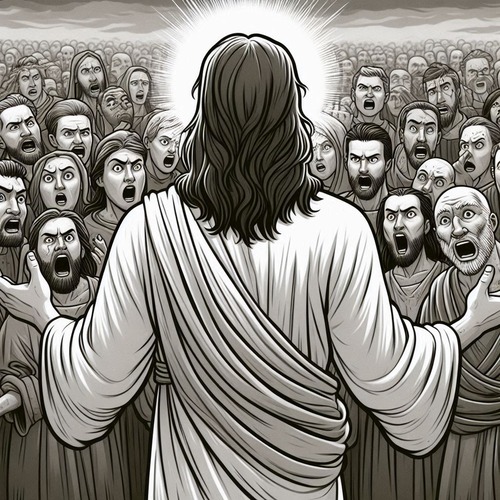
Picture the scene: Jeshua the high priest stands trembling before the Angel of the LORD, clothed in filthy garments. Satan crouches at his right hand, hurling accusations. The atmosphere crackles with cosmic tension. Then the Angel speaks—not as a messenger, but as God Himself: “The LORD rebuke you, O Satan!”
This is no ordinary prophetic vision. It’s a courtroom drama that unveils the gospel itself, enacted centuries before Calvary. But it raises questions that have captivated Reformed theologians for generations: Who is this mysterious Angel who speaks with divine authority? How does Jeshua prefigure Christ? And can two figures in one passage both point forward to the Messiah? The answers highlight the very heart of our salvation.
THE ANGEL WHO IS GOD
This is no created angel. The text won’t allow it. Notice how He speaks in verse 2: “The LORD rebuke you, O Satan! The LORD who has chosen Jerusalem rebuke you!” He doesn’t say, “May the LORD rebuke you,” as a messenger might. He speaks as YHWH in the first person, exercising prerogatives that belong to God alone—removing iniquity in a single day, promising the coming Branch, silencing the accuser of God’s people.
The Reformed tradition speaks with one voice here. Calvin, Owen, Hengstenberg, Keil, Pusey, and Barron unanimously identify this Angel as the pre-incarnate Christ, the second Person of the Trinity. Calvin puts it memorably: “Whenever this name ‘Angel of the LORD’ is used with the definite article, it denotes the uncreated Son of God.”
This isn’t angelic mediation—it’s divine self-revelation. The eternal Son, appearing in visible form before His incarnation, preparing Israel (and us) for Bethlehem. When Jesus later claims, “Before Abraham was, I AM” (John 8:58), He’s acknowledging a ministry that stretches back through Israel’s history. The Angel of the LORD in Zechariah 3 is YHWH manifest, the Word before He became flesh.
JESHUA: THE HIGH PRIEST WHO FORESHADOWS OUR GREAT HIGH PRIEST
But what about Jeshua himself? His very name—Yeshua in Hebrew, the same name we translate as “Jesus”—hints at his typological significance. He stands as the representative head of restored Israel, freshly returned from Babylonian exile, bearing the weight of their covenant unfaithfulness.
Those filthy garments aren’t just dirty—they’re defiled, symbolising the sin and spiritual pollution of the people (Isaiah 64:6). Jeshua cannot cleanse himself. He’s helpless before both his accusers and his Judge. Yet watch what happens: “Behold, I have taken your iniquity away from you, and I will clothe you with pure vestments” (v. 4).
This is forensic justification enacted before our eyes—the guilty declared righteous, not through self-improvement but through divine intervention. The filthy robes are removed; clean garments replace them. The clean turban is placed on his head. Jeshua stands transformed, not by his own effort but by sheer grace.
Reformed divines from Edward Reynolds to Thomas Boston to Jonathan Edwards saw clearly what’s happening here: Jeshua typifies Christ who both bears our filth and clothes us in His own righteousness. Like the high priest on the Day of Atonement, Jeshua represents his people. But unlike any mere human priest, the Christ he foreshadows will actually accomplish what the ritual only symbolised—permanent, perfect cleansing.
TWO TYPES, ONE CHRIST
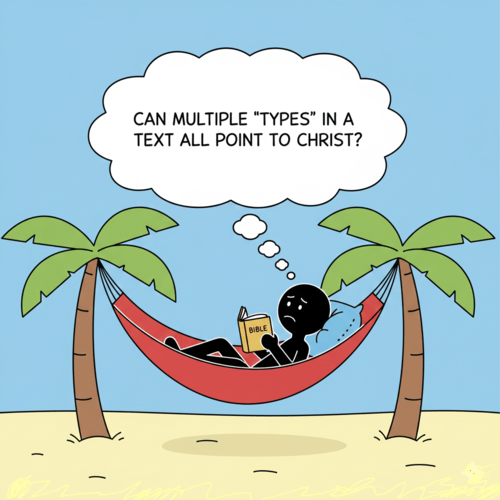
Can two figures in one vision both point to Christ? Not only can they—Scripture does this repeatedly, because no single type can capture the fullness of who Christ is.
Consider the pattern: Melchizedek the king and Aaron the priest together reveal Christ the royal priest. David the conquering king and Isaiah’s suffering servant together show us Christ the kingly sufferer. Multiple types aren’t confusion—they’re complementary revelation.
In Zechariah 3, we see this dual typology at its finest:
The Angel reveals Christ in His divine nature and judicial authority—the Judge who has the power and right to justify.
Jeshua reveals Christ in His human nature and mediatorial priesthood—the representative who is cleansed so He might cleanse others.
Together they portray the one Mediator who is both the offerer and the offering, both Priest and Sacrifice. They show us the mystery Paul would later unfold: Christ is “God manifest in the flesh” (1 Timothy 3:16), fully divine and fully human, the only one qualified to bridge the infinite chasm between holy God and sinful humanity.
THE GOSPEL IN EVERY VERSE
Watch how the gospel unfolds verse by verse in Zechariah 3:
- Verse 2 shows us Christ the electing God: “The LORD who has chosen Jerusalem.” Before Satan can accuse, grace has already chosen. Election silences the accuser (Romans 8:33).
- Verse 4 gives us Christ the justifying Priest: “I have taken your iniquity away from you.” This is substitutionary atonement—our sin imputed to Christ, His righteousness imputed to us (2 Corinthians 5:21).
- Verse 8 names Him explicitly: “I am bringing my servant the Branch”—the messianic title from Jeremiah 23:5 and Isaiah 11:1, fulfilled in Jesus, David’s greater Son.
- Verse 9 points to Calvary: “I will remove the iniquity of this land in a single day.” One sacrifice, once for all, on one Friday afternoon outside Jerusalem’s walls (Hebrews 9:26; 10:10).
- Verse 10 promises the peace Christ’s kingdom brings: rest under vine and fig tree, Micah’s vision of shalom realised.
FROM VISION TO VICTORY
Zechariah 3 collapses the centuries between promise and fulfilment. The Angel who silenced Satan in the vision became the man Christ Jesus who crushed the serpent’s head at the cross. The high priest who needed cleansing became the Great High Priest who cleanses us.
Every believer stands where Jeshua stood—accused, defiled, helpless. And every believer hears what Jeshua heard: “Behold, I have caused your iniquity to pass from you.”
Christ is both the divine Judge who acquits and the human Priest who sympathises. In Him, every accusation is answered, every stain removed, every robe of righteousness secure. The courtroom drama of Zechariah 3 is every believer’s story—and the verdict is final.
RELATED FAQs
Why does the Angel of the LORD refer to “the LORD” in the third person in some verses? This puzzled interpreters until Reformed theology clarified the doctrine of the Trinity. In verse 2, the Angel says “The LORD rebuke you,” appearing to distinguish Himself from YHWH. Yet He speaks with divine authority. This reflects the economic Trinity—the Son operating in subordination to the Father’s will during His pre-incarnate missions, just as He would later in the incarnation (John 5:19). The Son can speak both as YHWH (sharing the divine essence) and about YHWH the Father (recognising personal distinctions). It’s an early hint of the Trinitarian mystery fully revealed in the New Testament.
- What’s the significance of Satan standing at Jeshua’s “right hand”? The right hand was the position of the accuser in ancient Near Eastern courts—the prosecutor’s place. Psalm 109:6 uses identical imagery: “Appoint a wicked man against him; let an accuser stand at his right hand.” This legal positioning makes the scene even more dramatic: Jeshua faces formal charges in a cosmic courtroom. O Palmer Robertson notes Satan’s position “demonstrates his role as the covenant prosecutor, bringing legitimate charges based on Israel’s actual sins.” What’s revolutionary is the Judge Himself dismisses the case—not because the charges are false, but because He will bear the penalty Himself. The accuser is legally right, but grace overrules justice through substitution.
- What do other Reformed scholars say about the Angel’s identity? The consensus is remarkably strong. Vern Poythress writes the Angel of the LORD passages are “genuine Christophanies—pre-incarnate appearances of the second person of the Trinity.” Edmund Clowney argued these appearances prepared Israel to recognise the incarnate Christ: “Israel knew YHWH could appear in human form; the incarnation was shocking in its permanence, not its possibility.” Modern Reformed theologians like Richard Pratt and Tremper Longman III maintain this interpretation. Even scholars who don’t identify as Reformed, like Christopher Wright, acknowledge this is “the most coherent reading of the text’s theological claims.”
How does the “stone with seven eyes” in verse 9 point to Christ? This enigmatic detail becomes clear through cross-referencing. The stone with seven eyes appears again in Zechariah 4:10 as “the eyes of the LORD, which range through the whole earth”—symbolising God’s omniscient presence. In Revelation 5:6, we find “a Lamb… with seven horns and seven eyes, which are the seven spirits of God sent out into all the earth.” The seven eyes represent the fullness of the Spirit’s illumination and the completeness of Christ’s knowledge and oversight. GK Beale argues this stone is “the Messiah as the foundation stone of God’s temple-people, possessing complete divine wisdom and authority.”
- Are there other passages where multiple types point forward to Christ? Absolutely—this pattern saturates Scripture. In Exodus alone, we find layered typology: The Tabernacle itself = Christ’s body, the place where God dwells with humanity (John 1:14: “tabernacled among us”; John 2:19-21). The Ark of the Covenant = Christ bearing the law (tablets), providing sustenance (manna), and exercising legitimate authority (Aaron’s rod)—prophet, priest, and king in one vessel. The Bronze Serpent = Christ lifted up for our healing (John 3:14-15), yet Moses who lifted it also foreshadows Christ as the prophet-deliverer. Passover includes multiple types: the lamb (Christ our sacrifice), the blood on doorposts (His atoning blood), and Moses the mediator who leads people out of bondage. In Genesis 22, both Isaac (the son offered) and the ram (the substitute provided) point to Christ. John Owen wrote that God uses “multiplied shadows because no single shadow could contain the substance.”
- How does Zechariah 3 relate to the book of Job? The parallels are striking. Both feature Satan accusing a righteous figure before a divine council. In Job 1-2, Satan questions Job’s integrity; in Zechariah 3, he accuses Jeshua of defilement. But the outcomes differ dramatically. Job must endure testing to prove Satan wrong through perseverance. Jeshua is simply declared clean by divine fiat—he does nothing to earn vindication. Derek Thomas observes: “Job shows us the believer under trial; Zechariah shows us the believer under grace.” Together they reveal complementary aspects of our salvation: God’s sovereignty refining us through suffering (Job) and God’s grace justifying us apart from works (Zechariah). Both Satan’s accusations and our sanctification are under divine control, but our legal standing rests entirely on God’s declarative word, not our demonstrated faithfulness.
Why is this vision given specifically after the exile? Timing is everything. Israel has returned from Babylon physically, but they’re spiritually demoralised. The temple is in ruins, their enemies surround them, and they’re acutely aware of the sins that caused the exile. They wonder: Has God’s patience expired? Will He still accept our worship? Zechariah 3 answers with a resounding yes—but not based on Israel’s merit. Bryan Chapell notes this vision proclaims “the impossibility of our self-justification and the sufficiency of God’s provision.” The post-exilic community needed to understand that restoration comes through divine grace, not human achievement. This prepares them for an even greater truth: the coming Messiah will accomplish what the returning exiles could not—permanent cleansing, eternal priesthood, and complete reconciliation. The vision sustains hope during the difficult rebuilding years by pointing beyond the second temple to the ultimate Temple, Christ Himself.
OUR RELATED POSTS
Editor's Pick
Prevenient Grace: 5 Reasons the Doctrine Fails
Can a spiritually dead person choose God? It’s one of the oldest questions in Christian theology. And how we answer [...]
Why Do People Hate the Doctrine of Election?
…WHEN THEY REALLY SHOULDN’T Few Bible doctrines provoke stronger reactions than election. The idea that God chose some for salvation [...]
The Doctrine of Providence: Does God Really Govern All Things?
You’re sitting in the doctor’s office when the diagnosis lands like a thunderclap. Your mind races: Why this? Why now? [...]
SUPPORT US:
Feel the Holy Spirit's gentle nudge to partner with us?
Donate Online:
Account Name: TRUTHS TO DIE FOR FOUNDATION
Account Number: 10243565459
Bank IFSC: IDFB0043391
Bank Name: IDFC FIRST BANK