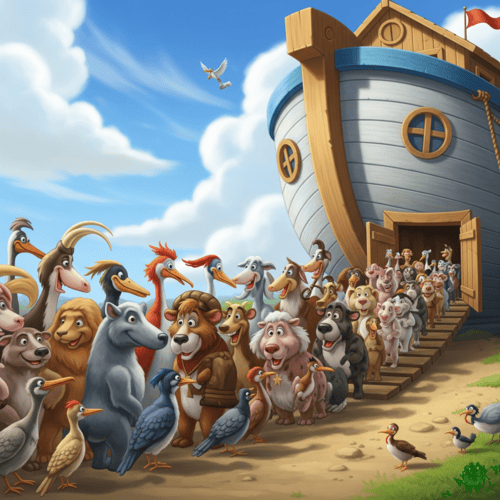
How Many Animals Were on Noah’s Ark? Solving the Genesis Puzzle
At first glance, the Bible appears to contradict itself about one of history’s most famous stories. Genesis 6:19–20 instructs Noah to take “one pair of every animal” aboard the ark, while Genesis 7:2–3 specifies “seven pairs of clean animals and birds, but only one pair of unclean animals.” Critics seize on this as evidence of a Bible inconsistency, but a careful examination reveals something far more sophisticated: a masterful example of ancient Hebrew narrative technique that provides both general instruction and specific detail.
THE BIBLE’S NARRATIVE STRUCTURE
So how many animals were on Noah’s ark? Which account do we go with? The key to resolving the apparent contradiction lies in understanding how ancient Hebrew writers structured their accounts. Rather than presenting information in strictly chronological order, they often employed a literary technique where they first provided a general overview, then circled back to offer specific details. This pattern appears throughout Scripture, from the creation account in Genesis 1–2 to the conquest narratives in Joshua.
In the Noah narrative, Genesis 6:19-20 establishes the foundational principle: representatives of every animal kind must be preserved. This general instruction ensures species survival. Genesis 7:2-3 then adds crucial specificity that serves both practical and theological purposes. Far from contradicting the earlier passage, it builds upon it with additional detail that wasn’t necessary for the initial understanding.
THE CLEAN vs UNCLEAN DISTINCTION
The distinction between clean and unclean animals wasn’t an arbitrary later addition to the story. This categorisation system predates the formal Mosaic law, reflecting principles that Noah would have understood. Clean animals were those suitable for sacrifice and, later, for human consumption under the covenant system. Unclean animals served other purposes in the ecosystem but weren’t used for worship or food.
Why would God require seven pairs of clean animals? The answer becomes clear when we consider what happened after the flood. Genesis 8:20 tells us “Noah built an altar to the Lord and, taking some of all the clean animals and clean birds, he sacrificed burnt offerings on it.” If Noah had only brought one pair of each clean animal, offering sacrifices would have immediately driven those species to extinction. The additional pairs ensured both the continuation of the species and the ability to worship God through sacrifice.
HOW MANY ANIMALS WERE ON NOAH’S ARK? HARMONISING THE PASSAGES
When we read Genesis 6:19-20 and 7:2-3 together, rather than in isolation, their relationship becomes clear. The first passage establishes the minimum requirement: at least one breeding pair of every animal kind must be preserved. The second passage provides additional specifications for certain categories of animals that serve special purposes.
Think of it like receiving instructions for a dinner party. You might first be told, “Invite your family members,” and then later receive the clarification, “Actually, invite your siblings and their spouses, but just one representative from each of your extended family branches.” The second instruction doesn’t contradict the first; it provides necessary detail for proper execution.
Genesis 6:19-20 ensures comprehensive species preservation. Genesis 7:2-3 ensures adequate numbers for post-flood worship and ecosystem restoration. Both instructions work together seamlessly when understood in their proper context.
THE SUPPORTING EVIDENCE
The Hebrew language itself supports the interpretation. The phrase “to keep them alive” appears in both passages, but with different emphases. In Genesis 6:19, it focuses on species survival. In Genesis 7:2-3, it encompasses both survival and functionality within God’s covenant relationship with humanity.
Additionally, this interpretation aligns with patterns found throughout Scripture. God often provides general principles first, then adds specific applications. The Ten Commandments work this way, as do many of Jesus’s teachings in the New Testament. This isn’t contradiction; it’s consistency in the Bible’s communication style.
Archaeological evidence from ancient Near Eastern flood narratives also supports this reading. Other cultures’ flood stories often mention different numbers of animals for different purposes, suggesting this was a common way to think about animal preservation in the ancient world.
ADDRESSING COMMON OBJECTIONS
- “Why wasn’t this distinction clear from the beginning?” This question assumes modern readers’ expectations should govern ancient literature. Hebrew narrative often builds understanding progressively, trusting readers to synthesise information as it unfolds. The original audience would have understood these complementary instructions without confusion.
- “Doesn’t this seem like after-the-event harmonisation?” Not when we consider the internal evidence. The clean/unclean distinction appears naturally throughout the narrative, the sacrificial purpose is explicitly stated, and the literary structure matches patterns found elsewhere in Scripture. The harmony emerges from careful reading, not forced interpretation.
- “What about the practical logistics?” While the logistics of housing and feeding these animals presents challenges, the biblical account addresses them systematically. The proportional differences between clean and unclean animals actually make practical sense when considered alongside their different post-flood purposes.
THE BIGGER PICTURE
The apparent contradiction, when properly understood, actually demonstrates the Bible’s internal consistency. Rather than contradicting itself, the Genesis account shows a narrative technique that serves both theological and practical purposes. It reveals an author who understood preserving species required different strategies for different types of animals.
The Noah narrative isn’t just about survival; it’s about restoration and worship. The varying numbers of animals serve this broader purpose perfectly. Clean animals in greater numbers enabled both species continuation and covenant worship. Unclean animals in smaller numbers fulfilled their ecological roles without unnecessary excess.
CONCLUSION: HOW MANY ANIMALS WERE ON NOAH’S ARK?
The Genesis account of Noah’s ark doesn’t contradict itself on animal numbers. Instead, it provides a masterful example of ancient Hebrew narrative technique that builds understanding progressively. Genesis 6:19-20 establishes the foundational principle of species preservation, while Genesis 7:2-3 adds the specific details necessary for post-flood worship and ecosystem restoration.
When we approach Scripture with careful attention to its literary context, cultural background, and internal structure, apparent contradictions often reveal themselves as sophisticated narrative techniques that enhance rather than undermine the text’s reliability. Rather than seeing contradiction, we begin to see completion. The Bible’s account of Noah’s ark demonstrates the kind of careful, purposeful communication we expect from a text that claims divine inspiration while employing human literary freedom.
HOW MANY ANIMALS WERE ON NOAH’S ARK? RELATED FAQs
How do we know the clean/unclean distinction existed before the Mosaic Law? The clean/unclean categories clearly predate formal Mosaic legislation, as evidenced by Noah’s immediate understanding of the distinction and his ability to offer “clean animals” as sacrifices (Genesis 8:20). John MacArthur notes these categories reflect moral and ceremonial principles embedded in creation itself, not arbitrary later additions. The distinction appears to be rooted in God’s original design for how humanity should relate to the animal kingdom.
- What about the birds—were they all considered “clean”? Genesis 7:3 specifically mentions “seven pairs of every kind of bird” without the clean/unclean distinction applied to other animals. This suggests birds as a category were generally considered clean, likely because they were commonly used in sacrificial worship throughout Scripture. However, Leviticus 11 later clarifies that some birds were indeed unclean, indicating the Genesis account may be using a broader categorisation for practical purposes during the crisis of the flood.
- How did Noah know which animals were clean without the written law? This question assumes moral and ceremonial knowledge only came through written revelation, but Scripture suggests God’s standards were known through direct communication and natural revelation long even before Sinai. Contemporary apologetics organisations note Genesis 6:19 indicates Noah was to take “two of every sort into the ark,” then “God supplemented this original instruction, informing Noah in a more detailed manner to take more of the clean animals.” Noah’s immediate compliance suggests he understood these categories through divine instruction.
Could this be evidence of multiple source documents being combined? While some critical scholars propose documentary theories about multiple sources, we may argue that if the Hebrew writer in Genesis 6 claimed two of every sort would go into the ark, and then said in Chapter 7 that two of every sort did not go into the ark, that would be a contradiction even in Hebrew minds. But Genesis 6 and 7 do not say that. The text shows clear literary unity and purposeful progression rather than clumsy editorial combination.
- What happened to the extra clean animals after the flood? The additional clean animals served multiple purposes beyond sacrifice. They provided genetic diversity for species recovery, supplied food for Noah’s family during the transition period, and established breeding populations for future sacrificial worship. The seven pairs ensured that even after Noah’s initial sacrifices, robust populations remained to replenish the earth and continue their role in human civilization.
- Why doesn’t the text explicitly explain this progression from general to specific? Ancient Hebrew narrative assumed readers would understand literary conventions that modern audiences miss. The original audience would have recognized the pattern of general principle followed by specific application, as this structure appears throughout Scripture. The text trusts readers to synthesise complementary information rather than over-explaining every detail, reflecting the sophisticated literary culture of the ancient Near East.
How does this interpretation affect our understanding of biblical accuracy? This resolution actually strengthens confidence in biblical precision rather than undermining it. It demonstrates apparent contradictions often result from incomplete understanding rather than textual error. The careful integration of general principles with specific applications shows the kind of sophisticated communication we should expect from divine revelation, revealing both theological depth and practical wisdom in the biblical narrative.
HOW MANY ANIMALS WERE ON NOAH’S ARK? OUR RELATED POSTS
- Noah’s Flood: Where Did All the Water Come From? And Go?
- Why Noah’s Flood Was Global: Scientific Evidences Often Overlooked
- Rocks Don’t Lie: 10 Global Evidences Supporting Noah’s Flood
- Ancient Flood Stories Compared: What Makes Noah’s Account Different?
- Fact Vs. Fiction: Did Rain Exist Before Noah’s Time?
- After the Flood: Did Noah Release a Raven Or A Dove?
- Why Didn’t Jesus Come Before Noah’s Flood? God’s Perfect Timing…
Editor's Pick

The Throne-Room Vision: Who Did Isaiah See?
The scene is unforgettable: Isaiah stands in the temple, and suddenly the veil between heaven and earth tears open. He [...]
The Angel of the Lord: Can We Be Certain It Was Christ All Along?
Throughout the Old Testament, a mysterious figure appears: the Angel of the LORD. He speaks as God, bears God’s name, [...]
SUPPORT US:
Feel the Holy Spirit's gentle nudge to partner with us?
Donate Online:
Account Name: TRUTHS TO DIE FOR FOUNDATION
Account Number: 10243565459
Bank IFSC: IDFB0043391
Bank Name: IDFC FIRST BANK