Is Being ‘Slain in the Spirit’ Biblical?
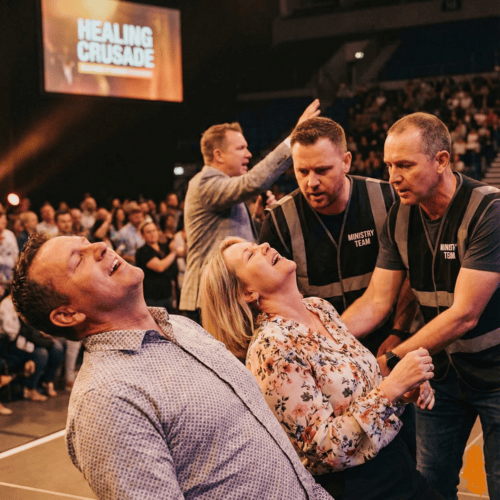
If you’ve ever watched footage from certain charismatic worship services, you’ve likely seen it: a preacher touches someone’s forehead, and they fall backward into the arms of waiting “catchers.” The phenomenon, called being “slain in the Spirit,” is attributed to the overwhelming power of the Holy Spirit. Rows of people lie on the floor, supposedly under God’s power.
Many sincere believers have experienced this or witnessed it. But sincerity doesn’t determine truth—Scripture does. So we must ask: Does the Bible support this practice? How are Christians who hold to the authority of Scripture to evaluate it?
WHEN PEOPLE ENCOUNTERED GOD IN SCRIPTURE
The Bible does record instances of people falling in God’s presence, but the pattern looks strikingly different from what we see in modern practice.
First, direction matters. Throughout Scripture, when people encountered God’s holiness, they fell forward on their faces in reverence, not backward. The prophet Ezekiel “fell facedown” when he saw God’s glory (Ezekiel 1:28). Daniel collapsed “with my face to the ground” during his visions (Daniel 8:17). When the risen Christ appeared to John on Patmos, John writes, “I fell at his feet as though dead” (Revelation 1:17). This posture expresses humble worship and holy fear—a conscious response to overwhelming divine majesty.
Second, context matters. These were extraordinary prophetic encounters, not regular worship gatherings. Isaiah’s vision in the temple left him crying, “Woe is me! For I am lost” (Isaiah 6:5). When Saul met Christ on the Damascus road, he fell to the ground—but this was his conversion, not a repeatable worship experience (Acts 9:4).
Third, these responses were self-initiated acts of reverence, not involuntary collapses caused by external power. People chose to prostrate themselves before God’s holiness. As John Calvin emphasised, true worship must be “according to God’s Word, not human invention or imagination.”
The pattern is clear: biblical prostration expressed conscious awe, not ecstatic loss of control.
THE PROBLEM OF FALLING BACKWARD
Here’s what should give us pause: the clearest instance of people falling backward in Scripture occurs not in blessing, but in judgement.
In John 18:6, when soldiers come to arrest Jesus in Gethsemane, he asks whom they seek. When they answer, Jesus declares, “I am.” The text tells us, “they drew back and fell to the ground.” This is God’s enemies recoiling from divine power—hardly a model for Christian worship.
Similarly, Isaiah 28:13 associates falling backward with God’s judgement: “that they may go, and fall backward, and be broken, and snared, and taken.”
The Reformed approach to Scripture interpretation insists patterns do matter. We interpret Scripture with Scripture. When the Bible consistently shows God’s people falling forward in worship but God’s enemies falling backward in judgement, shouldn’t that inform how we evaluate modern practices?
The Regulative Principle of Worship—a key Reformed conviction—tells us God prescribes how He wants to be worshiped. The Westminster Confession (21.1) states worship must be according to Scripture’s warrant. What God hasn’t commanded or modelled in His Word, we shouldn’t require or expect in worship. Since Scripture provides no positive example of believers falling backward as an act of worship, we lack biblical grounds for this practice.
TESTING THE SPIRITS
Reformed theology gives us a framework for evaluating spiritual phenomena. Paul commands us to “test everything; hold fast what is good” (1 Thessalonians 5:21). How do we test?
First, test by fruit, not feeling (Matthew 7:16-20). Jesus said we’d know true spiritual work by its fruit. Does this practice cultivate deeper holiness and Christlikeness? Does it emphasise what Jesus said the Spirit’s primary work would be—glorifying Christ and convicting of sin (John 16:8-14)? Or does it centre on spectacular experience for its own sake?
Second, consider the Spirit’s character. Paul writes that “the spirits of prophets are subject to prophets” (1 Corinthians 14:32). God doesn’t override human will or strip us of dignity. He also insists, “God is not a God of confusion but of peace,” and “all things should be done decently and in order” (1 Corinthians 14:33, 40). The Holy Spirit works in ways consistent with His character—bringing order, not chaos; clarity, not confusion; conscious worship, not involuntary spectacle.
Charles Spurgeon wisely warned believers to be suspicious of any experience that draws attention to itself rather than to Christ. When the phenomenon becomes the focus, something has gone wrong.
WHAT SHOULD WE SEEK INSTEAD?
Here’s the good news: the Holy Spirit does work powerfully—but primarily through what the Reformed tradition calls the “ordinary means of grace.”
Scripture calls us to seek a deeper filling of the Spirit through the means He Himself ordained: the Word preached and read (Romans 10:17; 1 Peter 1:23), the sacraments rightly administered (Romans 6:3-4), and prayer (Ephesians 6:18).
We should hunger for a Spirit-empowered life that bears recognisably Christlike fruit—love, joy, peace, patience, kindness, goodness, faithfulness, gentleness, and self-control (Galatians 5:22-23). We should desire worship governed by Scripture, not driven by spectacle.
The Regulative Principle protects us from both confusion and manipulation, keeping Christ—not experience—central.
Don’t miss this: the Spirit doesn’t need theatrical manifestations to work mightily. The Protestant Reformation—perhaps the greatest spiritual awakening in church history—came through recovered biblical preaching, not ecstatic phenomena. Thousands were genuinely converted, lives were transformed, and entire nations were turned back to the gospel through the simple, faithful exposition of God’s Word.
The Westminster Shorter Catechism (Q&A 88-89) teaches us the Spirit makes the Word effectual for salvation through ordinary reading and especially preaching. This is God’s chosen method—and it’s sufficient.
A BETTER WAY THAN BEING SLAIN
There’s a profound irony here: in pursuing spectacular experiences, we may miss the truly supernatural work the Spirit wants to do. His greatest work isn’t in physical manifestations but in transforming rebels into Christ’s image (2 Corinthians 3:18). That’s the real miracle.
If we’re spiritually hungry—good. Let’s seek the Spirit’s filling through Word, prayer, and obedience, not by pursuing experiences Scripture doesn’t promise. Let’s trust God’s prescribed means are sufficient. Let’s trust the ordinary is genuinely supernatural when the Spirit works through it.
As JI Packer wrote, “The Spirit is known by what he brings us to see and believe about Christ, not by what he makes us feel.”
The Spirit-filled life isn’t about falling down. It’s about standing firm in Christ, growing in holiness, and finding these ancient paths are more than enough.
RELATED FAQs
How do Reformed continuationists respond to the phenomenon of being slain that we see in some churches? Even Reformed continuationists like Wayne Grudem and Sam Storms—who believe that all spiritual gifts including prophecy and tongues are as active today as in the early church—express significant caution about “slain in the Spirit” practices. Grudem notes the phenomenon lacks clear biblical precedent and warns against treating it as normative or expected. Storms emphasises that even if God occasionally causes someone to fall under conviction or in response to His presence, the organised, predictable nature of the practice in many services suggests human manipulation rather than sovereign divine action. Most Reformed continuationists argue that the Spirit’s miraculous work should align with Scripture’s patterns and point to Christ, not become a repeatable ritual.
- When we see instances of folks being ‘slain’, is it right for us to ask “by which spirit”? Absolutely—Scripture commands us to “test the spirits to see whether they are from God” (1 John 4:1). Paul warns that “even Satan disguises himself as an angel of light” (2 Corinthians 11:14), reminding us that supernatural phenomena aren’t self-validating. Moreover, Paul tells us that “God gave us a spirit not of fear but of power and love and self-control” (2 Timothy 1:7)—the Holy Spirit’s influence produces rational, self-controlled worship, not loss of bodily control or chaotic manifestations. Sinclair Ferguson notes we must evaluate any spiritual manifestation by asking: Does it exalt Christ? Does it align with Scripture? Does it produce lasting holiness? Asking these questions isn’t uncharitable scepticism—it’s biblical discernment and pastoral care for God’s people.
- Could being ‘slain in the Spirit’ simply be a psychological or sociological phenomenon? Many scholars, including Reformed psychologists, say group dynamics, social pressure, and suggestibility can produce physical responses that feel spiritual. When everyone around us is falling and “catchers” stand ready, the expectation creates powerful psychological pressure to conform. Dr John MacArthur points out similar phenomena occur in non-Christian religious contexts worldwide, suggesting natural rather than supernatural causes. This doesn’t mean participants are insincere—they may genuinely believe they’re experiencing God—but sincerity doesn’t authenticate the source.
- What about the ‘Toronto Blessing’ and similar movements—how do Reformed theologians view these? The Toronto Blessing (1994) and similar revivals featuring mass “slayings,” uncontrollable laughter, and animal sounds have been almost universally rejected by Reformed scholars. RC Sproul called it a “travesty” that confused emotional manipulation with the Spirit’s work. Michael Horton argued these movements trivialise God’s holiness and reduce worship to entertainment. Even more moderate voices like DA Carson expressed deep concern that such phenomena distract from the gospel and the Spirit’s actual fruit. The consensus: when chaos replaces order and spectacle replaces Scripture, we’ve departed from biblical Christianity.
If I have been ‘slain in the Spirit’ and found it meaningful, should I doubt my salvation? No—experiencing this phenomenon doesn’t invalidate one’s salvation if we’ve genuinely trusted in Christ alone. Reformed pastoral wisdom distinguishes between saving faith and subsequent spiritual experiences. Kevin DeYoung emphasises that assurance rests on Christ’s finished work and the Spirit’s witness through Scripture, not on emotional experiences. However, believers should evaluate past experiences through Scripture and may need to recognise that what they attributed to the Spirit might have had other causes. Growth in discernment is part of sanctification, not evidence against conversion.
- Are there any historical precedents for this in Reformed or Protestant history? While various physical manifestations occurred during some revivals (including Jonathan Edwards’ era), nothing quite resembling the modern organised “slain in the Spirit” practice appears in mainstream Reformed history. Edwards himself wrote carefully about discerning true from false religious affections, warning against valuing physical manifestations. The Cane Ridge Revival (1801) featured falling and unusual behaviours, but Reformed leaders like Charles Hodge later critiqued these excesses as departures from biblical order. Church historian Iain Murray notes the great Reformed awakenings were marked primarily by deep conviction of sin and transformed lives, not theatrical physical phenomena.
What would a healthy charismatic service look like from a Reformed perspective? Reformed scholars who appreciate charismatic gifts while maintaining biblical order suggest several boundaries: the Word must remain central and authoritative, with any spiritual gifts submitted to Scripture’s test. DA Carson argues that genuine Spirit-filled worship maintains both supernatural openness and doctrinal fidelity. Everything should be done “decently and in order” (1 Corinthians 14:40) with rational engagement, not emotional manipulation. Grudem emphasises prophecy and other gifts should edify the church and exalt Christ, never becoming ends in themselves. The service should produce believers who know the Bible better and love Jesus more, not those chasing the next experience.
OUR RELATED POSTS
Editor's Pick
The Throne-Room Vision: Who Did Isaiah See?
The scene is unforgettable: Isaiah stands in the temple, and suddenly the veil between heaven and earth tears open. He [...]
The Angel of the Lord: Can We Be Certain It Was Christ All Along?
Throughout the Old Testament, a mysterious figure appears: the Angel of the LORD. He speaks as God, bears God’s name, [...]
SUPPORT US:
Feel the Holy Spirit's gentle nudge to partner with us?
Donate Online:
Account Name: TRUTHS TO DIE FOR FOUNDATION
Account Number: 10243565459
Bank IFSC: IDFB0043391
Bank Name: IDFC FIRST BANK