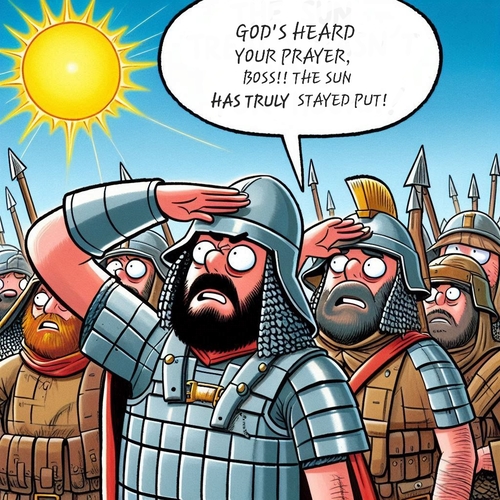
Joshua’s Long Day: Did the Sun Really Stand Still Over Gibeon?
“Sun, stand still over Gibeon, and you, moon, over the Valley of Aijalon. So the sun stood still, and the moon stopped, till the nation avenged itself on its enemies” (Joshua 10:12-13).
Few biblical accounts provoke more sceptical laughter than Joshua’s long day. Critics dismiss it as ancient mythology, impossible physics, or religious hyperbole. Yet modern science offers compelling responses that honour both Scripture’s authority and careful scholarship, demonstrating this extraordinary event does deserve serious consideration, rather than reflexive dismissal.
The fundamental question we should be asking, however, isn’t whether such a day is scientifically possible—it’s whether God exists. If an omnipotent Creator brought the universe into existence ex nihilo—from nothing—extending one day would present no great challenge to Him. The real question our sceptic friends must answer isn’t “Could there ever have been such a day?” but rather “Is there a God?” Answer that affirmatively, and Joshua’s long day becomes not only possible but expected, and within the scope of divine intervention.
THE BIBLE ACCOUNT: MORE THAN MYTHOLOGY
The text of Joshua 10:12-14 presents this event as historical fact, not poetic metaphor. The narrator explicitly states, “There has never been a day like it before or since” and emphasises “the LORD listened to a human being.” This language indicates the author understood he was recording an unprecedented historical miracle, not crafting symbolic literature.
Reformed hermeneutics recognises Scripture’s historical narratives demand historical interpretation unless clear literary markers suggest otherwise. The Joshua account contains no such markers—instead, it bears the hallmarks of eyewitness testimony embedded in a broader historical chronicle of Israel’s conquest.
SCIENTIFIC POSSIBILITIES: GOD’S SOVEREIGNTY OVER NATURE
The most important consideration precedes all scientific speculation: if God does exist, Joshua’s long day requires no naturalistic explanation to be credible. The same divine power that created matter, energy, space, and time could easily manipulate any or all of them for specific purposes. Demanding purely naturalistic explanations for divine miracles commits a category error—it’s rather like asking what colour Wednesday tastes like.
Nevertheless, modern critics often assume the account requires the earth’s rotation to cease—an event that would indeed cause catastrophic effects. However, the Hebrew text allows for multiple interpretations that align with physical realities:
Modern critics often assume the account requires the earth’s rotation to cease—an event that would indeed cause catastrophic effects. However, the Hebrew text allows for multiple interpretations that align with physical realities:
- Localised Phenomenon: The Hebrew words dom (stand still) and amad (stopped) can describe apparent rather than absolute cessation. God could have created localised atmospheric effects—perhaps through unique cloud formations or atmospheric refraction—that prolonged daylight over the battlefield while leaving earth’s rotation undisturbed.
- Gravitational Adjustment: An omnipotent God could theoretically adjust gravitational forces to gradually slow and restart earth’s rotation without catastrophic effects. While beyond natural possibility, this remains within divine capability.
- Perception vs Reality: The account focuses on the observer’s experience rather than cosmic mechanics. Extended daylight for military purposes need not require stopping planetary motion.
Reformed theology affirms God’s absolute sovereignty over natural law. The One who established physical constants can suspend or modify them according to His purposes.
WHY GOD PERMITTED THIS “FREAK INCIDENT”
Divine Necessity, Not Showmanship. Scripture reveals clear reasons why God intervened so dramatically:
- Covenant Faithfulness: God had promised Israel the land of Canaan. The five-king coalition represented a critical threat to this covenant promise. Divine intervention ensured covenant fulfillment.
- Military Necessity: The extended daylight allowed Israel to complete a decisive victory that would have been impossible under normal circumstances. Partial victory would have left dangerous enemies to regroup and counterattack.
- Demonstration of Divine Authority: This miracle served as powerful testimony to surrounding nations that Israel’s God possessed absolute authority over creation itself—a message that would facilitate future conquests through intimidation rather than bloodshed.
- Answer to Faith-Filled Prayer: Joshua’s bold prayer demonstrated extraordinary faith in God’s willingness to intervene. God’s response validated such faith and established a pattern of divine responsiveness to believing prayer.
The text emphasises this wasn’t divine showboating but purposeful intervention aligned with God’s redemptive plan. The miracle served essential theological and practical purposes within salvation history.
HISTORICAL PARALLELS AND ASTRONOMICAL CONSIDERATIONS
Ancient Records of Long Days: Interestingly, various ancient civilisations record unusually long days or nights:
- Chinese records mention a long day during the reign of Emperor Yao
- Aztec and Incan traditions describe extended darkness followed by delayed sunrise
- Egyptian and Greek sources reference unusual solar phenomena
These accounts require careful evaluation, and their existence suggests Joshua’s long day wasn’t entirely unprecedented in human memory.
Middle Eastern Context: The geographical location proves significant. The Jordan Valley’s unique atmospheric conditions could enhance any divine manipulation of light refraction. The region’s clear skies and dry climate would make extended daylight particularly noticeable and militarily advantageous.
No similar events are recorded in subsequent Middle Eastern history. This supports the Bible’s claim, “there has never been a day like it before or since.”
OUR CONFIDENCE IN SCRIPTURE
We approach Joshua’s long day keeping in mind several key principles:
- Scripture’s Self-Authentication: God’s Word validates itself through its internal consistency and divine authority. External scepticism doesn’t diminish biblical truth.
- Divine Omnipotence: If God created the universe ex nihilo, temporarily modifying natural processes presents no insurmountable difficulty.
- Redemptive Purpose: Miracles serve God’s salvation plan rather than mere spectacle. Joshua’s long day advanced the establishment of God’s covenant people in the promised land.
- Historical Reliability: Archaeological evidence increasingly supports biblical historical narratives, lending credibility to supernatural accounts embedded within historical contexts.
CONCLUSION: FAITH AND REASON UNITED
Joshua’s long day challenges modern naturalistic assumptions while remaining entirely consistent with biblical theism. Rather than requiring blind faith despite evidence, it calls for faith informed by careful scriptural study and openness to divine possibility.
The Reformed tradition confidently affirms the God who spoke creation into existence could easily extend a day to accomplish His covenant purposes. Sceptics may scoff, but believers recognise in Joshua’s long day a powerful demonstration of God’s faithfulness to His promises and His absolute sovereignty over all creation.
“Is anything too hard for the LORD?” (Genesis 18:14)
JOSHUA’S LONG DAY: RELATED FAQs
What do the leading Reformed voices say about Joshua’s long day? Leading Reformed theologians consistently affirm the historical reality of Joshua’s long day while emphasizing God’s sovereignty over natural law. RC Sproul argued that questioning this miracle essentially questions God’s omnipotence, while John MacArthur emphasizes that the text’s straightforward historical narrative demands literal interpretation. Both reject allegorical interpretations that would undermine Scripture’s reliability and God’s power to intervene supernaturally in history.
- Could Joshua’s prayer be considered presumptuous or inappropriate? Reformed theology views Joshua’s bold prayer as exemplary faith rather than presumption, since it aligned perfectly with God’s covenant promises and Israel’s mission. Joshua prayed not for personal glory but to complete God’s commanded conquest of Canaan. His confidence stemmed from understanding God’s character and promises, demonstrating the kind of faith-filled prayer that God delights to answer according to His revealed will.
- How do we explain the lack of global records of this event? The miracle may have been geographically localised to the battlefield region, explaining why distant civilisations wouldn’t necessarily record it. Additionally, ancient record-keeping was often sporadic and culturally specific—the absence of universal documentation doesn’t negate a localised supernatural event. Some apologists, however, point to scattered ancient references to unusual solar phenomena as possible indirect confirmations from neighbouring cultures.
What’s the Reformed position on the Book of Jashar mentioned in Joshua 10:13? Reformed scholars generally view the Book of Jashar as a legitimate ancient Hebrew collection of heroic songs and historical records, now lost to us. The reference demonstrates Joshua’s account drew from established historical sources, strengthening rather than weakening its credibility. This citation functions similarly to how modern historians reference primary sources, and indicates the author’s commitment to accurate historical documentation rather than mythological storytelling.
- Did this miracle violate God’s established natural order or work through it? Reformed theology distinguishes between God’s ordinary providence (working through natural means) and extraordinary providence (supernatural intervention). Joshua’s long day represents extraordinary providence where God temporarily suspended or modified natural law for specific redemptive purposes. This doesn’t violate God’s character since He remains sovereign over the natural order He created. He is free to intervene when His purposes require it.
- How does this miracle fit into our understanding of salvation history? Theologians see Joshua’s long day as integral to God’s unfolding plan of redemption, not merely an isolated wonder. The conquest of Canaan was essential for establishing Israel as God’s covenant people, through whom the Messiah would eventually come. This miracle therefore served the ultimate purpose of advancing God’s salvation plan for humanity, demonstrating how even extraordinary interventions serve ordinary redemptive purposes.
How do we respond to attempts to find naturalistic explanations for the miracle? While appreciating scientific inquiry, Reformed apologists warn against reducing biblical miracles to purely natural phenomena, which can undermine Scripture’s supernatural claims. They argue seeking naturalistic explanations, while potentially interesting, isn’t necessary for believing the account’s truth. The primary issue remains theological rather than scientific—if God exists and Scripture is reliable, the miracle’s mechanism becomes a secondary curiosity rather than a primary concern.
JOSHUA’S LONG DAY: OUR RELATED POSTS
- Joshua & Yeshua: Exploring the Name and Life Connections
- The Fall of Jericho: Does Archaeology Back the Bible Account?
- BC 1446 or 1250: When Did the Exodus Really Happen?
- 22 or 42: How Old Was Ahaziah When He Became King?
- The Deuteronomy 34 Mystery: Who Wrote Moses’ Obituary?
- The Rahab Mystery: Why Is A Prostitute in Jesus’ Family Tree?
Editor's Pick

The Throne-Room Vision: Who Did Isaiah See?
The scene is unforgettable: Isaiah stands in the temple, and suddenly the veil between heaven and earth tears open. He [...]

The Angel of the Lord: Can We Be Certain It Was Christ All Along?
Throughout the Old Testament, a mysterious figure appears: the Angel of the LORD. He speaks as God, bears God’s name, [...]
SUPPORT US:
Feel the Holy Spirit's gentle nudge to partner with us?
Donate Online:
Account Name: TRUTHS TO DIE FOR FOUNDATION
Account Number: 10243565459
Bank IFSC: IDFB0043391
Bank Name: IDFC FIRST BANK