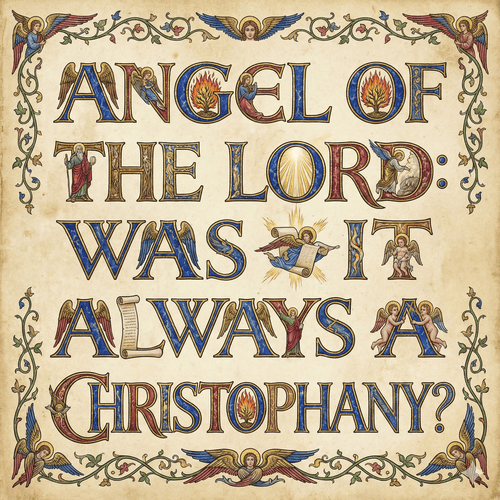
The Angel of the Lord: Can We Be Certain It Was Christ All Along?
Throughout the Old Testament, a mysterious figure appears: the Angel of the LORD. He speaks as God, bears God’s name, yet seems distinct from God. He accepts worship, forgives sins, and leads Israel through the wilderness. For centuries, Reformed theologians from John Calvin to John Owen have confidently identified this figure as the pre-incarnate Christ—the Second Person of the Trinity appearing before Bethlehem.
But can we be certain? What makes Reformed interpreters so sure these ancient theophanies were Christophanies—encounters with Jesus Himself?
The answer lies in converging lines of biblical evidence that, taken together, form a compelling case: the Angel bears the Divine Name, exercises divine prerogatives, accepts worship, forgives sins, and—most decisively—the New Testament writers themselves identify Him as Christ.
HE BEARS THE DIVINE NAME AND EXERCISES DIVINE PREROGATIVES
The most striking evidence appears in Exodus 23:20-23, where God promises to send His Angel before Israel, warning: “Pay careful attention to him and obey his voice…for my name is in him.” This wasn’t merely an angelic messenger carrying divine authority. Calvin and later Reformed theologians saw this as decisive proof of full deity. The covenant Name—YHWH—cannot be shared with creatures. Only God Himself bears His own Name.
When we trace this Angel’s appearances, we find Him doing precisely what only God can do. In Exodus 3, the Angel appears in the burning bush, then declares, “I AM WHO I AM”—the Divine Name itself. In Genesis 22, the Angel stops Abraham’s hand and declares, “now I know that you fear God, seeing you have not withheld your son…from me.” The Angel doesn’t merely speak for God; He speaks as God.
Stephen’s speech in Acts 7:30-38 removes any ambiguity. He explicitly identifies the Angel at the burning bush as the One who gave the law on Sinai—the same Person he calls “the Lord.” And everywhere the New Testament identifies this Lord as Christ. As John 1:18 tells us, “No one has ever seen God; the only God, who is at the Father’s side, he has made him known.”
HE ACCEPTS WORSHIP AND FORGIVES SIN
Perhaps nothing distinguishes the Angel of the LORD more clearly than His acceptance of worship. When John falls at an angel’s feet in Revelation 22:8-9, the created angel recoils: “You must not do that! Worship God.” Yet when Joshua encounters the Commander of the LORD’s army in Joshua 5:13-15, he falls on his face in worship—and receives no rebuke. Instead, the Commander declares the ground to be holy, echoing the burning bush encounter. This is no mere angel; this is deity manifest.
Even more remarkably, in Zechariah 3:1-4, the Angel of the LORD pronounces cleansing and justification for Joshua the high priest: “Behold, I have taken your iniquity away from you.” The forgiveness of sin belongs to God alone (Isaiah 43:25). When Jesus forgave sins in Mark 2, the scribes rightly recognized this as a divine claim: “Who can forgive sins but God alone?” Yet here is the Angel, centuries earlier, exercising this same prerogative.
Jesus Himself would later claim in John 5:22-23 that the Son is to be honoured precisely as the Father is honoured. The Angel’s acceptance of worship and pronouncement of forgiveness perfectly matches the divine authority Christ claimed for Himself.
THE NEW TESTAMENT’S EXPLICIT IDENTIFICATION
The most persuasive evidence comes from the apostles themselves. They didn’t merely hint at Christ’s Old Testament presence—they stated it explicitly.
Jude 5, in the best manuscript evidence, reads: “Jesus, who saved a people out of Egypt, afterward destroyed those who did not believe.” This isn’t symbolic language; it’s direct identification of Christ as Israel’s deliverer from Egypt.
Paul is equally clear in 1 Corinthians 10:4, 9: “the Rock was Christ,” and “We must not put Christ to the test, as some of them did.” Paul references Israel testing the Angel in Exodus 17:2, 7, directly equating that Angel with Christ.
The writer of Hebrews adds confirmatory evidence: the Son is the one through whom God spoke to the fathers (Hebrews 1:1-2), and angels themselves worship Him (1:6). And in perhaps the most stunning Old Testament prophecy, Zechariah 12:10 has YHWH declaring, “they will look on me whom they have pierced”—a verse John’s Gospel applies to Christ on the cross.
These aren’t isolated proof-texts but a consistent apostolic pattern. The New Testament writers saw no difficulty identifying Christ as the active divine presence throughout Israel’s redemptive history.
ADDRESSING COMMON OBJECTIONS
Some object: “But sometimes the Angel seems distinct from God, like in Zechariah 1:12 or Genesis 18-19.”
Precisely! This distinction of persons doesn’t negate their unity—their oneness in essence. It previews the trinity. Genesis 18-19 shows the Angel dialoguing with God, and Zechariah 1:12 depicts the Angel interceding to YHWH. This is exactly Christ’s mediatorial role, later revealed fully in Romans 8:34 and Hebrews 7:25. Personal distinction within the Godhead isn’t a problem; it’s a preview of Trinitarian truth.
Others ask: “Couldn’t this just be a theophany—and not necessarily the Second Person in the Trinity specifically?”
But the New Testament never attributes Old Testament theophanies to the Father. John 1:18 and 6:46 tell us the Father has never been seen—all visible manifestations are through the Son. The New Testament’s identifications aren’t generic; they’re specifically Christological. The Angel accepts worship and forgive sins. And the Angel’s consistent mediatorial, redemptive role perfectly matches Christ’s eternal work as the one Mediator between God and humanity.
THE GLORY REVEALED
The Reformed certainty that the Angel of the LORD was Christ rests on solid biblical ground: He bears the Divine Name, accepts worship, forgives sins, and the apostles explicitly identify Him as Jesus. Far from speculation, this identification emerges from careful exegesis and Trinitarian theology.
This understanding magnifies Christ’s eternal glory. The Jesus born in Bethlehem didn’t begin His existence in Mary’s womb. He has always been God’s chosen means of revelation and redemption. When Abraham looked up and saw the ram caught in the thicket, when Moses trembled before the burning bush, when Joshua bowed before the Commander of heaven’s army—they encountered the same Saviour we worship today.
The Angel of the LORD Is not an abstract theological puzzle but our beloved Christ, revealing Himself throughout history to His people, preparing them for the day when the Word would become flesh and dwell among us, full of grace and truth.
RELATED FAQs
How do we distinguish “the Angel of the LORD” from ordinary angels in Scripture? The key is context and divine markers. When Scripture uses the definite article—“the Angel of the LORD” (Hebrew: mal’ak YHWH)—combined with divine attributes, we’re dealing with deity, not a created messenger. Look for these indicators: (1) He speaks in the first person as God (“I am the God of your father,” Exodus 3:6); (2) He accepts worship without correction; (3) He bears the Divine Name; (4) He exercises divine prerogatives like forgiving sin or making covenant promises. In contrast, ordinary angels consistently deflect worship, speak of God in the third person (“The LORD has sent me,” Zechariah 2:8-9), and function as messengers rather than divine agents. The grammatical construction mal’ak YHWH (Angel of Yahweh) versus simply mal’ak (an angel) often signals this distinction, though context remains the ultimate guide.
- What do contemporary Reformed scholars say about this identification? Modern Reformed theologians maintain the historic position with robust support. Michael Horton writes in The Christian Faith that the Angel of the LORD represents “the visible manifestation of the invisible God, which the New Testament identifies as the preincarnate Son.” Sinclair Ferguson argues in The Holy Spirit that these appearances demonstrate Christ’s eternal mediatorial role. Vern Poythress, in Theophany, provides extensive exegetical analysis supporting the Christophanic interpretation, noting how the Angel’s pattern of revelation-and-concealment mirrors the Incarnation itself. Robert Letham’s The Holy Trinity shows how these Old Testament appearances informed early church Trinitarian theology. Even scholars like James Hamilton Jr. (God’s Glory in Salvation through Judgment) demonstrate how the Angel functions as the visible expression of God’s glory throughout the redemptive narrative—a role the New Testament consistently assigns to Christ.
- Did the early church fathers too consider these to be Christophanies? Overwhelmingly, yes. Justin Martyr (c. 150 AD) explicitly identified the Angel of the LORD as the pre-incarnate Logos in his Dialogue with Trypho, arguing that the Father—being unbegotten and ineffable—never appeared, but the Son did. Irenaeus, Tertullian, and Origen all held this view. Augustine was more cautious, sometimes suggesting any person of the Trinity could appear, but even he acknowledged the fittingness of identifying these theophanies with the Son as the Father’s visible Word. Athanasius and the Cappadocian Fathers used these Old Testament appearances to defend Christ’s deity against Arian heresy—if the Angel was YHWH in the Old Testament, and the Angel was Christ, then Christ is fully divine. The patristic consensus strongly supports the Christophanic interpretation, providing historical continuity with Reformed theology.
What about the Angel in Jacob’s wrestling match (Genesis 32)? Was that Christ too? The evidence strongly suggests yes. Genesis 32:24-30 describes Jacob wrestling with “a man,” yet Jacob declares, “I have seen God face to face” (v. 30), and names the place Peniel (“face of God”). Hosea 12:3-4 retrospectively identifies Jacob’s opponent as both “the angel” and “God”: “He strove with the angel…he met God at Bethel.” This wrestling match displays the Angel’s characteristic pattern—appearing in human form yet possessing divine identity. Remarkably, the encounter results in both blessing and wounding, prefiguring Christ’s work: He blesses us through His own wounding. Jacob’s limp becomes a permanent reminder that encountering God transforms us. The Reformed tradition sees this as Christ in His pre-incarnate mediatorial role, engaging humanity in a way that both judges (the dislocated hip) and saves (the blessing and new name, Israel).
- If Christ appeared before the Incarnation, does that diminish the uniqueness of Bethlehem? Not at all—it actually magnifies it. The pre-incarnate appearances were temporary, veiled manifestations where Christ assumed human form momentarily for specific revelatory purposes. But the Incarnation represents the eternal union of divine and human natures in one Person. At Bethlehem, the Word didn’t merely appear as human—He became human, taking humanity permanently into His Person (John 1:14). As the Westminster Larger Catechism explains, Christ “took upon him man’s nature, with all the essential properties…yet without sin” (Q. 37)—a permanent assumption, not a temporary theophany. The Angel appearances foreshadowed the Incarnation and prepared God’s people for it, demonstrating Christ’s eternal willingness to condescend and mediate. Far from diminishing Christmas, the Old Testament theophanies show that the God who came to us in Bethlehem has always been coming to us, always seeking relationship with His people.
- Why does Genesis 18 seem to show three “men” but only one is identified as the LORD? Genesis 18 presents one of Scripture’s most fascinating Trinitarian hints. Three “men” appear to Abraham; he addresses them initially in the singular (“My Lord,” v. 3), suggesting he recognises divine presence. As the narrative unfolds, two depart toward Sodom (later called “angels” in Genesis 19:1), while one remains—the LORD Himself (18:22). This One discusses Sodom’s judgement with Abraham and exercises divine knowledge and authority. The Reformed reading sees this as a pre-incarnate Christophany accompanied by two created angels. Some theologians suggest the three figures together hint at the Trinity, though this remains debated. What’s clear is that the One who stays, dialogues with Abraham, and pronounces judgement is identified as YHWH—and consistently with the Angel of the LORD pattern, Reformed theology identifies Him as the Second Person, the visible manifestation of God’s presence and the executor of divine judgement and mercy.
Were there any Angel of the LORD appearances after the Incarnation? Notably, no. The specific title “Angel of the LORD” (mal’ak YHWH) with its characteristic divine attributes disappears after Christ’s incarnation, death, and resurrection. The New Testament mentions “an angel of the Lord” (Greek: aggelos kyriou, with an indefinite article) in passages like the Christmas narrative and Peter’s prison escape, but these are clearly created angelic messengers, not deity. This cessation makes theological sense: once Christ came in the flesh, died for sins, rose, and ascended, there was no further need for pre-incarnate appearances. The Angel of the LORD accomplished His preparatory work. Now the risen, ascended Christ mediates through His Spirit and will return visibly at the Second Coming. As Hebrews 1:1-2 declares, God has now spoken definitively “by his Son”—no longer through temporary theophanies but through the permanent God-man. The silence of the Angel after Pentecost actually confirms His identity: the mission of preparation was complete, and the full revelation had come.
OUR RELATED POSTS
Editor's Pick
The Throne-Room Vision: Who Did Isaiah See?
The scene is unforgettable: Isaiah stands in the temple, and suddenly the veil between heaven and earth tears open. He [...]
The Angel of the Lord: Can We Be Certain It Was Christ All Along?
Throughout the Old Testament, a mysterious figure appears: the Angel of the LORD. He speaks as God, bears God’s name, [...]
The Doctrine of Providence: Does God Really Govern All Things?
You’re sitting in the doctor’s office when the diagnosis lands like a thunderclap. Your mind races: Why this? Why now? [...]
SUPPORT US:
Feel the Holy Spirit's gentle nudge to partner with us?
Donate Online:
Account Name: TRUTHS TO DIE FOR FOUNDATION
Account Number: 10243565459
Bank IFSC: IDFB0043391
Bank Name: IDFC FIRST BANK