Who Was Joshua 5’s Commander of the Lord’s Army?
WHY DOES THE REFORMED TRADITION AFFIRM IT WAS JESUS?
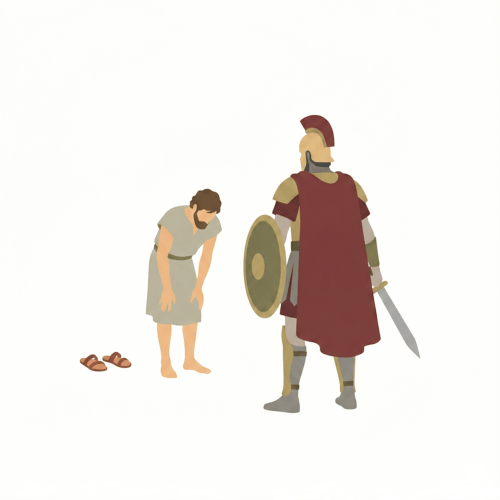
Before the walls of Jericho fell, something else happened first. Joshua encountered a mysterious figure—an armed warrior who claimed command of the LORD’s army. The conversation was brief but staggering. Joshua fell on his face in worship. The Commander accepted it. Then came the command: “Take off your sandals, for the place where you are standing is holy.”
Who was this? A powerful angel? The archangel Michael? Or someone far more significant?
The Reformed theological tradition has long maintained it was Jesus Christ Himself, appearing centuries before Bethlehem. This wasn’t just an angel with a message—this was the pre-incarnate Second Person of the Trinity, the divine Son taking visible form in the Old Testament. Here’s why this identification isn’t speculation but solidly grounded in Scripture.
THE WORSHIP TEST: ONLY GOD CAN PASS IT
The most decisive evidence comes from what happens in verse 14. When Joshua asks, “Are you for us or for our enemies?” the Commander identifies Himself and Joshua’s response is immediate: he “fell facedown to the ground in reverence.”
This is worship. And the Commander accepts it.
This matters enormously because Scripture is crystal clear about worship: Created angels refuse it every single time. When the apostle John falls at an angel’s feet in Revelation 19:10, the angel rebukes him sharply: “Don’t do that! I am a fellow servant… Worship God!” The same thing happens again in Revelation 22:8-9. Paul warns against angel worship in Colossians 2:18. The pattern is consistent and unambiguous: angels reject worship because only God may receive it.
Yet here, the Commander doesn’t just tolerate Joshua’s worship—He accepts it without a word of correction. No rebuke. No redirection. The text treats this worship as entirely appropriate. If this were a created angel, we would expect the same refusal we see elsewhere in Scripture. The Commander’s acceptance of worship reveals His divine identity.
This isn’t an isolated incident. Throughout the Old Testament, when the Angel of the LORD appears, worship follows. Abraham worshiped one of the three visitors at Mamre, recognising Him as the LORD Himself (Genesis 18). Gideon and Manoah both worshiped when the Angel of the LORD appeared to them, and Scripture affirms they had encountered God (Judges 6, 13). The pattern is clear: this is deity appearing in visible form.
HOLY GROUND: THE THEOPHANIC SIGNATURE
“Take off your sandals, for the place where you are standing is holy” (Joshua 5:15).
These words should sound familiar. They’re nearly identical to what Moses heard at the burning bush: “Take off your sandals, for the place where you are standing is holy ground” (Exodus 3:5). And at the burning bush, the speaker was unmistakable—the Angel of the LORD who identified himself as “I AM,” the covenant name of Yahweh Himself.
This isn’t coincidence. It’s a deliberate parallel. The same divine presence that commissioned Moses now commissions Joshua. The same holy ground, the same holy God.
But notice: the ground doesn’t become holy because an angel is present. Ground becomes holy because God Himself is present. As John Calvin notes in his commentary, this pattern of removing sandals marks genuine theophanies—divine appearances—throughout redemptive history. When God draws near in manifest presence, the very earth reflects His holiness.
The significance is profound. The God who spoke from the burning bush, who led Israel through the wilderness in the pillar of cloud and fire, now stands before Joshua with a drawn sword. The same divine Commander who guided Moses now guides his successor. This is covenant continuity—the same LORD keeping His promises across generations.
COMMANDER OF THE LORD’S ARMY: A DIVINE TITLE
The Hebrew is striking: śar-ṣĕḇāʾ YHWH—Commander of Yahweh’s host. This isn’t a messenger angel reporting on duty. This is the supreme military leader of heaven’s armies, and He’s personally directing Israel’s conquest of Canaan.
Throughout the Old Testament, the Angel of the LORD appears as a divine warrior. He leads Israel’s battles, brings victory, and judges enemies. Isaiah 63:9 speaks of “the angel of his presence” who saved Israel. This Commander isn’t merely representing God’s interests—He is God acting in history.
The Reformed tradition sees this as beautifully consistent with Hebrews 2:10, which calls Jesus “the captain of their salvation” (KJV) or “the pioneer of their salvation” (ESV). The same Greek word (archēgos) carries the sense of a military leader, a trailblazer who goes before his troops. The Commander of Joshua 5 and the Captain of Hebrews 2 are the same person—Christ leading his people into promised rest, whether the earthly Canaan or the heavenly reality it prefigured.
THE ANGEL OF THE LORD PATTERN
The Reformed tradition identifies the Angel of the LORD as the pre-incarnate Christ. The pattern throughout Scripture is remarkably consistent.
In Genesis 16, Hagar encounters the Angel of the LORD and concludes, “I have now seen the One who sees me.” She calls him “the LORD” (Yahweh) who spoke to her. In Genesis 22, the Angel stops Abraham from sacrificing Isaac and speaks in the first person as God Himself: “Now I know that you fear God.” When the Angel appears to Manoah in Judges 13, Manoah declares afterward, “We have seen God!” His wife wisely responds that if the LORD meant to kill them, he wouldn’t have accepted their offering.
Why does the Second Person of the Trinity appear rather than the Father? Reformed theology answers from Scripture itself: “No one has ever seen God, but the one and only Son, who is Himself God and is in closest relationship with the Father, has made him known” (John 1:18). Jesus says in John 6:46, “No one has seen the Father except the one who is from God; only he has seen the Father.”
The Son is the visible Image of the invisible God (Colossians 1:15). Throughout redemptive history, when God appears in bodily form, it is the Second Person of the Trinity—the one who would ultimately take on human flesh permanently at the Incarnation. These Old Testament Christophanies prepare for and point toward Bethlehem.
OBJECTIONS ANSWERED
- “It’s just Michael the archangel”: No biblical text ever calls Michael “Commander of the army of YHWH” or permits him to receive worship. Michael is called “one of the chief princes” (Daniel 10:13)—a high-ranking angel, yes, but clearly subordinate and one among others.
- “Joshua was mistaken to worship”: Scripture never corrects him. The text treats this encounter as a true theophany, a genuine divine appearance. If Joshua erred, the biblical author would have indicated it, as Scripture does elsewhere when worship is misdirected.
- “It’s God the Father”: The Father is never seen and always sends the Angel/Son as His visible representative (John 1:18; 6:46). When God appears in visible form in the Old Testament, it is the Son in His pre-incarnate state.
WHAT THIS MEANS FOR US
The Commander of Joshua 5 is Jesus Christ—our eternal Captain who guarantees victory over every enemy. This isn’t abstract theology; it’s profound assurance. The same divine Commander who brought down Jericho’s walls fights for His people still.
When Paul tells us our struggle is against spiritual forces of evil (Ephesians 6:10-12), we don’t fight alone or under distant orders. Christ Himself oversees our battles. The Commander with the drawn sword goes before us.
From Moses to Joshua to us, there’s one divine Captain leading one covenant people into promised rest. Be strong and courageous. Our Commander has never lost a battle.
RELATED FAQs
Why does Jesus appear to Joshua at this specific moment? Jesus appears immediately before Israel’s first major battle in the Promised Land to establish his authority and reassure Joshua of divine presence. This isn’t merely encouragement—it’s a commissioning parallel to Moses at the burning bush, confirming that the same God who led the exodus now leads the conquest. The appearance establishes that Jericho’s fall will be the LORD’s victory, not human military achievement. Coming right after Israel’s circumcision and Passover celebration (Joshua 5:2-12), Christ’s appearance links covenant faithfulness to military success. His drawn sword signals he’s personally taking command of the campaign.
- What do modern Reformed scholars say about this passage? Contemporary Reformed exegetes like Daniel Block, Dale Ralph Davis, and Richard Pratt Jr strongly affirm the Christophanic interpretation. Davis writes in his Joshua commentary the Commander’s acceptance of worship “settles the matter” of His divine identity. Block notes the deliberate parallels to Moses’ burning bush encounter and argues the text presents Yahweh Himself in visible form. These scholars emphasise ancient Israel would have understood this as a direct divine appearance, not an angelic messenger, based on the worship and holy ground elements.
- Did Joshua recognise this was God, or did he think it was just an angel? Joshua’s immediate prostration in worship (v14) suggests he recognised the divine nature of this figure, though the text doesn’t explicitly state his thought process. The question “Are you for us or for our enemies?” indicates initial uncertainty about the figure’s identity or allegiance, not His nature. Once the Commander identifies Himself and Joshua worships, there’s no confusion—Joshua addresses him as “my Lord” (Hebrew: adonai) and asks for instructions. The narrative treats Joshua’s recognition as correct, with no divine correction.
Why does the Commander say He’s neither for Israel nor their enemies? The Commander’s answer—“Neither, but as commander of the army of the LORD I have now come”—corrects Joshua’s framing of the question. Joshua assumed a binary choice (our side or theirs), but Christ establishes He doesn’t serve Israel’s agenda; Israel serves His. This is God’s war, God’s conquest, and God’s glory at stake. Reformed theologians see this as a crucial theological corrective: God isn’t Israel’s tribal deity fighting their battles on demand; he’s the sovereign LORD whose purposes Israel must align with. The question isn’t whose side God is on, but whether we’re on His side.
- What happened to the conversation? Why does Joshua 5:15 seem to end abruptly? The chapter break is unfortunate because Joshua 6:1-5 continues the Commander’s instructions directly. The strategy for conquering Jericho—marching around the city, priests with trumpets, the ark of the covenant leading—comes from the Commander himself. Modern scholars recognise this as a continuous narrative where Christ personally dictates the battle plan. The “abrupt” ending actually flows seamlessly into detailed divine instructions, demonstrating the Commander wasn’t there merely for a brief encouragement but to personally direct the campaign’s opening battle.
- Does this appearance contradict the idea that Old Testament Israel didn’t fully understand the Trinity? Not at all. Reformed theology acknowledges progressive revelation—Israel didn’t have New Testament clarity about the three persons of the Godhead. However, they clearly recognised multiple divine persons in their Scriptures: Yahweh, the Angel of Yahweh, the Spirit of God. They understood these passages as genuine encounters with God, even if the full Trinitarian framework wasn’t yet revealed. The New Testament doesn’t contradict these Old Testament theophanies but illumines them, showing us the Son was active in redemptive history from the beginning. Christ’s statement “Before Abraham was, I AM” (John 8:58) confirms His pre-existence and Old Testament presence.
How does this appearance relate to Jesus as both Prince of Peace and Divine Warrior? This passage reveals the fullness of Christ’s nature and mission that our culture often misses. The same Jesus who says “Blessed are the peacemakers” appears here with a drawn sword as Commander of heaven’s armies. Reformed theology holds these together: Christ makes peace through conquest—defeating sin, death, and Satan. Isaiah 9:6-7 calls Him “Prince of Peace”. He establishes His kingdom with justice and war against evil. The Commander of Joshua 5 and the Lamb of Revelation 19 (who makes war in righteousness) are the same person. True peace comes not from passive tolerance but from Christ’s complete victory over all God’s enemies and ours.
OUR RELATED POSTS
Editor's Pick
The Throne-Room Vision: Who Did Isaiah See?
The scene is unforgettable: Isaiah stands in the temple, and suddenly the veil between heaven and earth tears open. He [...]
The Angel of the Lord: Can We Be Certain It Was Christ All Along?
Throughout the Old Testament, a mysterious figure appears: the Angel of the LORD. He speaks as God, bears God’s name, [...]
SUPPORT US:
Feel the Holy Spirit's gentle nudge to partner with us?
Donate Online:
Account Name: TRUTHS TO DIE FOR FOUNDATION
Account Number: 10243565459
Bank IFSC: IDFB0043391
Bank Name: IDFC FIRST BANK