Of all the quantities physicists have ever measured, one is so bafflingly precise that scientists call it the worst prediction in the history of science.
It involves the cosmological constant—the invisible energy of empty space that acts as a sort of cosmic antigravity, pushing the universe outward. When particle physicists calculated how much of this energy should exist, their equations spit out a number 10^{120} times larger than what astronomers actually observe.
Had this cosmic expansion energy been even a fraction larger, space would have flown apart so fast that matter could never clump together. That would have left a universe without a single galaxy, star, or planet. Had it been a wee bit smaller, gravity would have won instantly, crushing the universe back into a point of nothingness a microsecond after it began. We’re here because this cosmic dial was set, against staggering odds, to the exact value that allows a stable universe to exist.
And that is only one dial among many. The question it raises is the oldest mystery dressed in the new clothes: why is our universe like this?
A Universe Balanced on a Knife-Edge
The fine-tuning argument begins with a simple observation. The laws of nature contain a handful of fixed numbers—the strengths of the fundamental forces, the masses of subatomic particles, and the conditions of the Big Bang. These numbers aren’t dictated by any deeper law of physics; as far as science can tell, they could have been anything.
Yet, they sit within absurdly narrow, life-permitting boundaries:
- The Strong Nuclear Force (the atomic “glue” holding atomic nuclei together): It is perfectly balanced against electromagnetism. If you strengthened this glue by just a few percent, stars would burn through their fuel in moments. Weaken it by a fraction, and atoms could never form anything heavier than hydrogen. We’d then be left with a cosmic desert completely devoid of carbon, oxygen and water. And us.
- Gravity: It sits in a similarly narrow band. A touch stronger, and stars would collapse into black holes before life could form around them; a tad weaker, and gas clouds would never compress enough to ignite into stars at all.
The argument isn’t that one number is surprising. It’s that an entire control panel of independent dials reads, against every mathematical expectation, as though it were deliberately calibrated to support life.
The Reluctant Witnesses
What gives this argument its unique force is that some of its most compelling testimony comes from those who wanted absolutely no part of its theological conclusion.
Fred Hoyle and Star Chemistry
The brilliant British astrophysicist Fred Hoyle was an avowed atheist. Yet, he was the one who figured out how stars manufacture carbon—the element that forms the chemical backbone of all organic life. Hoyle realised this process could only happen if the carbon atom possessed a very specific, rare state called an energy resonance (a precise frequency that allows particles to bind together smoothly during stellar collisions).
He predicted this resonance must exist, and experiments proved him right. The sheer improbability of this arrangement struck Hoyle so forcefully that he later wrote:
”A common sense interpretation of the facts suggests that a superintellect has monkeyed with physics, as well as with chemistry and biology…”
He never embraced religion, which is exactly why his words carry weight. It is the spontaneous admission of a hostile witness, not a convert.
Roger Penrose and Cosmic Order
Mathematical physicist Roger Penrose calculated the precision needed to set the low-entropy (highly ordered) state of the early universe. Without this pristine initial order, a coherent flow of time and the formation of complex structures would be physically impossible.
The odds he calculated against this happening by chance? 1 in 10^{10^{123}}.
This number is so gargantuan that if you tried to write out every single zero in standard notation, you’d run out of atoms in the observable universe to write them on. Penrose reached for the word “Creator” only as a vivid figure of speech, yet the math stands as one of the most extravagant numbers ever produced by serious science.
Three Steps to a Designer
Stated cleanly, the argument moves through three logical steps:
- The fine-tuning is real: This is mainstream, consensus physics—not fringe speculation.
- It is not explained by physical necessity: Nothing in our current understanding of physics states these constants had to have these specific values.
- Design is the best explanation: Between the two remaining options—blind chance or deliberate design—design is far more rational. A life-permitting universe is exactly what we’d expect if an intentional Mind wanted it. Such a universe would be wildly improbable if no one did.
Notice what is not being claimed. This isn’t a geometric proof that forces an opponent into a logical corner. It is an inference to the best explanation—the same type of everyday reasoning used by detectives solving a crime or doctors diagnosing a rare illness. The evidence doesn’t force a mechanical verdict; it simply points powerfully in one direction.
The Common Escape Hatches
1. The Multiverse
The most popular secular escape route is the multiverse hypothesis. This suggests that there are an infinite number of universes out there, each with its own randomly assigned physical laws. If you roll the cosmic dice an infinite number of times, a life-permitting universe like ours becomes inevitable, and we simply happen to live in the winning lottery ticket.
It’s an ingenious idea, but it solves far less than it appears to:
- It creates a new mechanism problem: Any hypothetical “universe generator” capable of churning out endless universes would itself require a highly complex, finely tuned set of background laws to run properly. The fine-tuning isn’t explained away; it is just kicked upstairs.
- It requires its own leap of faith: These other universes are, by definition, completely unobservable to us. Conjuring an unseen infinity of worlds purely to avoid an unseen Creator is not a sleek, minimalist scientific conclusion. It’s a massive metaphysical wager.
2. The Anthropic Principle
Another common objection is the anthropic principle: Of course we see a universe fit for life, because if it weren’t, we wouldn’t be here to complain about it.
While true, this misses the point entirely. Philosophy professor John Leslie offers a classic parable to expose the flaw in this logic:
Imagine you’re facing a firing squad of 50 elite marksmen. The command is given, the rifles crack, and you open your eyes to find every single bullet missed you.
To say, “Well, obviously they missed, otherwise I wouldn’t be here to think about it,” does absolutely nothing to explain why 50 trained shooters all missed. Your survival still screams out for an explanation.
In the exact same way, the fact that we’re alive explains why we’re looking at a fine-tuned universe—but it fails completely to explain why the universe was fine-tuned in the first place.
What the Argument Can and Cannot Do
Honesty requires a final word on the limits of this argument. Even at its most successful, fine-tuning points to a grand cosmic architect—a setter of dials. It cannot, on its own, introduce you to a personal God who knows your name, loves you, or acts in history. That God is known not through a telescope, but through revelation.
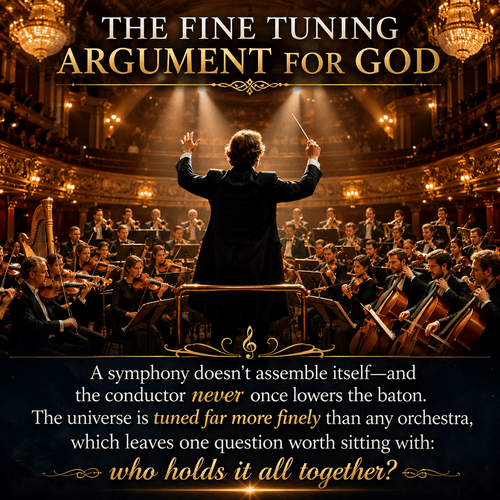
Yet, this evidence is far from empty. Christian Scripture makes a claim that’s actually bolder than mainstream Intelligent Design: the universe is not merely wound up like a grandfather clock and left to run on its own. Colossians 1:17 states “in him all things hold together.”
The constants of physics aren’t just ancient settings left behind by an absent engineer; they’re the steady, ongoing expression of a present Lord sustaining reality from one split second to the next. The fine-tuning is the ongoing rhythm of His faithfulness, inviting us to look a little closer at the hand that holds it all.
Tough Questions, Honest Answers
Doesn’t the vast hostility of space prove the universe wasn’t designed for us?
If we were almost anywhere else in the cosmos, other than here on earth, we’d be killed instantly—by everything from the freezing vacuum of space to the thermonuclear furnaces of stars. But the argument is about whether a universe capable of hosting life is possible, not whether every square inch of it is comfortable. To get the massive, long-lived stars required to forge heavy elements like carbon and iron, the universe must be vast, ancient, and mostly empty. The vastness of space isn’t bad design; it is a structural prerequisite for having a planetary home like ours.
Is this just a “God-of-the-Gaps” argument?
A “God-of-the-Gaps” argument points to a hole in current scientific knowledge and drops God into the blank. Fine-tuning does the exact opposite: it’s based on what we do know. It is built on our most precise, highly tested, mainstream mathematical physics. Furthermore, as our measurements have grown more exact over the last few decades, the fine-tuning problem has become dramatically sharper, not weaker. It’s a feature of the completed scientific map, not a hole in it.
How is this different from old arguments about animal eyes or wings?
In the 1800s, William Paley argued that complex biological structures (like an eye) required a designer. Charles Darwin then proposed that natural selection could explain biology over time. But fine-tuning deals with a layer of reality deep beneath biology. It looks at the laws of physics that had to be operational before a single molecule, planet, or living cell could even exist. Natural selection can only operate in a universe that already features stable chemistry and burning stars. Darwin’s theories cannot explain why a universe structured to allow biology exists in the first place.
Could a future “Theory of Everything” explain why the constants are what they are?
It’s possible that a future, deeper discovery in physics will reveal that these constants couldn’t be any other value. But this doesn’t eliminate the puzzle—it just relocates it. We would then have to ask: Why does our universe run on a foundational “Theory of Everything” that happens to perfectly produce a life-permitting reality, out of all the chaotic alternatives? The fine-tuning simply moves from the settings on the dials to the design of the engine itself.
Did scientists like Hoyle and Penrose actually come to believe in God?
No, and it would be dishonest to imply otherwise. Hoyle remained hostile to conventional religion to the end, preferring vague notions of a cosmic intelligence; Penrose is not a theist and uses words like Creator only loosely. This is worth saying plainly, because the strength of their testimony lies precisely in their reluctance. When men with every motive to reach a different conclusion find themselves describing the universe as a put-up job, or reaching for the language of superintellects, they’re not preaching. They’re reporting what the evidence pressed upon them against their own inclinations.
If God is all-powerful, why would He need to fine-tune anything at all?
He wouldn’t need to. An all-powerful God could sustain life by direct miracle in any universe, or in none. The question quietly assumes that fine tuning was a constraint God laboured under, when in fact it was a choice he made. The Maker of all things characteristically works through ordered means—the seasons, seed-time and harvest, the steady laws by which the world runs—and that order is not a limit on his power but a display of his wisdom. A universe of exquisite and intelligible law tells us something that a universe of arbitrary miracle would not: that behind it stands a mind of reason and faithfulness rather than caprice. The fine tuning is not God’s necessity. It is his signature.
Does accepting the fine-tuning argument mean rejecting the Big Bang or evolution?
Not in the least, and this is often misunderstood. The argument actually depends on mainstream cosmology. It takes the measured age, expansion and constants of the universe, the Big Bang included, and asks why those measurements fall where they do. It is a question about the settings of nature’s laws, and it stands entirely apart from debates about the origin or development of biological life. Believers who hold a range of views on how and when God made the world can all weigh this argument on its own merits. It does not ask how the first living cell arose. It asks why there should be a universe in which living cells are possible at all.
Related Reads:
- Aquinas’ Quinque Viae: Timeless Arguments for the Existence of God
- The Universal Moral Oughts: Signposts to the Divine
- The Kalam Cosmological Argument: Does the Universe Need a Creator?
- The Teleological Argument: Does Nature Point to a Designer?
- The Ontological Argument: Can We ‘Logic’ Our Way to God?
- The BGV Theorem: How Physics Points to a Spaceless, Timeless Creator
- RNA World Hypothesis: Can Chemistry Explain Life’s Origin?
- Does Math Disprove Materialism? The Case from Numbers and Logic
- The God Particle: What Does the Higgs Boson Really Say About God?