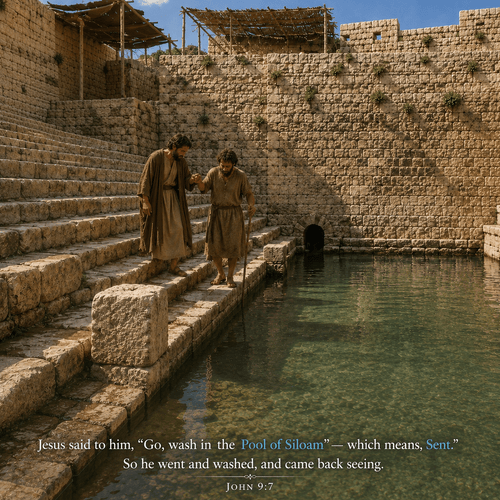
Jesus once healed a man born blind by sending him to a pool. “Go, wash in the Pool of Siloam” (John 9:7), Jesus tells him. John pauses the narrative here to explain the pool’s name meant “Sent”. Well, the man does go. And he comes back seeing. For 2000 years that pool has been remembered for the miracle. In 2025 it became the talk of historians and Bible-lovers for an entirely different reason.
In the summer of 2025, a team of archaeologists and scientists announced they’d dated a massive stone wall buried beneath the City of David in Jerusalem. The wall turned out to be a dam—the largest ever found in Israel and the earliest known in Jerusalem—built around 800 BC. The structure had sat in the ground for nearly 2,800 years. The surprise wasn’t that it existed, but how precisely it could now be dated, and what that precision tells us about the kingdom that built it.
That kingdom was Judah, ruled at the time by one of the kings the Bible does name. And the discovery, modest as a heap of ancient stones might sound, speaks directly to a question sceptics have pressed for decades: was the Judah of the Bible—organised, literate, governed by capable kings—a real historical kingdom? Or was it a flattering portrait added into the text long after the fact?
A Dam Beneath the City of David
The dam stands at the southern end of the Tyropoeon Valley, within what became the lower City of David. Its design was both clever and practical. It sealed the valley, redirecting water from the Gihon Spring—Jerusalem’s lifeline—into a large open reservoir while also trapping seasonal rainwater. The excavation directors, Nahshon Szanton, Filip Vukosavović and Itamar Berko, describe a wall roughly 12 metres high and more than 8 metres wide, with an exposed length of 21 metres that continues beyond the edge of the dig.
This was no village waterhole. A structure on that scale demanded planning, skilled labour, engineering knowledge and the central authority to command all three—exactly the kind of project a functioning state undertakes, and an ordinary tribe does not.
How Straw and Twigs Fixed the Date
What makes the find remarkable isn’t the wall but the date, and the way it was reached. The team, led by Johanna Regev and Elisabetta Boaretto of the Weizmann Institute of Science working alongside the Israel Antiquities Authority, used a method called microarchaeology. Rather than dating loose material that might have drifted into the site centuries later, they extracted microscopic fragments of organic matter from inside the dam’s mortar—material that had been mixed into the wet mortar at the very moment of construction.
Two kinds of material did the work: uncharred straw and charred twigs.
BUT WHY STRAW AND TWIGS?
- Precision: A stalk of straw or a slender twig grows and dies within a few years. Its radiocarbon “clock” records the exact moment the plant stopped living.
- Construction timing: Because this material was mixed into wet mortar at the moment the dam was built, the carbon date directly reflects the date of construction.
- The “old wood” safeguard: This bypasses the “old wood problem”—the risk that a large, reused timber beam might be centuries older than the building it belongs to. Straw and twigs simply cannot be older than the harvest that produced them.
- Dual verification: Uncharred straw and charred twigs preserve differently. When both chemical paths point to the same 805–795 BC window, that agreement is a powerful, built-in check against error.
As Elisabetta Boaretto noted, a resolution that tight—a window of barely a decade—is a rare achievement when dating finds that are this ancient.
The researchers then set their date against independent climate records: drill cores from the Dead Sea, stalagmites from the Soreq Cave, and traces of past solar activity preserved in cosmogenic isotopes. Together these revealed a region lurching between prolonged drought and sudden flash floods—precisely the conditions that would drive a kingdom to invest in monumental water management.
What It Reveals About Judah’s Kings
The dam was raised during the reign of King Joash—called Jehoash in some passages—or possibly his son and successor Amaziah. Joash ruled Judah from roughly 835 to 796 BC. The books of Kings and Chronicles describe both men as rulers of an established kingdom with all the machinery of government: a temple, a priesthood, a treasury, military campaigns and public works (see 2 Kings 11–14; 2 Chronicles 24–25).
For much of the last century a school of thought known as biblical minimalism (the view that the Bible’s historical narratives were composed as legend long after the events they describe) has argued this picture is inflated. On that reading, Judah before the late 8th century was a small, rural, largely illiterate chiefdom—nothing like the organised monarchy the Bible portrays—and the grander narrative was composed much later to furnish the nation with a prestigious past.
A state-built dam dated to 800 BC is hard to reconcile with that scepticism. You don’t get a wall 12 metres high, engineered to manage a city’s entire water supply, from a loose tribal society. You get it from a centralised kingdom with the authority to plan, fund and execute large-scale civic works. The discovery confirms—physically, measurably—the very thing the minimalist reading denies: that Judah’s early kings governed a capable, organised state, just as the Bible describes.
One Water System, the Whole Biblical Story
The dam isn’t an isolated curiosity. It’s the earliest known link in a chain of waterworks at the same spring—a chain that runs straight through the Bible narrative.
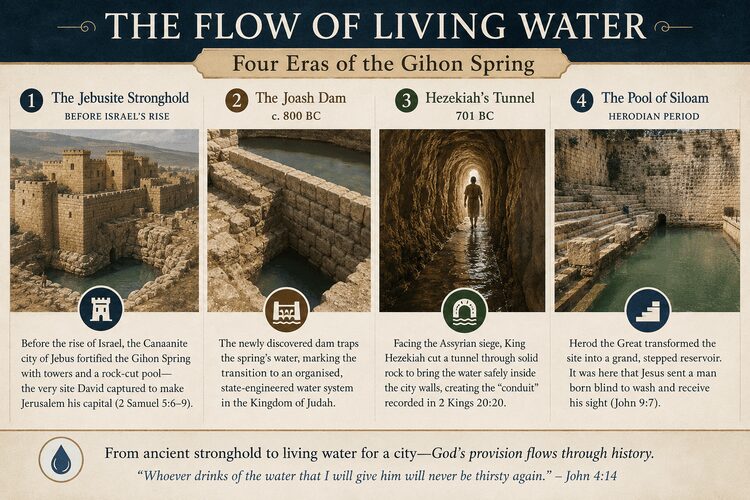
One spring. One site. Four eras—Jebusite, Joash, Hezekiah, Herod—and the same flowing water threading through them all, from the conquest of Jerusalem to the miracles of Christ. The newly dated dam supplies the earliest Israelite phase of that story, the piece that had been missing.
Isaiah, who ministered in this very period, drew on these waters for his imagery. He warned a faithless people who had “refused the waters of Shiloah that flow gently” (Isaiah 8:6), and later promised that “with joy you will draw water from the wells of salvation” (Isaiah 12:3). The physical lifeline of the city became, in the prophets and finally in Christ, a picture of the salvation God provides.
What It Proves—and What It Doesn’t
The Bible doesn’t record Joash building this dam. So this isn’t a case of Scripture predicting something that archaeology later uncovered.
What the discovery does is quieter and sturdier: it confirms the world the Bible describes.
- It shows that the kings of Judah, at exactly the time and place Scripture sets them, commanded the resources and organisation the text takes for granted.
- It anchors the antiquity of a water system the Bible refers to from Hezekiah to Jesus.
- And it does so through a dating method—radiocarbon on short-lived material—that’s precise, well-established and entirely uncontroversial for a date as recent as 800 BC.
That’s the right way to weigh archaeological evidence. It rarely proves the Bible in a single stroke. What it does, find after patient find, is show that the biblical writers knew the world they were writing about—its kings, its cities, its waters—and described it truly.
For a generation taught to treat the Bible as legend dressed up as history, that’s no small thing. The same spring that watered David’s city, that Hezekiah secured against an empire, and that Jesus used to open blind eyes has now yielded a wall that quietly confirms the Bible’s account of the kings who ruled there. The waters of Siloam are still telling the truth.
Tough Questions, Honest Answers
What exactly is the Siloam Dam?
It is a monumental stone wall in the City of David in Jerusalem, built to dam the Tyropoeon Valley and channel the Gihon Spring into a large reservoir while also catching rainwater. Announced in 2025, it is the largest dam ever found in Israel and the earliest known in Jerusalem.
How can scientists date a wall so precisely after 2,800 years?
They dated tiny fragments of straw and twigs trapped in the dam’s mortar when it was built. Because these short-lived plants died the year they were harvested, their radiocarbon date marks the moment of construction—narrowing it to roughly 805 to 795 BC, a window of only about ten years.
Which king built it—Joash or Amaziah?
The date falls within the reign of Joash (about 835 to 796 BC) or his successor Amaziah. Both are kings of Judah named in the books of Kings and Chronicles, so either way the builder was a monarch the Bible records.
Does this discovery prove the Bible is true?
Not in the sense of fulfilling a specific prophecy—the Bible never mentions this dam. What it does is corroborate the world Scripture describes: an organised Judahite kingdom, capable of large public works, at exactly the time and place the Bible places it. That is corroboration, not a single knockout proof, and it is the stronger claim for being honest.
Is radiocarbon dating reliable, and doesn’t it conflict with the Bible?
Radiocarbon dating is well-established and accurate, and a date of around 800 BC sits comfortably within its most reliable range. There is no tension with Scripture here; on the contrary, the method delivers a date that fits the biblical timeline for Judah’s kings. Christians can welcome the science with confidence rather than suspicion.
What does the dam have to do with the Pool of Siloam where Jesus healed the blind man?
Everything—it is the same site at an earlier stage. The dam created the first great reservoir at the Gihon Spring. Hezekiah later tunnelled the water inside the walls; Herod rebuilt the pool in stone; and it was that pool where Jesus sent the blind man to wash and receive his sight (John 9:7). The 2025 discovery fills in the earliest chapter of that continuous story.
Why does it matter whether Judah was an organised kingdom so early?
Because many scholars have argued that the Bible’s picture of capable early kings was invented centuries later. A state-engineered dam at 800 BC is concrete evidence that such a kingdom really existed when and where the Bible says it did—which strengthens our confidence in the historical books that record its kings, its faith and its God.
Related Reads
- Hezekiah and Assyria: 4 Compelling Archaeological Discoveries
- Jehoiachin’s Ration Tablets: Vindicating Bible Accounts
- Discovery of the Mt Ebal Curse Tablet: Where Things Stand
- Digging Up Truth: How Babylon’s Ruins Validate Scripture
- Shiloh Unearthed: Where Archaeology Meets Scripture
- Hezekiah’s Reforms: Lachish Discoveries Confirm Bible Account
- Dead Sea Scrolls: How Ancient Texts Confirm Bible Integrity
- Ten Discoveries That Support New Testament Reliability
- The Ketef Hinnom Scrolls: An Accidental Yet Phenomenal Find
- What Do the Dead Sea Scrolls Prove? The Case for Bible Reliability