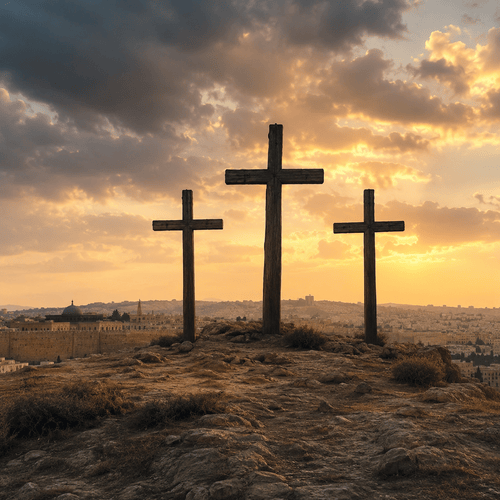
Of all the ways a man could be put to death, why this one?
Jesus could have died in many ways. He could have been stoned, as the crowd once tried to do (John 8:59). He could have been quietly poisoned, or simply allowed to grow old. Yet the Bible doesn’t treat the manner of His death as an accident of history. It treats it as necessary. The cross wasn’t merely where Jesus happened to die; it was where He had to die.
That’s a bold claim, so let’s test it carefully. In this article we will look at what Scripture actually says about why the Son of God died by crucifixion and not by other means. What we will find is that crucifixion—and only crucifixion—brings together a whole cluster of promises, pictures, and prophecies that God had been laying down for centuries.
1. The Curse of the Tree
We begin with the single most important verse for this whole question. Writing to Christians in Galatia, the apostle Paul says:
“Christ redeemed us from the curse of the law by becoming a curse for us—for it is written, “Cursed is everyone who is hanged on a tree” (Galatians 3:13).
To feel the force of this, we need to know what Paul is quoting. He is reaching back to an old law given through Moses:
“…for a hanged man is cursed by God” (Deuteronomy 21:23).
In ancient Israel, when a criminal was executed, his body was sometimes hung on a piece of wood as a public sign. It announced to everyone passing by: this man is under the curse of God. A “curse,” in the Bible, isn’t bad luck or a magic spell. It’s the settled judgement of a holy God against sin—the very opposite of His blessing.
Now we can see why the manner of death matters so much. Paul teaches what’s often called penal substitution. That phrase simply means this: Jesus took the penalty (the punishment) that we deserved, standing in our place as our substitute. But to bear our curse in a way everyone could see, Jesus had to die a death that publicly displayed cursed-ness—a body lifted up on wood. Stoning wouldn’t have done this. Beheading wouldn’t have done this. Only being “hanged on a tree” placed him visibly under the curse we deserved.
John Calvin makes a sharp point here. Jesus wasn’t lynched by a mob; He was formally sentenced by a judge. This mattered, Calvin says, so that Christ might be condemned as guilty in our place, even though He was innocent, and so we might be declared innocent through Him. The one who never sinned was treated as a sinner, so sinners could be treated as righteous. The cross is where that great exchange happened in full public view.
2. “Lifted Up” Like the Serpent
There’s a second thread, and Jesus Himself draws it. Speaking to a teacher named Nicodemus, He said:
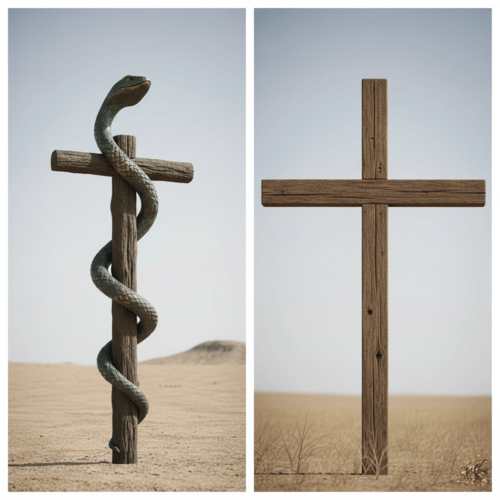
“And as Moses lifted up the serpent in the wilderness, so must the Son of Man be lifted up” (John 3:14).
This points back to a strange episode in Israel’s history. The people had rebelled, and God sent venomous snakes among them. When they cried out, God told Moses to make a bronze snake and lift it high on a pole. Anyone bitten who simply looked at it in faith would live (Numbers 21:8–9). The snake— symbol of the curse and of judgement—was lifted up, and it became the means of rescue.
Notice the key word: lifted up. Jesus is saying His own death must be a death by raising, by elevation. And in case we miss it, John spells it out later:
“And I, when I am lifted up from the earth, will draw all people to myself.” He said this to show by what kind of death he was going to die (John 12:32–33).
That last line is remarkable. John tells us plainly the kind of death carried meaning. It wasn’t enough for Jesus to die; He had to be lifted up, so the ancient picture of the serpent on the pole would find its true fulfilment in the Saviour on the cross.
3. The Convergence of the Prophecies
Here’s where the case becomes, in my view, watertight. Long before the cross, the Old Testament had set out a whole list of requirements for how the promised Saviour would die. The striking thing is that crucifixion is the only method of execution that satisfies all of them at once. Consider them together:
| What was required | Where it was foretold | How crucifixion fulfilled it |
|---|---|---|
| His hands and feet pierced | Psalm 22:16; Zechariah 12:10 | Nails driven through hands and feet (John 19:37); no other Jewish execution pierced the body |
| Not a single bone broken | Exodus 12:46; Numbers 9:12 | Death came slowly, so the soldiers did not break his legs (John 19:33–36); stoning would have shattered bones |
| His blood shed | Hebrews 9:22 | Nails, thorns, and the spear drew blood; strangling or drowning would have shed none |
| A public, shameful death | Philippians 2:8; Hebrews 12:2 | The cross was the most degrading death Rome had; the shame was borne openly |
| Garments divided by lot | Psalm 22:18 | Soldiers cast lots for his clothing at the foot of the cross (John 19:23–24) |
Sit with that table for a moment. Psalm 22, which describes pierced hands and feet and the casting of lots for clothing, was written roughly a 1000 years before Rome invented crucifixion. The requirement that no bone be broken came from the rules for the Passover lamb—the lamb whose blood spared Israel from death. Jesus is that Lamb, and so His bones, like the lamb’s, remained whole.
Why this matters
Take away crucifixion and the pieces no longer fit. Stoning breaks bones. Strangling sheds no blood and pierces nothing. Beheading is neither slow nor a “hanging on a tree.” Only crucifixion threads every needle at once—the piercing, the unbroken bones, the shed blood, the public shame, and the dividing of the garments. It isn’t that crucifixion happened to match a few details. It’s that no other death could have matched them all.
4. God’s Deliberate Plan, Not a Twist of Fate
Someone might object: surely the method was decided by Rome and the mob, not by God? Surely it was just the way things fell out? Scripture answers firmly. The historical machinery that produced a crucifixion was itself arranged by God.
Consider the pieces. Israel was under Roman occupation, and the Jewish leaders admitted,
“It is not lawful for us to put anyone to death” (John 18:31).
The Jewish method of execution was stoning. But because Rome held the power of the sword, Jesus was handed over to the Roman governor Pilate. And the Roman method was crucifixion. In other words, God arranged the politics of the age so a Gentile form of death would fulfil a Hebrew Scripture about being “hanged on a tree,” and so that both Jew and Gentile shared in the guilt of the cross. Nothing here is accidental.
The apostles saw this clearly. On the day of Pentecost, Peter told the crowd that Jesus was:
“…delivered up according to the definite plan and foreknowledge of God” (Acts 2:23).
And in a prayer soon after, the early church said of Herod, Pilate, the Gentiles, and Israel that they did:
“…whatever your hand and your plan had predestined to take place” (Acts 4:27–28).
This is one of the most breathtaking truths in the Bible. The wickedest act in human history—the murder of the Son of God—was also the most carefully planned act of God’s love. Human beings acted freely and are truly guilty; and at the same time God had ordained every detail, down to the kind of death His Son would die. The two truths don’t cancel out. God ordained not only that Christ would die, but exactly how.
5. Two Trees: Adam and Christ
There’s a beautiful pattern woven through the Bible that makes the cross even more fitting. Trouble entered the world at a tree, and rescue came through a tree.
- The first tree: In the garden, the first man, Adam, disobeyed God by eating from a tree, and through that one act sin and death spread to the whole human race (Genesis 3; Romans 5:12–19).
- The second tree: On the cross—repeatedly called a “tree” in the New Testament—the second and greater Adam, Jesus Christ, obeyed God perfectly, undoing what the first Adam had done (1 Corinthians 15:22).
The Bible speaks of Christ as a “federal head,” which means a representative—one man who acts on behalf of many, the way a head of state signs a treaty for a whole nation. Adam represented us in his disobedience at a tree; Christ represented us in his obedience at a tree. Even a small detail whispers this pattern: when Isaac was to be sacrificed, he carried the wood up the mountain on his own back (Genesis 22:6)—just as Jesus carried His cross. The disobedience at wood is answered by obedience on wood.
6. A Death Slow Enough to Finish the Work
Crucifixion was a slow death. That, too, was fitting. A quick execution would have given no room for what happened in those hours. Because Jesus remained conscious, He could speak, and His words on the cross reveal the meaning of the whole event.
Near the end He cried out a single Greek word, tetelestai, translated “It is finished” (John 19:30). In everyday Greek this word was stamped on a bill that had been paid in full. Jesus wasn’t gasping His life was over; He was announcing the debt of sin had been completely paid. Then, in full control to the last, He said, “Father, into your hands I commit my spirit!” (Luke 23:46). His life wasn’t ripped from Him. He laid it down. The slow death of the cross allowed the finished work to be declared and that final offering to be freely made.
7. The Cross as Victory
One more strand completes the picture. The cross wasn’t only a payment; it was a triumph. Paul writes that on the cross God cancelled the record of debt that stood against us, and something more:
“He disarmed the rulers and authorities and put them to open shame, by triumphing over them in Him” (Colossians 2:15).
The very moment that looked like Christ’s total defeat was, in truth, the defeat of sin, death, and the devil. The public execution was a public victory. The payment for sin comes first—and this is the heart of the matter—but out of that payment flows the conquest of every power that held us captive.
8. A Careful Word About “Had To”
We should be precise about what “had to” means here, so we don’t say more than the Bible allows. God was under no outside force. Nothing above Him or beyond Him twisted His arm and made crucifixion happen. The necessity isn’t a chain on God; it flows from God.
The right way to say it
Not this: God was forced by some higher law to use crucifixion.
But this: God freely chose to save sinners by curse-bearing, freely promised the manner of it through the prophets, and, having so decided, bound Hmself to it. Given His own wise and loving plan, the cross became certain and fitting. So when we say Jesus “had to” be crucified, we mean it was certain because God had promised it and wise because it fulfilled everything he’d been preparing. The cross was foreordained and fitting—never forced.
Bringing It Together
Why crucifixion, and not some other death? Because no other death could carry the weight of meaning God had built into this one. On the cross, and only on the cross, we see the curse borne on a tree, the serpent-picture fulfilled in the lifting up, the prophecies converging to the last detail, the eternal plan unfolding through free and guilty human hands, the first Adam’s failure reversed by the second, the debt declared paid in full, and the powers of darkness openly defeated.
The cross was never Plan B. It was the plan—the deliberate, loving, wise design of God to rescue His people. That’s why Jesus had to die by crucifixion specifically. And that’s why, of all the images the first Christians could have chosen, they chose the cross.
Tough Questions, Honest Answers
Could God not simply have forgiven sin without any death at all?
The Bible says that “without the shedding of blood there is no forgiveness of sins” (Hebrews 9:22). This isn’t because God is unable to do otherwise, but because He is perfectly just. A judge who let the guilty go free with a wave of the hand would not be good; He’d be corrupt. At the cross God shows Himself to be both perfectly just, punishing sin, and the one who justifies, forgiving the sinner. Both meet in the death of Christ.
Does the “curse of the tree” mean Jesus was actually cursed by God?
Yes—but on our behalf, not for His own wrongdoing. Jesus was sinless and deserved no curse. He took upon Himself the curse our sin deserved, so we could receive the blessing His goodness deserved. This great exchange is the very heart of the good news (2 Corinthians 5:21).
Is the bronze serpent link something Christians invented later?
No. Jesus Himself made the connection while He was still alive, before the cross had even happened (John 3:14). He deliberately pointed back to the serpent that Moses lifted up and applied it to His own coming death. The early Christians were simply following His lead.
If God planned the crucifixion, were the people who killed Jesus really guilty?
Yes, fully guilty. Scripture holds both truths at once: the men who crucified Jesus acted with real freedom and wicked intent, and God had ordained it beforehand (Acts 2:23; 4:27–28). God’s planning didn’t force anyone to sin; the guilt was entirely their own. Yet God, in His wisdom, wove even their evil into His good and saving purpose.
Why does it matter that Jesus’ bones weren’t broken?
It ties Jesus directly to the Passover lamb, whose bones were not to be broken (Exodus 12:46). At the first Passover, a lamb’s blood shielded Israel from death. Jesus is the true Passover Lamb, whose blood shields His people from the judgement they deserve. The unbroken bones are a quiet but powerful sign He is the reality the old ritual was pointing to.
Did Jesus die of a broken heart, exhaustion, or the spear?
The Gospels stress Jesus was in control of the moment of His death. He “gave up His spirit” (John 19:30) after declaring His work finished. Whatever the medical details, the deeper truth is that no one took His life from Him; He laid it down willingly (John 10:18). The spear thrust came after He had already died, confirming His death and fulfilling prophecy (John 19:34–37).
Does focusing on the cross ignore the resurrection?
Not at all. The cross and the empty tomb belong together. The crucifixion is where the price for sin was paid; the resurrection is God’s public receipt, proving the payment was accepted and that death itself is beaten (Romans 4:25). A crucified Saviour who stayed dead would save no one. This article focuses on why the death took the form it did, but that death always looks forward to the risen life that followed three days later.