The Question Believers Are Afraid to Ask
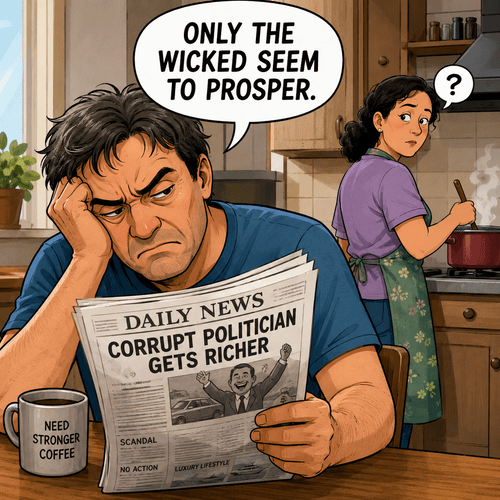
You’re scrolling through the news, and there they are. The politician who cheated his way to the top: everybody knows he’s corrupt. Yet, he keeps winning election after election. And there are the businessmen he’s hand-in-glove with, who default on taxes and borrowings, and yet, seem to be none the worse for it. They look healthy. Untroubled. Even proud of themselves.
Then you think of the widow in your church who prays every morning and cannot pay her hospital bill.
Something inside you goes quiet, and a question forms that you hesitate to say out loud: Why does God allow this?
Here’s the first thing to know. Nursing the question isn’t a sin. It’s in the Bible. Asaph, who led temple worship, wrote a whole psalm about it. Jeremiah argued about it with God to His face. Habakkuk shouted it.
But notice how they ask. Jeremiah begins: Righteous are you, O LORD, when I complain to you; yet I would plead my case before you (Jeremiah 12:1). He settles God’s character before He raises the question of God’s timing.
That’s the difference between lament and rebellion. Lament carries the trouble to God. Rebellion takes it and walks away. This article is about walking the first road.
What Asaph Saw—and Where His Arithmetic Failed
Psalm 73 is the most honest chapter in Scripture on this subject, and it opens with a confession: But as for me, my feet had almost stumbled, my steps had nearly slipped (Psalm 73:2). Why? For I was envious of the arrogant when I saw the prosperity of the wicked (Psalm 73:3).
Put what he saw beside what he’d been taught to expect.
| What Asaph expected | What Asaph actually saw |
|---|---|
| The wicked suffer | They have no pangs until death; their bodies are fat and sleek (Psalm 73:4) |
| Trouble finds them out | They are not in trouble as others are (v.5) |
| Pride brings a person down | Pride is their necklace (v.6)—worn openly, like jewellery |
| God notices | How can God know? Is there knowledge in the Most High? (v.11) |
His conclusion was bitter: All in vain have I kept my heart clean (Psalm 73:13).
We must be clear here, because much bad teaching hangs on it. Asaph’s data was correct, and God never corrects him on the facts. Scripture nowhere promises the godly will always do well in this life and the wicked will always suffer.
Where did Asaph go wrong? Not in what he observed, but in how he measured it. Two instruments were faulty:
- His timescale was too short. He was totalling a sum using only the numbers that fit inside a lifespan, then complaining the answer came out wrong. DA Carson puts it sharply in How Long, O Lord?: much of our anger with God comes from demanding a verdict while the evidence is still being presented.
- His heart was envious. Envy doesn’t merely feel unpleasant; it bends our eyesight. Asaph later calls himself brutish and ignorant (Psalm 73:22)—a beast that sees the grass in front of its face and nothing beyond.
God hadn’t failed. Asaph was doing eternal accounting with a pocket calculator.
The Sanctuary Changes the Sum
Then comes one of the great turning points in Scripture: When I thought how to understand this, it seemed to me a wearisome task, until I went into the sanctuary of God; then I discerned their end (Psalm 73: 16-17).
Notice what didn’t happen. God sent no statistics and explained no individual case. What changed was where Asaph was standing.
The word translated “end” is the Hebrew aharit: the final outcome, how the story concludes. Asaph had been reading and stopping at the interval. In the sanctuary he was handed the last page.
Derek Kidner calls this verse the hinge of the psalm: everything before it is weighed by sight, everything after it by what God has said. Same man, same evidence, opposite conclusion.
WHAT IS “THE SANCTUARY” FOR US?
Asaph went to the temple. We have what the temple pointed to: the preached Word, the sacraments, prayer and the gathered people of God—the means of grace.
We may not think our way out of this alone at 2 in the morning. Asaph tried, and it exhausted him. The answer is found not in a quiet room with a notepad, but among God’s people, under God’s Word.
And what did he see? Truly you set them in slippery places; you make them fall to ruin (Psalm 73:18). Asaph doesn’t say the wicked stand on solid ground and will one day be knocked off. Their footing was never solid. It’s not a mountain. It’s a wet marble floor—and their security a dream that ends when somebody wakes (Psalm 73:20).
God’s Kindness Is Real, But It’s Not Salvation
Here many Christians make the opposite mistake, speaking as though the success of the wicked were stolen, accidental or from the devil. Scripture forbids that.
Jesus is explicit: God makes his sun rise on the evil and on the good, and sends rain on the just and on the unjust (Matthew 5:45). Paul told a pagan crowd God had given them rains, fruitful seasons and gladness (Acts 14:17). The health of the corrupt man, the profit of his business—these are genuine gifts from God’s hand.
Key term: common grace
Common grace is the favour God shows to all people, believers and unbelievers alike, in this present world. John Murray described it as every favour short of salvation bestowed on an undeserving world.
It’s real and genuinely kind. It restrains evil and provides good things. But it doesn’t make anybody right with God.
Grasp this and a whole industry of false teaching collapses. If God gives good things to the wicked, good things can’t be a scoreboard of His approval.
David puts it with devastating precision: men of the world whose portion is in this life (Psalm 17:14). Portion means share, allotment, the whole of what a person receives. Theirs has been paid out. In full. In local currency. Now. Nothing further is coming.
Delay Isn’t Denial
“But why so long?” That’s the real ache in our question, and Scripture answers directly. God’s delay is never idleness. It’s doing at least three things at once.
- It makes room for repentance. Do you presume on the riches of his kindness… not knowing that God’s kindness is meant to lead you to repentance? (Romans 2:4). The prosperity we resent is, for some, the very kindness that will one day break them.
- It fills the cup. Abraham’s descendants waited 400 years because the iniquity of the Amorites is not yet complete (Genesis 15:16). Meanwhile the unrepentant man is storing up wrath for the day of wrath (Romans 2:5). Every unpunished sin isn’t justice evaded. It’s a deposit.
- It displays God’s character. What if God… has endured with much patience vessels of wrath prepared for destruction? (Romans 9:22). Restraint is not weakness.
Here the argument turns personal. Manasseh filled Jerusalem with innocent blood, reigned 55 years and was converted (2 Chronicles 33). Nebuchadnezzar destroyed Jerusalem and ended up praising the God of heaven (Daniel 4). Saul of Tarsus was his generation’s most effective persecutor, and God’s answer was a road, a light and salvation (Acts 9).
Had God settled accounts when we think He should, none of them would have lived to be saved. Neither, in all likelihood, would we. Every Christian is a living example of God’s judgement delayed—which makes it hard to demand speed for others while depending on patience for ourselves.
Ecclesiastes admits the cost honestly: Because the sentence against an evil deed is not executed speedily, the heart of the children of man is fully set to do evil (Ecclesiastes 8:11). God accepts that cost, and He’s not asleep. Malachi speaks of a book of remembrance in God’s presence, and of a day when the difference between those who serve God and those who don’t becomes undeniable (Malachi 3:16-18).
When Prosperity Is Itself the Judgement
Now the part that turns the question upside down. We assume prosperity is the absence of judgement. Scripture repeatedly presents it as a form of judgement. Read Psalm 73:18 slowly: Truly you set them in slippery places. Who set them there? God did. The height isn’t an oversight. The height is the setting-up.
Paul says it three times in one paragraph. God’s response to a society that suppresses the truth? God gave them up (Romans 1:24, 26, 28). Not fire. Not plague. He lets go of the wheel and allows people to have exactly what they want. At full speed. Here’s how Hosea puts it: Ephraim is joined to idols; leave him alone (Hosea 4:17).
THE HARDEST SENTENCE IN THIS ARTICLE
The most frightening thing God can do to a person in this life is to do nothing at all.
The Westminster Confession states it soberly: God sometimes withholds His grace from hardened sinners and gives them over to their own lusts (5.6). A man who sins, prospers and feels nothing hasn’t been overlooked. He has been left alone—and being left alone by God isn’t mercy. It’s the beginning of the sentence.
So let’s not envy people who have everything and fear nothing. Something has already gone badly wrong, and it doesn’t appear on their bank statements.
Why We Cannot Read Providence Backwards
One more guard-rail, against two opposite errors.
God does sometimes judge visibly within history. Herod was struck down (Acts 12:23). Ananias and Sapphira fell dead in a church meeting (Acts 5). Such accounts show God can act now, not only later—but they’re recorded precisely because they’re the exceptions. Not the rule.
Moses drew the line once and for all: The secret things belong to the LORD our God (Deuteronomy 29:29). Providence isn’t a code to be cracked. It’s a hand to be trusted.
- Do not read another’s wealth as God’s approval. It may be common grace. It may be the slippery place. We cannot tell from outside, and we’re not asked to.
- Do not read your own suffering as God’s punishment. If we’re in Christ, the punishment for our sin fell on Him and none is left over. What remains is a Father’s discipline—the Lord disciplines the one he loves (Hebrews 12:6)—the language of family, not of a courtroom.
A Better Portion, and How to Stop Fretting
Psalm 73 ends not with an explanation but with a Person. Nevertheless, I am continually with you; you hold my right hand (v.23). While Asaph was busy envying, God had never let go of him. Then come the verses that answer everything: Whom have I in heaven but you?… God is the strength of my heart and my portion for ever (Psalm 73:25-26).
There is that word again. Portion. The wicked have theirs in this life. The believer’s portion is God Himself, and it cannot be devalued, seized, taxed or lost. Once we see that, the comparison collapses—not because their prosperity has gone, but because we don’t want to swap.
Thomas Boston, who wrote The Crook in the Lot while burying most of his own children, put it in a line: whatever crook there is in a person’s lot, it is of God’s making. The bend in our lives isn’t a manufacturing defect. It is deliberate, measured and temporary.
The Heidelberg Catechism says knowing God’s providence makes us patient in adversity and thankful in prosperity (Q.28). Both halves matter.
Which leaves the question Psalm 73 was really asking. Not why do they have so much? but what do I want? If what we want is what they have, no explanation from God will ever satisfy us. If what we want is God, we already have Him. And their prosperity becomes what it always was: a short lease on a slippery floor.
But for me it is good to be near God (Psalm 73:28).
Asaph got there. So can we.
Tough Questions, Honest Answers
Does the Bible teach wealth is a sign of God’s blessing?
Not in the way modern prosperity preaching claims. The promises of material blessing in Deuteronomy 28 were made to the nation of Israel under a specific covenant tied to the land, and they are not transferable guarantees to individual Christians today. Proverbs speaks in general wisdom principles—diligence usually produces provision—but proverbs describe how life normally works, not how it always works, which is exactly why Job and Ecclesiastes sit in the same Bible. The clearest refutation is the Lord Jesus himself, who had nowhere to lay his head, and the apostles, described as poor yet making many rich. In the New Testament, wealth is treated far more often as a spiritual danger than as a spiritual reward.
If God ordains the prosperity of the wicked, does that make Him the author of their sin?
No, and Scripture is careful here in a way we must be careful too. God ordains, permits, limits and directs sinful acts, yet the sinfulness of those acts proceeds from the creature alone and never from God. The Westminster Confession states this precisely (5.4). Theologians distinguish primary and secondary causes: God is the primary cause of all things, but he works through real secondary causes, that is, human beings making real choices for which they are genuinely responsible. Joseph’s brothers meant it for evil and God meant it for good, in the very same event (Genesis 50:20). God is never morally implicated in the sin he governs, because he never approves it, never tempts anyone to it, and always intends a righteous end by it (James 1:13).
Is it right to pray the imprecatory psalms against people who prosper through injustice?
Yes, with care. The imprecatory psalms—69, 109, 137 and others—are inspired Scripture, and the martyrs in heaven pray in exactly this key: O Sovereign Lord, how long before you will judge and avenge our blood? (Revelation 6:10). The crucial point: these prayers hand vengeance to God rather than taking it up ourselves. The one praying them is putting the weapon down, not picking it up. They must be prayed alongside Christ’s command to love our enemies and His own prayer for those crucifying Him. Also, let’s remember, we were once objects of wrath ourselves. Let’s test ourselves with this question: would we be disappointed if God answered by converting them.
If the wicked prosper, does my suffering mean God is angry with me?
If you are in Christ, no—and this needs saying plainly, because many believers quietly assume the opposite. All of God’s judicial anger against your sin was exhausted at the cross, and there is now no condemnation for those who are in Christ Jesus (Romans 8:1). What remains is fatherly discipline, which Hebrews describes as evidence of sonship rather than of rejection (Hebrews 12:6-8). Much suffering, moreover, has nothing to do with your particular sins at all, as Job and the man born blind both demonstrate.
What’s the difference between envy and a righteous longing for justice?
They can feel almost identical, so Scripture gives us ways to tell them apart. Envy wants what the wicked have; a longing for justice wants what God is. Envy is satisfied by their downfall and quietly enjoys it; a longing for justice is satisfied only when God is seen to be right, and would be equally content if he were vindicated by their repentance. Envy is self-centred and looks sideways at people; the desire for justice is God-centred and looks upward. Asaph shows us both faces: he begins in envy (Psalm 73:3) and ends confessing that bitterness had made him behave like an animal before God (Psalm 73:21-22).
Do the wicked prosper because Satan controls the world’s systems?
Satan is real and active—John says the whole world lies in the power of the evil one (1 John 5:19)—but his power is never absolute or independent. He’s a creature, and in Job 1 he cannot touch a single sheep belonging to Job without express permission, which God grants with precise limits. Popular Christian talk often slides into a kind of dualism, as though God and Satan were two roughly equal powers fighting over contested ground; the Bible knows nothing of this. Every ounce of the devil’s activity operates on leash held by God and serves purposes the devil himself does not intend. That is why Christ’s victory over him is described as already accomplished rather than still uncertain.
Should Christians work for justice now, or simply wait for the final judgement?
Both, and the second is what makes the first sustainable. God requires His people to do justice and love kindness (Micah 6:8), to seek justice and correct oppression (Isaiah 1:17), and He has appointed the civil magistrate as His servant to restrain evil in the present age (Romans 13:1-4). Waiting for the last day is no excuse for passivity now. At the same time, the certainty of final judgement frees us from the crushing burden of believing that every wrong must be righted by us, immediately, or it will never be righted at all. Christians can therefore labour for justice patiently, without bitterness and without despair.
Related Reads
- The Doctrine of Providence: Does God Really Govern All Things?
- Purpose in Pain: Why Trust Providence When His Plan Is Hidden?
- Fate vs Chance vs God’s Providence: Which Really Rules Our Lives?
- Doesn’t God Cause People to Do Evil?
- If God Wants Everyone Saved, Why Aren’t They?
- Will a Loving God Allow Violence? Insights from the Old Testament
- Would a Loving God Allow Birth Defects?