A King With No Army
Picture yourself on the old road that comes down the Mount of Olives. Below you stand the walls of Jerusalem. It’s Passover week, and word has spread a king is coming.
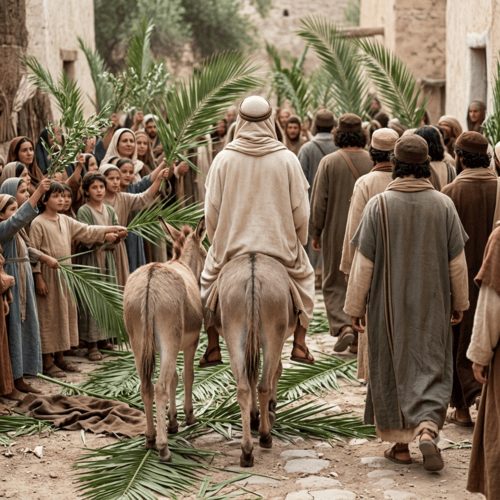
You know what a king looks like. Hooves on stone, armour, soldiers in ranks, prisoners in chains behind. Instead, a carpenter’s son from a village in the north comes down the hill on a young donkey no one has ridden before. No weapons. No soldiers. Just a crowd throwing coats on the road and shouting an old psalm.
So why a donkey? The usual answer: Jesus was poor, or simply modest. Both are too inadequte. The donkey was not transport but a message, chosen deliberately and written down centuries earlier. Here was Jesus, preaching a sermon. Without opening His mouth.
What the Four Gospels Tell Us
All four Gospel writers record the event, and each adds a piece of the picture.
| GOSPEL | WHAT IT ADDS |
|---|---|
| Matthew 21:1–11 | Quotes Zechariah 9:9, joined to a line from Isaiah 62:11. Mentions a donkey and her colt, and records the city was shaken and asked, “Who is this?” |
| Mark 11:1–11 | The fullest account of fetching the colt, noting it was one on which no one has ever sat. |
| Luke 19:28–44 | The only Gospel that records Jesus weeping over the city and announcing its ruin. |
| John 12:12–19 | Quotes Zechariah in shortened form, beginning “Fear not.” John alone mentions palm branches, and adds an honest note in 12:16. |
That last note unlocks the whole event:
His disciples did not understand these things at first, but when Jesus was glorified, then they remembered that these things had been written about him and had been done to him. (John 12:16)
Read that slowly. The meaning was in the act before it was in anybody’s head. The men leading the donkey didn’t know what they were doing. Jesus did.
Zechariah 9: The King Who Breaks the Weapons
Almost everybody who quotes Zechariah 9:9 stops at verse 9. That’s where the misunderstanding begins, because verse 9 only makes sense with verses 1–8 before it and verse 10 after it. The chapter opens with God marching in judgement through the nations to Israel’s north and west—Damascus, Tyre, Sidon, the Philistine cities. It reads like a war report. And then, after all that marching, the King arrives at his own capital. How?
Behold, your king is coming to you; righteous and having salvation is he, humble and mounted on a donkey, on a colt, the foal of a donkey. (Zechariah 9:9)
Three words describe him:
- Righteous. Not a strongman seizing power, but a king who deserves the throne he is riding towards.
- Having salvation. In Hebrew a passive form: not only “he brings rescue” but “he is rescued”—a King whom God himself will deliver. An odd thing to say of a conqueror; exactly right for a man who would be buried on a Friday and raised on a Sunday.
- Humble. The Hebrew word also means “afflicted” or “lowly”, from the family of words used of the poor whom God defends. This King is not merely modest in manner; he is one of the low.
Then comes verse 10:
I will cut off the chariot from Ephraim and the war horse from Jerusalem; and the battle bow shall be cut off, and he shall speak peace to the nations; his rule shall be from sea to sea. (Zechariah 9:10)
NOTICE WHOSE WEAPONS ARE DESTROYED
Not the enemy’s. Israel’s own. Ephraim’s chariot. Jerusalem’s war horse. This King doesn’t arm His people—He disarms them, and then rules the earth by speaking.
Notice too, the line about the donkey isn’t Zechariah’s only prophecy about the passion week. Chapters 9 to 14 read like a script:
| WHAT THE TEXT SAYS | PASSION WEEK |
|---|---|
| Zechariah 9:9 – riding on a donkey | The entry into Jerusalem |
| Zechariah 11:12–13 – 30 pieces of silver | The price paid to Judas |
| Zechariah 13:7 – “Strike the shepherd, and the sheep will be scattered” | Quoted by Jesus on the way to Gethsemane |
| Zechariah 12:10 – “Him whom they have pierced” | The crucifixion |
| Zechariah 14:4 – His feet on the Mount of Olives | Where the ride began |
Jesus wasn’t improvising. He was following a script He’d written.
The Donkey Was No Symbol of Poverty
Here’s where many sermons go wrong. We hear “donkey” and picture a shabby farm animal, so we conclude Jesus was making a point about poverty. But in Israel a donkey was valuable property and a respectable mount for a man of rank. What it wasn’t was a war animal. It was what you rode in peacetime, and the Old Testament had been building this image for centuries:
- Genesis 49:10–11. In Jacob’s blessing on Judah, the sceptre will not depart from the tribe—and the coming ruler is pictured binding his foal to the vine and his donkey’s colt to the choice vine. A ruler and a donkey’s colt, long before Zechariah.
- 1 Kings 1. The clearest parallel of all. Adonijah tried to seize his father’s throne and announced it with chariots and horsemen, and fifty men to run before him. King David’s answer was to put Solomon on the royal mule and send him to Gihon to be anointed. The usurper took horses. The rightful heir took a beast of burden—and the beast of burden won.
- 2 Samuel 15–16. David, driven out by his own son, went up the Mount of Olives weeping, his household riding donkeys. Jesus comes down that same slope, also weeping. The rejected king returns.
Notice Israel’s kings normally rode mules. Zechariah reaches further back, past David’s mule to Judah’s donkey in Genesis 49—the promise made at the very beginning, walking through the gate.
Not a Horse: The One Law Every Other King Broke
There’s a law in Deuteronomy that’s rarely preached:
Only he must not acquire many horses for himself or cause the people to return to Egypt in order to acquire many horses. (Deuteronomy 17:16)
In the Bible a horse isn’t a farm animal. It’s military hardware—the engine of the chariot, the tank of the ancient world—and Egypt was the great horse market, where you went if you wanted an army in a hurry. So the law isn’t about animals. It’s about where a king looks for security.
Some trust in chariots and some in horses, but we trust in the name of the LORD our God. (Psalm 20:7)
Solomon broke this law spectacularly, importing horses from Egypt by the thousand (1 Kings 10:26–28), and most kings after him followed. So when Jesus chooses a donkey and refuses a horse, He’s not only fulfilling Zechariah. He’s keeping Deuteronomy 17—the first King of Israel ever to do so—in public, before the largest crowd of the year.
The contrast was sharpened by the Roman governors, who came up for the feasts from the west with cavalry and standards.
| ROME ENTERS FROM THE WEST | JESUS ENTERS FROM THE EAST |
|---|---|
| War horses and armed men | One unbroken colt |
| Authority borrowed from Caesar | Authority given from heaven |
| Peace kept by fear | “He shall speak peace to the nations” |
| Came to hold a city for a week | Came to save a world for ever |
A Sermon Acted Out
Something here should surprise us. For three years Jesus had refused exactly this. When the Galilean crowd moved to make Him king by force, He slipped away into the hills (John 6:15). He hushed demons who named Him and told healed people to say nothing. Now He stages a public claim to the throne. Why now?
Because now the symbol interprets the claim. On a donkey he can accept the title “King” without being misunderstood, since the donkey rules out the crowd’s definition of the word. He’s no longer hiding; He is defining.
The prophets understood this. Jeremiah walked around Jerusalem in a wooden yoke (Jeremiah 27); Ezekiel lay on his side beside a clay model of the city (Ezekiel 4). They preached with their bodies when words alone would not land. Herman Ridderbos observed this entry is a declaration of messianic office rather than a burst of popular enthusiasm—the initiative is entirely Christ’s. It is a prophet’s sign-act, and the sign is the donkey.
“The Lord Has Need of It”
The arrangements repay attention. Jesus sends two disciples into a village with instructions that read like coordinates: you will find a colt tied, one never ridden; untie it; if challenged, say that the Lord needs it (Mark 11:2–3).
- He knew what they would find. The colt, where it was tied, that it was unbroken, even that bystanders would challenge them.
- He claimed the right to take it. Requisitioning property was a royal prerogative, and this is the only occasion in the Gospels where Jesus does anything of the kind—a quiet, unmistakable act of kingship. He calls Himself “the Lord”, and the owners let the animal go.
- The colt had never been ridden. Animals never put to ordinary work were the ones set apart for sacred use (Numbers 19:2; Deuteronomy 21:3; 1 Samuel 6:7). And anyone who has handled young animals knows an unbroken colt does not walk calmly down a steep road through a shouting crowd with cloaks flapping under its feet. The creature obeys its Creator—as it did in Numbers 22, where a donkey saw what a prophet could not.
DID MATTHEW MAKE A MISTAKE ABOUT TWO DONKEYS?
Critics argue Matthew misread Hebrew poetry. Zechariah 9:9 says “on a donkey, on a colt, the foal of a donkey”—one animal described twice, in the ordinary style of Hebrew parallelism. Matthew mentions two animals (21:2, 7), so, it is said, he invented a spare donkey to fit the prophecy. Three replies: a Jewish writer, writing for readers who knew the Psalms by heart, is the last person likely to miss Hebrew parallelism. Mark and Luke tell us the colt was unbroken, and unbroken young animals are led beside the mother to keep them settled. Matthew reports the practical detail the others leave out. “He sat on them” in 21:7 most naturally refers to the cloaks just mentioned, not to two animals at once.
Hosanna: The Right Words, the Wrong Rescue
The crowd sang from Psalm 118, one of the psalms sung at Passover. “Hosanna” isn’t a cheer but a prayer, meaning “Save now!” They weren’t congratulating Jesus. They were begging Him for rescue—and they had a very specific rescue in mind—victory over Roman rule.
- The garments on the road. When Jehu was proclaimed king, his officers spread their cloaks under his feet (2 Kings 9:13). A coronation gesture, and everyone knew it.
- The palm branches. Palms were a national emblem. When Simon Maccabeus took the citadel of Jerusalem after a military victory, his people entered with palm branches and songs (1 Maccabees 13:51); palms later appeared on the coins of the Jewish revolt. Waving them in Passover week was a political act. The crowd was quoting Scripture and meaning revolution.
There was nothing wrong with the words. Psalm 118 is about the Messiah, and Jesus is the Messiah, so every syllable they shouted was true. What was wrong was the rescue they had in mind. They wanted a king who’d drive Rome out. He had come to rescue them from a deeper bondage—to drive sin out of their hearts.
Three verses above the line they were shouting, the same psalm had already warned them how the story would go: “The stone the builders rejected has become the cornerstone” (Psalm 118:22). Jesus quotes that verse back to them within days (Matthew 21:42). They were singing a song that predicted their own rejection of Him, and they had not noticed.
A WARNING FOR FULL CHURCHES
The voices that shouted “Hosanna” on the Sunday were shouting “Crucify him” by the Friday. Nothing had changed except that Jesus, in their estimate, turned out not to be the king they’d ordered. Loud praise isn’t the same as a changed heart, and enthusiasm for a Christ of our own design will not survive contact with the real one.
Luke alone tells us what Jesus was doing while the shouting went on. He was weeping.
Would that you, even you, had known on this day the things that make for peace! But now they are hidden from your eyes. (Luke 19:42)
He’s riding into the city that will execute Him, and His tears aren’t for Himself. He weeps because they didn’t recognise the time of their visitation. God had come to them in person, and they missed Him in all the cheering.
From the Colt to the Cross
The ride doesn’t end at the city gate. Follow where the donkey was taking Him.
Sunday: the inspection
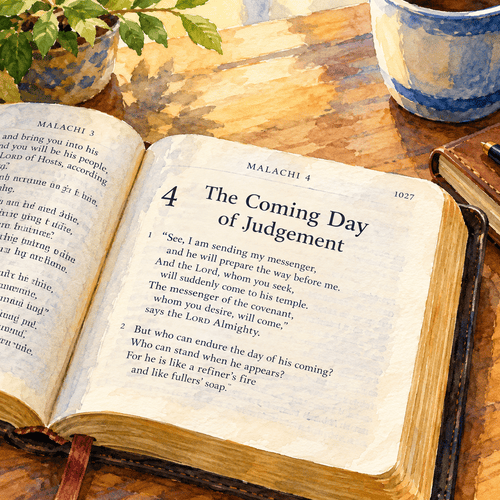
Jesus went straight into the temple, looked round at everything, and went out to Bethany (Mark 11:11). An anticlimax, until you remember Malachi 3:1: “the Lord whom you seek will suddenly come to his temple.” The owner is walking through His house, taking notes.
Monday: the cleansing
He returns and overturns the money-changers’ tables. Zechariah again had the last word: his final chapter promises there will “no longer be a trader in the house of the LORD of hosts” (14:21).
Thursday: the blood of the covenant
In an upper room he lifts a cup and calls it “my blood of the covenant.” Read two verses past the donkey prophecy: “because of the blood of my covenant with you, I will set your prisoners free” (Zechariah 9:11).
Friday: the throne
The Romans nailed a notice above His head and, without meaning to, wrote the truth: “This is Jesus, the King of the Jews.” The donkey was carrying Him to a coronation after all—the crown thorns, the throne wood, the subjects fled.
Older teachers described the life of Christ under two headings: His humiliation, from the manger to the grave, and His exaltation, from the resurrection to His return. The entry sits inside the humiliation like sunlight through a crack in a shutter—a deliberate flash of glory shown to a city that will not look at it. And none of it was an accident. Jesus “was delivered up according to the definite plan and foreknowledge of God” (Acts 2:23). The donkey and the ride were booked before the world was made.
The Donkey Now, the White Horse Later
Zechariah promised this King’s rule would stretch from sea to sea. Look at the world and you may wonder how. The answer is in the same verse: “He shall speak peace to the nations.” His kingdom advances by speech—the gospel preached, believed and obeyed. John Calvin argued the sceptre by which Christ rules is the preaching of His Word. And Isaiah had said as much: “He strikes the earth with the rod of His mouth” (Isaiah 11:4). The church was given a book, not a sword.
But the donkey isn’t the last picture of Jesus in the Bible. In Revelation 19:11 heaven opens and the same King appears on a white horse, robed in blood, a sword coming from His mouth to judge the nations. That’s not a contradiction of Palm Sunday but its sequel. He came the first time on a borrowed colt, offering peace to anyone who will take it, so we need not meet Him the second time as a warrior.
When He rode in, the city shook and asked, “Who is this?” (Matthew 21:10). They were looking straight at the answer. He was sitting on it.
Tough Questions, Honest Answers
Do donkeys have a cross on their backs because one carried Jesus?
Many donkeys really do have a dark stripe along the spine crossed by another over the shoulders, and there’s a popular legend the mark was given to the breed as a reward for carrying Christ. It’s a charming story, but it’s only a story—the Bible says nothing about it, and the marking appears in wild donkey populations that have nothing to do with Jerusalem. God is perfectly free to leave reminders of Himself in creation, and there’s no harm in being moved by the sight. There’s harm in teaching a folk tale as though it were Scripture. If we want a sign that points to Christ, we already have the one He gave us: the bread and the cup.
What happened to the donkey and her colt afterwards?
Scripture doesn’t tell us, and the silence is worth respecting. Jesus had promised the owners the animal would be sent back (Mark 11:3), and there’s every reason to think it was. Later legends grew up around the donkey, and in some places relics were claimed, but none of that has any authority. The Gospel writers keep our eyes fixed on the rider, not the animal, and we do well to follow them. Curiosity about the details Scripture withholds is one of the easiest ways to lose the point of the details it gives.
How far did Jesus actually ride?
Not very far at all. He began near Bethphage and Bethany, on the eastern slope of the Mount of Olives, and rode down into the Kidron Valley and up to the city—somewhere around two miles, or a little over three kilometres, on foot-worn tracks. The whole journey would have taken well under an hour. It’s a useful corrective to the paintings: this was a short ride on a small animal over rough ground, not a grand parade down a boulevard. The greatness of the event lay entirely in who was riding and why.
Why is it called Palm Sunday, and did palms even grow near Jerusalem?
The name comes from John 12:13, the only Gospel that specifically mentions palm branches; Matthew and Mark simply say the crowd cut branches from the trees and spread them on the road. Date palms flourished in the Jordan Valley around Jericho, which was on the pilgrim route up to Jerusalem, so branches could easily have been carried up by travellers. Jerusalem itself sits high in the Judean hills, where olive and other trees are more common. The naming of the day is a later church custom rather than a biblical command, so it should be held loosely. What matters isn’t which leaves were waved but which King they were waved at.
Did Jesus ride a donkey at any other time in His life?
The Gospels never say so. Nativity scenes almost always show Mary riding a donkey to Bethlehem, and Christmas cards show one on the flight to Egypt, but Scripture describes neither—Luke says only that Joseph went up to Bethlehem, and Matthew says only that Joseph took the child and his mother and departed by night. A donkey is entirely plausible in both cases, and no one need be scandalised by the pictures. But it is a healthy habit to notice the difference between what the Bible says and what our imagination has added to it. The one ride the Gospels do record, they record four times, because that ride carried a meaning the others did not.
Does the triumphal entry mark the end of Daniel’s 70 weeks?
Some writers have calculated the “seven weeks and sixty-two weeks” of Daniel 9:25 forward from a Persian decree and landed on the very day of the entry, and the arithmetic is genuinely striking. It should still be handled with care. The starting decree is disputed, the length of the year used in the calculation is disputed, and Daniel 9 as a whole is one of the harder passages in the Old Testament. The safest reading is the one Daniel himself gives us: the Anointed One would come and then be cut off (9:26), and Jesus arrived and was crucified within the same week. We can be confident of the substance of the prophecy without insisting on a precise date that Scripture never states.
Is the donkey a clean or an unclean animal under the law of Moses?
Unclean. A donkey has neither a split hoof nor a cud to chew, so it could never be eaten or offered in sacrifice. That makes one small law shine very brightly: the firstborn of a donkey had to be redeemed by the death of a lamb, or else its neck was broken (Exodus 13:13). An unclean creature could live only if a lamb died in its place. On that Sunday morning the picture was turned around and acted out in the street—the unclean animal carrying the Lamb of God into the city where He’d be killed. If you’ve ever wondered whether there’s a place in the story for people who know they’re unclean, that donkey is your answer.
Related Reads
- The King Revealed: How Palm Sunday Fulfils Messianic Prophecy
- Genesis 49: Does Jacob’s Blessing of Judah Point to Christ?
- Sacred Fury: What Christ’s Temple Cleansing Truly Means
- Did Jesus Cleanse the Temple Twice?
- What Did the Inscription on Jesus’ Cross Really Say?
- Messianic Prophecies: Progressive Specificity You Just Can’t Ignore
- The Three Offices of Christ: As Prophet, Priest and King
- Jesus in Zechariah: The Priest-King Foretold 500 Years Early
- Mount of Olives in the Bible: Where the King Wept and the Glory Returns