When we open our Bibles today, we rarely stop to consider the extraordinary journey the text has made through history. Behind our English translations lie ancient manuscripts copied by hand across centuries, in different languages, by different communities, for different purposes. Two great textual traditions stand at the heart of this story: the Masoretic Text (MT) and the Septuagint (LXX). Understanding these two traditions—their origins, their differences, and their relationship—gives us a richer and more confident understanding of how God has preserved His Word.
The Masoretic Text is the authoritative Hebrew Bible, the textual foundation of almost every modern Protestant Old Testament. The Septuagint—its name coming from the Latin word for 70 (hence the Roman numerals LXX)—is the oldest known Greek translation of the Hebrew Scriptures. Completed over the course of the 3rd to 1st centuries BC, it became the primary Old Testament of the early church and remains central to Eastern Orthodox Christianity today.
These aren’t mere academic curiosities. The differences between the two texts touch on Messianic prophecy, the canon of Scripture, chronology, and the cosmic scope of God’s plan for the nations. Let’s examine each in turn.
Origin And History
The Septuagint (LXX)
The Septuagint was produced in Alexandria, Egypt, beginning in the 3rd century BC. Alexandria was home to one of the largest Jewish communities in the ancient world—Jews who spoke Greek rather than Hebrew as their daily language. To make the Scriptures accessible to this community, Jewish scholars began translating the Hebrew texts into Greek. According to an ancient tradition preserved in the Letter of Aristeas, 72 scholars completed the translation of the Pentateuch (the first five books of Moses) in 72 days—a tradition that gave the translation its name.
By the time of Christ, the LXX was the Scripture of the Greek-speaking Jewish world. It had spread throughout the Roman Empire and shaped the theological vocabulary of Hellenistic Judaism. When the New Testament authors quoted the Old Testament, they very frequently drew on the Septuagint’s wording. This is not a minor detail: it means the LXX was woven into the very fabric of apostolic preaching and early Christian theology.
The Masoretic Text (MT)
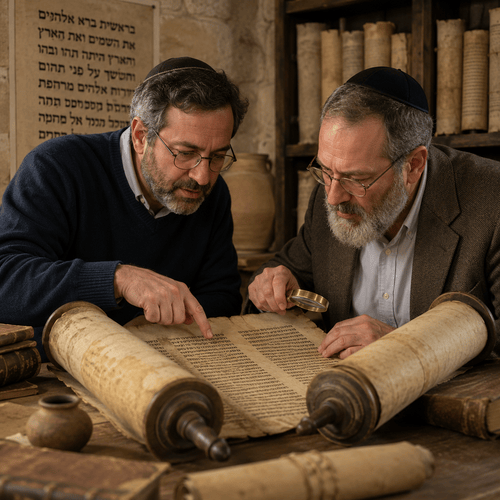
The Masoretic Text represents the standardised Hebrew Bible as preserved and transmitted by Jewish scholars known as the Masoretes—a word derived from the Hebrew masorah, meaning “tradition.” Working between roughly the 6th and 10th centuries AD, the Masoretes did far more than simply copy text. They developed an intricate system of vowel markings and cantillation signs (pronunciation guides) to safeguard the precise reading of Scripture for future generations. The underlying consonantal text they worked from, however, was considerably older, with roots stretching back to the period before Christ.
The Reformers—Luther, Calvin, and others—gave the Hebrew text renewed prominence. Rather than relying on the Latin Vulgate (Jerome’s 4th-century translation) or the Greek Septuagint, they insisted on ad fontes—returning to the sources. The Westminster Confession of Faith (1646) enshrined this principle, affirming the Old Testament in Hebrew is “immediately inspired by God, and by His singular care and providence kept pure in all ages” (WCF 1.8). Protestant translations have, therefore, historically treated the Masoretic Text as the primary Old Testament authority.
Key Differences Between The Mt And The Lxx
1. Differences in Canon: Which Books Are Scripture?
The most immediately visible difference concerns the scope of the Old Testament itself. The Masoretic Text contains the 39 books of the Hebrew Bible that Protestant Christians recognise today. The Septuagint includes additional books—works like Tobit, Judith, 1–4 Maccabees, the Wisdom of Solomon, Sirach (also called Ecclesiasticus), Baruch, the Letter of Jeremiah, and expanded versions of Daniel and Esther.
Protestant traditions classify these additional books as Apocrypha—writings worthy of reading but not authoritative Scripture. Roman Catholic and Eastern Orthodox traditions regard many of them as Deuterocanonical (meaning “second canon”), considering them fully part of Scripture. The Catholic Church formally affirmed their canonical status at the Council of Trent in 1546, in part as a response to the Protestant Reformation’s rejection of them.
The Reformers rejected the Apocryphal books on the grounds that they were never part of the Hebrew canon recognised by the Jewish community, a principle also articulated by Jerome himself, who distinguished between books suitable for edification and those authoritative for establishing doctrine.
2. Textual Differences: Windows Into the Ancient Text
Beyond the canon question, the MT and LXX sometimes diverge in the wording of specific passages. The differences matter enormously — not because they undermine Scripture’s reliability, but because they illuminate the history of the text and, in several cases, open up rich Christological and theological depth. Here are four examples that deserve far more attention than they typically receive.
Example 1: Deuteronomy 32:8—The Nations and the Sons of God
This may be the single most theologically significant textual difference in the entire Old Testament, yet it rarely appears in popular discussions.
- Masoretic Text: “He set the boundaries of the peoples according to the number of the sons of Israel”
- Septuagint: “He set the boundaries of the peoples according to the number of the angels of God.”
The MT’s reading—”sons of Israel”—suggests God divided the nations according to the 70 descendants of Jacob (Genesis 46). The LXX reads “angels of God” (some manuscripts say “sons of God”), which paints a vastly different picture: God assigning the nations of the world to the oversight of heavenly beings, while reserving Israel as His own special inheritance (Deuteronomy 32:9).
Crucially, this isn’t simply a Greek interpretive flourish. The Dead Sea Scrolls—ancient Hebrew manuscripts discovered near Qumran between 1947 and 1956, predating both the Masoretic standardisation and the LXX by centuries—preserve a Hebrew text of this verse that reads “sons of God” (bene elohim), not “sons of Israel.” This suggests the MT may reflect a later scribal revision, while the LXX preserves an older reading.
The theological stakes are high. The “sons of God” reading underlies the concept of the Divine Council—the heavenly court over which God presides as sovereign (see Psalm 82; Daniel 10:13–21). It provides the cosmic backdrop to Paul’s language about Christ’s supremacy over all “thrones, dominions, rulers, and authorities” (Colossians 1:16; Ephesians 1:21) and to the New Testament’s vision of the church as the reclaimed inheritance of all nations under one Lord.
Example 2: Amos 9:11–12—The Fallen Tent and the Gentile Mission
- Masoretic Text: “…that they may possess the remnant of Edom and all the nations who are called by my name.“
- Septuagint: “…that the remnant of mankind may seek the Lord, and all the Gentiles who are called by my name.“
At the Jerusalem Council in Acts 15, the apostle James cited this passage from Amos to justify the inclusion of Gentiles in the church without requiring circumcision—one of the most consequential decisions in church history. The text he quoted was the Septuagint version. The MT’s reading, “possess the remnant of Edom,” would have made his argument considerably less clear, since it speaks of conquest rather than seeking the Lord.
Some scholars argue the LXX here reflects a different (and perhaps older) Hebrew Vorlage—the underlying Hebrew text from which the translators worked—rather than being a free Greek paraphrase. Either way, the theological point is striking: the LXX reading opened the door, textually, for the Gentile mission, and James’ use of it at the Jerusalem Council shaped the entire trajectory of Gentile Christianity.
Example 3: Psalm 40:6—Ears Opened or a Body Prepared?
- Masoretic Text: “Sacrifice and offering you did not desire, but my ears you have opened [or ‘dug’]“
- Septuagint: “Sacrifice and offering you did not desire, but a body you have prepared for me.”
The author of Hebrews quotes this verse in Chapter 10, verses 5–7, applying it directly to the Incarnation: Christ coming in a prepared body to offer the one perfect sacrifice that animal offerings could only shadow. He quotes the Septuagint.
The MT’s phrase “ears you have opened” is a genuine Hebrew idiom for attentiveness and obedience —to have one’s ears opened is to be made ready to hear and do God’s will (compare Exodus 21:6; Isaiah 50:5). The Septuagint’s rendering, “a body you have prepared,” moves from the part (ears) to the whole (body), drawing out the implication: perfect obedience requires a perfect human instrument. This isn’t a mistranslation so much as a theologically perceptive rendering that the New Testament author recognised as pointing directly to the Incarnation.
Here the LXX does not contradict the Hebrew—it extends its logic toward its ultimate fulfilment in Christ.
Example 4: Isaiah 9:6—Where the MT Excels
Not every difference favours the LXX. This example runs in the opposite direction, and intellectual honesty requires saying so.
- Masoretic Text: “Wonderful Counsellor, Mighty God, Everlasting Father, Prince of Peace.”
- Septuagint: “Angel of Great Counsel” [collapsing all four titles into one].”
The MT’s fourfold title is theologically magnificent, carrying rich implications about Christ’s divine nature the church has long treasured. The LXX condenses all four titles into a single phrase, “Angel of Great Counsel”, thereby losing much of the Christological and Trinitarian resonance. This is a case where the Hebrew text preserves a fuller, more textured reading, and where the Reformers’ instinct to return to the Hebrew proves its worth.
The lesson isn’t that one text is always superior to the other. It’s that both traditions are ancient witnesses, each preserving readings of genuine value, and that reading them together—as scholars, translators, and pastors have done across the centuries—produces a richer understanding than either alone.
3. Differences in Chronology
The genealogies of Genesis 5 and 11 differ significantly between the MT and the LXX, producing substantially different biblical timelines. Using the MT numbers, Archbishop James Ussher famously calculated the Flood at approximately 2,348 BC. The LXX genealogies add roughly 1,300 extra years, placing it closer to 3,300 BC.
This affects the dating of Adam, Noah, the Flood, and the call of Abraham, and in turn shapes how the biblical timeline relates to archaeology and ancient history. Scholars continue to debate whether the MT or the LXX better preserves the original numbers, with some arguing the LXX’s longer figures better align with ancient Near Eastern historical records. This remains an open question.
Evaluating The Reliability Of Both Texts
Why Protestants Trust the Masoretic Text
The Masoretic Text represents the Hebrew Scriptures as preserved within the covenant community—the Jewish people to whom, as Paul writes, “were entrusted the oracles of God” (Romans 3:2). The Masoretes were extraordinarily careful scribes: they counted letters, tracked the middle word of each book, and developed elaborate checking systems to catch copying errors. The consistency of the MT across surviving manuscripts is remarkable.
The Reformers also observed the Jewish community never accepted the Apocryphal books as Scripture—a significant point for those who believed the Old Testament canon was entrusted to Israel. The Westminster Confession accordingly declares that the books of the Apocrypha, “not being of divine inspiration, are no part of the canon of the Scripture, and therefore are of no authority in the Church of God” (WCF 1.3).
The Septuagint as an Ancient Witness
Yet the LXX is far from irrelevant to Protestant theology. Its value lies in several areas. First, the New Testament authors cited it as Scripture — a fact that cannot simply be dismissed. Second, as we have seen, the Dead Sea Scrolls demonstrate some LXX readings reflect ancient Hebrew texts that predate the Masoretic standardisation. Third, the LXX provides an invaluable second witness: it agrees with the MT—which is the great majority of the time. The agreement of two independent traditions strengthens our confidence in the faithful transmission of God’s Word.
One significant complication is that the Septuagint isn’t a single, uniform text. It exists in multiple manuscript traditions with varying readings, which means it cannot always be cited as a single unified authority against the MT. The MT, by contrast, is highly standardised.
The Move Toward Hebrew Priority: A Gradual History
It is sometimes assumed that the early church always preferred the Hebrew text. The reality is more nuanced. The early church was predominantly Greek-speaking, and the LXX was simply the Scripture most Christians knew. Augustine, writing in the early 5th century, defended the authority of the LXX against Jerome, who had controversially chosen to translate his Latin Vulgate directly from the Hebrew rather than the Greek.
Jerome’s decision was itself a significant moment: it planted the seed for later Hebrew priority by insisting that the hebraica veritas—the Hebrew truth—was the authentic original. The Reformers built on this instinct. Luther, Calvin, and the translators of the major Protestant Bible versions turned to the Hebrew as the “original tongue” of the Old Testament, the text God had given to His covenant people and which the Jewish community had faithfully preserved.
This wasn’t a wholesale rejection of the LXX, but a principled decision about primary authority. Reformed theologians have always recognised the LXX’s value for textual criticism, translation history, and New Testament background—while maintaining that the Hebrew text is the foundational source for Old Testament doctrine.
Conclusion: So Which Do We Trust?
The Masoretic The and the Septuagint aren’t rivals to be played off against each other. They’re two ancient streams of a single river—the river of God’s revealed Word flowing through human history. Each tradition has distinctive strengths. The MT offers a meticulously preserved Hebrew text with extraordinary stability across centuries. The LXX provides earlier manuscript witnesses, highlights the theological vocabulary of the New Testament, and in certain passages preserves readings of demonstrable antiquity.
Where they agree—which is the great majority of the time, on every matter essential to Christian faith—their independent witness is a powerful testimony to the faithful transmission of Scripture. Where they differ, those differences invite us into deeper study rather than into doubt.
The Westminster Confession of Faith affirms that God, by His singular care and providence, has kept the Scriptures pure in all ages (WCF 1.8). The convergence of the MT and LXX on all essential doctrines—the nature of God, human sin, the Messianic hope, salvation, and resurrection—is itself evidence of that providential preservation. God worked through Jewish scholars in Alexandria and through Masoretic scribes in Tiberias alike, ensuring His revelation was not lost but faithfully handed on.
In an age of uncertainty, the two streams of ancient testimony aren’t a problem to be solved. They’re a gift to be received with gratitude.
Frequently Asked Questions
Why did early Jewish communities distance themselves from the Septuagint?
By the late 1st century AD, many Jewish leaders had grown wary of the LXX because Christians were using it extensively to demonstrate Jesus was the promised Messiah. As Jewish-Christian relations became increasingly strained following the destruction of the Temple in AD 70, the Jewish community turned decisively toward the standardised Hebrew text—the text that would become the Masoretic Text—as their authoritative Scripture, rejecting the Greek translation that had been embraced by the church. New Greek translations of the Old Testament, such as those by Aquila and Theodotion, were produced specifically for Jewish use as alternatives to the LXX.
Do the Dead Sea Scrolls support the MT or the LXX?
The Dead Sea Scrolls—discovered between 1947 and 1956 in the Judean desert—are a landmark in this discussion. They contain fragments of Old Testament books that predate both the Masoretic standardisation and the Septuagint translation. The picture they present is nuanced: some scrolls align closely with the MT, others align with the LXX, and some represent yet other textual traditions. This demonstrates that multiple Hebrew textual traditions coexisted in ancient Judaism before the Masoretes standardised one of them. Crucially, the Scrolls confirm that some LXX readings—such as the “sons of God” reading in Deuteronomy 32:8—reflect genuine ancient Hebrew texts, not Greek interpretive invention.
Why do Roman Catholic and Eastern Orthodox churches accept the Apocrypha?
Both traditions received the Septuagint as Scripture through the practice of the early church, particularly the Greek-speaking church of the first several centuries. The additional books in the LXX were read, quoted, and regarded as authoritative in many parts of the early church. The Roman Catholic Church formally defined these books as part of the biblical canon at the Council of Trent (1546), in direct response to the Protestant Reformation’s decision to follow the Hebrew canon. Eastern Orthodoxy has historically been somewhat less rigidly defined on this question, but similarly treats the deuterocanonical books as Scripture.
Does any major Christian doctrine depend exclusively on the LXX or the MT?
No major Christian doctrine stands or falls on a uniquely LXX or uniquely MT reading. The core doctrines of the faith—the Trinity, the Incarnation, human sinfulness, justification by grace through faith, the resurrection—are abundantly attested across both traditions. The textual differences we have explored are theologically enriching, not theologically destabilising. This is itself a testimony to God’s providence: the essential message of Scripture has been preserved across multiple textual streams.
What does the Westminster Confession of Faith say about the original language texts?
Westminster Confession of Faith 1.8 states that the Old Testament in Hebrew and the New Testament in Greek, “being immediately inspired by God, and by His singular care and providence kept pure in all ages, are therefore authentical.” This is why Reformed churches have historically treated the Masoretic Text as the primary Old Testament authority—not because the LXX lacks value, but because the Hebrew is the language in which God originally gave His Word to the covenant community of Israel. The Confession also affirms that this text is to be the final court of appeal in all religious controversies, though it recognises the church’s responsibility to make Scripture available in the common languages of the people.
Could modern scholars reconstruct the original Old Testament text?
Scholars practise what is known as textual criticism — the careful comparison of the MT, the LXX, the Dead Sea Scrolls, the Samaritan Pentateuch, and other ancient witnesses to identify the most likely original readings where texts differ. This discipline has greatly deepened our understanding of the Bible’s transmission history. However, no single manuscript perfectly preserves every original word in its original form. What is remarkable—and what should strengthen our confidence—is the extraordinary degree of consistency across these ancient witnesses on every matter of doctrinal substance.