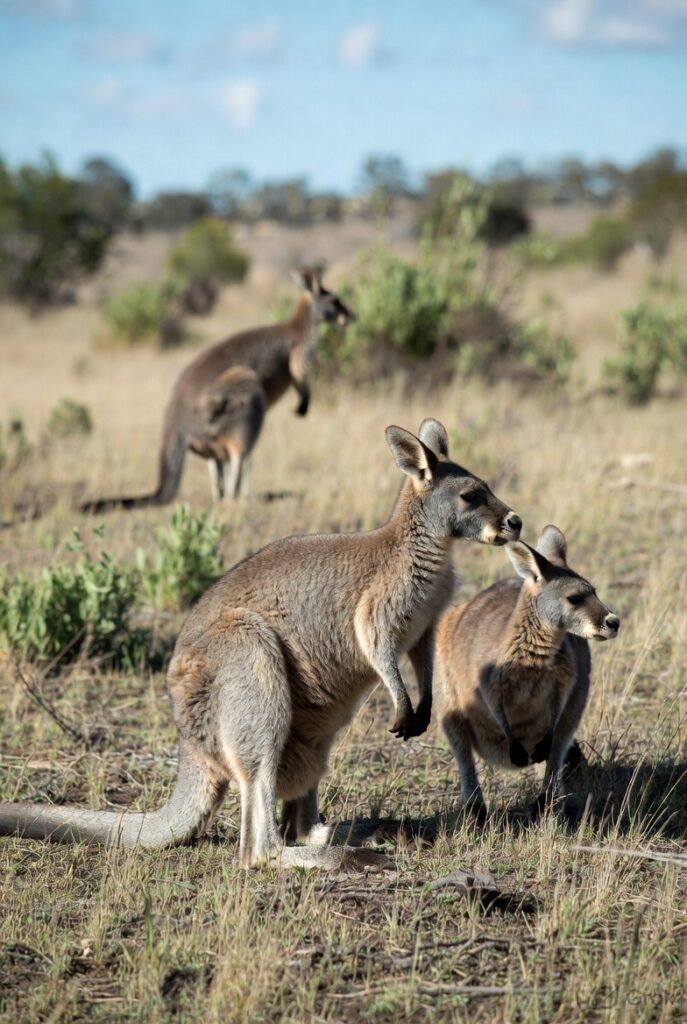
Picture the first kangaroo ‘couple’, hopping off Noah’s Ark somewhere in the mountains of Ararat, thousands of kilometres from Australia. No bridges. No boats. Just water in every direction. How did it ever get home?
This is one of the most popular questions people ask about the Genesis Flood. If every land animal outside the Ark died in the Flood, every land animal alive today must trace back to the pairs that walked down the gangplank near Ararat. So how do we explain koalas in Australia, sloths in South America, lemurs found only on Madagascar, and penguins in Antarctica?
It’s also a question with a long history. Christian thinkers have wrestled with it for centuries, long before modern biology existed. And their answers still hold up remarkably well today. Let’s work through this carefully, one step at a time, being honest about both the strong points and the genuine difficulties along the way.
Getting the Question Right
Before answering, it helps to state the problem honestly. A weak version of this objection is easy to wave away. But it’s not what thoughtful sceptics are really asking.
They’re not simply asking, could an animal cross an ocean? They’re asking something sharper: why does each landmass have its own unique set of animals, found nowhere else along the supposed route from Ararat? If every creature had marched out from one starting point, we might expect a trail of related species scattered along the way. Instead, we find endemism, species found in one place and nowhere else in the world. Australia is dominated by marsupials, pouched mammals like kangaroos and koalas. Madagascar has lemurs and little else quite like them anywhere nearby.
That’s the real puzzle. A good answer has to explain not just how animals could travel, but why they ended up sorted the way they are. It’s worth saying plainly, at the outset, that this is a genuinely hard question for anyone who holds to a single, worldwide Flood a few thousand years ago. A thoughtful answer should feel like careful reasoning through real difficulty, not a magic trick that makes the problem vanish.
What the Bible Actually Requires
Genesis 7:15 tells us exactly what boarded the Ark: “They went into the ark with Noah, two and two of all flesh in which there was the breath of life.”
Two limits matter here, and both are easy to miss on a casual reading.
- First, only air-breathing land creatures needed a place on board. Fish, and most sea creatures, could simply survive in the floodwaters themselves. That alone removes a large share of the how-did-it-get-everywhere problem, since marine and many aquatic species never needed to disperse from Ararat at all.
- Second, the Ark carried kinds, not species. Genesis 6:20 specifies animals coming according to their kinds, from the Hebrew word min. A kind is best understood as something like a broad family grouping, closer to cat family or dog family than to Siberian tiger or chihuahua. This matters enormously for the dispersal question, as we will see in a moment.
| ON THE ARK | NOT NEEDED ON THE ARK |
|---|---|
| Air-breathing land animals, as representative kinds rather than every species | Fish and most sea creatures |
| Birds | Amphibians, on some readings |
| Land-dwelling creeping things | Most invertebrates |
This distinction between kind and species isn’t a modern workaround invented to solve a modern problem. It reflects how the original Hebrew text actually categorises the created order, grouping living things by broad family resemblance rather than by the fine-grained taxonomy modern biology uses.
After the floodwaters receded, God repeated the original creation mandate to these survivors: “Bring out with you every living thing that is with you of all flesh, that they may swarm on the earth and be fruitful and multiply on the earth.” Repopulating the earth wasn’t left to chance. It was a purposeful, commissioned filling, carried out, as we will see, through perfectly ordinary means.
Four Ways Animals Could Have Travelled
Once we understand that only representative kinds needed to disperse, not every species we see today, the dispersal problem becomes far more manageable. None of these four mechanisms needs to work alone. Most researchers propose the four mechanisms may even have worked together, in different combinations for different animals, over a period of some centuries after the floodwaters finally receded. Here are the four main mechanisms proposed, each grounded in ordinary processes we can still observe at work in the world today.
- Kinds Diversified Rapidly After the Flood The Ark didn’t need to carry a separate pair for lions, tigers, leopards, and every wildcat, just a pair, or a few, representing the cat kind. Once released into new environments, isolated populations diversified quickly through entirely ordinary processes: genetic variation already present in the founding pair, natural selection suited to new climates, and populations simply splitting apart over generations. This isn’t the same as molecules-to-man evolution, which requires brand new genetic information appearing across kind boundaries. It’s rapid diversification within a kind, and biologists observe this happening on remarkably short timescales even today, in Galapagos finches and African cichlid fish.
- A Single Post-Flood Ice Age Created Land Bridges Many researchers propose the Flood itself triggered a single Ice Age. Warm post-Flood oceans would have driven heavy evaporation, whilst volcanic ash in the atmosphere cooled the continents, a combination that produces rapid snow and ice build-up. As that ice locked up ocean water, sea levels dropped, exposing land bridges: a strip connecting Asia to North America, and shrunken sea gaps toward Australia and New Guinea. Animals could walk most of the way, needing to swim or raft only short remaining stretches. When the ice later melted, rising seas cut these routes off again, permanently stranding the animals that had already crossed.
- Floating Vegetation Carried Animals Across Open Water This sounds unlikely until you learn it happens regularly today. Storms tear loose huge floating mats of vegetation, logs, root balls, and tangled plant matter, and these rafts drift across open sea carrying small animals with them. Scientists have documented iguanas surviving exactly this kind of journey between Caribbean islands after a hurricane. Reptiles and small mammals cope with this well because they need little food or water for days at a time, which fits a noticeable pattern: remote islands tend to have plenty of reptiles but comparatively few large mammals.
- People Carried Animals With Them After Babel, as families and tribes dispersed across the earth, they took livestock, working animals, and companion animals with them. This accounts for a further slice of the puzzle, particularly for domesticated and semi-domesticated species that show up in places their wild relatives never could have reached alone.
| MECHANISM | HOW IT WORKS | BEST EVIDENCE FOR IT |
|---|---|---|
| Rapid diversification within kinds | Founding pairs split into new populations, adapting to new environments | Observed rapid speciation today, such as finches and cichlids |
| Ice Age land bridges | Lower sea levels exposed walkable routes between continents | Sea levels documented from past ice ages are low enough to have exposed the Beringia land bridge and similar shelf routes. |
| Rafting on vegetation mats | Storms create floating islands that drift across open sea | Documented iguana rafting between Caribbean islands |
| Human transport | Post-Babel migration carried animals along with people | Long, well-documented history of livestock and companion-animal migration |
The Australia Puzzle: What About Marsupials?
Australia is the hardest case, so it deserves special attention.
Here’s a fact that surprises most people: marsupials weren’t always confined to Australia. Fossil marsupials have been found across South America, North America, Europe, Africa, Asia, and even Antarctica. Living marsupials, like the opossum, are still found throughout the Americas today. This tells us marsupials likely had a much wider range in the past, and later survived mainly where they faced less competition from other mammals. Australia’s isolation may have provided exactly that kind of shelter.
This is a genuine strength. We don’t need an unbroken chain of marsupial fossils from Ararat to Australia. Extinction along the way, combined with survival in a sheltered refuge, is a perfectly ordinary biological pattern, one seen in many other animal groups too.
It’s worth being equally honest about the limits of this answer. The tidy correlation between marsupial fossils and the southern continents is also explained elegantly by slow continental drift over deep time.
Not Whether, But When: A Fair Fight
Here’s something rarely mentioned in these debates: the dispersal mechanisms above aren’t creationist inventions. Mainstream biology uses every one of them.
Secular biologist George Gaylord Simpson coined the term sweepstakes dispersal specifically to describe the improbable ocean crossings needed to explain, for instance, monkeys and rodents reaching South America, or lemurs reaching Madagascar. Land-bridge migration across the Bering Strait region is standard material in any introductory biology textbook.
So the real disagreement is not can rafting or land bridges actually work. Both sides agree they can. The real disagreement is about timescale and starting point, how much time was available, and where the migration began. That’s a fairer and more accurate way to frame the debate than pretending the mechanisms themselves are far-fetched.
WHAT AUGUSTINE AND CALVIN SAID
This question is far from new. Writing in the fifth century, theologian Augustine of Hippo directly asked how animals reached remote islands after the Flood, suggesting they swam, were carried by people, or were perhaps providentially placed there. A thousand years later, Reformation-era commentator John Calvin treated the Flood as real history whilst noting that Moses often describes things as they would have appeared to an ordinary observer, rather than offering a scientific manual. Both men modelled a posture worth imitating today: take the text seriously as history, then reason carefully and humbly about the mechanics.
God’s Providence in the Filling of the Earth
Behind every mechanism above sits a bigger truth. The same God who commanded the animals to swarm on the earth and be fruitful and multiply is the God who providentially governed how that happened. Land bridges, ocean currents, climate shifts, and animal instinct aren’t gaps that need a miracle stitched in. They’re the ordinary means through which God’s extraordinary purpose was carried out.
This fits the wider shape of the covenant God made with Noah: God promises seedtime and harvest, cold and heat, summer and winter, shall not cease while the earth remains. The very climate systems that drove post-Flood dispersal, the ice, the shifting sea levels, the ocean currents, are covered by that same covenant faithfulness. This is common grace in action: God sustaining the ordinary rhythms of the world for every creature, believer and unbeliever alike, long after the immediate crisis of judgement had passed.
Scripture doesn’t answer every mechanical question about how the animals got where they are today, but it doesn’t need to. It gives us the history and the purpose. Careful, humble reasoning fills in plausible means, always held with appropriate confidence rather than false certainty. Where the text is silent, we should hold our models loosely, resisting both the temptation to ignore hard evidence and the temptation to let current scientific fashion overrule what Scripture actually says.
So, how did that first kangaroo get home? Most likely through some combination of rapid diversification within its kind, an Ice Age land bridge stretching toward Southeast Asia, and short island-hopping crossings on floating debris, all governed by the same providence that filled the earth in the first place. The question turns out to have a coherent, historically grounded answer. It just takes patience to work through it properly, rather than expecting a single one-line reply.
Tough Questions, Honest Answers
Did every single species fit on the Ark?
No, and this is a common misunderstanding. Genesis 6:20 specifies kinds, a broader category roughly like a family grouping. The Ark needed to carry only representative kinds, not every species alive today.
How did freshwater fish survive a flood of seawater mixed with rain?
Many freshwater species tolerate a range of salinity, and floodwaters would have varied in salinity by location and depth rather than being uniformly oceanic. Some freshwater fish simply did not survive everywhere, which is consistent with today’s uneven freshwater fish distribution.
Why are there no fossils showing the migration route from Ararat?
Fossilisation requires rapid burial under specific conditions, which migration corridors rarely provide. The absence of route fossils is weak evidence either way, since it’s exactly what we would expect regardless of which model is correct.
Doesn’t continental drift explain marsupial distribution better than migration?
It offers a tidy explanation over deep time, and that is a fair point in its favour. The migration model has to work harder to compress the same pattern into a shorter, post-Flood timeframe, a real tension worth acknowledging honestly rather than dismissing.
Was the Flood global or limited to a region?
Faithful readers of Scripture differ on this question. Most historic interpreters have read Genesis 6 to 9 as describing a global Flood, though a substantial minority reads the all-the-earth language as describing the whole inhabited world known to Noah, a phrase that in Hebrew usage can carry either sense depending on context. The dispersal question addressed in this article is sharper, and more pressing, under a global reading than under a regional one.
How long did it take animals to repopulate the earth?
The Bible doesn’t give a timetable. Proposed models generally work within the centuries between the Flood and the beginnings of recorded ancient history, using the post-Flood Ice Age as the key window for major land-bridge migrations.
Isn’t rafting across oceans just too unlikely to explain everything?
It doesn’t need to explain everything on its own, it’s one of four mechanisms working together. And it’s not a fringe idea: secular biologists use the same explanation, under the name sweepstakes dispersal, for many of the same puzzling animal distributions.