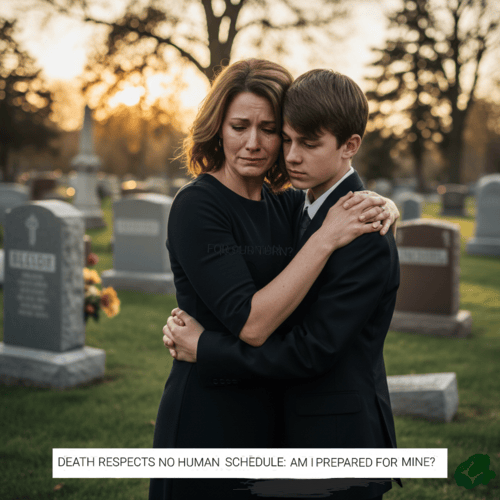
Six months after her husband died, a widow wakes in the night. She is sure she can smell his aftershave. A few weeks later she catches a glimpse of him in his armchair, just for a moment. A friend tells her about a medium in town who ‘brings messages from the other side’. Should she go?
Stories like hers are very common. In a 2023 survey by the Pew Research Center, about half of American adults said a dead relative had contacted them, often in a dream. In many parts of the world, from India to China to Mexico, families offer food to the spirits of their ancestors, light lamps for them, or ask them for help. Ghost-hunting shows fill hours of television.
So can the dead contact the living? Do our loved ones visit us? And if they don’t, what are people experiencing? Let’s see what the Bible says, what it forbids, and the far better comfort it offers to those who grieve.
THE SHORT ANSWER
No. The Bible teaches that the dead do not return to visit, haunt or send messages to the living. At death, the soul goes either to be with Christ or to judgement, and there is no road back.
God himself can send someone from the dead for his own purposes, as at the Transfiguration. But humans can never summon the dead, and God strictly forbids trying.
KEY WORDS EXPLAINED
- Medium: someone who claims to pass on messages from the spirits of the dead.
- Necromancy: trying to contact the dead, especially to learn the future.
- Spiritualism: a religious movement that began in America in 1848 and teaches that the living can talk with the dead.
- Intermediate state: the time between a person’s death and the resurrection of the body at Jesus’ return.
Where Do the Dead Go?
To answer whether the dead can visit us, we first have to ask where they are. The Bible’s answer is clear and short.
- Believers go to be with Christ. Paul said he would rather be “away from the body and at home with the Lord” (2 Corinthians 5:8), and that to depart and be with Christ “is far better” (Philippians 1:23).
- Unbelievers go to judgement. “It is appointed for man to die once, and after that comes judgement” (Hebrews 9:27).
- There is no third place for wandering souls. The Bible never describes the dead drifting around houses, battlefields or graveyards.
The Westminster Confession of Faith (1646) sums it up. The souls of the righteous are received into heaven, and the souls of the wicked are cast into hell. Then it adds: ‘Besides these two places, for souls separated from their bodies, the Scripture acknowledgeth none.’
That one sentence rules out ghosts in the popular sense: restless spirits with ‘unfinished business’, stuck between this world and the next.
No Way Back
The Bible also says plainly that the dead do not come back to visit. When King David’s baby son died, he stopped fasting and said:
‘But now he is dead. Why should I fast? Can I bring him back again? I shall go to him, but he will not return to me.’
2 Samuel 12:23
Job said the same thing: ‘he who goes down to Sheol does not come up; he returns no more to his house’ (Job 7:9–10).
Jesus made the point most strongly. In his story of the rich man and Lazarus, the rich man in torment begs Abraham to send Lazarus back to warn his five brothers. Abraham refuses. There is ‘a great chasm’ fixed between the dead and the living, and ‘none may cross’ (Luke 16:26). Then comes the final line: ‘If they do not hear Moses and the Prophets, neither will they be convinced if someone should rise from the dead’ (Luke 16:31).
Notice two things. The dead could not cross back on their own. And God’s chosen way of speaking to the living is his Word, not messages from beyond the grave. We look at the related question of near-death experiences in Do Near-Death Experiences Prove Heaven? Habermas and the Bible.
What God Forbids, and Why
Ancient Israel was surrounded by nations that tried to talk with the dead. God’s command to his people was blunt:
‘There shall not be found among you anyone who … practises divination or tells fortunes or interprets omens, or a sorcerer or a charmer or a medium or a necromancer or one who inquires of the dead, for whoever does these things is an abomination to the LORD.’
Deuteronomy 18:10–12
What the Bible forbids: contacting the dead and the spirit world
| Practice | What it is | What Scripture says |
|---|---|---|
| Consulting a medium | Paying or asking someone to pass on messages from the dead | “Do not turn to mediums or necromancers; do not seek them out” (Leviticus 19:31). |
| Necromancy | Calling up the dead to ask about the future | “Should they inquire of the dead on behalf of the living?” (Isaiah 8:19). |
| Divination and fortune-telling | Seeking secret knowledge through spirits, signs or objects | Paul cast out a “spirit of divination” from a fortune-telling slave girl (Acts 16:16–18). |
| Sorcery | Using spiritual powers to control people or events | Listed among “the works of the flesh” (Galatians 5:19–21). |
| Ancestor worship | Praying to, feeding or seeking blessings from dead ancestors | God alone is to be worshipped and prayed to (Exodus 20:3; Matthew 4:10). |
Why is God so strict? Isaiah gives the answer:
‘And when they say to you, “Inquire of the mediums and the necromancers who chirp and mutter,” should not a people inquire of their God? Should they inquire of the dead on behalf of the living? To the teaching and to the testimony!’
Isaiah 8:19–20
Turning to the dead is turning away from the living God. It treats God’s Word as not enough. And, as we’ll see, it opens a door to deception.
Didn’t Samuel Come Back?
The most famous exception is King Saul’s visit to a medium at Endor (1 Samuel 28). Saul had already rejected God, and God had stopped answering him. So in desperation he asked a medium to bring up the prophet Samuel.
What happened next shocked even the medium. When Samuel appeared, ‘she cried out with a loud voice’ (1 Samuel 28:12). This was clearly not what usually happened at her séances. God himself stepped in, and the message Samuel brought was not comfort but judgement: Saul and his sons would die the next day. The Bible’s final verdict is stern:
‘So Saul died for his breach of faith. He broke faith with the LORD in that he did not keep the command of the LORD, and also consulted a medium, seeking guidance.’
1 Chronicles 10:13
Far from encouraging us to contact the dead, the Endor story is a warning. We look at it in detail in Did the Witch of Endor Actually Raise Samuel from the Dead?
When the dead appeared in the Bible: who was in charge?
| Event | Who brought it about | What it teaches |
|---|---|---|
| Samuel at Endor (1 Samuel 28) | God, overriding a forbidden séance | Seeking the dead brings judgement, not comfort. |
| Moses and Elijah at the Transfiguration (Matthew 17:1–8) | God, to honour his Son | The Law and the Prophets point to Jesus. “Listen to him.” |
| Saints raised at Jesus’ death (Matthew 27:52–53) | God, at the cross and resurrection | Jesus’ victory over death is real. |
| The rich man’s request (Luke 16:27–31) | Refused | God’s Word is enough; the dead do not return to warn us. |
In every case, God is in control. No human ever successfully calls up the dead by their own power, and no one in the Bible is commended for trying.
Even the Disciples Thought They Saw a Ghost
Belief in ghosts isn’t new. When the disciples saw Jesus walking on the sea, ‘they were terrified, and said, “It is a ghost!”’ (Matthew 14:26). And when the risen Jesus appeared to them, ‘they were startled and frightened and thought they saw a spirit’ (Luke 24:37).
Jesus’ answer is worth hearing:
‘See my hands and my feet, that it is I myself. Touch me, and see. For a spirit does not have flesh and bones as you see that I have.’
Luke 24:39
Then he ate a piece of fish in front of them. Jesus was not a ghost, a vision or a spirit-message. He was risen in body. The Christian hope is not that the dead will hover near us as spirits, but that they will one day be raised.
So What Are People Experiencing?
If the dead don’t visit, what do people see, hear and feel? We should be careful and kind here. Many people who report these things are honest and grieving. The Bible and careful research point to several explanations.
| Explanation | What it explains | What to remember |
|---|---|---|
| Grief | Sensing a loved one’s presence, hearing their voice, glimpsing them in a familiar chair | Very common and not a sign of madness. A 1971 study in the British Medical Journal found nearly half of widowed people in Wales had sensed or seen their dead spouse. |
| Dreams | Vivid dreams in which the dead speak or seem at peace | Dreams can comfort, but they are not messages from heaven. Test everything by Scripture. |
| Suggestion and the ideomotor effect | Ouija boards that “spell” words, creaks and shadows in a “haunted” house | Our muscles can move without our knowing it, and fear makes us see patterns. |
| Fraud | Mediums who seem to know private details | Spiritualism began in 1848 with the Fox sisters. In 1888 Margaret Fox admitted they had made the “spirit rappings” by cracking their toe joints. Magician Harry Houdini later exposed many mediums. |
| Deceiving spirits | Experiences that draw people away from God and his Word | “Even Satan disguises himself as an angel of light” (2 Corinthians 11:14). |
That last explanation matters most. Paul warned that ‘some will depart from the faith by devoting themselves to deceitful spirits and teachings of demons’ (1 Timothy 4:1). If a spirit pretends to be your grandmother and tells you there’s no judgement, no need for Jesus and nothing to fear, it isn’t your grandmother. And it isn’t your friend.
WHAT ABOUT OUIJA BOARDS AND GHOST HUNTING?
The Ouija board was sold as a harmless parlour game from 1890. Ghost-hunting shows are presented as entertainment. But both are built on the idea that we can and should contact the dead.
A Christian has no need to play with something God calls an abomination (Deuteronomy 18:12). Treat it the way Paul’s converts in Ephesus treated their magic books: they burned them (Acts 19:19).
If you’ve used them in the past, there’s no need to panic. Confess it to God, get rid of them, and rest in Christ, who has “disarmed the rulers and authorities” (Colossians 2:15).
Can Our Loved Ones in Heaven See Us?
This is a gentler question, and the Bible says less than we’d like. Hebrews 12:1 speaks of ‘so great a cloud of witnesses’, but in context these are the Old Testament believers whose faithful lives witness to us, not spectators watching us from above. The souls under the altar in Revelation 6:9–10 know that injustice continues on earth, but we’re not told they watch our daily lives.
What we do know is enough. Our loved ones in Christ are ‘at home with the Lord’. They are not anxious, not lost and not trying to reach us. We explore this further in Life After Death: Can Our Deceased Loved Ones See Us Now?
IF YOU HAVE SENSED A LOVED ONE SINCE THEY DIED
You are not going mad, and you are not alone. Grief affects the body and mind in powerful ways.
- Thank God for the love that makes you miss them so much.
- Don’t seek out more experiences or go to a medium. Bring your grief to God instead (Psalm 62:8).
- Talk to your pastor or a trusted Christian friend. Grief is meant to be carried together (Galatians 6:2).
- Hold on to the promise: believers who die are with Christ, and you will see them again at the resurrection.
Better Than a Message from the Dead
People go to mediums because they want three things: to know their loved one is all right, to hear from them, and to know they’ll meet again. The gospel gives all three, and gives them for certain.
- To know they are all right: Those who die in Christ are “with Christ”, which is “far better” (Philippians 1:23).
- To hear from them: We don’t need a new message. God has already spoken about them in his Word, and their faith still speaks to us (Hebrews 11:4).
- To meet again: “For since we believe that Jesus died and rose again, even so, through Jesus, God will bring with him those who have fallen asleep” (1 Thessalonians 4:14).
Paul wrote those words so that Christians would ‘not grieve as others do who have no hope’ (1 Thessalonians 4:13). Notice that he doesn’t say we won’t grieve. We do. But our grief has a horizon.
One man did come back from the dead to speak to the living. Jesus said, ‘I died, and behold I am alive forevermore, and I have the keys of Death and Hades’ (Revelation 1:18). He doesn’t whisper through a medium. He speaks plainly in his Word, and he holds the keys. If you want to know what lies beyond death, don’t ask the dead. Ask the one who conquered it.
Tough Questions, Honest Answers
Are ghosts real?
Not in the popular sense of dead people wandering the earth. The Bible teaches that the dead go either to be with Christ or to judgement, and it knows of no third place (Hebrews 9:27; Luke 16:26). Many ‘ghost’ experiences have natural causes such as grief, fear or fraud. Some may involve evil spirits, which the Bible says are real and deceptive (2 Corinthians 11:14).
Is it a sin to watch ghost-hunting shows or horror films?
The Bible gives no list of films. But it calls us to fill our minds with what is true and pure (Philippians 4:8), and to have nothing to do with contacting the dead (Deuteronomy 18:10–12). Ask what a programme is teaching you to believe and to want. If it makes contacting spirits look exciting or harmless, it’s wise to switch it off.
Is it wrong to talk to a loved one at their grave?
Speaking out loud in grief is natural, and it isn’t the same as consulting the dead. The danger comes when we expect them to hear, answer or help us. Then it becomes prayer to the dead, which belongs to God alone. Bring the words you want to say to God, who hears every prayer (Psalm 65:2).
Should Christians pray for the dead?
No. Scripture gives no command or example of praying for people after they die. Their eternal state is settled at death (Hebrews 9:27). We pray for the living, and we thank God for those who died in faith. See Prayers for the Dead: Does God Require It?
What should I do if my house feels haunted?
Stay calm and don’t try to make contact. Check first for ordinary causes: noises, draughts, stress, lack of sleep. Then pray in the name of Jesus, read Scripture in your home, and remove anything connected with the occult (Acts 19:19). Ask your pastor and church elders to pray with you. Christ has authority over every spirit (Colossians 2:15).
Can the dead appear to us in dreams?
God sometimes spoke through dreams in the Bible, but there’s no record of him sending the dead to speak in them. Dreams of loved ones are a normal part of grief, and they can be a comfort. But we never take guidance or new teaching from them. Test every message by God’s Word (Isaiah 8:20).
Are ancestor rituals and death anniversary rites wrong for Christians?
Remembering and honouring our parents and grandparents is good and biblical (Exodus 20:12). Gathering as a family, giving thanks to God and sharing memories is fine. What Christians cannot do is pray to the dead, offer them food or sacrifices, or ask them for blessing or protection. That is worship, and worship belongs to God alone (Matthew 4:10).
Related Reads
- Do Near-Death Experiences Prove Heaven? Habermas and the Bible
- Did the Witch of Endor Actually Raise Samuel from the Dead?
- Life After Death: Can Our Deceased Loved Ones See Us Now?
- What Happens to Our Souls When We Die?
- Why Is the Bible Silent About the Intermediate State?
- What Does Sheol Mean? Hell, Grave, Or Something Else?
- Prayers for the Dead: Does God Require It?
- Are Occult Symbols in Video Games a Doorway for Spiritual Attack?
- Curses, Hexes and Black Magic: Can These Impact the Christian?