Scroll for long enough on any social platform and you’ll likely meet someone telling you their words changed their life. They call it manifestation, and they mean it in a very literal way: my life is going the way it’s going because of what I’ve been saying. Give it long enough, and you’ll meet the same idea again—this time inside a church group, a prayer app, or a Christian influencer’s page. Inst&ead of “manifest,” they’ll say “decree.” Instead of “the universe delivers,” they’ll say “God releases it.” Instead of a vision board, you get a declarations journal.
Same engine. Different fuel label.
This piece asks a simple question and answers it without flinching: when a Christian “decrees and declares” an outcome into being, is that spiritual warfare—the real, Ephesians‑6 kind—or is it a marketing technique wearing a warfare costume? We’ll define our terms carefully, walk through the biblical case, and finish with seven honest questions people actually ask.
What “manifestation” actually means
Manifestation is the belief that focused thought and spoken words have creative power: that saying something with enough conviction helps make it real. It usually comes with a technique:
- The 369 method—writing your wish three times in the morning, six times at midday, nine times at night.
- Scripting—writing your future as if it has already happened (“I am so grateful I got the promotion”).
- Lucky girl syndrome—repeating “everything always works out for me” until you start noticing (or attracting) evidence that it’s true.
These all descend from an older idea called the law of attraction: like attracts like, so positive thoughts attract positive circumstances. That idea itself descends from a 19th-century American religious movement called New Thought, which taught that mind is the deepest reality and that a person’s thinking can reshape their circumstances, health, and finances. New Thought writers such as Phineas Quimby and Ralph Waldo Trine fed directly into 20th-century self-help (Napoleon Hill’s Think and Grow Rich, Norman Vincent Peale’s The Power of Positive Thinking) and, in 2006, into Rhonda Byrne’s bestseller The Secret—which is where most people encountered this idea for the first time.
The Christian version, in its own words
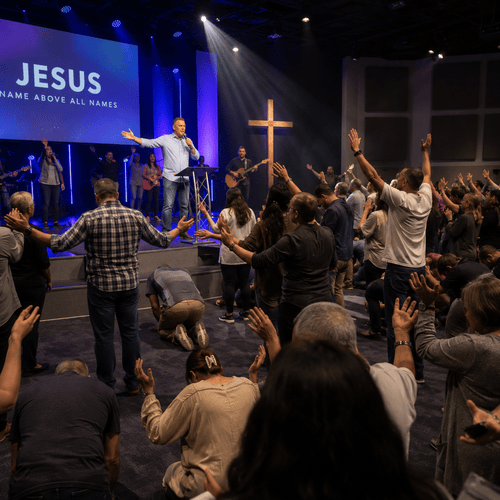
Here’s the part that matters for us. This same idea has a fluent Christian dialect, and it markets itself as spiritual warfare rather than self-help. You’ll recognise the vocabulary:
| SECULAR MANIFESTATION | CHRISTIAN EQUIVALENT |
|---|---|
| Manifesting, the law of attraction | Decreeing and declaring |
| Affirmation | Positive confession |
| Scripting your future | “Calling things that are not as though they were” |
| Vision board | Prophetic declarations list |
| “The universe delivers” | “Heaven backs up your words” |
| Vibration, energy | Anointing, atmosphere |
The theological name for this dialect is the Word of Faith movement. Its key figures are traceable: EW Kenyon absorbed New Thought ideas about the creative power of belief and re-expressed them in Bible language in the early 20th century. Kenneth Hagin then popularised Kenyon’s teaching through the phrase “what I confess, I possess” and the memorable line “faith in your faith.” From there it fed into the prosperity preaching of men like Kenneth Copeland and Creflo Dollar, and into the wider “decree and declare” culture now common in charismatic and New Apostolic circles.
The claims made for this practice aren’t modest. Believers are taught decreeing “activates spiritual forces,” “releases God’s power,” and “commands the atmosphere”. They’re told a spoken sentence, given in faith, is itself a weapon in spiritual combat. Some decrees promise “aristocratic privileges,” “kingdom millionaire” status, and cancelled debts. This is worth pausing on: the promises are almost identical to secular manifestation’s promises of money, romance, and luck—only the brand name has changed.
Why this isn’t spiritual warfare—the case, point by point
- Creating with a word is God’s job description, not ours Genesis 1 opens with God saying “Let there be light”—and there was light. This isn’t a technique God used and then handed down to us; it’s the defining act that separates Creator from creature. Scripture keeps this distinction sharp: God is the one who “calls into existence the things that do not exist” (Romans 4:17), and “by the word of the Lord the heavens were made” (Psalm 33:6). When a human being claims that same creative authority for their own sentences, they’re reaching for something Scripture reserves for God alone—which is exactly the original temptation in Eden: “you will be like God” (Genesis 3:5).
- It reverses the direction prayer is supposed to flow Real prayer asks; it doesn’t instruct. Jesus modelled this at the most painful moment of His life: “not as I will, but as you will” (Matthew 26:39). James is blunt about the alternative: making confident plans and declarations without reference to God’s will is “boasting in your arrogance” (James 4:13‑16). The correct posture instead is “if the Lord wills.” A decree culture quietly flips this: instead of the creature submitting a request to the Sovereign, the creature issues an instruction and expects heaven to comply.
- It moves the power from God’s word into ours This is the theological fingerprint of the whole movement, and Hagin said it out loud: “faith in your faith.” As per the Bible, the power is entirely in God—His character, His promises, His will. In manifestation religion, whichever costume it’s wearing, the power sits in the strength of human belief and the precision of human wording. That’s a different god running a different universe.
- It can’t explain the cross A theology built on guaranteed decrees has no room for Job, no room for Paul’s “thorn in the flesh” that God refused to remove after three direct requests (2 Corinthians 12:7‑9), no room for a Saviour who was crucified in weakness before He was raised in power. Scripture’s pattern is glory through suffering, not glory instead of suffering (Romans 8:17). A gospel that promises no lack, no delay, and no “no” from God has, without quite noticing, deleted the cross from the centre of the story.
- It’s unfalsifiable in a way that should worry us If the decree “works,” the method gets the credit. If it doesn’t, the explanation is always personal: you don’t have enough faith, you have hidden doubt, or “you spoke death over yourself.” Notice this is the same trap critics have spotted in lucky girl syndrome: when it fails, the method is never blamed—you are. Notice the pattern. The claim can’t be tested, the fault always lands on the believer, and the demands only grow. That pattern belongs to a sales technique, not a theology.
One test question
Ask any decree or manifestation claim this: “What observation would prove this false?” If there isn’t one—if every failure gets absorbed as ‘not enough faith’ or ‘wrong vibration’—you’re not looking at a doctrine. You’re looking at a sales technique with a built-in excuse clause.
What Ephesians 6 actually says warfare looks like
This matters because “spiritual warfare” is precisely the passage decree teaching likes to borrow from. And it says something almost opposite.
| DECREE / MANIFESTATION CULTURE | EPHESIANS 6:10‑18 |
|---|---|
| Posture: command your circumstances | Posture: “stand firm”—hold your ground |
| Weapon: your spoken decree | Weapon: “the sword of the Spirit, which is the word of God”—His word, not ours |
| Goal: change your outcome | Goal: resist, don’t be moved |
| Offensive action: declare it done | Offensive action: prayer and supplication—asking God |
Even 2 Corinthians 10:3‑5, a favourite proof-text for decree culture, is about demolishing “arguments and every lofty opinion raised against the knowledge of God”—that is, false ideas. Read carefully, manifestation theology is itself one of those “lofty opinions.” Real spiritual warfare would take aim at the lie, not borrow its logic.
The verses people quote—and what they’re actually doing
| VERSE QUOTED | WHAT IT’S USED TO PROVE | WHAT IT ACTUALLY SAYS |
|---|---|---|
| Proverbs 18:21 | Words create outcomes | A wisdom saying about how speech wounds or blesses relationships — not a law of physics |
| Mark 11:23 | You can speak to your “mountain” | Faith directed at God, immediately defined in the next verse as prayer (v.24) |
| Isaiah 55:11 | Our words never return empty | God’s own word from God’s own mouth—the passage’s entire point is that this is uniquely His |
| Romans 4:17 | We can call things that aren’t as though they were | Describes God’s action; Abraham’s part is simply to believe Him |
| Job 22:28 | You can decree a thing and it is established | Spoken by Eliphaz, whom God directly rebukes for wrong speech about Him (Job 42:7) |
Lifting a phrase out of its sentence and building a technique on it is how a Bible verse becomes a spell. Reading the whole paragraph is usually enough to see the difference.
Warfare or marketing? Follow the fruit—and the invoice
Genuine warfare, biblically defined, is costly, God-dependent, and often looks like losing before it looks like winning. Set that beside what decree culture actually offers:
- A product line. Courses with titles like “Spiritual Warfare 101,” downloadable decree PDFs, five-month declaration devotionals, conference tickets.
- A guaranteed value proposition. Health, wealth, promotion, and favour, delivered by a repeatable formula—precisely the structure of a self-help programme.
- Escalating aspiration. “Kingdom millionaire,” “aristocratic privileges”—lifestyle branding aimed at people already sitting in church pews.
- Built-in repeat business. Every failed decree is solved by more decreeing, more conferences, more books—never by the method being wrong.
Even commentators outside the church already describe secular manifestation trends as “repackaged” older ideas dressed in new hashtags. The Christian decree movement is a repackaging of a repackaging—New Thought, then Word of Faith, then a decrees app on your phone. Warfare is cross-shaped and costly. This is glory-shaped and for sale.
The real alternative
None of this means Christian speech is powerless. It means it works differently. Scripture calls us to meditate on God’s word (Psalm 1:2), to pray it back to Him in submission, to confess sin honestly, to profess faith in Christ before others, and to encourage one another with truth. In every one of these, God remains the actor and we remain the recipients of His grace. The gospel itself runs in exactly the opposite direction from manifestation: God speaks over us in Christ; we receive it by faith. Our assurance rests on what He has already declared finished at the cross—not on how convincingly we can declare anything ourselves.
Tough Questions, Honest Answers
Is there a difference between biblical prophecy and “manifesting” an outcome?
Yes, and it’s an important one. Old Testament prophecy was God revealing His own message through a chosen spokesperson, who was tested against strict accuracy (Deuteronomy 18:20‑22) and had no authority to alter the message. Manifestation reverses the flow entirely: the human being originates the desired outcome and speaks it out expecting reality to conform. A prophet transmits what God has said; a person manifesting invents what they want and calls it faith. Confusing the two turns personal ambition into something falsely marked “thus says the Lord.”
Sports psychologists use visualisation and confident self-talk with athletes—is that the same thing as manifestation?
Not quite, though the two get confused. Visualisation in sport is a psychological rehearsal technique: it’s mentally practising a skill to improve muscle memory and reduce anxiety. And it makes no metaphysical claim that words or images bend outer reality. Manifestation claims something stronger: that the universe, or God, is causally obligated to deliver the outcome because you believed and spoke it. A Christian can use ordinary mental preparation and self-discipline without any conflict with Scripture, provided no one is claiming it summons a guaranteed result.
Is it wrong for a parent to speak encouraging, hopeful words over their children?
No, this is simply loving parental encouragement, and Scripture commends it (Proverbs 22:6, Ephesians 6:4). The concern in this article is a specific theological claim: that a parent’s spoken formula obligates God to deliver a scripted outcome, and that any disappointment means the parent didn’t believe hard enough. Speaking hope, blessing, and truth over your children in humble dependence on God is simply good parenting; treating your words as a guaranteed mechanism is where the line is crossed.
If God does answer prayer, how is that different from manifestation “working”?
The difference is entirely about who holds the authority. In prayer, the believer asks a sovereign God who is free to say yes, no, or wait, according to His own will (1 John 5:14). In manifestation, the outcome is treated as owed once the correct words and belief-level are supplied—there is no “no” available, because the technique is presented as reliable by design. Answered prayer glorifies God’s freedom and wisdom; a “working” decree glorifies the technique and the person who mastered it.
Are vision boards or writing down goals sinful for a Christian?
Not inherently. Planning, setting goals, and even picturing a desired future are ordinary parts of wise living (Proverbs 16:9, Luke 14:28). The problem isn’t the planner or the picture—it’s the belief attached to it: that the image or words themselves possess creative power to summon the outcome apart from God’s will. A Christian can plan carefully and hope earnestly while holding every plan loosely under “if the Lord wills” (James 4:15).
My friend does daily “declarations” from a Christian devotional and finds it genuinely helpful for her anxiety—how do I raise a concern without sounding unkind?
Start by affirming what’s true and good: meditating on Scripture and speaking truth over anxious thoughts is a thoroughly biblical practice, and her instinct to fight fear with God’s word is right. Gently distinguish the practice from the theology behind it. Ask what she believes is actually happening when she speaks a decree, and see whether the answer describes God’s sovereign kindness or a mechanism she is operating. Point her towards devotionals that lead her to prayerful dependence on God’s promises, rather than material that frames her own words as the active ingredient. Keep the tone curious rather than corrective; this is usually a conversation, not a confrontation.
Does this article mean Christians shouldn’t pray boldly or with confidence?
Not at all—Scripture repeatedly commends bold, confident prayer (Hebrews 4:16, 1 John 5:14‑15). The distinction is between confidence in God’s character and promises and confidence in the mechanics of our own words. A believer can ask boldly for healing, provision, or breakthrough while still submitting the outcome to God’s wisdom, exactly as Jesus did in Gethsemane. Boldness and submission aren’t in tension; manifestation’s error is removing the submission, not adding the boldness.
Related Reads
- Are Occult Symbols in Video Games a Doorway for Spiritual Attack?
- Is “Deliverance Ministry” Biblical or Dangerous? The New Exorcism Trend
- Standing Firm: A Biblical, Reformed View of Spiritual Warfare
- How Does Satan Tempt Us? Can He Put Thoughts In Our Heads?
- ‘Take Every Thought Captive’: What Does 2 Corinthians 10:5 Mean?
- Africa Statement on the Prosperity Gospel: 14 Articles Explained