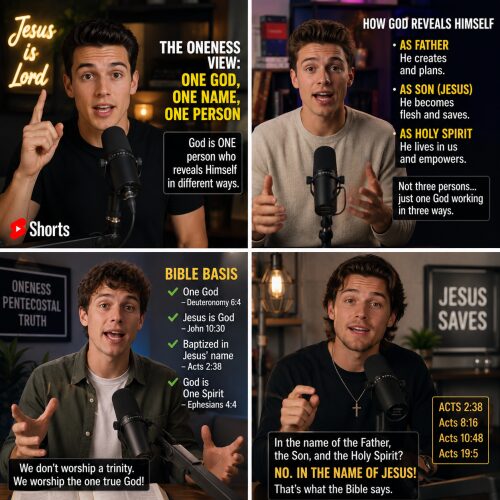
Open any video app, search “the Trinity is unbiblical,” and you’ll meet them: confident, polished young preachers with millions of views arguing the Christian doctrine of the Trinity is a man-made lie. Most belong to a movement called Oneness Pentecostalism. Their pitch is simple, and simple things travel fast online: there’s only one God, so how can God be three persons? Jesus, they say, isn’t one member of a Trinity. Jesus is the Father, the Son and the Holy Spirit—one single person wearing three different hats.
It sounds like it’s protecting God’s oneness. It even quotes the Bible at speed. But it’s neither new nor true. The church weighed this exact idea and rejected it more than 1,700 years ago. This article explains what Oneness teaches, why it collapses under Scripture, and how to answer it clearly and kindly—verse by verse.
What Oneness Pentecostalism actually teaches
First, two words we can’t avoid.
- Being means what something is.
- Person means who someone is.
You’re one being (one human) and one person (one “who”). Keep the two ideas apart and the whole debate becomes clear.
The historic Christian claim is this: God is one being who exists eternally as three persons—Father, Son and Holy Spirit. One what, three whos. Not three gods. Not one person in three costumes. One God, three persons.
Oneness Pentecostalism denies the “three persons” part. It teaches God is one being and also one person, who has simply played three different roles across history: Father in creation, Son in redemption, Spirit in the church. The old name for the idea is modalism—God appearing in three modes, one after another, like the same actor playing three characters in a play.
| HISTORIC CHRISTIANITY | ONENESS PENTECOSTALISM | |
|---|---|---|
| God is… | one being | one being |
| existing as… | three persons | one person |
| Father, Son, Spirit are… | three distinct persons | three roles of one person |
| Between them there is… | eternal love; one sends another | nothing—they’re the same person |
The movement’s most careful writer, David K Bernard, argues the case at book length. Oneness teachers also add a further claim with eternal stakes: that a person must be baptised with the exact words “in Jesus’ name” (not the words of Matthew 28:19) and must speak in tongues to be truly saved. That’s why this isn’t a small quarrel over vocabulary. It touches who God is and how the gospel is preached.
The one distinction that settles it
Everything turns on the difference between being and person. Oneness treats “one God” as meaning “one person,” so any hint of three persons sounds to them like three gods. But that’s a mistake in maths, not in the Bible.
Think of it this way. To say God is “one person and three persons” would be a flat contradiction—and no Christian says it. To say God is “three beings” would indeed be three gods—and no Christian says that either. What Scripture teaches is one being existing as three persons: two different categories, so no contradiction at all.
The Hebrew word for “one” in Israel’s great confession, “Hear, O Israel: the Lord our God, the Lord is one” (Deuteronomy 6:4), is echad. It means a unity, not a lonely singleness. The same word describes a man and his wife becoming “one flesh” (Genesis 2:24)—two persons, one union. So notice, the very verse Oneness preachers quote most doesn’t say what they want it to say.
We hold to one God as firmly as they do. The question is never whether God is one. It’s what kind of oneness the Bible actually describes.
The evidence “modes” cannot survive
Here’s the heart of the matter. If Father, Son and Spirit are just three roles played by one person, then they can never appear together, speak to one another, love one another, or send one another. A single actor cannot play all three parts on stage at the very same moment. Yet that’s exactly what the Bible shows. Time and again.
- Three at once at the Jordan. When Jesus was baptised, the Son stood in the water, the Spirit came down like a dove, and the Father’s voice spoke from heaven: “This is my beloved Son, with whom I am well pleased” (Matthew 3:16–17). Three persons, one scene, one moment.
- Face to face in eternity. John opens his Gospel: “the Word was with God, and the Word was God” (John 1:1). “With” points to two who’re together; “was God” means the Word is fully God. They’re distinct, yet both are God.
- Praying in the garden. In Gethsemane Jesus prays, “not as I will, but as you will” (Matthew 26:39). Two wills in loving agreement. Clearly He can’t be talking to Himself.
- Love before the world began. Jesus speaks of the Father loving Him “before the foundation of the world” (John 17:24). Love needs someone to love. A single-person God had no one to love before creation; three persons in eternal love make sense of a God who is love.
- Seated at the right hand. Stephen, dying, sees “the Son of Man standing at the right hand of God” (Acts 7:56)—two persons, not one. And the risen Son now prays for us to the Father (Romans 8:34).
None of this fits one person in three costumes. All of it fits three persons who’re one God.
Answering their five best verses
Oneness apologists move fast through a handful of favourite verses. Slow down, and each one turns out to prove the opposite. Here are their five strongest, answered plainly.
| VERSE | ONENESS READS IT AS | WHAT IT ACTUALLY SAYS |
|---|---|---|
| Isaiah 9:6—”Everlasting Father” | Jesus is the Father | “Father of eternity” is a Hebrew way of saying the Messiah is eternal—not that He is the person of the Father |
| John 10:30—”I and the Father are one” | They’re one person | “one” here means one thing (a unity), and the verb is “we are”; verse 36 has the Father sending Him—so, two persons |
| John 14:9—”seen me…seen the Father” | Jesus is the Father | Jesus perfectly reveals the Father (Hebrews 1:3); the next verse says each is in the other—which needs two |
| Colossians 2:9—fullness of deity in Christ | Jesus is the Father | It says Jesus is fully God, which we gladly affirm; it never says He is the Father |
| Matthew 28:19—”name” (singular) | the one name is Jesus only | one shared name held by three distinct persons, each marked out separately in the Greek |
What about baptism “in Jesus’ name” in Acts (2:38; 8:16; 10:48)? Notice Luke’s wording keeps changing—“in the name of Jesus Christ,” then “into the name of the Lord Jesus,” and so on. A fixed magic formula doesn’t change its wording. Luke is telling us these people were baptised under Jesus’ authority—as Christians, not as followers of John the Baptist—not handing us words that must replace what Jesus Himself commanded in Matthew 28:19.
The hidden trap in Oneness teaching
There’s a deeper problem Oneness cannot escape. Once you say Jesus simply is the Father, you must explain all those verses where Jesus prays to the Father, obeys the Father and is sent by the Father. So Oneness teachers answer: the human Jesus prayed to the divine Father inside Him.
But look at what that does. It splits Jesus into two persons—a human one who prays and a divine one who answers. To avoid the ancient error of one person in three modes, Oneness falls into a second ancient error: dividing Christ in two. The church rejected both.
One heresy traded for another
- Patripassianism (“the Father suffered”): if the Father just is the Son, then the Father died on the cross. But the Bible says the Father raised the Son from the dead (Romans 6:4; Galatians 1:1). The one who raises and the one raised cannot be the same person.
- Nestorianism (splitting Christ into two persons): the only way Oneness can explain Jesus praying is to cut Him in two. The historic answer is cleaner—one divine Son, distinct from the Father, who took on a full human nature and so can truly pray to his Father as a real man.
This was settled long ago
Oneness preachers online often claim they’re recovering the pure faith of the first Christians, before clever men invented the Trinity. History says the opposite. Their view is the one that was tried and rejected.
- AD 200—Praxeas in Rome. A teacher named Praxeas taught that the Father himself became the Son and suffered. The church leader Tertullian answered him, coined the Latin word for “Trinity,” and summed up the faith as “one substance, three persons.”
- AD 220—Sabellius. A teacher called Sabellius organised the “one person, three modes” idea so thoroughly that modalism is still nicknamed “Sabellianism” after him. He was excommunicated.
- AD 325—Council of Nicaea. The wider church confessed the Son to be “true God from true God,” of the same being as the Father.
- AD 381—Council of Constantinople. The full deity of the Holy Spirit was affirmed.
- AD 451—Council of Chalcedon. One person, Christ, in two natures—divine and human. This is exactly the answer Oneness lacks.
- AD 1914 onwards. A “New Issue” split early American Pentecostalism, reviving the old modalism as today’s Oneness movement.
The Trinity isn’t a late invention. Modalism is the recycled idea.
Why it matters, and how to respond
Some will ask: why not let this go? Because the Trinity isn’t a puzzle for scholars—it’s the name and face of the God we worship. A God who is eternally three persons in love is a God who was never lonely, who didn’t need to create in order to love, and who saves us by the Father sending the Son and pouring out the Spirit. Lose the persons and you lose that whole story.
When you meet a Oneness friend—and many are sincere, warm believers who love Jesus—speak gently. Don’t mock. Agree loudly God is one. Then ask the simple questions: Who was Jesus praying to? Who loved the Son before the world was made? Whose voice spoke over the water while the Son stood in it? Let the Bible’s own scenes do the work. The goal isn’t to win an argument but to help a brother or sister see the fuller, richer God who’s really there.
Tough Questions, Honest Answers
If the word “Trinity” isn’t in the Bible, doesn’t that prove it was invented later?
It’s true the word “Trinity” doesn’t appear in the Bible—but neither does “Bible,” “monotheism,” or “incarnation,” and Oneness teachers happily use those. A single word can faithfully summarise many verses without appearing in any of them. The claim that “Trinity” was borrowed from Babylonian or Greek pagan religion doesn’t survive checking, because pagan triads were three separate gods—the exact opposite of one God in three persons. The doctrine was drawn out of Scripture to guard God’s oneness, not to dilute it.
Doesn’t 1 Timothy 3:16 say “God was manifest in the flesh,” proving Jesus is the Father?
In some older translations this verse reads “God was manifest in the flesh,” and Oneness teachers use it to say Jesus is the Father. Two things answer it. First, the earliest and best Greek manuscripts read “He who was manifested in the flesh,” referring to Christ, without the word “God” at all. Second, even the fuller reading only says God took on flesh in Jesus—which every Christian believes—and never says Jesus is the person of the Father. The verse teaches the incarnation, not modalism.
Aren’t the usual illustrations—water as ice, liquid and steam, or the three parts of an egg—good ways to explain the Trinity?
These popular pictures actually teach the Oneness error, not the Trinity, so it’s best to drop them. The same water becoming ice, then liquid, then steam is one thing in three forms, one after another—which is precisely modalism. The egg (shell, white, yolk) fails the other way, splitting God into three parts that are each less than the whole. The Father, Son and Spirit are not three forms or three slices of one God, but three persons who exist together, always, in love. It’s safer to let the Bible’s scenes—the baptism, the garden, the cross—teach us than to lean on any illustration.
Who is “us” in “Let us make man in our image” (Genesis 1:26)?
At creation God says, “Let us make man in our image, after our likeness” (Genesis 1:26). That plain plural—”us,” “our”—is striking in a book that insists there’s only one God. It’s not God speaking to angels, because humans are made in God’s image, not in the image of angels. The most natural reading is that the one God is speaking within Himself, among the persons of the Godhead. It’s an early hint of what the New Testament makes clear: one God, more than one person.
Is the Holy Spirit a real person, or just God’s power?
Oneness teaching tends to treat the Spirit as simply God’s power or presence rather than a distinct person. But Jesus calls the Spirit “another Helper” (John 14:16)—another of the same kind as Himself, sent by the Father. The Spirit can be lied to (Acts 5:3–4), grieved (Ephesians 4:30), and can speak and decide (Acts 13:2). A force isn’t lied to or grieved; only a person is. The Spirit is a person, distinct from the Father and the Son, and fully God.
Do I have to fully understand the Trinity to be a Christian?
No one fully understands the Trinity, and you don’t need to in order to be saved. God is infinite, so we should expect some things about Him to stretch beyond our minds. What matters is that we believe what He has revealed—one God: Father, Son and Holy Spirit—rather than flattening it into something easier to picture. A God we could completely explain would be a God small enough to fit inside our heads, and that’s no God at all.
Can a Oneness Pentecostal be saved, or is this a cult?
This calls for care rather than a quick verdict. On one hand, Oneness teaching gets the identity of God wrong at a serious level, and when it makes a particular baptism and speaking in tongues necessary for salvation, it adds requirements to the free gospel of grace. On the other hand, many people in these churches sincerely trust Jesus Christ as Lord and Saviour, and God alone reads the heart. It’s wiser to say the official teaching is a grave error to be lovingly corrected. Point people to Christ, patiently teach them who He truly is, and leave final judgement to the Lord.
Related Reads
- Social vs Classical Trinitarianism: Does God Have One Will or Three?
- Defending the Trinity: Biblical Answers to Common Objections
- Can You Be Christian But Reject the Trinity?
- Is Jesus God? The Biblical and Historical Case for the Deity of Christ
- Oneness Theology Vs Biblical Truth: Doctrines in Conflict
- Can We Be Sure Isaiah 48:16 Is a Clear Early Hint of the Trinity?
- Conciliar Trinitarianism: Is "One God, the Father" Biblical?
- Did Constantine Or the Church Invent the Trinity? What History Shows