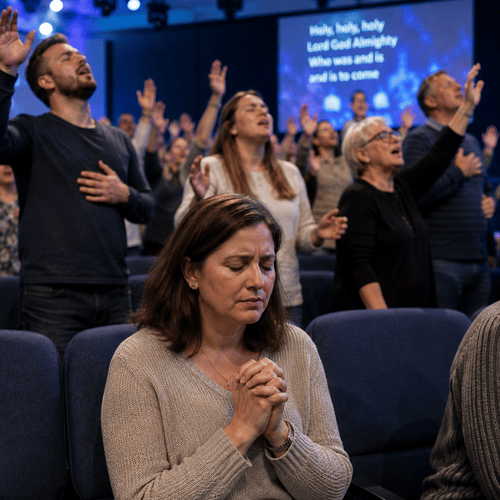

The Lord’s Prayer is one of the most repeated in human history. What’s more, “Our Father in Heaven” is one of the most searched Bible passages online. Most of us learned it as children, saying the words long before we understood them.
Jesus gave this prayer in answer to a simple request: “Lord, teach us to pray” (Luke 11:1). The answer is striking. He doesn’t begin with a technique. He begins with a name: “Our Father in heaven.” Before Jesus teaches us what to ask for, He teaches us who we’re asking.
Read slowly, the Lord’s Prayer turns out to be far more than a list of requests. It’s a compressed portrait of God’s own character: His nearness, His holiness, His kingship, His goodness, His mercy, His power. Let’s walk through the prayer clause by clause, in both texts, to show what each line reveals about the God we are praying to—and why that matters for how we pray.
Two Prayers, One Pattern
Jesus gave this prayer more than once. Matthew records it during the Sermon on the Mount, offered freely as a pattern for prayer. Luke records a shorter version, given later, in direct response to a disciple’s request. The wording differs slightly; the substance is identical.
| ELEMENT | MATTHEW 6:9–13 | LUKE 11:2–4 |
|---|---|---|
| Address | Our Father in heaven | Father |
| God-ward requests | Name, kingdom, will | Name, kingdom |
| Us-ward requests | Bread, forgiveness, deliverance | Bread, forgiveness, temptation |
| Doxology | Present in some manuscripts | Absent |
The church has always used the fuller, Matthew’s form in worship. Both versions are equally Scripture; one is simply more compact than the other.
The Shape of the Prayer: God First, Us Second
Look closely at the order of the six requests, and a pattern appears.
THREE REQUESTS ABOUT GOD (“YOUR”): your name, your kingdom, your will.
THREE REQUESTS ABOUT US (“US”, “OUR”): our bread, our forgiveness, our deliverance.
The ordering isn’t an accident. Before we ask for anything for ourselves, we ask that God’s name be honoured, that His rule may advance and His will be obeyed. Only then do we bring our own needs: food, forgiveness, protection. The order teaches a priority—God’s glory outranks our comfort. Not because God is selfish, but because seeking his glory first turns out to be our own deepest good as well.
“Our Father”: the God Who Adopts
The very first word overturns two common mistakes. It’s not “my Father,” as if faith in God were a purely private affair. It’s “our Father”—a family word, binding every person who prays it to every other believer, even when we pray alone.
But notice the mistake in the other direction too. Scripture says God made every human being and cares for all He has made. It doesn’t say everyone may call God “Father” in the same intimate sense used here. That address belongs, in the New Testament, to those who’ve received God’s own Spirit: “you have received the Spirit of adoption as sons, by whom we cry, ‘Abba! Father!’” (Romans 8:15; see also Galatians 4:6). “Abba” is an intimate family word, closer to “Dad” than to a formal title—the cry of a child, not a stranger.
This means the opening word of the prayer is already a gospel word. We don’t become God’s children by nature or good behaviour, but through Christ, “the only Son from the Father” (John 1:14), who shares his sonship with all who trust him. To pray “Our Father” sincerely is to stand, by faith, inside that adoption.
“In Heaven”: Near, Yet Infinitely High
Two words hold the prayer’s opening in perfect balance. “Father” tells us God is close, warm, personally involved. “In heaven” tells us He is exalted, sovereign and able to act. Neither phrase is allowed to stand alone.
Take away “in heaven,” and God shrinks into a comfortable, undemanding companion who exists mainly to make us feel better. Take away “Father,” and God becomes a distant, unreachable force with no interest in us at all. The Bible refuses both errors in a single breath. “Heaven” here isn’t primarily a location far away in space; it’s a way of speaking about God’s throne, His rule and His unlimited capacity to help. Thomas Watson, the 17-century preacher, put it simply: heaven speaks of God’s power and glory, so that a Father who is “in heaven” is a Father worth trusting with impossible requests.
“Hallowed Be Your Name”: Holiness Comes First
- What “hallowed” means: to treat something as holy, set apart, unique, not to be handled carelessly.
- What “name” means: in the Bible’s own idiom, a person’s whole revealed character and reputation, not merely the label people call them by.
Put together, the first request in the Lord’s Prayer isn’t about our circumstances at all. It’s a plea that God Himself—His character, His reputation in the world—be honoured as utterly unique, both in our own hearts and across the whole earth. That this request comes before every other one is itself a lesson: it reveals a God for whom His own glory isn’t vanity but the highest good in the universe, the very thing the prophet Ezekiel says God acts to protect: “I will vindicate the holiness of my great name… and the nations will know that I am the LORD” (Ezekiel 36:23).
“Your Kingdom Come”: the God Who Reigns Over History
The second request asks for God’s kingdom—His active rule as king—to come. Understood against the rest of Scripture, this request stretches across the whole of history.
- Already: the kingdom broke into history at Christ’s first coming. “The kingdom of God is at hand,” Jesus announced (Mark 1:15).
- Now: the kingdom continues to advance quietly, through the spread of the gospel and the life of the church, wherever people submit to Christ as king.
- Not yet: the kingdom will arrive in full at Christ’s return, when, as Paul writes, “at the name of Jesus every knee should bow… and every tongue confess that Jesus Christ is Lord” (Philippians 2:10–11).
To pray this line is to confess that history is not drifting aimlessly. It is moving, under the hand of a sovereign God, toward an appointed end.
“Your Will Be Done, on Earth as It Is in Heaven”: the God Whose Will Is Good
This request is easy to misread, so it’s worth slowing down over two different senses of “God’s will” that Scripture uses.
- God’s hidden, decreed will: everything He has sovereignly determined will happen, including events we cannot always understand.
- God’s revealed, commanded will: what He has told us, in His word, that He wants us to do.
The prayer is chiefly about the second: asking that people on earth obey God’s commands as promptly and gladly as the angels do in heaven. But it also touches the first, in the form of submission—the same submission Jesus Himself modelled in Gethsemane, praying, “not my will, but yours, be done” (Luke 22:42).
A fair question follows naturally: if God’s will is going to happen regardless, why pray for it? Because prayer isn’t a briefing for an uninformed God. It’s the means by which God’s own people are aligned to His will, and drawn into willing participation in it, rather than mere spectators of it.
“Give Us This Day Our Daily Bread”: the God Who Provides
After three requests about God’s own glory, the prayer now turns, without embarrassment, to something as small as bread. The shift reveals something about God’s character: He isn’t too exalted to care about our most ordinary, physical needs.
The word translated “daily” (Greek: epiousios) is so rare that ancient scholars struggled to define it precisely; it may have been coined specifically for this prayer. The best sense is something like “bread sufficient for today” or “bread for the coming day.” Either way, the emphasis lands on daily dependence rather than stockpiled security, echoing how God fed Israel with manna one day at a time in the wilderness (Exodus 16), and anticipating Jesus’s own instruction, a few verses later in the same sermon, not to be anxious about tomorrow (Matthew 6:25–34).
“Forgive Us Our Debts, as We Also Have Forgiven Our Debtors”: the God Who Forgives
Scripture pictures sin as a debt—an obligation we owe God and cannot possibly repay ourselves. This request asks God to cancel that debt.
EVIDENCE, NOT CURRENCY: “as we forgive” is not a payment that earns God’s forgiveness. It is proof that we have already received it. A heart that refuses to forgive others reveals it has never grasped how much it has itself been forgiven (see Matthew 18:21–35; Matthew 6:14–15).
Two forgivenesses are in view here. There’s the once-for-all legal forgiveness that comes the moment a person trusts Christ, when the debt is cancelled entirely and permanently. And there’s the ongoing, day-by-day forgiveness a child already in the family asks for, to keep the relationship warm and unhindered (see 1 John 1:9). The Lord’s Prayer is chiefly about the second kind: a family conversation, not a courtroom appeal.
“Lead Us Not Into Temptation, but Deliver Us From Evil”: the God Who Protects
At first glance the line seems to raise a real difficulty. James writes plainly “God cannot be tempted with evil, and he himself tempts no one” (James 1:13). So why would we ask God not to “lead us into temptation,” as if He might?
The answer lies in the Greek word behind both “temptation” and “trial,” peirasmos, which covers a wider range than the English word “temptation” alone. It can mean a testing that strengthens faith, which God does sometimes permit for good purposes, or an enticement toward sin, which God never causes. This final request asks God for two things at once: not to abandon us to trials beyond what we can bear (compare 1 Corinthians 10:13), and to rescue us decisively from the evil one. This is a live question even today—in 2017, changes to the prayer’s wording in some Catholic liturgies renewed public debate over exactly this point. The traditional wording holds up well once peirasmos is properly understood.
The Doxology: “For Yours Is the Kingdom, and the Power, and the Glory, Forever”
Many English Bibles include this closing line; some, in a footnote, note it’s missing from the oldest and best Greek manuscripts of Matthew. Most scholars regard it as a beautiful and doctrinally sound addition, drawn from an Old Testament prayer of King David’s (1 Chronicles 29:11), added early for use in church worship rather than original to Matthew’s Gospel. Christians are on solid ground praying it; they should simply know its textual history.
Whatever its origin, its content summarises the whole prayer. Kingdom speaks of God’s sovereignty. Power speaks of his unlimited ability. Glory speaks of his surpassing worth. And “forever” reminds us these things do not depend on circumstances; they already belong to God, which is precisely why we can pray everything before it with confidence rather than anxiety.
Putting It Together: a Portrait of God
| LINE OF THE PRAYER | WHAT IT REVEALS ABOUT GOD |
|---|---|
| Our Father | He adopts and loves as a Father |
| …in heaven | He is transcendent and able to act |
| Hallowed be your name | He is holy |
| Your kingdom come | He reigns over history |
| Your will be done | He is good and wise |
| Our daily bread | He provides |
| Forgive us our debts | He is merciful |
| Lead us not / deliver us | He protects |
| The doxology | He is sovereign, powerful and glorious forever |
We cannot pray this prayer honestly while holding a small view of God. Every line insists He is both near and exalted, both holy and merciful, both sovereign over history and attentive to a single day’s bread. That’s the God Jesus teaches His followers to call “Our Father.”
Tough Questions, Honest Answers
Jesus said not to “heap up empty phrases” (Matthew 6:7) right before giving this prayer. Isn’t reciting it word-for-word a contradiction?
No—the warning is against thoughtless, mechanical repetition, treating many words as a kind of spell to twist God’s arm. Reciting fixed words is not automatically empty; it depends entirely on whether the heart engages with the meaning. Christians across history, including many who wrote deeply about prayer, have both recited this prayer verbatim and warned against saying it carelessly. The prayer itself, given by Jesus as a pattern, is the church’s standing proof that repeated words and sincere prayer are not opposites.
Why do some churches end with “the kingdom, the power and the glory,” while others stop at “deliver us from evil”?
This follows directly from the manuscript question addressed above. Translations based on later Greek manuscripts include the doxology; those based on the earliest manuscripts often place it in a footnote instead, since it does not appear in the oldest copies of Matthew available to us. Both traditions handle the evidence honestly; neither alters the prayer’s meaning, since the doxology’s content is thoroughly biblical even if its precise placement in Matthew is debated.
The Lord’s Prayer is full of “we” and “us,” even when prayed alone. Why does such a personal prayer sound so communal?
Because the God who teaches it never intends prayer to be purely individualistic. Even in solitude, a Christian praying “give us” and “forgive us” deliberately joins their voice to every other believer’s, remembering that they belong to a family rather than standing alone before God. This shapes how we should pray more broadly: our concerns for daily bread, forgiveness and protection are meant to include others, not only ourselves.
Different traditions count six or seven petitions in the prayer. Does the numbering matter theologically?
Not substantially. Most Reformation-era catechisms count six petitions, treating “lead us not into temptation” and “deliver us from evil” as one combined request; some older traditions, following Augustine of Hippo, count seven by separating them. Either way, the content covered is identical; the difference is how the lines are grouped, not what they teach.
If I struggle to forgive someone who has hurt me deeply, does that mean God hasn’t forgiven me?
Struggling to forgive is not the same as refusing to forgive. The prayer’s warning targets a hardened, unwilling heart, not a wounded one still working through real pain. Someone who wants to forgive, and is asking God for help to get there, is already showing the kind of heart the prayer describes—very different from someone who has decided never to let go of bitterness. If you are unsure which describes you, that concern itself is usually a sign of the former, and worth bringing honestly to God in prayer.
Is “the evil one” in the final line a personal devil, or just a way of describing evil in general?
Scripture consistently speaks of Satan as a real, personal being—“your adversary the devil prowls around like a roaring lion” (1 Peter 5:8)—not merely a poetic label for impersonal misfortune. The Greek phrase can be translated either “evil” or “the evil one,” and both readings point to the same reality in the end, since personal, spiritual opposition to God lies behind evil in the world. Praying for deliverance “from evil” therefore includes, rather than excludes, deliverance from Satan’s schemes.
Is it enough for a Christian to only ever pray the Lord’s Prayer, or should it lead to other prayers?
Jesus gave it as a pattern, not a ceiling—a compact model showing the right subjects and right order for prayer, not an exhaustive script meant to replace all other praying. Many faithful Christians pray it daily as an anchor, while also bringing specific people, needs and thanksgivings to God in their own words, shaped by its priorities. Used well, it is less a single prayer to be recited and more a set of headings under which a whole life of prayer can be organised.
Related Reads
- Fatherlessness: Does Knowing God Heal the Father Wound?
- If God Is Sovereign, Why Bother Praying?
- The Paradox of Prayer: Why Ask When God Already Knows?
- Praying in the Spirit: How the Holy Ghost Empowers Our Prayer Life
- How to Pray to the Trinity: A Practical, Biblical Guide
- What Does “Abba, Father” Really Mean?
- Prayerlessness and Spiritual Dryness: Does the Bible Offer a Remedy?