A word appears 74 times in our Bibles. Most preachers skip it. Most Bible readers mumble past it. And if we search online, we’ll be told again and again nobody knows what it means.
That word is Selah.
Some say it means ‘forever’. Some say it means ‘pause and think’. On social media, people use it to mean ‘relax’ or ‘enough said’. Parents give it to their baby daughters. Singers put it in song titles.
But here’s the surprise: the Bible itself leaves us enough clues to rule out most of these ideas—and to point clearly to the right one. In this article, we shall follow those clues one by one, like detectives. By the end, we’ll know the most likely meaning of Selah, why the other views fail, and why this small word matters far more than you think.
What Is Selah?
Selah (say it ‘SEE-lah’) is a Hebrew word. Hebrew is the language in which most of the Old Testament was first written.
When you see Selah in your English Bible, you’re not reading a translation. You’re reading a transliteration. That means the translators simply wrote the Hebrew word in English letters, without turning it into an English meaning. ‘Hallelujah’ and ‘Amen’ came to us the same way.
Why did the translators do this? Because they weren’t sure how to translate it. Peter Craigie, in his well-known commentary on the Psalms, admits both the origin of the word and its exact meaning are still uncertain.
But ‘uncertain’ doesn’t mean ‘hopeless’. A doctor may not name an illness at first sight, but the signs point one way. Selah is the same. First, here are a few helpful words.
KEY WORDS YOU WILL MEET
- Transliteration: writing a word in the letters of another language, without translating it.
- Rubric: an instruction written into a text to tell people how to perform it, like stage directions in a play.
- Interlude: a short piece of music played between the sung parts of a song.
- Septuagint: the ancient Greek translation of the Old Testament, made about 200 years before Jesus.
Where Does Selah Appear in the Bible?
The Book of Psalms is Israel’s ancient hymnbook, divided into 5 smaller ‘books’. Here are the facts at a glance.
| Question | Answer |
|---|---|
| How many times does Selah appear? | 74 times, all in the Old Testament |
| How many in the Psalms? | 71 times, spread across 39 psalms |
| Anywhere else? | Only Habakkuk 3, 3 times (verses 3, 9 and 13) |
| In the New Testament? | Never |
| Do Selah psalms have music headings? | Yes. 31 of the 39 begin ‘To the choirmaster’, meaning the leader of temple music |
| Which parts of Psalms? | Mostly Books I–III (Psalms 1–89). None in Book IV (Psalms 90–106). Only Psalms 140 and 143 in Book V |
| Where in a verse? | Usually at the end of a section. Sometimes in the middle of a sentence. Four psalms end with it (Psalms 3, 9, 24 and 46) |
Do you see the pattern? Selah gathers in songs clearly prepared for temple music. Keep that in mind.
Selah Meaning: 5 Views Compared
Here are the 5 main views. The last column gives our verdict on each, which the rest of this article explains.
| VIEW | WHAT IT SAYS | MAIN SUPPORT | VERDICT |
|---|---|---|---|
| 1. A music instruction: ‘lift up’ | Selah tells musicians to lift up their instruments or voices, probably for a short interlude | Where Selah appears; music headings; the Septuagint; Habakkuk 3 | Best fit |
| 2. A simple pause | Selah means ‘stop here for a moment’ | Selah often comes at the end of a section | Partly true, but too thin |
| 3. ‘Forever’ or ‘Amen’ | Selah is a word of praise meaning ‘for ever’ | Some ancient Jewish teachers; Jerome | Fails: it often sits mid-sentence |
| 4. ‘Weigh this’ | Selah comes from a Hebrew word meaning ‘to weigh’ or ‘to value’ | A similar word in Job 28:16 | Possible, but forced |
| 5. A secret code | Selah is short for a phrase such as ‘turn back, singer’ | Medieval guesses | No ancient support |
How People Have Read Selah Through History
This debate is over 2,000 years old. Notice the earliest witness points to music, and the ‘forever’ idea came later.
Timeline: Selah Through the Centuries
- About 250–150 BC (the Septuagint): Jewish scholars translating the Psalms into Greek render Selah as diapsalma, a word for a musical interlude or break.
- 2nd century AD (Aquila): A Jewish translator named Aquila renders it with a Greek word meaning ‘always’.
- Early centuries AD (the Talmud and Targums): Jewish teaching (the Talmud) and Aramaic paraphrases of Scripture (Targums) link Selah with ‘forever’.
- About AD 400 (Jerome): Jerome, who translated the Bible into Latin, follows the ‘forever’ idea and writes semper, meaning ‘always’.
- 1557 (John Calvin): In his commentary on the Psalms, Calvin reads it as a musical sign.
- Early 1700s (Matthew Henry): Henry treats it as a call for a solemn pause.
- 1869–1885 (Charles Haddon Spurgeon): In The Treasury of David, Spurgeon treats Selah as a rest in the music and a call to lift up the heart.
- Today: Most English Bibles leave Selah untranslated. The New Living Translation renders it ‘Interlude’.
The Case for Our View: Seven Clues
Now for the detective work. No single clue settles the matter by itself. But think of a rope. Each thread is weak on its own. Twist 7 threads together, and the rope can hold a heavy load. Here are our 7 threads.
Clue 1: Selah Lives in Songs
Selah appears only in the Psalms and in Habakkuk 3. Both are songs. It never appears in the Bible’s history books, its laws, its letters or its ordinary prophecy. Selah belongs to worship music, and Habakkuk gives the clearest test.
THE HABAKKUK TEST: REMOVE THE MUSIC, AND SELAH DISAPPEARS
In Habakkuk 1 and 2, the prophet speaks with God. There is no Selah. But chapter 3 is different. It is a prayer turned into a song, and it has music instructions at both ends:
A prayer of Habakkuk the prophet, according to Shigionoth. (Habakkuk 3:1, ESV)
To the choirmaster: with stringed instruments. (Habakkuk 3:19, ESV)
‘Shigionoth’ was probably a kind of song or musical style. Only in this chapter—the one prepared for singing—does Selah appear. Take away the music, and Selah vanishes too. That is strong proof that Selah is a music word.
Clue 2: Selah Follows the Music Leaders
As we saw, 31 of the 39 Selah psalms carry the heading ‘To the choirmaster’. Many belong to the Sons of Korah and to Asaph. These were Levite families whom David put in charge of the songs in God’s house (1 Chronicles 6:31–39). In Book IV, where their names are missing, Selah is missing too.
Clue 3: Selah Ignores the Grammar
Sometimes Selah appears right in the middle of a sentence. Look at this verse:
He will send from heaven and save me; he will put to shame him who tramples on me. Selah God will send out his steadfast love and his faithfulness!
Psalm 57:3, ESV
The sentence carries on straight after Selah. If Selah meant ‘forever’ or ‘Amen’, this would make no sense. But if Selah is a note for the musicians—like a mark in the margin of a song sheet—it fits perfectly. The same thing happens in Psalm 55:19 and Habakkuk 3:3 and 3:9.
Clue 4: The Earliest Translators Heard Music
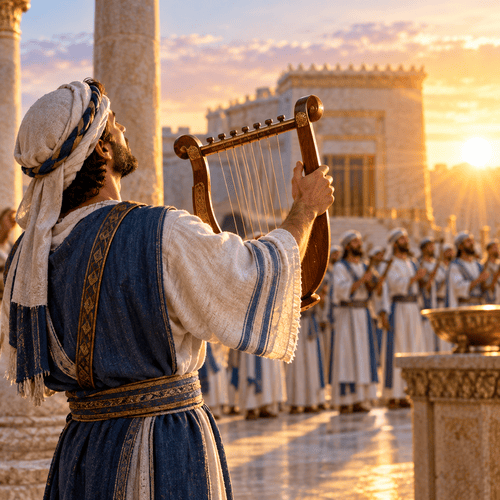
The Septuagint translators lived over two thousand years before us, while the temple still stood. When they met Selah, they wrote diapsalma, a Greek word for a musical interlude. They knew how the psalms were sung.
Clue 5: Selah Keeps Musical Company
Psalm 9:16 ends with two unusual words: ‘Higgaion. Selah’. What is ‘Higgaion’? In Psalm 92:3, the same Hebrew word is translated ‘melody’ played on the lyre. So here we have two music words standing side by side, like ‘chorus’ and ‘repeat’ in a modern songbook.
Clue 6: The Root Word Means ‘Lift Up’
Most scholars link Selah to the Hebrew verb salal, which means ‘to lift up’ or ‘to raise’. Here is that verb in action:
Sing to God, sing praises to his name; lift up a song to him who rides through the deserts; his name is the LORD; exult before him!
Psalm 68:4, ESV
Psalm 68 itself contains Selah 3 times. So Selah most likely told the singers and players to ‘lift up’—to raise the music, to play an interlude, or to raise their voices higher.
Clue 7: The Apostles Never Preached It
Jesus and the apostles quote the Psalms again and again. Yet not one of them ever uses Selah. The apostles treated it as an instruction for performing the song, not as part of the message to be preached. That’s exactly what our view expects.
OUR CONCLUSION IN ONE PARAGRAPH
Selah is an instruction for worship, written into the text of the psalms. It most likely means ‘lift up’. It marked a moment when the music rose—probably an instrumental interlude—at a key point in the song. The result was a pause in the words, which gave worshippers time to take in what they had just sung about God.
What the Bible Teachers Said
We’re not the first to reach this view. Some of the church’s finest Bible teachers arrived at much the same place.
- John Calvin (1509–1564): Commenting on Psalm 3, Calvin admitted scholars disagreed about Selah. Even so, he judged it most likely to be a musical sign. He also noticed that it tends to appear where the psalmist wants us to stop and mark something important.
- Matthew Henry (1662–1714): Henry, whose commentary is still loved by many families, saw Selah as a call to pause and seriously consider what has just been said.
- Charles Haddon Spurgeon (1834–1892): The ‘Prince of Preachers’ agreed Selah was a rest in the music. But he loved to turn it into a call for the reader to lift up the heart to God along with the music.
- Derek Kidner (1913–2008): In his commentary on Psalms 1–72, Kidner linked Selah to the idea of ‘lifting up’, pointing either to a musical interlude or to a raising of the voices.
Notice what these teachers did. They were honest about what we do not know, but they let the musical meaning become a call to the heart.
An Honest Limit
A strong case is also an honest case. Here is what the evidence does and does not allow.
| WE CAN SAY WITH CONFIDENCE | WE CANNOT SAY WITH CERTAINTY |
|---|---|
| Selah belongs to worship music | The exact English word that best translates it |
| Selah does not mean ‘forever’ or ‘Amen’ | Whether it guided instruments, voices or both |
| Selah marks important moments in the psalms | How long each interlude lasted |
| Selah is part of the text God gave us | What the music actually sounded like |
This is not a weakness. Moses told Israel:
The secret things belong to the LORD our God, but the things that are revealed belong to us and to our children for ever, that we may do all the words of this law.
Deuteronomy 29:29, ESV
The sound of the temple orchestra is one of those secret things. The words of the psalms—the things God has revealed—are what we need.
Why Selah Matters for Us Today
Does any of this really matter? Yes. This small word teaches four big lessons.
1. Selah Marks the High Points
Look at where Selah falls. It’s not random. Again and again, it comes straight after the greatest truths in the psalm.
| PSALM | WHAT COMES JUST BEFORE SELAH | WHY IT MATTERS TO US |
|---|---|---|
| Psalm 3:4 | God answers David’s cry from his holy hill | God hears his people in trouble |
| Psalm 24:10 | ‘The LORD of hosts, he is the King of glory!’ | The King of glory has come in Christ |
| Psalm 32:5 | David confesses his sin, and God forgives | Forgiveness is free and full |
| Psalm 46:7, 11 | ‘The LORD of hosts is with us’ | God is our safe place in every storm |
| Psalm 82:2 | God rebukes unjust rulers | Every power will answer to God |
Read Psalm 32:5 slowly, and imagine the music rising at the end:
I acknowledged my sin to you, and I did not cover my iniquity; I said, ‘I will confess my transgressions to the LORD,’ and you forgave the iniquity of my sin. Selah
Psalm 32:5, ESV
The singers stop. The harps lift up. Sin confessed; sin forgiven. God gives his people a moment to let that truth sink deep.
2. God Breathed Out Even the Music Notes
Paul says that ‘all Scripture is breathed out by God’ (2 Timothy 3:16). Selah stands in the Hebrew text God gave his people. So even an instruction for musicians is part of the Scripture we receive and trust. Jesus himself taught that not even the smallest mark of God’s Word is wasted:
For truly, I say to you, until heaven and earth pass away, not an iota, not a dot, will pass from the Law until all is accomplished.
Matthew 5:18, ESV
We don’t need to understand everything to trust everything.
3. God Cares How We Worship
Selah shows Israel’s worship was planned and ordered, down to how the songs were sung. Paul gives the same principle to the church: ‘all things should be done decently and in order’ (1 Corinthians 14:40). Worship is not whatever we feel like doing. It is our response to God, shaped by his Word.
4. True Meditation Fills the Mind
Many people today use Selah as a word for emptying the mind. That is the opposite of what the Bible teaches. In Scripture, meditation means filling your mind with God’s Word and thinking about it deeply:
But his delight is in the law of the LORD, and on his law he meditates day and night.
Psalm 1:2, ESV
Selah doesn’t ask us to think about nothing. It asks us to stop and take in what we have just sung about God. The pause is never empty. It is full of truth.
Conclusion: Which View Is the Right One?
So which view wins? Selah is most likely a musical instruction meaning ‘lift up’. It told the temple musicians to raise the music, usually for a short interlude, at the high points of the song. The ‘pause and think’ idea is not wrong, but it describes the effect of Selah rather than its meaning. The other views fail when tested against the Bible itself.
Next time you read Selah, don’t skip it. Let it do what God designed it to do. Stop for a moment. Remember what you’ve just read about God. Lift up your heart to him. Then read on.
Selah.
Tough Questions, Honest Answers
Should I read ‘Selah’ aloud when I read a psalm in church?
There is no rule in Scripture either way. Selah is part of the text, so reading it aloud is perfectly fine. Some readers prefer to pause silently for a moment instead. Both honour its purpose, which is to give people time to take in what was just read. If your church is not familiar with the word, explain it once from the pulpit. That way, every Selah becomes a small moment of worship rather than a puzzle.
Does Selah mean ‘rock’?
No. This is a common mix-up with a different word, Sela, which means ‘rock’ or ‘cliff’. Sela is the name of an Edomite stronghold that King Amaziah captured: ‘He struck down ten thousand Edomites in the Valley of Salt and took Sela by storm’ (2 Kings 14:7). In Hebrew, Sela ends with a different letter from Selah, and the two words are not related. Many people link Sela with the rock city of Petra in Jordan, though this is not certain. Whatever the case, Sela is a place, while Selah is a music word.
Is Selah a good name for a Christian girl?
There’s nothing wrong with the name. Baby-name websites often say it means ‘pause and praise’ or ‘rock’, but as we have seen, the first is only a loose idea and the second confuses it with Sela. If you choose the name, choose it with its true meaning in mind: a call to lift up worship to God. That is a beautiful prayer for any child. But remember that no name carries a blessing by itself. A child is blessed by God’s grace in Christ, not by the sound of a word.
Why do some Bibles put Selah in a footnote or leave it out?
Some translations, such as the New International Version, move Selah from the main text to the footnotes. Their reason is that Selah was an instruction for musicians, not part of the words to be read or sung. That is an understandable choice, and it does not deny that Selah is in the Hebrew text. Still, many readers find it helpful to see Selah where it stands, because its position shows the high points of the psalm. If your Bible puts it in a footnote, it’s worth noticing where it would have been.
Is it right to use ‘Selah’ like ‘Amen’ in prayer or on social media?
Amen has a clear meaning in the Bible: ‘truly’ or ‘so be it’. It is a word of agreement that God’s people say together. Selah does not mean that. Using Selah to mean ‘end of discussion’ or ‘relax’ changes its meaning, even if it is done with good intentions. It is not a sin to use the word, but we should not treat it as a holy word with special power. Paul says, ‘I will pray with my spirit, but I will pray with my mind also’ (1 Corinthians 14:15). Words of Scripture should be used with understanding.
Why don’t metrical psalm books include Selah?
A metrical psalter rewrites the psalms into regular lines with rhythm and rhyme, so a whole church can sing them to simple tunes. The Scottish Psalter of 1650 is a famous example. Because Selah was an instruction rather than part of the sung words, the editors left it out, just as you would not sing the word ‘chorus’ printed above a hymn verse. Some churches today play a short musical interlude where Selah stands, which is a lovely way to honour it. Either way, singing the psalms remains a joy and a command: ‘singing psalms and hymns and spiritual songs, with thankfulness in your hearts to God’ (Colossians 3:16).
Are there other mysterious words in the Psalms like Selah?
Yes, quite a few. Many psalm headings contain words such as Miktam (Psalm 16), Maskil (Psalm 32), Shiggaion (Psalm 7), Sheminith (Psalm 6), Gittith (Psalm 8) and Alamoth (Psalm 46). Most of these probably name types of songs, tunes, or musical instruments. They remind us the psalms were real songs, sung by real people with real instruments. We’ve lost the tunes, but God has kept the words. And the words are what we need to know Him, trust Him and praise Him.
Related Reads
- Understanding Perspicuity: What Does the Term Really Mean?
- Jesus in the Psalms: The King, the Sufferer, the Song
- Jesus in the Book of Habakkuk: 7 Ways the Prophet Sees Christ
- Psalm 22:3: How Does God Inhabit the Praise of His People?
- The Pilgrim’s Progress: Journeying Through the Psalms of Ascent
- What’s the Regulative Principle? And Why Does It Still Matter?
- True Worship That God Delights In: Insights from Scripture
- Exegesis vs Eisegesis: What Do the Two Terms Really Mean?
- Bible Interpretation 101: The Grammatical-Historical Method Explained