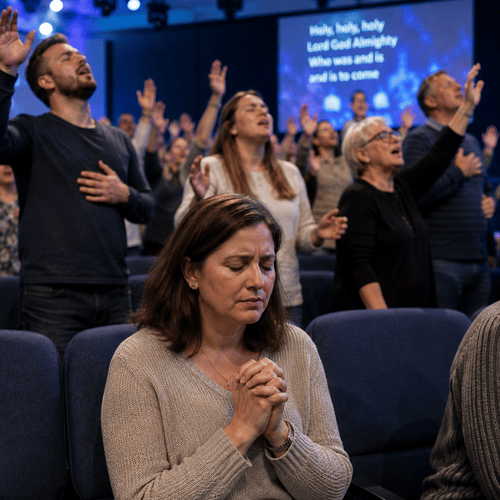

Walk into a Christian bookshop today and you’ll likely find a whole shelf marked “spiritual formation”. Churches run spiritual formation groups. Colleges offer spiritual formation degrees. Pastors speak of being formed rather than merely taught.
Some Christians love the phrase. Others hear it and grow uneasy, because it carries a faint smell of the monastery—of silent retreats, breathing exercises and practices that seem to come from somewhere other than the Bible.
Both reactions hold something true. So let’s do two things here. First, let us understand what people mean by spiritual formation, where the idea came from, and why it spread so quickly. Second—and this matters far more—let’s ask what the Bible itself says about how a Christian is shaped into the likeness of Jesus Christ. On that question Scripture is neither silent nor vague.
The short answer is this. God really is forming His people into the image of His Son. That isn’t a modern invention; it’s the plain teaching of the New Testament. But the Bible also tells us
- Who does the forming
- What tools He uses
- Where the work happens, and
- What it rests on.
We need to get those four things right for an account of growth that’s both deep and safe.
Where Did the Phrase Come From?
The word “formation” was borrowed. For centuries the Roman Catholic Church used it to describe the training of priests, monks and nuns. A man entering a religious order passed through “formation”—a long, supervised shaping of his habits, his prayers and his character.
The phrase entered the wider Christian world through a small number of very influential writers:
- Richard Foster—his book Celebration of Discipline (1978) reintroduced practices such as fasting, silence, solitude, simplicity and confession to Protestant readers. He later founded the Renovaré movement.
- Dallas Willard—a philosopher whose books The Spirit of the Disciplines (1988) and Renovation of the Heart (2002) argued that Christians had shrunk the gospel down to forgiveness and quietly dropped obedience.
- Henri Nouwen and Thomas Merton—Catholic writers on solitude and the inner life, who supplied much of the movement’s emotional tone.
Knowing this history isn’t by itself an argument against anything. Very few people who use the phrase today know that it began in monasteries, and that matters when we come to weigh the practices it recommends.
Why It Caught On
It caught on because it named a real famine.
By the late 20th century many churches were very good at producing decisions and very poor at producing disciples. People walked an aisle, signed a card, joined a small group—and then stayed exactly the same for 20 years. Willard called this the gospel of “sin management”: a Christianity that handles the guilt problem and leaves the character problem untouched.
We should be honest enough to say the diagnosis was largely right. The hunger that drove people to bookshop shelves was a good hunger. Something in them knew being forgiven ought to lead to lasting change.
The question isn’t whether the hunger was real. It’s whether the food on offer was the food God actually prescribed.
What the Bible Actually Says About “Forming”
Here’s something that often surprises people. “Formation” isn’t merely a monastic word. It’s a New Testament word. The Greek word group behind it (morphē, meaning shape or form) appears at some of the most important points in Paul’s letters.
| TEXT | WHAT IT SAYS | WHAT IT TEACHES |
|---|---|---|
| Galatians 4:19 | Paul labours “until Christ is formed in you” | Formation has a goal: Christ’s own character should begin to take shape in the believer |
| Romans 8:29 | God predestined His people “to be conformed to the image of his Son” | Formation is God’s eternal purpose, not a human project |
| Romans 12:2 | “Be transformed by the renewal of your mind” | Formation happens through the mind being renewed, not bypassed |
| 2 Corinthians 3:18 | Beholding the Lord’s glory, we “are being transformed into the same image” | Formation comes by looking at Christ, and the worker is the Spirit |
That last verse repays slow reading. Notice three things in it.
- The verb is passive. We are being transformed. We’re not the ones doing the transforming; we’re the ones being worked on.
- The method is beholding. Change comes as we look at the glory of the Lord—which Paul has just told us we see in the face of Christ, made known in the Scriptures.
- The worker is named. “For this comes from the Lord who is the Spirit.” The Holy Spirit is the agent. Not a technique. Not a retreat. Not a breathing pattern.
THE KEY PRINCIPLE
Spiritual formation is receptive before it’s active. We don’t shape ourselves by effort and then ask God to bless the result. We look at Christ, and the Spirit reshapes us as we look.
The Foundation: Union With Christ
Before we talk about how we grow, we must be clear about the soil we’re growing in. And that soil has a name: union with Christ.
John Calvin taught that everything a Christian receives comes from being joined to Jesus Christ, and that this union gives us two gifts at once—a “double grace”, as he called it. The first gift is justification: God declares us righteous, freely, because of what Christ has done. The second is sanctification: God begins to make us actually righteous, slowly, over a lifetime. The two gifts are different, but they can never be separated, because they come in the same package—Christ Himself.
This is why Calvin insisted we don’t receive forgiveness from Christ and then go looking elsewhere for the power to change. Both come from the same place.
John Murray sharpened this further with what he called definitive sanctification. Working from Romans 6, he pointed out something we usually read past: Paul doesn’t tell Christians to die to sin. He tells them they have already died to sin. The old master has been broken. The chains are already off. Only then does Paul say: now live like it.
This changes the whole shape of Christian effort. We’re not fighting to become free. We’re fighting because we’ve been made free.
Sinclair Ferguson presses the same point in a way many readers find liberating. The cure for legalism, he argues, isn’t a smaller dose of law and a larger dose of licence. The cure is Christ Himself—because both legalism and lawlessness grow from the same root, a suspicion that God isn’t truly generous.
Growth Never Buys the Verdict
This is the single most important safeguard in the whole subject, and it’s where the historic Protestant account parts company sharply with the Roman Catholic tradition that gave us the word “formation” in the first place.
Our growth doesn’t contribute one gram to your standing with God.
| JUSTIFICATION | SANCTIFICATION | |
|---|---|---|
| What it is | A legal verdict: God declares you righteous | A real change: God makes you holy |
| When | In a moment, at conversion | Over a whole lifetime |
| Whose work | Christ’s work, outside you | The Spirit’s work, inside you |
| Your part | You receive it by faith alone | You cooperate, but the Spirit enables |
| Does it grow? | No—it is complete and cannot increase | Yes—it is partial and grows unevenly |
| Can you lose it? | No | You may stumble badly, but God will finish it |
The Westminster Confession says sanctification in this life is never complete—that some remnants of corruption remain in every part of us. That’s not pessimism. It’s realism, and it’s kind. It means we can stop measuring God’s love for us by how well this month went.
REMEMBER
Growth flows from a settled acquittal. It never earns one. The moment formation becomes a way of securing God’s favour, it stops being Christian.
The Tools God Uses: The Ordinary Means of Grace
So if God forms us, how does He do it? The confessions give a strikingly plain answer. The Westminster Shorter Catechism asks what the outward means are by which Christ gives us the benefits of redemption, and answers: His ordinances, especially the Word, the sacraments and prayer.
That’s it. No secret techniques. No advanced level for the spiritually gifted.
| THE MEANS | WHAT IT LOOKS LIKE | WHY IT FORMS US |
|---|---|---|
| The Word | Preaching, reading, hearing, memorising, meditating | God speaks; faith is born and fed by what is heard |
| The sacraments | Baptism and the Lord’s Supper | God attaches visible signs to His promises to strengthen weak faith |
| Prayer | Private, family and gathered prayer | We answer God’s voice and learn dependence |
Notice two features of this list that cut across most modern formation literature.
It’s ordinary. These are the things available every week to every believer, including the illiterate, the exhausted and the poor. Michael Horton has written a whole book pressing this point: the Christian life is not a series of radical breakthroughs but a long, unspectacular faithfulness. God works in ordinary ways because He intends to reach ordinary people.
It’s churchly. Preaching needs a preacher. The Lord’s Supper needs a table and a congregation. Much of the popular formation movement is intensely private—the retreat, the journal, the solitary hour. Those have their place. But God’s appointed workshop is the gathered church on the Lord’s Day, and no amount of private practice replaces it.
The Canons of Dort add one more instrument that we rarely put on our lists: God preserves and grows His people through warnings, threats and promises, and through the discipline of the church. Being told off, lovingly and biblically, is a means of grace.
Two Movements: Putting to Death, Coming Alive
The Heidelberg Catechism describes true repentance as having two parts, and this remains the best short description of daily Christian growth ever written. It speaks of the dying of the old self and the coming to life of the new.
- Mortification—putting sin to death. Grief over sin, refusal to feed it, cutting off what supplies it. John Owen’s famous warning stands: be killing sin, or it will be killing you.
- Vivification—coming alive. Real joy in God, and a growing delight in doing what pleases Him. Not merely stopping the bad, but starting the good.
This is why formation is more like warfare than like gardening. It’s largely missing from the gentler modern literature, and its absence leaves readers unprepared for how violent the internal struggle actually feels. We’re not simply cultivating; we’re fighting.
God’s Main Classroom: Providence and Suffering
Here’s the part of spiritual formation that no one signs up for and everyone receives.
Scripture consistently says God shapes His people chiefly through what He sends them—not through what they schedule (Romans 5:3–5; Hebrews 12:5–11; James 1:2–4).
Notice how much of our actual formation happens in places we didn’t choose: the illness, the difficult marriage, the job that didn’t come, the child who wandered, the long stretch of ordinary weeks. God isn’t waiting for us to attend a retreat. He’s already at work.
THE COMFORTING FACT
If God formed His people mainly through advanced practices, formation would belong to those with time, money and quiet. Because He forms us mainly through Word, prayer, church and providence, it belongs to everyone.
Not the Cloister but the Kitchen
The medieval world had a clear picture of the serious Christian: he left ordinary life behind. Marriage, business and family were second-class; the monastery was where holiness happened.
The Reformation broke that picture in half. Holiness was moved out of the cloister and into the home, the field, the workshop and the market. The mother feeding a child and the farmer mending a fence were doing work as genuinely holy as any monk’s. Herman Bavinck later wrote at length on the Christian family as the ordinary school of Christian character.
This is worth remembering precisely because the word “formation” came to us from the monastery. The safest form of the practice keeps the Reformation’s correction firmly in place. Our formation happens mostly where our life happens.
Six Tests for Any Spiritual Practice
Christians ask constantly whether a particular practice is safe. Rather than ruling on each one individually, here’s a grid we can apply ourselves.
| TEST | ASK THIS | WARNING SIGN |
|---|---|---|
| 1. Appointed | Is this commanded or modelled in Scripture, or invented? | “An appearance of wisdom” with no biblical warrant |
| 2. Word-filled | Does it fill my mind with God’s Word, or empty my mind? | The goal is a blank mind rather than a fed mind |
| 3. Christ-directed | Does it send me to Christ’s finished work, or to my own experience? | The measure of success is how I felt |
| 4. Accountable | Is it open to correction by the church and the text’s real meaning? | Private impressions that cannot be tested or questioned |
| 5. Fruitful | Does it produce love, humility and repentance? | Strong feelings, unchanged temper |
| 6. Creation-affirming | Does it treat the body or God’s good gifts as the enemy? | Severity to the body as the path to holiness (1 Timothy 4:1–5) |
Most disputed practices sort themselves out quickly under these six questions.
How Do We Know It’s Working?
Jonathan Edwards wrote the most careful book ever produced on this question. In Religious Affections he examined 12 signs of genuine spiritual experience, and gave far more space to the 12th—Christian practice—than to all the others. Not the intensity of the feeling. Not the tears. Not the sense of having touched something. What a person actually does, over time, under pressure.
The New Testament agrees. The test of the Spirit’s work is the fruit of the Spirit—love, joy, peace, patience, kindness, goodness, faithfulness, gentleness, self-control (Galatians 5:22–23). Every item on that list is measured by other people, not by our own inner weather.
So the honest questions are these: Am I quicker to forgive than I was five years ago? Do I hate my sin more? Is Christ more precious to me? Am I easier to live with?
When Growth Feels Like Going Backwards
In closing, it’s good to know where many sincere Christians think they stand.
We may read all of this and conclude we’re falling, not standing. We may feel we were more zealous 10 years ago, and that our sin looks worse now, not better.
Understand what’s happening. As the Spirit works, our sensitivity to sin grows faster than our sin decreases. We’re not becoming worse; we’re seeing more clearly. The room was always this dusty. Someone has opened the curtains.
John Newton, who knew a great deal about slow progress, put it in words worth keeping: “I am not what I ought to be, and not what I hoped to be, but by the grace of God I am not what I used to be”.
That’s spiritual formation. Not a technique we master, but a work God has begun in us and has promised to finish (Philippians 1:6). The Spirit is patient. He isn’t finished. And He doesn’t abandon what He starts.
Tough Questions, Honest Answers
Is spiritual formation a Catholic or New Age idea?
Neither, though it has been used by both. The idea that God shapes His people into Christ’s likeness is thoroughly biblical—Paul uses the language himself in Galatians 4:19 and Romans 8:29. What’s borrowed is the modern vocabulary, which came from Roman Catholic training programmes for priests and religious orders, and some of the practices, a few of which have roots in mysticism rather than Scripture. The wise response is not to abandon the word but to fill it with biblical content. Keep the reality, test the methods.
Is lectio divina an acceptable way to read the Bible?
It depends entirely on which version you mean. As traditionally practised—reading a passage slowly, thinking about it, praying it back, resting in God—it looks remarkably like what the Puritans called meditation, and there’s nothing objectionable in it. The danger appears when it’s used to seek a private mystical impression detached from what the text actually means, so that the passage becomes a springboard for whatever comes into the mind. Scripture has one meaning, determined by the author, and that meaning governs every application. If a practice makes us more careful readers of the text, we keep it; if it makes the text a mirror for our own feelings, we drop it.
Where did centering prayer come from, and is it Christian meditation?
Centering prayer was developed in the 1970s at St Joseph’s Abbey in Massachusetts by three Trappist monks—William Meninger, Basil Pennington and Thomas Keating—drawing on a medieval work called The Cloud of Unknowing. Keating was open about part of the motivation: young Westerners were turning to Eastern meditation, and he wanted to offer a Christian alternative. The method involves repeating a sacred word to move beyond thoughts into wordless awareness. This is where it parts company with biblical meditation, which fills the mind with revealed truth rather than clearing it. When Scripture commands meditation, the object is always given—God’s law, His works, His character. Emptying is not the biblical pattern.
Do I need a spiritual director or a spiritual formation coach?
The New Testament certainly assumes you need other people. But the roles it names are pastors and elders who teach and shepherd, and fellow believers who exhort one another daily. These are accountable, plural and located in a local congregation. A private spiritual director operating outside that structure carries real risks: unaccountable authority, an unhealthy dependence on one individual’s impressions, and guidance that cannot be tested by anyone. If you want someone to help you grow, look first to your own elders and to a mature believer in your church who knows your life.
Is the Enneagram a useful tool for spiritual growth?
Its origins should give any Christian pause. The system as we have it was assembled in the twentieth century by Oscar Ichazo and Claudio Naranjo, drawing on esoteric and occult sources, and later given Christian clothing. The deeper problem is not its history but its diagnosis: it tells you that your core problem is a wound or a personality pattern, whereas Scripture says the core problem is sin against a holy God, and the remedy is not self-understanding but a Saviour. Personality descriptions can occasionally be observant, and self-knowledge has its place. But no typology can tell you what only the Word can—what you are before God, and what He has done about it.
Is “Christian mindfulness” the same as Buddhist mindfulness?
The techniques often overlap even when the labels differ. In Buddhist practice, mindfulness serves a specific goal: detachment, and eventually the recognition that the self is an illusion. Christianity says the opposite—you are a real person, made in God’s image, accountable to Him and destined for resurrection. There is nothing wrong with slowing your breathing, calming a racing mind, or paying attention to the present moment; these are simply features of being a creature with a body. The question is what your mind is then directed towards. Christian attentiveness is always attentiveness to something—God’s works, God’s Word, God’s presence—never bare awareness for its own sake.
Why do I feel less holy the longer I walk with Christ?
Because you are seeing more, not sinning more. As the Spirit works, He gives you a clearer view of God’s holiness and a sharper sense of your own heart, and that awareness grows faster than your actual sin decreases. The mature Christians in Scripture said the harshest things about themselves—Paul called himself the foremost of sinners late in his ministry, not early. This feeling is therefore evidence of the Spirit’s work rather than evidence against it. Take it as a reason to look again at Christ, whose righteousness is already counted as yours, and whose work in you will certainly be completed.
Related Reads
- Why Christians Fast: The Biblical Discipline’s Very Real Rewards
- What Does ‘Pray In Secret’ Mean?
- Walk by the Spirit Daily: What Does It Actually Look Like?
- What Happens When You Read the Bible Daily?
- The Paradox of Prayer: Why Ask When God Already Knows?
- The Christian Sabbath: Why Did Sunday Replace Saturday?
- Is God Calling Me to Missions? How to Know for Certain