Ask most churchgoers where history is heading and you will hear the same answer: downwards. The world gets darker. The church gets smaller. Evil wins the argument, and then Jesus arrives at the last minute to rescue what’s left.
It sounds humble. It sounds realistic. It matches the news.
But there’s another answer, and for two centuries it was the majority view among English-speaking Protestants. It says the gospel isn’t a rescue operation for a shrinking minority. It’s a conquest. The knowledge of God will fill the earth as the waters cover the sea, and it will happen before Jesus returns, not after.
That view is called postmillennialism. This article explains what it is, why the Bible teaches it, and what to do with the hard questions that are usually thrown at it.
What the word actually means
Break it into two halves.
“Millennium” comes from the Latin for a thousand years. It’s taken from Revelation 20, where an angel binds Satan and the saints reign with Christ for a thousand years.
“Post” simply means “after”.
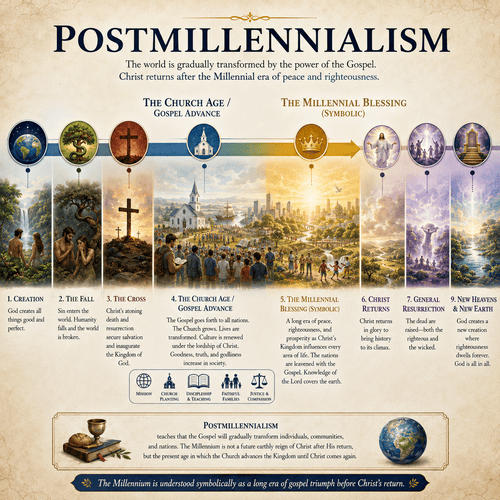
So postmillennialism teaches Christ will return after the millennium, not before it. The millennium isn’t a future age in which Jesus rules physically from an earthly throne in Jerusalem. It’s a long stretch of ordinary history in which the gospel succeeds so widely that most of the world is converted, and Christian faith visibly shapes families, law, learning and public life.
Four claims hold the whole position together:
- Christ is reigning now. He was enthroned at the Father’s right hand when He ascended. He’s not waiting to become King.
- His reign steadily defeats His enemies. Not all at once, and not by a single dramatic event, but progressively, through history.
- That victory becomes visible. The kingdom isn’t only spiritual and hidden. In time it changes nations.
- The victory comes by ordinary means. Preaching, prayer, the Lord’s Supper, baptism, patient teaching, the quiet work of the Holy Spirit. No shortcut. No cataclysm.
The “thousand years” isn’t a stopwatch. Numbers in Revelation are symbolic almost everywhere else in the book, and this one signals a long, complete, God-appointed span. It may be far longer than a literal millennium.
How it compares with the other views
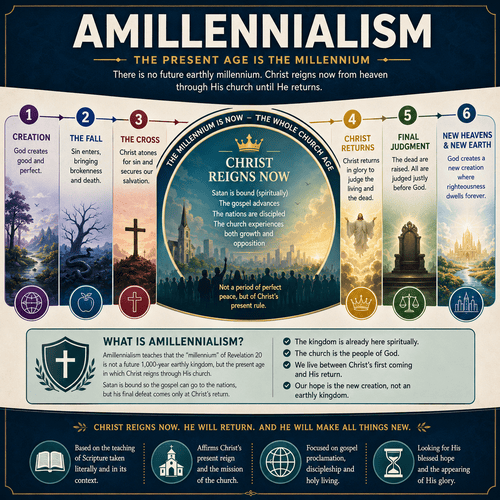
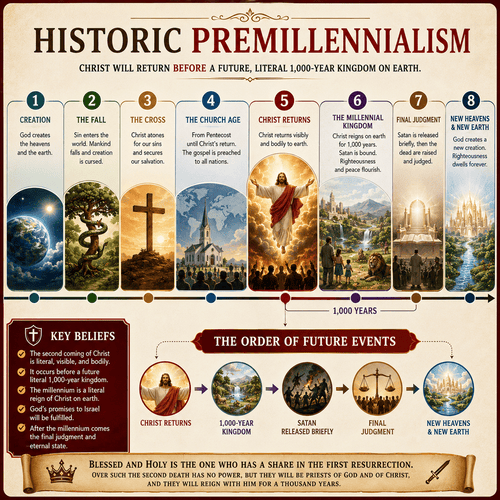
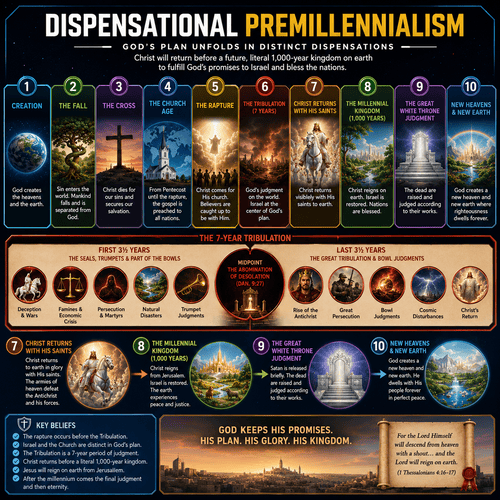
| DISPENSATIONAL PREMILL | HISTORIC PREMILL | AMILL | POSTMILL | |
|---|---|---|---|---|
| When does Christ return? | Before the millennium, in two stages | Before the millennium | At the end of history | After the millennium |
| What is the millennium? | A future earthly reign from Jerusalem | A future earthly reign after the tribulation | The whole church age, now | A future golden age within history |
| Is the gospel expected to succeed widely first? | No | No | Not especially | Yes |
| Israel and the church | Two separate peoples of God | One people | One people | One people |
| Resurrections | Several | Two | One general resurrection | One general resurrection |
Notice how much the last two columns share. Postmillennialism and amillennialism agree on one visible return, one resurrection, one judgement, one people of God, and a renewed physical creation. The disagreement is about how much ground the gospel takes before the end. That’s a family argument, not a fight over the faith itself.
The promises are too big to shrink
The case begins in the Old Testament, and it begins with the sheer size of what God promised.
God told Abraham in your offspring shall all the nations of the earth be blessed (Genesis 22:18). Paul later calls this promise “the gospel” preached in advance (Galatians 3:8). So the gospel comes with a stated scope built in: all the nations.
The rest of Scripture keeps enlarging it rather than trimming it back:
- Psalm 2:8—the Father tells the Son to ask, and He will give Him the nations as His inheritance and the ends of the earth as His possession.
- Psalm 22:27—All the ends of the earth shall remember and turn to the LORD. This sits at the end of the psalm that begins with the cry from the cross. The crucifixion produces worldwide conversion.
- Psalm 72:8–11—dominion from sea to sea; all kings falling down; all nations serving him.
- Isaiah 11:9—the earth shall be full of the knowledge of the LORD as the waters cover the sea.
- Habakkuk 2:14 repeats it almost word for word.
- Daniel 2:34–35, 44—a stone cut without human hands strikes the statue of the world empires, and then grows into a great mountain that fills the whole earth.
That last image deserves a pause. Daniel doesn’t describe a rock that gets rescued from the plain. He describes a rock that grows, gradually, until nothing else is left standing. The growth happens in ordinary time, inside history, before any final consummation. Daniel 7 says the same in different words: the Son of Man receives dominion, and all peoples, nations, and languages should serve Him (Daniel 7:14).
If these promises mean that God will save a small remnant scattered thinly across the globe, the language is wildly oversized. Words like “all”, “fill”, “ends of the earth” and “every nation” have to be quietly emptied out. Postmillennialism simply declines to empty them.
Jesus described slow growth, not quick collapse
When Jesus explained what His kingdom would be like, He reached for two pictures, and both are pictures of expansion.
A mustard seed, the smallest of seeds, grows into a tree large enough for birds to nest in. Leaven, a tiny amount of yeast, is worked into a large batch of dough till it was all leavened (Matthew 13:33).
Both parables share a shape: an insignificant beginning, a slow process, and a total result. Leaven doesn’t stay in one corner of the loaf. It doesn’t fight the dough to a draw. It changes everything it touches. Jesus chose that image deliberately.
He said the same thing about opposition. I will build my church, and the gates of hell shall not prevail against it (Matthew 16:18). Gates are defensive. A church that’s merely surviving doesn’t threaten anyone’s gates. This is a picture of an advancing army, not a besieged garrison.
Then comes the commission itself. Having declared all authority in heaven and on earth has already been given to Him, Jesus tells His disciples to make disciples of all nations (Matthew 28:18–20). The Greek word is ethnē—peoples, nations, whole societies, not merely scattered individuals collected out of them. And the command comes wrapped in a promise: He is with them to the end of the age. A commission backed by all authority and unbroken presence isn’t a commission designed to fail.
A King who is reigning right now
The strongest single text is Psalm 110:1, the verse the New Testament quotes more than any other: Sit at my right hand, until I make your enemies your footstool.
Two things are happening in that sentence at the same time. The Son is seated. The enemies are being subdued. The subduing isn’t something that waits until the seating ends—it’s what the seating produces. Verse 2 puts it plainly: He rules in the midst of your enemies.
Peter says this began at Pentecost. God has made the crucified Jesus both Lord and Christ (Acts 2:36), and He is now seated, waiting while His enemies are made a footstool. Paul draws the line to its end: He must reign until He has put all His enemies under His feet. The last enemy to be destroyed is death (1 Corinthians 15:25–26).
Read that carefully. Death is the last enemy, removed at the resurrection when Christ returns. Which means the other enemies are dealt with before that—during the reign, inside history. That’s postmillennialism in a single verse.
The ingathering of Israel
Romans 11 adds something remarkable. Paul says a partial hardening has come upon Israel until the fullness of the Gentiles has come in (Romans 11:25), and then all Israel will be saved.
He also describes what this will do to the world. If Israel’s stumbling meant riches for the nations, how much more will their full inclusion mean? He calls it life from the dead (Romans 11:15). Whatever else the phrase means, it doesn’t describe a world sliding into darkness. It describes an explosion of blessing still ahead of us.
This is one of those places where writers across the millennial views converge. Charles Hodge, John Murray and Herman Bavinck all expected a future large-scale turning of the Jewish people, whatever else they held. Postmillennialism simply follows the thought through to its consequence for the nations.
What Revelation 20 actually says
Revelation 20 is usually treated as the problem passage. It’s better read as a supporting one.
An angel seizes Satan and binds him for a specific stated purpose: so that he might not deceive the nations any longer (Revelation 20:3). That’s the whole point of the binding. Before Christ, the nations sat in darkness and the gospel was fenced inside one small country. After the cross, the fence came down. Jesus Himself said the ruler of this world would be cast out, and that He would then draw all people to Himself (John 12:31–32).
So the millennium is the period in which the nations can finally hear and believe. Satan isn’t annihilated; he is chained. He can still tempt individuals. What he can no longer do is hold entire peoples in blanket darkness. That’s precisely the condition the world has been in for 2000 years—and precisely why worldwide gospel success is possible.
Four things postmillennialism isn’t
- It’s not the Social Gospel. The 19th-century liberals expected the kingdom to arrive through education and social reform, without conversion, without the cross, without the Spirit. That’s a different religion. Postmillennialism expects the world to be won by preaching a crucified and risen Saviour, one converted heart at a time.
- It’s not a denial of Christ’s return. Jesus will return, visibly, bodily and personally, to raise the dead and judge the world. Nothing here softens that.
- It doesn’t require theonomy. Some who hold this view also argue the civil laws of Moses should govern modern nations. Many who hold it do not, and never did. The Westminster Confession itself says those judicial laws expired with the state of Israel, binding no other nation beyond their “general equity” (19.4).
- It’s not utopianism. Sin, sickness and death continue throughout the millennium. What changes is that the gospel becomes the dominant influence in the world rather than a minority report.
Where the view came from
- Fourth century—Augustine of Hippo taught the millennium is the present church age. The Western church largely followed him for a thousand years.
- 1600s—Thomas Brightman argued from Scripture for a coming era of gospel prosperity. English Puritans including John Owen and Thomas Goodwin developed the hope, especially around Romans 11.
- 1747—Jonathan Edwards published An Humble Attempt, calling churches to united prayer for a worldwide outpouring of the Spirit. His confidence helped ignite the modern missionary movement.
- 1800s—the view becomes dominant in Britain and America. Charles Hodge, William Greenough Thayer Shedd and Benjamin Breckinridge Warfield all held it. Warfield argued that when all of history is counted, the saved will vastly outnumber the lost.
- 1914–1945—two world wars shatter the shallow optimism of the age. Many abandon the view, often confusing it with the liberal version that had grown up alongside it.
- 1957 onwards—Loraine Boettner’s The Millennium, and later work by Iain Murray, Kenneth Gentry and Keith Mathison, recover the older, confessional form.
The honest objections
“But the Bible predicts apostasy and persecution.”
It does, and postmillennialism doesn’t deny a word of it. Two things need saying. First, much of what’s usually read as end-of-the-world material—Matthew 24 in particular—was spoken about the destruction of Jerusalem in AD 70, an event Jesus placed within that generation (Matthew 24:34). Second, Scripture describes repeated cycles of falling away throughout history, and Revelation 20:7–9 describes a short, final rebellion at the very end. A brief revolt against a Christianised world isn’t the same as permanent decline. It’s the last gasp of a defeated enemy.
“It hasn’t happened, so it has failed.“
Two thousand years feels long to us. Measured against the Old Testament’s timescales, it is not. And the objection assumes facts that are not in evidence. The church began with a hundred and twenty frightened people in an upper room. Ancient paganism collapsed. Hospitals, universities, abolition and mass literacy came out of Christian conviction. Today the fastest growth is in Africa, Asia and Latin America. The gospel has not stalled; it has relocated, which is exactly what an advancing army does.
“What about believers who’re suffering right now?“
This is the objection that matters most. A believer in a hostile village doesn’t need cheerfulness. But notice what this view actually gives her. It tells her her suffering isn’t the end of the story, and not even the shape of the story. It’s Friday, not Sunday. The pattern of the kingdom is cross first, crown afterwards—for the Head and for the body. Her grandchildren may worship freely where she cannot. That’s a firmer comfort than being told the darkness will simply deepen until the rescue comes.
Why any of this matters
Eschatology isn’t a hobby for people who like charts. What you believe about the end shapes how you live now.
- It changes evangelism. You aren’t fishing for survivors. You’re conscripting for a kingdom that is going to win.
- It changes cultural work. Teaching, medicine, farming, art and law aren’t brass on a sinking ship. They’re the beginnings of a world being reclaimed.
- It changes prayer. Your kingdom come, your will be done, on earth as it is in heaven becomes a request you actually expect God to answer.
- It changes your reading of the news. Headlines aren’t prophecy. A bad decade isn’t the end of the world.
- It changes your posture. Neither panic nor retreat. Patience, because the mustard seed is still growing.
The question at the heart of it all is simple. Did the cross accomplish a rescue of the few, or the redemption of the world? For God so loved the world—and the Son who was lifted up said he would draw all people to himself. He is seated. His enemies are being made his footstool. The stone is still growing into a mountain.
We aren’t waiting for the King to start reigning. We’re watching Him reign.
Tough Questions, Honest Answers
Do postmillennialists believe in the rapture?
Not in the popular sense. There’s no secret removal of the church years before a tribulation—that idea entered the church only in the 1830s through John Nelson Darby and spread through the Scofield Reference Bible. The passage usually cited, 1 Thessalonians 4:16–17, describes believers being caught up to meet the Lord in the air, using a Greek word (apantēsis) that in the ancient world described citizens going out of a city to welcome a visiting king and escort him back in. Christ descends; His people go out to greet him; they return with him. It’s one loud, public, unmissable event at the end of history, not a silent disappearance. On this, postmillennialists and amillennialists stand together against the whole rapture-chart industry.
Was John Calvin a postmillennialist?
No, and it would be dishonest to claim him. Calvin never wrote a commentary on Revelation, and he dismissed literalistic millennial speculation sharply in the Institutes (3.25.5). His outlook was closer to Augustine’s. What’s fair to say is that Calvin’s own commentaries on the Psalms and Isaiah are strikingly expansive about the worldwide reach of Christ’s kingdom, and his successors in Geneva and Britain drew out that thread. The developed position arrives later, with Thomas Brightman and the Puritans. Postmillennialism should be argued from Scripture, not from a roll call of famous names.
Is postmillennialism the same as Christian nationalism?
They’re not the same thing, though they often travel together in current debates. Postmillennialism is a claim about what the gospel will achieve; Christian nationalism is a claim about how a particular state should be constituted. One can hold the first without the second, and Charles Hodge and BB Warfield did precisely that. The danger worth naming is real: optimism about the kingdom can quietly curdle into optimism about political power, and the two aren’t the same currency. Christ’s kingdom advances by conversion, not by capture. When the church starts measuring success in legislative wins rather than in baptisms, it has changed religions without noticing.
What’s the difference between postmillennialism and preterism?
Preterism is a view about when prophecy was fulfilled, not about how history ends. Partial preterists hold much of Matthew 24 and Revelation was fulfilled in the destruction of Jerusalem in AD 70, while still expecting a future bodily return, resurrection and judgement—a position defended by Kenneth Gentry and, in a milder form, by RC Sproul. Most postmillennialists today are partial preterists, which is why the two get confused. Full preterism, which claims every prophecy including the resurrection was fulfilled in AD 70, is a different matter altogether: it denies the future bodily resurrection and therefore falls outside Christian orthodoxy. The distinction isn’t pedantic. It’s the difference between an interpretive option and a denial of the creed.
Which churches hold this view today?
No major denomination requires it. The Westminster Confession and the continental confessions teach one return, one general resurrection and one judgement, and deliberately leave the millennial question open—which is why congregations holding different views sit side by side in the same presbyteries. In practice the view is strongest today in the Communion of Reformed Evangelical Churches, among some Presbyterian and confessional Baptist congregations, and in the circles influenced by writers such as Douglas Wilson and Keith Mathison. It’s a minority position, and it should be held as one—with argument, not with sneering at brothers who read Revelation 20 differently.
If the millennium comes first, could Christ’s return be thousands of years away? What about “I am coming soon”?
Possibly, yes—and that’s not a problem. The New Testament never teaches Christ could return any second; it teaches we should be ready whenever He does. Jesus told parables about a master who was delayed a long time (Matthew 25:5, 19), and Peter answered scoffers by saying a thousand years are as a day to the Lord (2 Peter 3:8). The “soon” language of Revelation carries the sense of suddenness and certainty rather than nearness on a calendar. Interestingly, this removes the great engine of date-setting: if the world must first be discipled, then no headline is a countdown clock. Watchfulness becomes faithfulness in our ordinary duties rather than scanning the sky.
Does our millennial view affect our salvation?
No. Not one of the historic confessions makes a millennial position a test of communion, and men whose orthodoxy nobody questions have held every one of the main views. Salvation rests on Christ crucified and risen, received by faith—not on getting Revelation 20 right. Geerhardus Vos, who did more than most to clarify how the “already” and the “not yet” fit together, treated these questions as serious but secondary, and that instinct is sound. Hold your view with conviction, argue it from the text, and refuse to break fellowship over it. A believer who expects the world to grow darker and a believer who expects it to grow brighter are still waiting for the same Lord, and they will meet him on the same day.
Related Reads
- Christ’s Return: A Primer on the Four Millennial Views
- What Is Dispensational Premillennialism? A Biblical Assessment
- What Is Historic Premillennialism? A Biblical Assessment
- What Is Amillennialism? A Biblical Assessment
- God’s Kingdom: What is the ‘Already but Not Yet’ Paradox?
- Israel in End-Time Prophecy: Exploring God’s Covenant Promises
- The Mark of the Beast: What Revelation 13 Really Means by ‘666’