
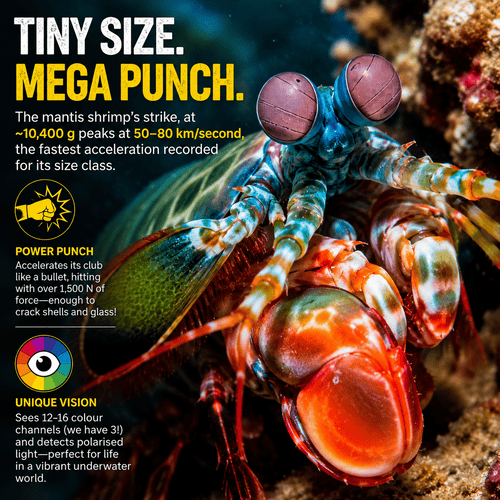
On a coral reef somewhere, a creature no longer than your finger is winding up to throw the fastest punch in the animal kingdom. The mantis shrimp—not actually a shrimp, but a fierce little predator called a stomatopod—is about to strike a crab with a blow so violent the water itself will flash with light. To understand what this animal is, we have to slow down a motion that takes less time than the blink of an eye, and look closely at machinery that human engineers are only beginning to copy.
A punch that breaks the rules
The “smasher” mantis shrimp kills with a club-like forelimb that accelerates at more than 10,000 times the force of gravity, reaching its target in under 3000ths of a second. The force at impact can reach 1,500 newtons—thousands of times the animal’s own weight, enough to shatter crab shells, snail armour, even aquarium glass.
Here’s the first puzzle: muscle cannot move that fast. No animal’s muscle fibres contract quickly enough to produce such a strike. So no, the mantis shrimp doesn’t rely on muscle for the blow itself. Instead it uses a spring-and-latch system, much like a crossbow. A saddle-shaped piece of its shell is slowly compressed and loaded with energy, held in place by a biological catch, and then released all at once. Energy stored over a leisurely moment is unleashed in an instant.
The strike is so fast it does something to the water that sounds like science fiction. As the club whips forward, it leaves behind pockets of vapour. The water moves so quickly it briefly boils at room temperature. These bubbles then collapse with such violence they release a flash of light and a burst of heat—an effect called cavitation. The result: the prey is struck twice: once by the club, and once by the imploding water a heartbeat later. Even a near miss can be fatal.
Armour that should not survive
A weapon that delivers such brutal force should destroy itself. Strike a hammer against stone ten thousand times and it cracks. Yet the mantis shrimp’s club takes thousands of these blows without breaking. The secret is in its structure: the club is built from layers of fibre, each layer rotated slightly from the one beneath it, forming a kind of spiralling staircase. When a crack tries to travel through the material, this twisting architecture forces it to change direction again and again until it runs out of energy. Engineers have studied the design closely and are now imitating it to build tougher body armour and aircraft panels.
That detail is worth pausing on. When a team of human scientists reverse-engineers the club, we rightly call their work brilliant. The original is older and works better. Consistency should make us ask who, or what, designed the first one.
The problem of the whole machine
The strike isn’t one clever feature but several features that are useless apart from one another. A powerful spring with no catch fires uselessly. A catch with no club to swing is pointless. And a fast strike attached to a fragile club would simply shatter the animal’s own weapon. The advantage appears only when the spring, the latch, the loading muscle, the crack-proof club, and the nervous system to aim and time it all exist together and are tuned to each other. A half-built version of this system isn’t merely less useful—it can be harmful. This is hard to explain as the product of countless tiny improvements, each one supposedly helpful on its own.
Eyes from another world
If the weapon were all, it would be quite enough. But the mantis shrimp also carries perhaps the strangest eyes in nature. They sit on stalks and move independently, and each single eye can judge depth on its own. They carry up to 16 kinds of light-detecting cells, where human eyes have only 3.
For years this was reported as proof the mantis shrimp sees more colours than any creature alive. It turns out this isn’t true. But the truth is more interesting. Tests show the animal is actually rather poor at telling similar colours apart. Instead of carefully comparing signals the way our eyes do, its eyes seem to scan a scene and recognise colour very quickly, trading fine detail for raw speed. This is exactly what a high-speed hunter needs: vision that keeps pace with a strike measured in 1000ths of a second. The eye isn’t built to win a contest for colours; it’s engineered as a perfect match for the weapon.
Stranger still, the mantis shrimp can see polarised light—light whose waves vibrate in a particular orientation. And it’s the only animal known to detect light that spirals, called circular polarisation. It does this using a natural optical device that works across every colour of light, something our best camera engineers still cannot reproduce. The animal even uses this hidden form of light to send signals its predators can’t see.
A Designer, and a hard question
Defenders of blind evolution point out spring-loaded mechanisms have appeared in many unrelated animals, from trap-jaw ants to snapping shrimp. They argue this shows such systems arise easily. But this cuts the other way. A complex, finely matched mechanism that’s hard to assemble even once becomes harder to explain—and not easier—when it must arise again and again. Engineers reach for the same good solution to the same problem repeatedly. So does the same Designer.
There remains an honest difficulty. Why would a good God design a creature into a living weapon? Two things can be said. First, the world we observe isn’t the world as it first was; the creation we study has been knocked out of its original order, subjected to a kind of futility, so the violence we see now needn’t reflect the Designer’s first intention. Second, the goodness of the Creator was never the same as mere gentleness. Power, ferocity, and breathtaking craftsmanship all display a glory that a tame and timid world could not. The mantis shrimp isn’t an embarrassment to that glory. It’s a small, fierce, gloriously over-built witness to it. And it asks us, with each impossible punch, to name the Mind behind it.
Tough Questions, Honest Answers
Isn’t the mantis shrimp simply the result of millions of years of natural selection?
Natural selection is real and powerful, but it can only preserve and refine what already works. The difficulty here isn’t fine-tuning a working strike but explaining how the many parts that must exist together—spring, latch, shock-proof club, and aiming system—arrived as a coordinated set. Selection rewards advantage at each step, yet a half-finished version of this weapon offers no advantage and may even harm the animal. The honest question isn’t whether selection sculpts, but whether it can assemble integrated machinery from scratch.
Spring-loaded mechanisms appear in many unrelated animals. Doesn’t that show they evolve easily?
Sure, it shows they’re excellent engineering solutions. But that’s a different thing altogether. If a complex, precisely matched mechanism is difficult to assemble by chance even once, then having it appear independently in ants, shrimp, and other creatures multiplies the difficulty rather than removing it. Human engineers also arrive at the same good design again and again, because good solutions are limited and recognisable. The repeated appearance of the same clever mechanism is exactly what we’d expect from a common Designer.
If the mantis shrimp doesn’t actually have the best colour vision, doesn’t that weaken the design argument?
Not at all. It strengthens it, which is precisely why honesty matters here. The popular claim was wrong, but the real picture is more impressive: the eye sacrifices fine colour detail for blistering speed, perfectly matching a predator whose strike lasts 1000ths of a second. That’s the signature of thoughtful engineering, which always involves trade-offs for a purpose. A designer optimises a tool for its job; he doesn’t max out every feature for its own sake.
Couldn’t the strike have evolved gradually, getting a little faster each time?
Speed alone isn’t the obstacle; coordination is. A faster strike is only useful if the club can survive it, the spring can store the energy, the latch can hold and release it on time, and the brain can aim it. Increase one part without the others and you’d get a broken limb. Or a wasted motion, not an improved hunter. Gradual change struggles to explain features that only help when several of them appear together and matched.
Why would a good God design such a violent killing machine?
This is a fair and serious question. Part of the answer is the world we study isn’t the world as it first was; creation has been pushed out of its original harmony, so the violence we observe now needn’t reflect the original design. The rest of the answer is that the Creator’s goodness was never the same as gentleness—power, fierceness, and astonishing artistry display a glory that a soft and timid world cannot. We can admire the engineering of the creature while recognising the present struggle of nature is part of a larger, broken story.
Isn’t this just a “God of the gaps” argument—crediting God for whatever science hasn’t explained yet?
A “God of the gaps” inserts God wherever knowledge runs out, only to retreat as science advances. That isn’t the argument here. The case rests not on our ignorance but on what we positively know: the more we learn about the mantis shrimp’s machinery, the more clearly it bears the marks of integrated, purposeful engineering. The inference grows stronger with knowledge, not weaker. That’s the opposite of a gap.
Hasn’t science already explained the mantis shrimp without needing a designer?
Science has described the mantis shrimp beautifully—the mechanics of the strike, the chemistry of the club, the optics of the eye. But describing how a machine works isn’t quite the same as explaining where the machine came from. A complete manual for a watch tells you nothing about whether watches have makers. The deeper question—how blind processes produced integrated, optimised systems that our own engineers still struggle to copy—remains very much open.
Our Related Posts