
It’s two in the morning, and a young woman stands in the fluorescent glare of an all-night pharmacy, holding a small box. She’s frightened. She has been told what’s inside the box is “just contraception.” She has also heard, perhaps from church, it’s something far darker. She does not need a slogan. She needs the truth.
So let’s ask it plainly, and answer it honestly: is the morning-after pill an abortion?
The question behind the question
The first surprise: the “morning-after pill” isn’t one thing. It’s a label stretched over several very different products, each of which works in a different way. The second surprise: the word “abortion” hides a buried assumption—a quiet answer to a question almost no one stops to ask: when does human life actually begin?
Everything hinges on how we answer that. Get the starting line wrong, and every conclusion after it is wrong too.
The definition that decides everything
Here’s the quiet move that wins the public debate before it begins. For most of medical history, “conception” meant fertilisation—the moment a sperm and egg unite to form a new, genetically complete human being. Then, in 1965, the American College of Obstetricians and Gynaecologists issued a short terminology bulletin redefining the word. From then on, in official usage, “conception” no longer meant fertilisation; it meant implantation—the moment, about a week later, when the days-old embryo embeds itself in the wall of the womb. Pregnancy, by the same stroke, was now said to begin not when a new life began, but when that life attached.
This wasn’t a scientific discovery. No new evidence about embryos had appeared, and the bulletin offered no scientific reason at all. It was a committee’s decision about words—and its purpose was not even hidden. Tellingly, the new definition never fully persuaded even the doctors who were instructed to use it. When researchers surveyed practising obstetricians decades later, most still said pregnancy begins at fertilisation—the older, plainer meaning the 1965 committee had tried to retire. The instinct that a human life starts when it starts has proven hard to legislate away.
Redefine the start of life, and any method that acts before implantation can be reclassified: even ending a life can be reclassified as merely “preventing pregnancy.” But notice what has happened. A moral question—does this destroy a human being?—has been swapped for a labelling question: has a pregnancy been clinically recorded yet? The embryo is the same living human organism the day before implantation and the day after. Implantation changes its address, not its nature. To define its death out of the category of “abortion” by moving the starting line of “pregnancy” is a trick of vocabulary, not an argument of substance.
So the real question isn’t the medical one. It’s this: from the first moment of fertilisation, is there a human being we’re bound to protect?
What Scripture says about the unborn
The witness is consistent and startling.
- Human dignity rests not on size, ability, or usefulness, but on being made in the image of God (Genesis 1:27). And that image isn’t earned by reaching some milestone of development. If dignity depended on capacity, the sleeping, the unconscious, and the newborn would all hold it only by degrees.
- The Psalms reach further back still. David says God knit him together in his mother’s womb and saw his “unformed substance” (Psalm 139:13–16). God was in personal relationship with him before he had any shape at all. Elsewhere David traces his very self, sins and all, back to conception (Psalm 51:5). There is an unbroken continuity of being; the person he is now is the same person who began then.
- In Luke’s Gospel, the unborn John leaps in his mother’s womb at the arrival of the newly conceived Christ (Luke 1:41–44)—two unborn children, one barely days old, already treated as persons who know and respond.
- The eternal Son of God became a human being not at birth, not at the first heartbeat, but at conception (Luke 1:35). The Word became flesh as a single cell. Whatever an embryo is, Christ once was. To say the unborn child is “not yet one of us” is to say something the incarnation forbids. Calvin, centuries ago, called the killing of the unborn a monstrous crime. His reasoning: the child in the womb is already a human being, and it’s doubly unnatural to destroy it in the one place it ought to be safest.
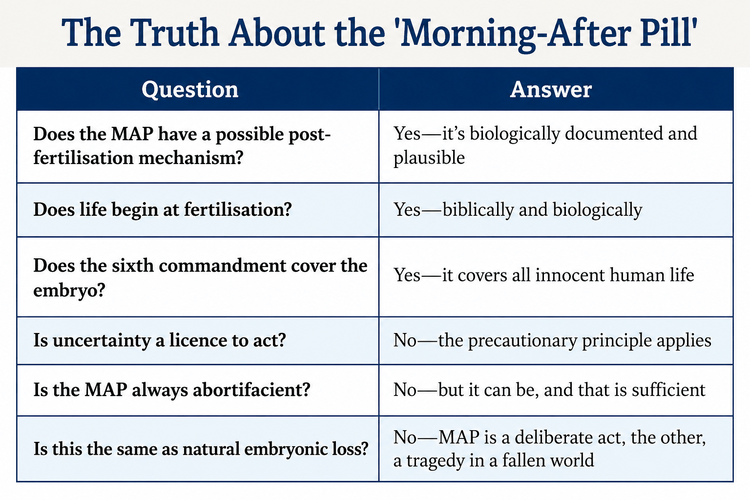
The scriptural case finds reinforcement in science: new insights into foetal consciousness have given the pro-life position additional evidential support. So we begin where Scripture begins: human life begins at fertilisation. Once we begin there, see how the nature of our question about the morning-after pill now changes. No longer is it whether taking the pill interrupts a “pregnancy.” It’s whether it destroys or prevents the survival of that new human being.
What the morning-after pills actually do
Now we’re ready to weigh the evidence. And here we must be precise, because the products differ sharply.
- The most common is Levonorgestrel, sold as Plan B and similar names. It’s a synthetic version of a natural hormone, and works mainly by stopping or delaying ovulation—the release of an egg from the ovary. If no egg is released, there will be no fertilisation, and so no new life. The best current research strongly supports this: study after study finds no effect on the lining of the womb. The pill has no power to stop an embryo from attaching, and pregnancies still occur when the pill is taken after ovulation has already happened. When it fails to prevent ovulation, it does not appear to do anything further. This is genuinely reassuring, and honesty requires us to say it plainly: Plan B is very likely not an abortion-causing drug.
- The second, Ulipristal Acetate, nicknamed Ella, is different in kind. Ulipristal works by blocking progesterone, the hormone that prepares and sustains the lining of the womb for a pregnancy. Its main effect, like Plan B’s, is to delay ovulation. But because it interferes with the very hormone that readies the womb, it can change that lining. And its makers’ own labelling admits this change “may also contribute” to how it prevents pregnancy. That careful phrase means it may sometimes act after fertilisation, by leaving the womb unable to receive a living embryo. Whether it truly does so is genuinely disputed; the science is unsettled. And unsettled is exactly the problem.
- The third is the copper intra-uterine device (IUD), a small device placed in the womb. No, this isn’t a pill. It’s sometimes used as emergency contraception after intercourse. Its main job is to disable sperm from reaching the egg. But when it’s used after fertilisation may already have occurred, its effectiveness openly depends on preventing a living embryo from implanting. Here even its defenders concede the point.
The principle that settles the hard cases
What do we do where science is uncertain—as with Ella? We follow a principle as old as conscience itself: we do not kill what may be a person. A hunter who hears rustling in the bushes and can’t tell whether it’s a deer or a child doesn’t pull the trigger. If a drug may sometimes destroy a human being, then “I wasn’t sure anyone was there” isn’t an excuse. It’s the very definition of recklessness toward life. Where there is real doubt about taking an innocent life, the doubt must be settled in favour of life.
So, is the morning-after pill an abortion?
The truthful answer is the one no honest opponent can dismantle, precisely because it follows the evidence: it depends which one.
- Levonorgestrel (Plan B) prevents ovulation and is very likely not an abortion.
- Ulipristal (Ella) carries a real and unresolved possibility of acting after a life has begun, and caution counsels against it.
- The copper IUD, used after the fact, can stop a living embryo from implanting, and is the clearest danger of all.
And beneath the whole debate lies that quiet redefinition: by moving the starting line of “pregnancy” to implantation, the death of an embryo can be kept from ever being called what it is.
A word of grace
No, this post isn’t prompted by the desire to win an argument or to hand anyone a verdict. We write because love constrains us to. And we dare not look away. Some lives are too small to speak for themselves. To say nothing while a person, however tiny, however hidden, might be lost isn’t gentleness. It would be indifference.
And yet truth told without love becomes a hammer, and we’ve no wish to swing one. Perhaps you’re reading this having already acted—in fear, or in confusion, perhaps. Or if your situation involved being wronged, know that pain is never your guilt to carry. Whatever the case, there’s no act beyond the reach of the mercy held out to you in Christ—mercy that does not flinch, does not shame, and does not keep score.
That is the offer. The same God who knits a child together in secret is the one who meets us in the open, with open hands in welcome. You aren’t too late. And you aren’t too far.
TOUGH QUESTIONS, HONEST ANSWERS
Where does the word “abortifacient” even come from?
It’s younger than most people assume. “Abortifacient” first appeared in English medical writing in the 1850s, built from two Latin parts—abortus, a miscarriage, and facere, to make or cause. So the word means, simply, “something that causes an abortion”: an abortion-maker. The root runs deeper still. The Latin aboriri, “to miscarry,” is the mirror image of oriri, “to rise, to be born” — so buried in the word is the picture of a life that had begun to rise being made to fail. What the word does not contain is any ruling on when that life begins. It only ever means “abortion-causing”; whether a given pill earns the name depends entirely on where one draws the line for the start of a human life. Which is exactly why the 1965 redefinition mattered so much: it changed not one thing about how any drug works—only which drugs the word was now permitted to describe
Hasn’t science proven the morning-after pill simply stops ovulation?
For levonorgestrel (Plan B), the evidence does point strongly that way, and we should welcome it rather than deny it. But that finding doesn’t transfer to Ella, whose anti-progesterone action raises a genuine post-fertilisation concern, or to the copper IUD, which can act after fertilisation outright. The honest approach follows the evidence product by product instead of issuing a single verdict for all of them.
Is the morning-after pill the same as the abortion pill (RU-486)?
No. The abortion pill, Mifepristone, is designed to end an established pregnancy by detaching an implanted embryo. The morning-after pill is meant to act earlier, mainly by preventing ovulation. Worth noting: Ella belongs to the same broad chemical family as Mifepristone—it blocks progesterone—though it’s weaker and used differently. That family resemblance is part of why Ella warrants more caution than Plan B.
Most fertilised eggs never implant naturally anyway. How is preventing implantation any different?
There’s a world of difference between natural death and a deliberate act. People die of natural causes constantly; that gives no one the right to kill. The fact that many embryos are lost naturally is a call to humility before God’s providence, not a license for human action against a life.
It’s only a tiny cluster of cells with no brain or feelings. How can that be a person?
Measuring worth by present ability proves far too much—it would also reduce the worth of the sleeping, the comatose, and the newborn, none of whom can yet do what we call “personal” things. The embryo is not a part of someone else, nor a different kind of thing that later “becomes” human; it’s already a whole, living human being with everything it needs to grow. Its dignity rests on what it is before God, not on what it can yet do.
What about ordinary birth control pills: are they abortion-causing too?
The same test applies: can the method destroy a living embryo? Standard combined pills work chiefly by suppressing ovulation, with a second effect of thickening cervical mucus to block sperm. Their labels have also long listed a third, or “tertiary,” effect—thinning the lining of the womb, which could in theory make implantation harder. Honesty here cuts both ways. There’s no positive scientific evidence this third effect actually causes embryos to be lost in practice; but because the possibility cannot be ruled out entirely, some Christians choose to avoid hormonal methods altogether. The framework matters more than any single product: weigh what a method can do to a living embryo, and where real doubt remains, let it fall on the side of life.
Isn’t this a private medical decision the church has no business judging?
The church’s task is not to coerce anyone but to tell the truth about God’s law and to help form the conscience. Naming what is at stake is an act of care, not control. And the same message that takes sin seriously is the message that freely forgives it.
Our Related Posts
- Healing from Abortion Guilt: Christ Offers Boundless Forgiveness
- Can Christian Couples Choose Permanent Birth Control?
- Selecting Embryos: The Hidden Ethics of “Healthy” IVF
- Can I Be Pro-Life But Not Religious? 7 Scientific Arguments
- Foetal Consciousness: How New Insights Strengthen Pro-Life Position
- Why NT Wright Is Wrong, Very Wrong on Abortion
- Why Are Christians So Rigidly Pro-Life?