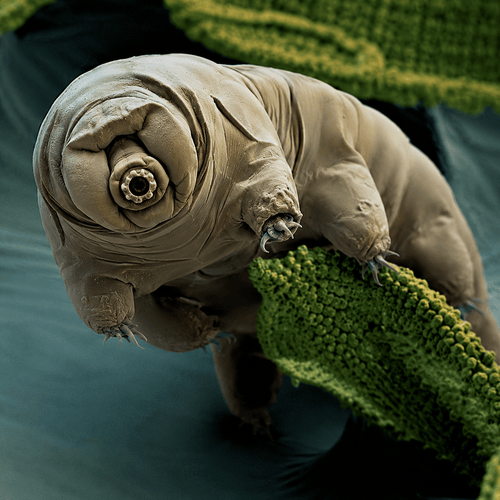
Somewhere in the damp moss on our roofs, an animal barely the size of the full stop at the end of this sentence is doing something we’d deem impossible. It’s called a tardigrade—or, more affectionately, a water bear. And it can survive very nearly anything the universe throws at it.
- Boil it.
- Freeze it to a whisker above absolute zero, around minus 272°C, the temperature at which molecules themselves stop moving.
- Crush it under a pressure 6 times greater than the deepest ocean trench.
- Blast it with a dose of radiation roughly a thousand times what would kill us.
- Fling it, unprotected, into the vacuum of space.
The tardigrade simply shrugs, waits, and walks away. In 2007 the European Space Agency did exactly that—it exposed water bears to open space for ten days—and many returned to life and went on to lay healthy eggs.
So the question this article exists to answer is obvious: did the tardigrade evolve these powers? Come, see why the tardigrade makes a compelling case—not for evolution but rather, for intelligent design.
A creature built for the unsurvivable
To see the puzzle clearly, we’d first need to know how tardigrades survive. When conditions turn deadly, the animal drives almost all the water out of its body, draws in its 8 legs, and shrivels into a tiny barrel called a “tun”. This condition is known as cryptobiosis, which means, quite literally, “hidden life”. Its metabolism—the sum of all the chemical reactions that keep a body running—doesn’t merely slow down. It stops. There’s no heartbeat to fail, no clock ticking down. Biological time is, in effect, switched off, sometimes for decades. In one study, tardigrades frozen for over 30 years revived and bred as though nothing had happened.
Holding that long pause together is a set of remarkable molecular tools. Chief among them is a protein found nowhere else in all of nature. It’s named Dsup, short for “damage suppressor”. The Dsup protein wraps itself around the animal’s DNA and shields it from the chemical shrapnel that radiation produces inside a cell. Its effect is so precise that when scientists splice the tardigrade’s Dsup gene into human cells, those cells become measurably more resistant to radiation damage. Working alongside Dsup are whole families of proteins unique to tardigrades. With names such as CAHS, these proteins turn the drying cell into a stable, glass-like solid, bracing its delicate machinery so it doesn’t shatter as the water departs.
This isn’t one clever trick. It’s an integrated survival system tuned for extremes that a moss-dwelling animal should never meet.
The evolutionist’s ‘story’—and where it breaks
The standard explanation runs like this. Tardigrades live in places that periodically dry out, so natural selection—the process by which helpful traits spread because their owners live long enough to breed—gradually shaped them to endure drought. The argument continues: surviving radiation, the vacuum of space and deep cold is simply a free side effect, because drying out and being irradiated can damage cells in much the same way. On this view, an extremophile—a creature that thrives in extreme conditions—is nothing more than an ordinary survivor, but with the dial turned up.
It’s a tidy story. But it also has serious cracks.
- The first crack is historical. In 2015 a celebrated study claimed roughly a sixth of the tardigrade’s genes had been borrowed wholesale from bacteria and other organisms by “horizontal gene transfer”—the passing of genes between unrelated creatures. Here, it seemed, was an easy origin for those survival genes: the water bear had simply picked them up second-hand. Within months the claim fell apart. Independent teams showed the “foreign” genes were laboratory contamination, and that genuine borrowing accounts for at most 1 or 2% of the genome. The easy answer evaporated. The signature survival proteins—Dsup, CAHS and the rest—are truly the tardigrade’s own, with no donor to copy from. The information for them had to come from somewhere else.
- The second crack runs deeper, and even secular biologists concede it. Natural selection can only preserve what helps an animal survive in its actual surroundings. It cannot plan ahead. It has no foresight—it cannot equip a creature for an ordeal it has never faced. Yet no tardigrade ancestor was ever exposed to the vacuum of space, or to the pressure inside a diamond press, or to a thousand lethal doses of radiation. There simply is no selective pressure to survive conditions that never occur where you live. The “side effect” reply explains a sliver—drought and radiation do share one damage pathway—but it cannot account for the sheer scale of the over-engineering, and it says nothing whatever about surviving a vacuum, which involves no such shared pathway at all. A mechanism whose function arrives long before there’s any need for it isn’t the mark of a blind, future-blind process. It’s the mark of design.
The problem of integrated machinery
Wait, there’s a third crack. Surviving total drought isn’t a single feature but a chain of steps, each one useless—or fatal—without the others. The animal must sense the danger in time, refold itself into the tun, manufacture its protective proteins on schedule, set into its glassy state, hold steady for years, then reverse the entire process and repair its damaged DNA on waking. A half-finished version of this chain doesn’t yield a slightly poorer survivor. It yields a corpse—and corpses leave no offspring to improve upon.
This is what biochemist Michael Behe named irreducible complexity: a system of matched, interdependent parts that does nothing useful until every part is present at once. Such systems fill the world of human design—an arch, an engine, a sentence—precisely because a mind can hold the finished goal in view and gather the parts towards it. Unguided steps cannot. And the honest admission of the field is itself revealing: the origin of these abilities, researchers grant, remains a mystery.
Reading the evidence
Lay the threads side by side:
- New, functional information that cannot have been borrowed.
- Abilities provisioned for futures the creature would never meet.
- A survival system that’s lethal unless complete.
Each thread points the same way. Specified, purposeful information is the universal calling-card of a mind. We know of no other cause in the universe that produces it.
This is the heart of intelligent design—not a retreat into “we cannot explain it, so God must have done it”, but a positive inference from what the evidence actually shows to the kind of cause that fits it. The tardigrade is a peculiarly pointed witness, because it’s so plainly over-built. It comes ready for catastrophes that, on any purely accidental account, should never have shaped it.
The God who answers Job out of the whirlwind doesn’t parade useful livestock before him. He parades creatures of extravagant, excessive wonder, precisely to humble the proud mind. And it seems He has hidden one such creature in the moss underfoot—an animal that laughs at the void of space. “The heavens declare the glory of God,” wrote the psalmist; so, it turns out, does the water bear. In Him, as the apostle Paul put it, all things hold together—down to the smallest barrel of hidden life, waiting in the dust for the rain.
Tough Questions, Honest Answers
Can tardigrades survive in space?
Yes. In 2007 the European Space Agency exposed tardigrades to the open vacuum of space for ten days. Many not only survived but afterwards laid healthy eggs. What makes this so striking is that no tardigrade has ever lived in space, so nothing in its past could have prepared it for those conditions. Natural selection can only build defences against dangers a creature actually faces. Survival in a vacuum is very hard to explain as an accident. It looks far more like equipment fitted in advance by a designer than a lucky by-product of evolution.
How do tardigrades survive radiation?
Tardigrades carry a protein called Dsup—short for “damage suppressor”—that wraps around their DNA and shields it from the harm radiation causes. Some species can endure a radiation dose around a thousand times greater than what would kill a human. Dsup is found nowhere else in nature, and scientists once hoped tardigrades had simply borrowed such survival genes from bacteria; that idea collapsed when the “borrowed” genes turned out to be contamination. So the information for this remarkable protein is genuinely the tardigrade’s own, with no donor to copy from—exactly the kind of new, specified information that points to a mind behind it.
What makes tardigrades almost indestructible?
When danger strikes, a tardigrade drives nearly all the water from its body and curls into a barrel-shaped “tun”, entering a state called cryptobiosis in which its metabolism stops altogether. In this dormant form it can withstand boiling heat, near-absolute-zero cold, crushing pressure and intense radiation. The toughness comes from an integrated kit of tools—the Dsup protein, special CAHS proteins that turn the drying cell into protective glass, and rapid DNA repair on waking. Because each part is useless without the others, the whole system must be present at once to work at all. This is a hallmark of design rather than slow, step-by-step accident.
Did tardigrades evolve, or were they designed?
The usual claim is that tardigrades evolved their toughness to survive drought, and that resistance to radiation, cold and the vacuum of space simply came along for free. Yet that cannot account for abilities calibrated to extremes the animal never meets, such as open space or pressures found nowhere in its habitat. Evolution by natural selection has no foresight; it cannot prepare a creature for trials it has never faced. When a survival system is provisioned for futures that could never have shaped it, the more reasonable conclusion is it was designed with those capacities built in.
Are tardigrades evidence for God?
They’re at the very least powerful evidence for intelligent design—the conclusion that certain features of living things are best explained by a mind rather than by undirected processes. The tardigrade carries new genetic information that cannot have been borrowed, abilities it never needed in its own environment, and a survival system that fails unless every part is present together. Each of these is a known signature of purposeful design, and we know of no blind process that produces them. For those willing to follow the evidence where it leads, the step from a designing mind to the God who “holds all things together” is a short and natural one.
How long can tardigrades survive without water?
Remarkably long. In their dried “tun” state, tardigrades have been revived after more than 30 years frozen. There are reports of longer dormancy still. With no water and no running metabolism, biological time is effectively paused—there’s no clock counting down towards death. Switching life off and on again so cleanly, and repairing the damage on waking, is extraordinarily hard to assemble by chance, since a half-working version would simply kill the animal. That all-or-nothing quality is precisely what we expect from a system designed to work as a whole.
How did tardigrades get their survival abilities?
For a time, scientists thought tardigrades had collected their survival genes from other creatures by “horizontal gene transfer”—the swapping of DNA with bacteria. That explanation failed when the supposedly foreign genes proved to be laboratory contamination, leaving the key proteins as the tardigrade’s own unique invention. Standard evolution struggles here, because it cannot create brand-new, finely-specified information from scratch, nor aim at survival challenges the animal never meets. The most coherent answer is that these abilities were given—built into the creature from the start by an intelligent Designer.
Our Related Posts