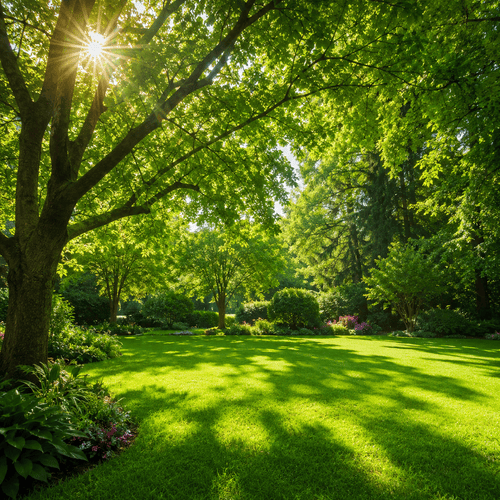
Look closely at a single green leaf. At this very moment it’s doing something our most advanced laboratories, after decades of effort and vast funding, still can’t copy. Silently, with no moving parts that wear out, it catches sunlight and uses that light to split water—prising apart one of the most stable molecules in nature—then turns thin air into food. This is photosynthesis: the process by which plants make sugar from sunlight, water and carbon dioxide. And the closer scientists look at it, the more it points beyond chance to a mind.
What makes photosynthesis special
Before we go further, consider what this everyday process actually involves:
- It splits water using nothing but sunlight—a feat no laboratory on Earth can yet copy cheaply or at scale.
- It releases the oxygen in every breath we take; without it, the air itself would be unbreathable.
- It feeds the world, building the base of almost every food chain from only light, water and air.
- It runs two linked chemical “factories” at once, each one useless without the other, in perfect step.
- It carries a built-in repair crew that constantly rebuilds its own machinery before it burns out.
- It captures light with an efficiency our finest engineers still envy and cannot match.
A machine we cannot build
Start with the headline fact. Deep inside every leaf sits the oxygen-evolving complex, a cluster of just four manganese atoms, one calcium and a few oxygens. The complex does something no human chemist can yet manage cheaply: tear hydrogen and electrons out of ordinary water using nothing but sunlight, releasing the oxygen we breathe as a by-product.
Splitting water sounds simple. It’s not. Every breath of oxygen in our atmosphere, and very nearly every meal we’ve ever eaten, depends on this one tiny piece of cellular machinery.
This is why the title is plain truth, not poetry. “Artificial photosynthesis”—building a man-made leaf that splits water and captures carbon the way a plant does—is one of the great unsolved problems of modern science. Teams of brilliant chemists have been trying, on purpose, with every advantage of intelligence and money, but still can’t seem to match what a blade of grass does for free.
Pause on that. If our finest minds, working deliberately, struggle to design photosynthesis, how reasonable is it to believe blind chance built it by accident?
Two factories, perfectly matched
Photosynthesis runs in two linked stages.
The first, the “light reactions”, uses chlorophyll—the green pigment that gives leaves their colour—to capture sunlight and turn it into chemical energy. Two light-driven engines, Photosystem II and Photosystem I, are wired together so precisely that electrons flow through them like water down a staircase, each step carefully tuned.
The second stage, the Calvin cycle, spends that energy. Here an enzyme called RuBisCO—the most common protein on Earth—grabs carbon dioxide from the air and builds it into sugar. The two stages are utterly interdependent. The light reactions make a fuel that’s useless unless the Calvin cycle is there to spend it; the Calvin cycle is dead without the fuel. Neither half does anything worthwhile alone.
The problem chance cannot solve
Here the evolutionary account runs into trouble. The standard story says photosynthesis evolved slowly, step by tiny step, in ancient bacteria long before plants existed. But three features make such a gradual origin extremely hard to believe.
- First, the oxygen paradox. The oxygen this process releases is, to the cell that makes it, a poison. The very same machine therefore needs a built-in protection system simply to survive its own product. A half-finished water-splitter that leaks oxygen and toxic by-products, without those defences already in place, doesn’t get a head start in life. It poisons itself. Natural selection cannot reward a half-built stage that kills the organism—and it cannot plan ahead to build protection for a job that does not yet exist.
- Second, self-repair. The heart of Photosystem II is so battered by its own work that the cell must tear out the damaged part and slot in a fresh copy every few minutes, all day long. Without this repair crew already running, the very first working Photosystem would cook itself. Machine and maintenance team are useless without each other.
- Third, interdependence. As we saw, the two factories only work as a pair. This is what is meant by irreducible complexity—a system whose parts only function together, so that removing any one piece breaks the whole. You cannot build it gradually, because the half-built versions do nothing useful. Or worse, they do harm.
Following the evidence
None of this is an argument from ignorance—a lazy “we can’t explain it, so God did it”. It’s the opposite. We reason exactly as detectives and scientists do, asking one simple question: in all our experience, what kind of cause produces things like this? Integrated machines whose parts are useless apart. Coded instructions, written in DNA, specifying every protein. Built-in error-correction and self-protection. It’s efficiency our own engineers envy.
We know of only one kind of cause that routinely produces such things: a mind. Intelligence builds integrated machines, writes coded information, designs repair systems and tunes them for efficiency. Blind chemistry does not. So when we find all these fingerprints together in a single leaf, the most reasonable conclusion isn’t that nobody made it, but that Somebody did. This is the heart of intelligent design—not a gap in our knowledge, but an inference to the best explanation.
From a designer to the Designer
Once we admit there’s a designer, the leaf begins to tell us what He’s like. He’s a chemist beyond our reach, who tuned a pigment to the exact light of a star. He’s generous, laying the base of the entire food chain so every creature might eat. He’s faithful, weaving repair and protection into His work and sustaining it moment by moment. The Bible names Him plainly: “by him all things were created… and in him all things hold together” (Colossians 1:16-17). The first thing God ever spoke into being was light—“Let there be light”—and from light, by His design, flows nearly all life on Earth.
So look again at that ordinary green leaf. It’s quietly performing a feat our cleverest laboratories cannot reproduce, running on sunlight and water, feeding the world. That’s not an awkward puzzle for the design hypothesis. It’s the whole point.
Tough Questions, Honest Answers
Some bacteria photosynthesise without producing oxygen. Doesn’t that “simpler” version prove there was a stepping stone?
It shows variety, not a ladder. Even the “simplest” light-using bacterium still needs a reaction centre, a pigment system, an electron-transport chain and carbon-capture machinery—a great deal of coordinated complexity in its own right. Calling it simpler only moves the puzzle, it doesn’t solve it; you’ve relocated the integrated design from the leaf to the microbe and quietly assumed it into existence. The question of how that first light-harvesting system arose remains unresolved.
Chloroplasts have their own DNA and resemble swallowed bacteria. Doesn’t that explain plant photosynthesis without any design?
The observation is real and fascinating: the photosynthesis machinery in plants does sit inside chloroplasts that look like captured bacteria. But even if a cell did take in a partner this way, that explains how an already-working photosynthetic system was passed on—not how it was built in the first place. Borrowing a finished engine isn’t the same as inventing one. The hard question, the origin of the machine itself, remains unanswered.
RuBisCO is famously slow and often grabs oxygen by mistake. Isn’t that clumsy, undesigned chemistry?
This is the strongest “bad design” objection, and it deserves a straight answer. “Slower than we’d like” isn’t the same as “undesigned”. Engineers constantly accept trade-offs for stability and control, and RuBisCO remains the most abundant protein on Earth, feeding the planet daily. Its apparent quirk even seems to serve useful roles in protecting the plant and handling nitrogen. And notice the hidden assumption: “a good designer wouldn’t do it that way” is a claim about God’s purposes, not about the chemistry—it quarrels with the workmanship without explaining how the machine arose.
Why are plants green rather than black? Wouldn’t a wise designer make them soak up every colour of sunlight?
At first glance, reflecting the green light the sun supplies so generously looks wasteful. But absorbing every wavelength at full strength would flood the system with more energy than it can safely handle, risking exactly the kind of damage the plant works hard to avoid. The “green gap” appears to be part of a careful balance between capturing enough light and not frying the machinery in bright sun. What looks like inefficiency in isolation often turns out to be sensible regulation within the whole.
Couldn’t each part have done some other useful job first, then been combined into photosynthesis later?
This is the most common reply to irreducible complexity, and it sounds reasonable until we examine it. Borrowing parts only works if each one is already a complete, precisely folded protein doing a real job—so we’ve not explained where that finished complexity came from, only shifted it elsewhere. Worse, the borrowed parts must then happen to fit together with exactly the right shapes, wiring, timing and regulation to form a new working whole. And it’s that coordinated assembly, not the lone pieces, where the real improbability lives. Expecting spare parts to fall into an integrated, self-repairing system that splits water is rather like expecting a scrapyard of unrelated components to assemble themselves into a running engine. The objection relocates the problem; it doesn’t dissolve it.
Why are there different kinds of photosynthesis, like C4 and CAM plants? Doesn’t that variety look like evolution at work?
Variety can equally be the mark of a designer fitting one excellent system to many different conditions. C4 and CAM plants are elegant adaptations for hot, dry climates—they concentrate carbon dioxide so the core machinery keeps working where ordinary plants would struggle. These read far more like clever engineering solutions to a known problem than like lucky accidents. A skilled designer is shown not by making one rigid model, but by tailoring a brilliant design to thrive across a varied world.
Photosynthesis turns only about one or two per cent of sunlight into plant growth. Why would a perfect Designer make something so inefficient?
That figure measures total biomass over a whole season, which undersells things badly: at the molecular level, the capture and transfer of light energy is astonishingly efficient, close to the theoretical limit. A plant is not a solar panel racing to maximise one number; it must also stay alive, repair itself, resist damage and avoid overheating, balancing many goals at once. Judged as a living, self-sustaining, self-repairing factory rather than a single-purpose machine, its performance is remarkable. “Less than we imagined” usually says more about our assumptions than about the design.
Our Related Posts