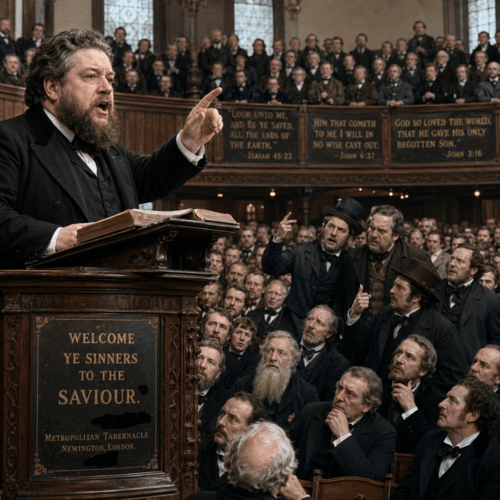
In January 1855, a 20-year-old Charles Spurgeon stood in his London pulpit and did something that got him branded a heretic—by other Calvinists.
He begged. He pleaded. He looked out at a congregation of strangers—and told every single one of them to come to Christ right then, without waiting for a feeling, a sign, or permission.
To a small but vocal group of fellow Baptists, that was outrageous. Not because Spurgeon had abandoned Calvinism, but because—in their hyper-Calvinist view—he’d taken it too far in the wrong direction. A true Calvinist, they argued, shouldn’t invite anyone to believe until there was evidence they were already among the elect. Spurgeon thought that was a betrayal of the gospel itself.
That argument is the doorway into hyper-Calvinism: what it actually is, where it came from, and why the very people you’d expect to defend it—convinced, five-point Calvinists—have spent three centuries arguing against it.
If you’ve ever heard the term used as a jab (“ugh, don’t be such a hyper-Calvinist”) aimed at anyone who takes God’s sovereignty seriously, this article is for you. That’s not what the word means, and getting it right matters—for your theology, and for how you talk to the person sitting across from you.
What Hyper-Calvinism Actually Means (Not What You Think)
Start with what it’s not. “Hyper-Calvinist” gets thrown around so loosely it’s worth clearing the ground first.
Hyper-Calvinism is NOT:
- Being deeply convinced of God’s sovereignty. No, believing firmly in election, predestination, and irresistible grace doesn’t make you a hyper-Calvinist—it makes you a Calvinist.
- Holding to all five points of Calvinism (TULIP). Total depravity, unconditional election, limited atonement, irresistible grace, and perseverance of the saints are the historic doctrines of grace, not the error under discussion.
- Being argumentative or insufferable about your theology. That has its own nickname—“cage-stage Calvinism”—and it’s a maturity problem, not the same doctrinal error (more on this below).
- Preferring older confessions, the King James Version, or metrical psalms. Personal or ecclesial taste isn’t a theological error either.
The word “hyper” doesn’t mean “extra enthusiastic,” as in hyperactive. It comes from the Greek preposition huper, meaning “over” or “beyond.” A hyper-Calvinist is someone who goes beyond what Calvinism—and Scripture—actually teach, not someone who believes it too strongly.
So what’s the actual error? Reformed writers who’ve studied this carefully, from Iain Murray to Phil Johnson, converge on a fairly precise definition. Hyper-Calvinism denies one or both of two specific things:
- Duty-faith—the idea that every person who hears the gospel is morally obligated by God to repent and believe, whether or not they turn out to be elect.
- The free offer of the gospel—the idea that God, through the preacher, sincerely and universally invites every hearer to Christ, not only those who already show signs of being chosen.
Deny both of those, and evangelism collapses. That’s precisely what happened historically, and precisely what Spurgeon fought against.
At a Glance: Calvinism vs. Hyper-Calvinism
| Question | Historic Calvinism | Hyper-Calvinism |
|---|---|---|
| Does God elect some to salvation? | Yes—unconditionally | Yes—unconditionally |
| Should the gospel be preached to everyone? | Yes, indiscriminately | No—or only cautiously |
| Is unbelief a sin for which all are responsible? | Yes | Denied or minimised |
| Is there common grace toward the non-elect? | Yes | Often denied |
| Basis for assurance | Christ, as offered in the gospel | Inward feeling, prior to faith |
The Two Errors at Its Root: Duty-Faith and the Free Offer
These two ideas sound technical, but they decide everything about how a church talks to unbelievers.
Duty-faith: everyone is obligated to believe
Duty-faith simply means repentance and faith aren’t optional extras offered to the fortunate few—they’re commanded of every person who hears the gospel. When God says through Ezekiel,
“I have no pleasure in the death of the wicked, but that the wicked turn from his way and live; turn back, turn back from your evil ways, for why will you die” (Ezekiel 33:11, ESV), that’s not addressed only to people God has secretly already decided to save. It’s a command to the room.
Paul says the same thing plainly in Athens: God “commands all people everywhere to repent” (Acts 17:30, ESV)—not “all the elect,” not “all who show signs of regeneration,” but all people, everywhere.
Hyper-Calvinists deny this. The reason: they argue, if God hasn’t chosen someone, it would be dishonest, pointless, or presumptuous to tell them they’re responsible to believe. Historic Calvinism rejects that reasoning as a category error—it treats a command (which everyone hears) as if it were a promise (which only the elect receive).
The free offer: Christ is genuinely offered to all
The free offer means the gospel invitation isn’t a formality or a riddle—it’s a sincere, open invitation extended to every hearer, elect or not. This is the language the Reformed confessions themselves use, and it’s precisely the phrase hyper-Calvinists have historically refused to say.
Why the resistance? Because if God has already fixed who will be saved, offering salvation to someone who will not be saved can feel like offering something God never intended for them. That objection sounds airtight—until you notice it’s trying to answer a question Scripture doesn’t ask us to answer.
Two wills, not two contradictions
The Reformed answer runs through Deuteronomy 29:29:
“The secret things belong to the Lord our God, but the things that are revealed belong to us and to our children, that we may do all the words of this law” (ESV).
God’s secret decree (who, in fact, will be saved) and God’s revealed will (the command to repent and believe, offered to all) operate on different levels. We’re never given access to the first. We’re commanded to obey the second. Hyper-Calvinism collapses the two, trying to preach from the decree instead of the command—and the moment we do that, evangelism has to stop, because nobody can read God’s secret list.
| Secret will (decree) | Revealed will (command) | |
|---|---|---|
| What it tells us | Who God will actually save | What God commands every hearer to do |
| Who can access it | God alone | Every reader and hearer of Scripture |
| What preachers should preach from | Never | Always |
Where It Came From: The English Particular Baptists
Hyper-Calvinism isn’t ancient. It’s a specific, traceable movement with a start date, and understanding the sequence explains why it happened at all.
1640s–1660s: Calvinism ascendant: During the Puritan era and the Westminster Assembly, English Calvinism affirmed sovereignty and duty-faith together, without apparent strain. The Westminster Confession and Larger Catechism—still standard Reformed documents today—both assume the free offer as normal preaching.
1660s onward: Reformed conviction under pressure: The restoration of the monarchy and the Act of Uniformity (1662) pushed Nonconformist congregations to the margins. Isolated, persecuted, and increasingly inward-looking, some communities began emphasising God’s secret decree over His public command—a theological retreat that mirrored their social one.
Early 1700s: Joseph Hussey and the turning point: Joseph Hussey’s 1707 book, tellingly titled God’s Operations of Grace but No Offers of His Grace, argued preachers should proclaim facts about Christ but must not “offer” Him to hearers as such. This is usually marked as the point hyper-Calvinism became an identifiable position rather than a drift.
1720s–1760s: Consolidation: John Skepp, Lewis Wayman, and John Brine developed and hardened Hussey’s position among England’s Particular Baptists, denying duty-faith outright and treating the free offer as a compromise with Arminianism.
John Gill (1697–1771): the complicated case: John Gill is frequently listed alongside the hyper-Calvinists, and he was certainly sympathetic to their concerns. But historians such as Peter Toon note Gill’s position was less extreme than Brine’s—he affirmed the general sufficiency of Christ’s death even while remaining uneasy with “offer” language. Whether Gill himself was a hyper-Calvinist in the fullest sense is still genuinely debated among historians.
1850s: Spurgeon’s confrontation: By the time young Spurgeon arrived at New Park Street Chapel in 1854, hyper-Calvinism had shaped a generation of English Particular Baptist preaching. His indiscriminate, urgent pleading with sinners was, to some in that tradition, close to scandalous. The clash that followed is the clearest case study in why confessional Calvinism rejects the hyper-Calvinist error.
Spurgeon’s Fight Against It
Spurgeon didn’t soften his Calvinism to win the argument. He sharpened it. His objections track four specific errors.
- He denied that invitations belong only to some. Hyper-Calvinists limited exhortation to congregations already showing signs of grace. Spurgeon addressed every hearer directly: “Look to him, blind eyes; look to him, dead souls; look to him.”
- He denied that assurance must come before faith. Hyper-Calvinism said you need an inward experience of conviction before you have the right to believe. Spurgeon located the warrant to believe in Scripture’s command itself, not in a prior feeling.
- He denied that inability cancels responsibility. Total depravity, for Spurgeon, was the reason we need grace to obey—not an excuse to stop commanding obedience. He wouldn’t tone down human helplessness “one whit,” and preached the command anyway.
- He denied that sovereignty and duty contradict. Spurgeon described divine decree and human responsibility as “two lines that are so nearly parallel… they do converge, and they will meet somewhere in eternity, close to the throne of God.”
Iain Murray’s account of this controversy, Spurgeon v Hyper-Calvinism: The Battle for Gospel Preaching, remains the standard history—and it’s worth noting that Spurgeon fought this battle as a convinced Calvinist defending Calvinism from a corruption within its own ranks, not as an outsider attacking it.
What the Reformed Confessions Actually Say
If hyper-Calvinism really were “where Calvinism naturally ends up,” you’d expect the confessional documents of Reformed churches to say so. They say the opposite.
| Confession | What it affirms | Reference |
|---|---|---|
| Canons of Dort (1618–1619) | The gospel is to be preached “promiscuously and without distinction” to all nations and people | Second Head of Doctrine, Article 5 |
| Westminster Confession of Faith | God’s eternal decree is fully compatible with genuine human responsibility and freedom | WCF chapters 3 and 9 |
| Westminster Larger Catechism | In effectual calling, Christ is “freely offered” to sinners in the gospel | WLC Q.31–32 |
These aren’t obscure footnotes—Dort is the very council that produced the five points hyper-Calvinists claim to be defending, and it explicitly requires the free, universal preaching hyper-Calvinism denies. This is why confessional Calvinists don’t experience the rejection of hyper-Calvinism as a compromise. It’s simply confessional consistency: holding what the documents actually say, rather than what a caricature of “strong” Calvinism implies they must say.
Common Grace, God’s Love, and the Non-Elect
A second front in the hyper-Calvinist error concerns how God relates to people He has not chosen to save—and it’s where the system produces its coldest fruit.
Common grace is the theological term for God’s general kindness toward all creation, believer and unbeliever alike: sunlight, rain, food, the restraint of evil, the basic order of society. Jesus points to exactly this in the Sermon on the Mount, where the Father
“makes his sun rise on the evil and on the good, and sends rain on the just and on the unjust” (Matthew 5:45, ESV).
Hyper-Calvinism, especially in its harder forms, denies common grace altogether, and with it, any sense that God has genuine kindness toward the non-elect. The logic is tidy but brutal: if someone isn’t chosen for salvation, the reasoning goes, God can only regard them with wrath. Historic Calvinism refuses that flattening.
- Common grace isn’t saving grace. God’s kindness in providence doesn’t guarantee anyone’s eternal salvation, and Reformed theology has never claimed it does.
- God’s kindness to all doesn’t require God’s decree to save all. The two truths sit at different levels, exactly as with the secret and revealed wills discussed above.
- Reformed theology holds both together without embarrassment. God can genuinely say, through Ezekiel, that He takes no pleasure in the death of the wicked, and simultaneously ordain, in His secret counsel, whom He will save—without those two truths cancelling each other out.
Strip common grace and the free offer away together, and what’s left is a God who has nothing for anyone outside the elect but calculated indifference or hatred. That’s not the God of Ezekiel 33, and it’s not the God confessional Calvinism proclaims.
Why This Still Matters Today (“Cage-Stage” Calvinism)
Hyper-Calvinism isn’t a museum piece. It’s a live temptation, especially for people newly excited about the doctrines of grace.
You’ve probably heard the term “cage-stage Calvinist”—the informal, half-joking label for a new convert to Reformed theology who becomes argumentative, superior, and exhausting to be around, as if they belonged in a cage until it wears off. Cage-stage is a maturity problem, not the historic error described above. But the two temptations often travel together, because both start from the same seed: pride in “having the system right.”
That pride can curdle into something closer to hyper-Calvinism if it’s left unchecked. Watch for these warning signs in your own walk, not just in others:
- Coldness toward the lost. If talk of election has made you less urgent about evangelism rather than more grounded in it, something has gone wrong.
- Hesitancy to plead with sinners directly. If you find yourself unwilling to tell an unconverted friend to repent and believe today, ask why—Scripture isn’t hesitant.
- Assurance tied to feeling rather than to Christ. If your confidence before God rests on an inward experience you’re trying to verify, rather than on Christ as He’s offered in the gospel, you’ve drifted toward the hyper-Calvinist pattern, whatever label you use for yourself.
Genuine confessional Calvinism does the opposite of what its critics expect. It doesn’t shrink evangelism—it grounds it. Sovereignty isn’t the reason to stop inviting sinners to Christ; it’s the reason the invitation can be preached boldly, to everyone, without fear that human resistance will have the final word. That was Spurgeon’s conviction in 1855, and it remains the historic Calvinist position now: preach the command, trust the decree, and leave the sorting to God.
Tough Questions, Honest Answers
Is Hyper-Calvinism just “extreme” Calvinism?
No. “Hyper” does not mean “very” or “extreme”—it means “beyond” or “over.” Hyper-Calvinism is a specific deviation from historic Calvinism, not historic Calvinism turned up a notch. A five-point Calvinist who affirms duty-faith and the free offer is not “half a step” from hyper-Calvinism; they are the very thing hyper-Calvinism departed from.
Did John Calvin teach Hyper-Calvinism?
No. Calvin’s Geneva was a missionary-sending centre, and Calvin himself preached and wrote in ways that assumed the gospel should be proclaimed openly to all hearers. Hyper-Calvinism emerged among English Particular Baptists more than a century after Calvin’s death, in a very different historical context of persecution and theological isolation.
Was John Gill a Hyper-Calvinist?
It is genuinely debated. Gill shared some of the movement’s caution about “offer” language, but historians such as Peter Toon distinguish his position from the harder line taken by John Brine. Gill affirmed the general sufficiency of Christ’s atonement in a way that some hyper-Calvinists did not, which is why scholars disagree on exactly where to place him.
Does the Bible really command everyone to believe, even the non-elect?
Yes. Acts 17:30 says God “commands all people everywhere to repent,” and Ezekiel 33:11 has God pleading with “the wicked” generally to turn from their ways and live. These commands are addressed to hearers as hearers, not filtered by whether they turn out, in God’s secret decree, to be among the elect.
If God has already chosen the elect, why evangelise at all?
Because God has ordained the preaching of the gospel as the means by which He calls His elect (Romans 10:14–15). Election is the reason evangelism will succeed, not a reason it is unnecessary. Historic Calvinists like Spurgeon evangelised urgently precisely because they trusted God’s sovereignty to work through their preaching, not despite it.
Is it wrong to tell someone “God loves you” before they’re saved?
Reformed theologians are careful here, but the answer is not simply no. Scripture affirms God’s common kindness toward all people (Matthew 5:45) and His stated lack of pleasure in anyone’s destruction (Ezekiel 33:11). What they avoid is implying that this proves someone is elect or guarantees their salvation—distinguishing common grace from saving love, without denying either.
How can I tell if I’m drifting toward Hyper-Calvinism myself?
Ask whether your growing conviction about sovereignty has made you less willing to plead with the lost, more hesitant to say “repent and believe” plainly, or more inclined to base assurance on an inward feeling rather than on Christ as offered in the gospel. If so, revisit Spurgeon’s example and the confessions themselves—both point back toward bold, indiscriminate preaching, not away from it.
Related Reads
- Romans 9 Calvinism and Arminianism: The Whole-Chapter Debate
- What Is Provisionism? A Reformed Response to the Flowers Challenge
- Common Grace Vs Saving Grace: How Are They Different?
- Regeneration Or Faith? Which Comes First in Salvation?
- The Synod of Dort: The Debate That Gave Us TULIP
- The Calvinist-Arminian Debate: The Strongest Objections to Calvinism Answered
- Biblical Compatibilism: God’s Sovereignty vs Human Choice