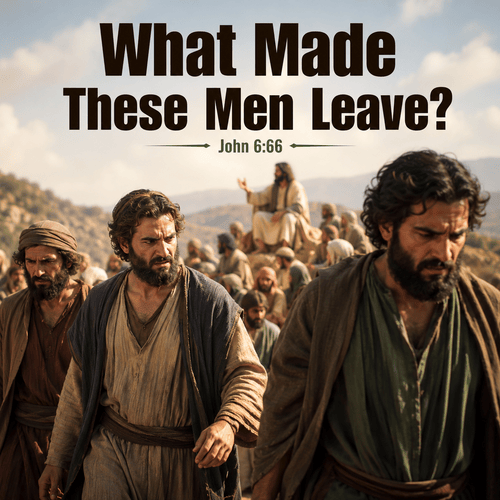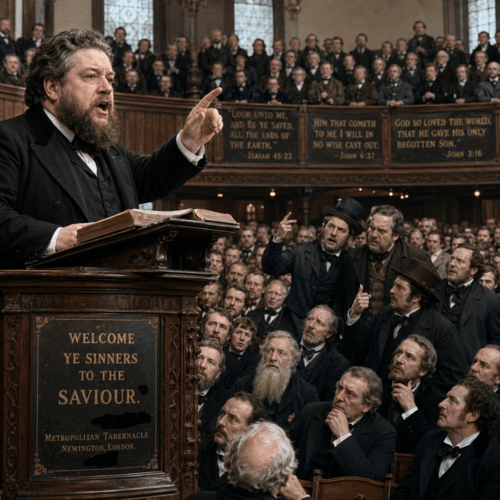
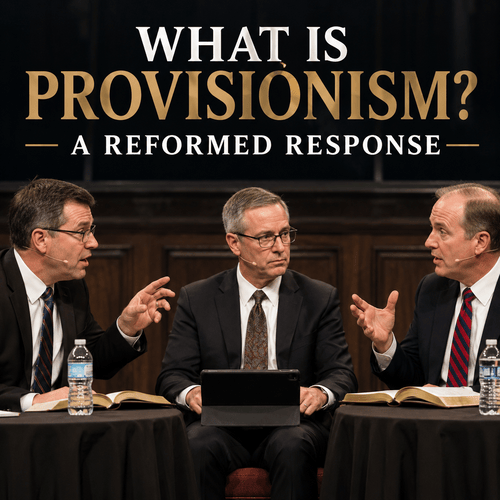
Something is shifting in the corner of the internet where ordinary Christians ask hard questions about salvation. Type “what is Provisionism” into Google and you’ll likely find a small but growing cluster of pages trying to answer a question almost nobody was asking a decade ago. The reason is one man and one podcast—Dr Leighton Flowers and his ministry, Soteriology 101—which has spent years building a slick, media-savvy case against Calvinism, and packaging its alternative under a brand-new name.
If you’ve never heard of Provisionism, you’re not alone. It’s young, it’s growing fast among Baptist and evangelical audiences, and remarkably few Reformed writers have engaged it in any depth. That’s the gap this article aims to close.
Flowers and the people who follow him wrestle honestly with hard questions. Why does God choose some and not others? Is my will really free? Does grace force itself on people against their will? Those are good questions, and they deserve careful answers—not just from a podcast, but from the whole counsel of Scripture. Provisionism offers one set of answers. We think the Bible gives a different, and better, one. Let’s work through it together.
What Is Provisionism? Origins and the PROVIDE Acrostic
Provisionism is a fairly new label for a very old set of ideas. It grew out of the “Traditionalist” movement inside the Southern Baptist Convention—a loose grouping of pastors and scholars who wanted a name for their view of salvation that was distinct from both Calvinism and the more familiar label “Arminian.” Leighton Flowers, a Texas-based apologist and former Calvinist himself, became the movement’s most visible and prolific spokesman, and it’s largely through his books, debates, and thousands of podcast episodes that the term Provisionism has spread.
The name points to the heart of the system: God has graciously made provision for every person to be saved, and it’s up to each individual to respond to that provision in faith. Flowers summarises the view using the acrostic PROVIDE:
| Letter | What it stands for |
|---|---|
| P | People sin—all humanity is separated from God by sin |
| R | Responsible—every person is able to respond to God’s gracious appeals; sin does not remove this ability |
| O | Open door—salvation is genuinely open to anyone who will come |
| V | Vicarious atonement—Christ’s death provides a payment sufficient for every person, not merely the elect |
| I | Inclusive call—God’s call to be saved goes out to all, not a select few |
| D | Deity’s sovereignty—God remains sovereign, but exercises that sovereignty without overriding human choice |
| E | Eternal security—once a person is truly saved, they cannot lose that salvation |
That last point is worth pausing on, because it’s where Provisionism quietly parts ways with classical Arminianism, which generally allows for the possibility of falling away from grace. Provisionism wants the Arminian view of the will and Calvinism’s confidence about eternal security, without buying either system’s full logic. It’s in that sense, a genuinely hybrid position. And understanding that hybrid nature is the key to evaluating it fairly.
How Provisionism Differs from Classical Arminianism
Because Provisionism borrows from both traditions, a side-by-side comparison is perhaps more useful than a paragraph of description. Here’s how the three positions line up on the questions that matter most:
| Doctrine | Calvinism | Classical Arminianism | Provisionism |
|---|---|---|---|
| Human depravity | Total inability to respond without regeneration | Depraved, but enabled by prevenient grace | Depraved, but never actually unable to respond |
| Election | Unconditional, individual, before creation | Conditional on foreseen faith | Corporate and conditional on faith |
| Atonement | Definite—for the elect | Unlimited in scope, provisional in effect | Unlimited and genuinely sufficient for all |
| Grace | Effectual and irresistible for the elect | Resistible, assisted by prevenient grace | Resistible; no special enabling grace needed |
| Security | Perseverance guaranteed for the elect | Salvation can be forfeited | Eternal security once truly believed |
Notice the pattern. On depravity, election, atonement, and grace, Provisionism sits close to Arminian territory. On perseverance, it borrows the Calvinist answer wholesale, but detaches it from the doctrine of effectual grace that historically supports it. This is precisely the point Reformed readers should press on, because eternal security without irresistible grace raises an obvious question: if God doesn’t sovereignly keep believers in faith, what stops the same “free will” that got someone into the faith from later walking them out of it? Provisionism does have an answer to this, but it requires importing assumptions about the nature of saving faith that aren’t obviously drawn from the same texts used to reject unconditional election.
The Core Claim: Total Depravity Without Total Inability
If you strip away the debates over Greek exegesis and historical labels, Provisionism rests on one move: separating sinfulness from inability. Flowers is happy to affirm every person is a sinner, guilty before God, and morally corrupt. What he denies is that this corruption disables the will so completely that we cannot, of ourselves, respond positively to the gospel appeal. On his view, sin affects everything about us—except, crucially, our capacity to say yes to God when the good news is clearly presented.
This is a significant departure from how Reformed theology has always read the relevant texts. Consider three lines of evidence:
- Paul describes the unregenerate mind as hostile, not merely weakened. “For the mind that is set on the flesh is hostile to God, for it does not submit to God’s law; indeed, it cannot” (Romans 8:7). The word is not “struggles to” or “is reluctant to”. It is cannot.
- Jesus ties coming to Him directly to the Father’s drawing. “No one can come to me unless the Father who sent me draws him” (John 6:44). A few verses later He repeats the point almost word for word (John 6:65), which suggests it wasn’t a throwaway line.
- Paul describes spiritual realities as literally unintelligible to the natural mind, not merely unwelcome to it: the natural person cannot understand the things of the Spirit, because they’re spiritually discerned (1 Corinthians 2:14).
None of this is Calvinism inventing a harsher anthropology for the sake of a theological system. It’s simply what the text says when read on its own terms. The Reformed answer to Provisionism’s central move, then, isn’t that people are more sinful than Flowers thinks. It’s that “responsible” and “able” aren’t the same category. Scripture holds people fully responsible for rejecting Christ (that’s precisely why unbelief is culpable). It also insists saving faith itself must be a gift, worked by the same Spirit who raises the physically dead (Ephesians 2:1–5). Responsibility doesn’t require ability; it requires only that the inability itself is morally blameworthy. This is exactly the sinner’s condition.
Corporate Election and the Reading of Romans 9
Provisionism’s second major move concerns election. Rather than reading Romans 9 as describing God’s choice of specific individuals for salvation, Flowers argues the chapter is really about corporate election—God’s choice of a people (first Israel, then the church) as a group, into which individuals enter by faith. On this reading, Jacob and Esau aren’t really about the eternal destinies of two men, but about which nation would carry God’s covenant purposes forward.
There’s a genuine insight buried in this: corporate categories do matter in Paul’s argument, and it would be careless exegesis to flatten Romans 9–11 into nothing but individual predestination. But the corporate reading struggles with the details Paul actually gives us. Consider the timing and the terms Paul uses:
- Paul specifies the choice was made before either child was born, and before either had done anything, good or bad (Romans 9:11). If this were purely a statement about national roles, the point about pre-birth timing does the argument no real work. The drama only makes sense if it’s bearing on the individuals themselves.
- Paul immediately anticipates the objection “Is there injustice on God’s part?” (Romans 9:14). The question only makes sense if unconditional individual selection, not merely a corporate assignment of roles, is what is actually at stake.
- The chapter’s illustrations—the potter and the clay, mercy on whom He has mercy, hardening whom He hardens (Romans 9:15–21)—are framed as answers to a question about individual fairness, not national logistics.
Corporate election isn’t wrong so much as incomplete. Individuals are chosen in Christ (Ephesians 1:4), and that choice is then worked out through the corporate life of the church. The individual and corporate dimensions sit together rather than replace one another. Provisionism needs the corporate reading to carry more weight than the text will bear, because without it, Romans 9 remains a very difficult chapter for any system built on libertarian free will.
Unlimited Atonement: Provision versus Application
Flowers draws a careful distinction here that’s worth taking seriously before responding to it. He argues Christ’s death is sufficient payment for every person who has ever lived, but that this payment only becomes effective—is only applied—when a person believes. The cross, in other words, provides; faith applies. This lets Provisionism affirm texts that speak of Christ’s death for “the world” (John 3:16) or as a propitiation “for the whole world” (1 John 2:2) without difficulty, since on this view the scope really is universal.
The Reformed doctrine of particular redemption (sometimes called “limited atonement,” though that label undersells what it affirms) makes a different distinction. It’s not a debate about how many people the cross is sufficient for in some abstract sense. Reformed theology is generally happy to affirm the infinite worth of Christ’s sacrifice. The real question is one of design and intention: for whom did the Father send the Son, and for whom did the Son actually lay down His life, with the specific purpose of securing their salvation?
Several texts point in a particular, rather than universal, direction:
- Jesus says He lays down his life for the sheep—not for the world in the same undifferentiated sense (John 10:11, 15).
- Matthew names the child born of Mary “Jesus … for He will save His people from their sins” (Matthew 1:21). Notice: a specific people, not humanity as an undifferentiated mass.
- Paul tells husbands to love their wives “as Christ loved the church and gave Himself up for her” (Ephesians 5:25)—a bridegroom’s self-giving for a particular bride.
There’s also a logical problem worth raising gently, not as a gotcha but as a genuine question Provisionism has to answer: if Christ’s death actually paid the penalty for our sin, and we still end up in hell paying for the same sin ourselves, in what sense was the payment ever made on our behalf? Provisionism’s answer—that payment was offered but never applied—is coherent as far as it goes, but it does turn the atonement into something closer to a universal offer than to a substitutionary payment. This sits in tension with the language of “bearing,” “paying,” and “propitiating” that Scripture actually uses.
Is Calvinism Really Determinism? Answering the Charge
This is where Flowers’ rhetoric is at its most vivid—and, frankly, at its least careful. He regularly describes Calvinism as a deterministic system that reduces human beings to mere puppets. At times he even reaches for comparisons to ancient dualistic and fatalistic philosophies to make the point land. It’s an effective soundbite. However, it’s not an accurate description of confessional Reformed theology.
Historic Reformed confessions never teach bare determinism in the sense Flowers attacks. They teach concurrence—the idea that God’s sovereign decree and genuine human will operate together, on different levels, without either cancelling the other out. A human being genuinely chooses; God, who ordains all things, ordains this choice to occur, through our own nature and desires, not against them. This is usually called compatibilism: free will and divine sovereignty are compatible. “Freedom” is defined as acting according to our own desires and nature, not as an uncaused, contra-causal power floating free of everything that makes us who we are.
The philosophical irony: Flowers’ own system faces a comparable problem from the other direction. If human choice must be entirely free of any prior determining cause—including God’s foreknowledge—to count as “authentic,” then God’s exhaustive foreknowledge of every future choice becomes philosophically awkward. How can God know with certainty what has not yet been determined by anything, including His own decree? Reformed theology answers this cleanly, because God’s knowledge of the future flows from His decree of the future. Provisionism’s answer here tends to be less settled, and different Provisionist writers resolve the tension in different ways. This is itself a sign the “authentic free will” foundation is carrying more theological weight than it can bear.
The Hard Cases Provisionism Can’t Easily Answer
Every system has its difficult questions. Fairness requires pressing Provisionism on its own hard cases, just as its advocates press Calvinism on unconditional election.
If salvation genuinely depends on a person’s informed, free response to the gospel, what happens to:
- Infants who die before they can understand or respond to anything?
- Those with profound cognitive disabilities, who cannot process a gospel appeal at all?
- The billions who’ve lived and died without ever hearing the gospel preached?
Flowers’ typical answer is that such people are saved on the basis of innocence. They have not yet had opportunity to reject the light they were given, so grace covers them. It’s a pastorally kind answer. It’s also, on Provisionism’s own terms, a quiet admission that salvation doesn’t always require an informed free-will response after all. If God can save someone apart from their conscious, responsible choice to believe, the very thing Provisionism insists is essential for everyone else turns out to be optional in exactly the hardest cases.
Reformed theology doesn’t need this exception, because it doesn’t claim salvation depends on the sinner’s independent choice in the first place. Notice the Westminster Confession’s answer to the same hard cases: elect infants and others incapable of being outwardly called are regenerated and saved by Christ through the Spirit, who works when, where, and how He pleases. And it flows from the same doctrine of grace that applies to every other believer. It’s not a special exception bolted on to patch a gap; it’s the same monergistic grace, doing for the incapable exactly what it does for the capable.
A Reformed Summary—What’s Right, and What’s Missing
Provisionism gets some important things right: God’s love for the world is real, His call to repentance is sincere and addressed to everyone, and human beings are genuinely responsible moral agents, not puppets. Reformed theology affirms all three. Where Provisionism goes wrong is in assuming that responsibility, sincerity of the call, and human agency can only be preserved by denying the Spirit’s necessary, effectual, regenerating work—and by treating libertarian free will as a foundation stronger than the biblical texts that describe it.
The Reformed vision isn’t smaller than Provisionism’s; it is larger. It holds together sincere invitation and sovereign election, real human choice and effectual grace, universal gospel proclamation and particular redemption—not as contradictions to be managed, but as a single, coherent account of how a God who is both perfectly sovereign and perfectly good saves sinners who cannot save themselves. That, ultimately, is the case this article has tried to make: not that Leighton Flowers asks bad questions, but that Scripture, read carefully and as a whole, answers them better than Provisionism does.
Tough Questions, Honest Answers
Is Provisionism the same as Arminianism?
Not exactly. Provisionism shares Arminianism’s view of human free will, conditional election, and resistible grace, but it departs from classical Arminianism by affirming eternal security—the belief that a person who is truly saved cannot later lose their salvation. It’s best understood as a hybrid position, built mainly on an Arminian foundation with one Calvinist-style doctrine grafted on.
Did Leighton Flowers invent Provisionism, or does it have older roots?
The label is new, but the underlying ideas aren’t. Provisionism is essentially a repackaging of positions that go back through Southern Baptist “Traditionalism” to classical Arminianism and, further back still, to the debates between Augustine and Pelagius in the early church. Flowers’ contribution has been branding, systematising, and popularising the view for a modern podcast audience, not originating it.
Does Provisionism deny total depravity?
It affirms depravity but redefines what depravity does. Provisionists agree every person is morally corrupted by sin and guilty before God. What they deny is that this corruption removes a person’s ability to respond positively to the gospel without a special, prior work of the Spirit. Reformed theology insists Scripture teaches both—depravity and the inability that necessarily accompanies it.
How do Provisionists interpret Romans 9?
Most Provisionist writers argue Romans 9 describes God’s choice of a corporate people—Israel, then the church—rather than His choice of specific individuals for salvation. Reformed interpreters agree corporate categories do matter in the passage. However, Paul’s specific details (the pre-birth timing, the question of injustice, the potter-and-clay illustration) only make sense if individual, not merely corporate, election is in view.
Is Provisionism a form of Semi-Pelagianism?
This is a live debate rather than a settled fact, and it depends on precise definitions. Some critics argue that by denying inherited guilt in the strict sense and emphasising unaided human ability to respond to grace, Provisionism drifts closer to ancient semi-Pelagian categories than to classical Arminianism. Provisionists themselves reject this label, insisting they affirm inherited corruption and guilt. Readers should weigh the actual arguments on both sides rather than treating the label itself as a settled verdict.
Does Calvinism really teach God is the author of sin?
No. Reformed confessions explicitly deny this, distinguishing between God’s decree that sin will occur and God’s causing sin in the same way He causes good. Historic Reformed theology teaches concurrence—God ordains all things, including human choices, while human beings remain the genuine, responsible agents of their own sinful acts. The charge that this amounts to “God authoring sin” is a common but mistaken caricature of the actual doctrine.
Can a Provisionist be a genuine Christian?
Yes. Provisionism is a debate about the mechanics of how salvation is applied—not a denial of the gospel itself. Those who trust in Christ’s death and resurrection for the forgiveness of sins are genuine believers, whether or not they have worked out a fully consistent doctrine of grace. This article critiques a theological system, not the sincerity or salvation of the people who hold it.
Related Reads
- Romans 9 Calvinism and Arminianism: The Whole-Chapter Debate
- What Is Hyper-Calvinism—and Why Do Calvinists Reject It?
- Why Does God Choose Some for Salvation and Not Others?
- Why Do Some Respond to God’s Call While Others Don’t?
- Prevenient Grace: 5 Reasons the Doctrine Fails
- Total Depravity: The Doctrine That Makes Grace Make Sense
- Biblical Compatibilism: God’s Sovereignty vs Human Choice
- Free Will vs Free Agency: Is "Agency" the Better Word?