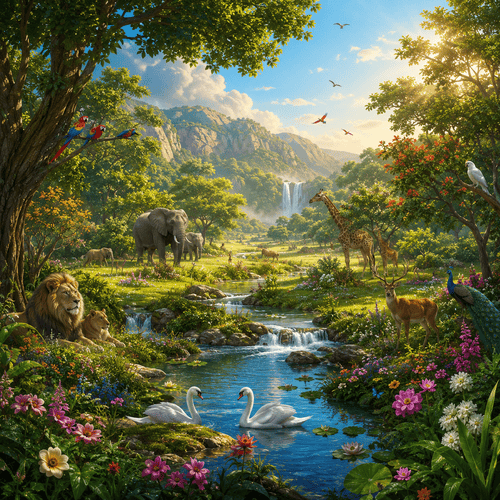
It’s one of the oldest questions in the world. If Eden was a real place—a real garden, with real trees and a real river—then surely we should be able to point to it on a map. And yet nobody can, at least not with certainty. People have placed Eden in Iraq, in Turkey, in Iran, in Africa, in Armenia, even in the Americas. So where was it?
The Bible doesn’t leave us guessing entirely. In Genesis 2, it gives us the closest thing Scripture ever offers to a set of directions: a river, and four channels flowing from it, with named lands and even the minerals found there. That’s a remarkable level of detail. The problem: when we follow the directions, two of the rivers are easy to find and two seem to have vanished. Unpacking that puzzle takes us somewhere far more important than a dot on a map.
What the Bible actually says
Here’s the key passage. Read it slowly, because every word will matter:
“And the LORD God planted a garden in Eden, in the east; and there he put the man whom he had formed… A river flowed out of Eden to water the garden, and there it divided and became four rivers.”
— Genesis 2:8, 10 (ESV)
Notice two things straight away. First, Eden and the garden aren’t the same thing. Eden is the wider region; the garden is a special plot planted inside it, towards the east. Second, one river rises in Eden, waters the garden, and then splits into four “heads”, meaning four branches or channels. The Bible then names them.
The four rivers
| RIVER | LAND IT FLOWS AROUND | WHAT IS NOTED |
|---|---|---|
| Pishon | Havilah | Gold, bdellium (a fragrant resin), and onyx stone |
| Gihon | Cush | — |
| Tigris (Hiddekel) | East of Assyria | — |
| Euphrates (Perath) | — | Named alone, needing no explanation |
Two of these we know at once. The Tigris and the Euphrates are among the most famous rivers in history. They still flow today, through modern Iraq. This is our anchor: the Bible is clearly pointing to the region of Mesopotamia—the fertile land “between the rivers”, in what’s now Iraq and eastern Syria. So far, so simple.
The puzzle: findable and unfindable rivers
Here’s where it gets interesting. If you look at a map of the Tigris and Euphrates today, they don’t behave the way Genesis describes. Genesis says one river divides into four. But the Tigris and Euphrates do the opposite: they begin separately, high in the mountains of eastern Turkey, run side by side, and only join together near the Persian Gulf. The text describes water spreading out from one source; the map shows water gathering in towards one mouth.
And then there are the other two rivers, the Pishon and the Gihon. No one can point to them with confidence on any modern map. They appear nowhere else in the world’s geography as we now have it. Two rivers we can find; two we can’t. That’s the puzzle every theory about Eden is really trying to solve.
The puzzle in one sentence
Genesis describes one river branching into four, in a land marked by the Tigris and Euphrates—yet today those two rivers join rather than branch, and the other two can’t be found at all.
Chasing the two lost rivers
The clues Genesis gives about the Pishon and Gihon are our best hope of narrowing things down.
The Pishon and the land of gold
The Pishon flowed around Havilah, “where there is gold”. This is a strong hint, because gold doesn’t come from just anywhere. The most likely candidate is Arabia. An ancient gold mine in western Saudi Arabia, known today as Mahd adh-Dhahab—which means “Cradle of Gold” —was worked thousands of years ago. That fits the description remarkably well.
Even more striking: in the 1990s, scientists studying satellite images from space found the dried-up bed of a great river that once ran from the gold-bearing hills of western Arabia down towards the Persian Gulf. It has been nicknamed the “Kuwait River”. Here was a real river, now dead and buried under desert sand, flowing exactly where a Pishon “around Havilah, where there is gold” ought to flow. That’s not proof, but it’s a stunning fit.
The Gihon and the land of Cush
The Gihon flowed around Cush. This word usually means the region south of Egypt, roughly modern Ethiopia and Sudan—which would be impossibly far away for a river also linked to Iraq. But “Cush” may point somewhere closer. An ancient people called the Kassites lived east of the Tigris, in the direction of Iran, and their name resembles Cush. If that’s the Cush in view, the Gihon could be a river flowing down from the mountains of Iran, such as the Karun.
Where, then? The main theories
Christians who take the Bible seriously have landed in a few different places. Here are the serious options, and the difficulty each one faces.
| THEORY | THE IDEA | THE DIFFICULTY |
|---|---|---|
| Head of the Persian Gulf | Read the four “heads” as rivers meeting where the Gulf is now; the site may lie under the sea today. | Requires reading “divided” as convergence, not branching |
| Northern mountains of Turkey | Eden sits where the Tigris and Euphrates actually rise | Struggles to fit the gold of Havilah and the land of Cush |
| Lost in the Flood | The Flood reshaped the earth’s surface; the old geography is simply gone | Leaves the location unknowable in principle |
| The promised land | Eden lay in the wide territory later given to Israel | A minority reading; strains the plain geography |
The strongest and most widely held view among careful scholars is the first one: the head of the Persian Gulf, in southern Mesopotamia. On this reading, the four rivers are seen meeting near the Gulf, with the Pishon as that lost “Kuwait River” draining Arabia and the Gihon as a river from Iran. During the last Ice Age, the floor of the Gulf was dry, low-lying land; as the ice melted and the seas rose, it flooded. If Eden lay there, the very ground it stood on may now be under water. That single idea neatly explains why the rivers no longer fit the map and why the garden itself cannot be found.
A note on the fringe theories
You’ll find confident claims placing Eden in Missouri, Florida, or an island now sunk beneath the ocean. These make lively websites but rest on no real evidence. The Bible’s own clues—the Tigris, the Euphrates, the gold, the named lands—point firmly to the ancient Near East, not to the Americas.
What Christians have long believed
This isn’t a new debate. John Calvin, writing his commentary on Genesis nearly 500 years ago, faced the very same puzzle. He did two wise things that are worth copying.
First, he refused to turn Eden into a fairy tale or a symbol floating in the sky. Some in his day wanted to spiritualise the garden away, placing it in the heavens. Calvin insisted it was a real place on the real earth, in the region of the Tigris and Euphrates. Second, he held the exact spot loosely. He freely admitted the land had changed over the centuries and that certainty about the precise location was beyond reach. He was confident about the truth of the account and humble about the map.
The pattern to follow
- Firm about the fact: Eden was a real garden in a real place, and Adam was a real man.
- Humble about the pin: the exact location is genuinely uncertain, and always has been.
Later Bible scholars have followed the same path. The best judgement of careful, faithful interpreters is this: Eden was a real location, most probably in Mesopotamia, quite possibly at the head of the Persian Gulf, and we simply cannot mark the spot with confidence.
Why we should not expect to find it
Between the garden and us stands the great Flood of Noah’s day. Whatever view one takes of its scale, a flood that reshaped the land would explain a great deal. It would explain why two of the rivers survive as real, named rivers while two have vanished. It would explain why the source and the mouth no longer line up with the text.
So the fact that we cannot find Eden is exactly what we might expect. A made-up story doesn’t usually anchor itself to real gold mines and real, mappable rivers. The survival of the Tigris and Euphrates shows the writer meant a real place; the loss of the Pishon and the Gihon is what a changed world would produce. Absence of a modern signpost isn’t evidence the garden was a myth.
The bigger secret hidden in the details
Now we reach the heart of the matter, and it’s far richer than geography. When you read Genesis 2 alongside the rest of the Bible, you notice the garden is being described in language that later belongs to one place above all: the temple, the house of God. Eden was not merely a garden. It was the first holy place on earth, the meeting point of God and humanity. Look at the clues:
- God walks in the garden (Genesis 3:8). The same word later describes God’s presence moving among His people in the tabernacle. The garden is where God comes down to be with us.
- Adam is told to “work and keep” it (Genesis 2:15). Those two words are the exact pair used later for the duties of the priests who served in God’s sanctuary. Adam isn’t just a gardener; he’s a guardian of holy space.
- The entrance faces east and is guarded by cherubim (Genesis 3:24). The tabernacle and temple were entered from the east, and figures of cherubim guarded the holiest place inside.
- Gold and onyx appear in the garden (Genesis 2:11-12) and reappear as the very materials of the tabernacle and the priest’s clothing.
- The tree of life stands at the centre. In the temple, a golden lampstand shaped like a tree stood in the holy place, and the walls were carved with trees and flowers.
- A river flows out of Eden. Later, the prophet Ezekiel sees a river flowing from the temple, and the final book of the Bible shows a river of life flowing from God’s throne.
Put it together and a clear picture forms: Eden was the original temple-garden, the place where earth touched heaven. Adam was placed there as a kind of priest-king, given a job much larger than tending plants. He was to guard this holy place and to spread its blessing outward. To fill the whole earth with the presence and worship of God. Sin cut that mission short. Adam was cast out, and the way back was barred by the cherubim and the flaming sword.
From Eden to the city of God
Here the whole Bible opens up as a single story. What was lost in Eden isn’t lost forever. The pattern of Eden—God dwelling with His people—runs like a golden thread all the way through Scripture:
- Eden: God walks with humanity in a garden-sanctuary, which is then lost through sin.
- The tabernacle and temple: God provides a holy place, decorated like a garden, where He can once more dwell among His people.
- Jesus Christ: the true temple in person, God come to live among us, opens the way back into God’s presence that Adam had closed.
- The New Jerusalem: the last pages of the Bible show a garden-city with the tree of life restored and the river of life flowing again—Eden regained, and made even greater.
Strikingly, that final city has no temple building in it, because God Himself fills the whole place with His presence. The mission first given to Adam—to spread the sanctuary until it covers everything—is finally complete. The garden becomes a city, and the city fills the new creation.
The point in a single line
We cannot find the garden on a map, but we can find our way back to what the garden was for—life with God—through Jesus Christ, the true and greater Eden.
Holding it all together
So where was the Garden of Eden? Three things can be said with confidence, and it’s important to keep them together.
- It was a real place. The named rivers, the gold, the identifiable Tigris and Euphrates all point to real geography in the ancient Near East. This matters, because a real Eden means a real Adam—the man whose fall and whose need for rescue lie at the centre of the gospel.
- Its location is genuinely uncertain. The best answer is Mesopotamia, most likely near the head of the Persian Gulf, with the site perhaps lost beneath the sea or reshaped by the Flood. Faithful Christians have always held this humbly.
- Its meaning is not uncertain at all. Eden was God’s first holy place, humanity’s home with God, lost through sin and reopened in Christ. That is the treasure the four rivers were guiding us towards all along.
The map may have washed away. The message never did.
Tough Questions, Honest Answers
Is the Garden of Eden a real place?
Yes. The Bible describes it with real rivers, real lands, and real minerals, and it treats Adam as a real person. The historic Christian view has always been that Eden was a genuine location on earth, even though its exact spot is now uncertain.
Why can’t we find the Garden of Eden today?
The most likely reasons are the great Flood, which would have reshaped the land, and the rising of the seas after the Ice Age, which may have covered the original site with water. Two of the four rivers still exist; two have vanished, exactly as a changed world would produce.
Where do the Tigris and Euphrates point?
They point to Mesopotamia, the fertile region between the two rivers in modern Iraq and eastern Syria. This is our firmest clue and the reason nearly all serious theories place Eden somewhere in that part of the world.
What were the Pishon and the Gihon?
These are the two rivers we can no longer identify with certainty. The Pishon flowed around a gold-rich land and may match a dried-up river bed found by satellite running from Arabia to the Gulf. The Gihon flowed around Cush, possibly a region towards Iran.
Did Noah’s Flood destroy the Garden of Eden?
Very likely, in the sense that a flood reshaping the land would erase the old geography. This helps explain why the rivers no longer match the text and why the garden cannot be found. It is a reason for the mystery, not an excuse to avoid it.
Was Eden the same as the promised land of Israel?
A few interpreters have suggested this, reading the geography broadly. It remains a minority view. The plain sense of the named rivers points more naturally to Mesopotamia than to Canaan.
Is the Garden of Eden the same as heaven?
No. Eden was an earthly place where God dwelt with humanity. But it was a picture and a foretaste of something greater. The Bible ends not with a return to a garden but with a garden-city, where God lives among his people forever.