Your sons have been playing a game for weeks. Then one evening you glance at one screen and see it: a five-pointed star glowing on the ground, a character chanting over a summoning circle, a demon’s face on the menu. A cold thought lands in your stomach: Have I let something into my house?
This is one of the most searched parenting questions online. This article builds a careful, Bible-based case for what actually happens when a screen shows occult imagery, and where the real danger to your child lies.
What do we mean by “occult symbols”?
Occult simply means hidden. Occult practices try to reach hidden supernatural power outside of God—divination (predicting the future by unnatural means), sorcery (spells or potions used to control events), necromancy (contacting the dead), or summoning (calling a spirit to obey you). A pentagram (five-pointed star), a sigil (a symbol believed to channel power), and a summoning circle are visual shorthand for these practices, borrowed by designers because they’re instantly recognisable.
Some fear even seeing such imagery is the same as practicing the occult, that the symbol itself is a kind of switch.
Two wrong answers to start with
TWO DITCHES EITHER SIDE OF THE ROAD
| The superstitious answer | The dismissive answer |
|---|---|
| “The symbol itself has power. Seeing a pentagram on screen can open a door for a demon to come through.” | “It’s just pixels. Symbols mean nothing. There’s no spiritual dimension to worry about at all.” |
| Treats an image as though it were spiritually charged, like a battery. | Treats the spiritual world as though it were not real at all. |
| Closer to a magical worldview than a Christian one. | Ignores what Scripture plainly says about the reality of evil spirits. |
Historic Christian teaching walks between the two ditches. The rest of this article builds that middle way from the ground up.
Does the symbol itself have power?
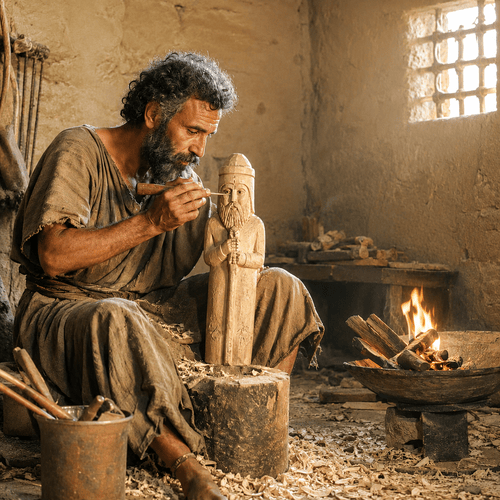
Start with the plainest text available. Writing about food offered to idols, the apostle Paul says: we know that “an idol has no real existence,” and that “there is no God but one” (1 Corinthians 8:4). The statue, in itself, is nothing—carved wood or stone with no built-in spiritual charge. It cannot reach out and touch you simply because you looked at it.
The same logic applies to a game. A rendered pentagram is coloured light on a screen, with no independent power to summon or transmit anything. Scripture nowhere teaches that images carry automatic spiritual force.
So is the demonic real, or not?
Yes—fully real. This is where the dismissive answer fails. The Bible never treats evil spirits as make-believe:
- Paul names the real enemy. We do not wrestle against flesh and blood, but against the rulers, against the authorities, against the cosmic powers over this present darkness, against the spiritual forces of evil in the heavenly places (Ephesians 6:12).
- Sorcery is a genuine sin, listed alongside enmity and rage in Galatians 5:20.
- The witch of Endor in 1 Samuel 28 is treated as spiritually real and serious, not as a trick.
- A whole city repented of it. In Acts 19:19, Ephesian believers who’d practised magic arts burned their books publicly, a costly break with something they knew to be genuinely dangerous.
Both things are true at once: the object has no power, yet the spiritual reality behind organised occult practice is genuine. Holding the two together is the key to the whole question.
The passage that solves the puzzle
Paul faced this exact tension in Corinth, and 1 Corinthians 8–10 is the master text for our subject. He says the idol is nothing (8:4), yet later warns: what pagans sacrifice they offer to demons and not to God. I do not want you to be participants with demons… you cannot partake of the table of the Lord and the table of demons (10:20–21).
Notice where the danger sits. Not in the object—but in participation, treating the practice as real, desirable, something to be joined. Looking at a picture of a summoning circle isn’t participation. Being trained, through hours of repeated play, to desire occult power as normal and good moves much closer to what Paul warns against.
Where exactly is the line? A spectrum, not a switch
Deuteronomy 18:10–12 forbids divination, sorcery and necromancy in the strongest terms, calling them an abomination to the LORD. But notice what the text forbids: practising these arts, not merely reading or watching a story that mentions them. Scripture itself narrates occult events (Endor, Simon Magus in Acts 8, the Ephesian sorcerers) without suggesting the reader sins by reading about them.
This gives a genuinely useful tool: a spectrum of risk, rather than a single switch that’s either ON or OFF.
| LEVEL | WHAT IT LOOKS LIKE | SPIRITUAL RISK |
|---|---|---|
| Depiction | Occult symbols exist as set-dressing or mark the villain as evil. | Low. Often morally clarifying: evil is shown as evil. |
| Simulation | The player casts “spells,” draws circles, performs rituals as game mechanics. | Moderate. Less about supernatural transfer, more about normalising and rehearsing these categories. |
| Invitation | The game presents real occult practice as attractive and rewarding, or teaches actual incantations, blurring fiction and reality. | Higher. Moves toward what Paul calls participation— real caution warranted. |
A villain wearing a pentagram sits at the low end of this table. A game that walks a child through performing an actual occult ritual sits much further along it. Most games fall somewhere on the depiction-to-simulation range, which is why blanket panic and blanket dismissal both fail. The honest answer requires looking at the specific game.
Can a Christian child be “invaded” through a screen?
This is the heart of the parental fear, and Scripture answers it with real confidence. A believer isn’t unguarded territory a symbol can quietly occupy.
- He who is in you is greater than he who is in the world (1 John 4:4).
- He has delivered us from the domain of darkness and transferred us to the kingdom of his beloved Son (Colossians 1:13).
A child who belongs to Christ is already indwelt by the Holy Spirit and is already transferred out of darkness’s domain. There’s no vacancy for a game symbol to fill. This isn’t to claim nothing can trouble or tempt a Christian—it plainly can. But it firmly answers the specific fear of invasion through passive exposure to an image. That fear rests on a view of vulnerability the Bible doesn’t teach.
So where’s the real doorway?
If it isn’t the symbol, and the child in Christ isn’t exposed territory, where does the actual danger lie? Scripture points inward: Keep your heart with all vigilance, for from it flow the springs of life (Proverbs 4:23).
Theologian John Calvin called the human heart a perpetual factory of idols, not because objects manufacture idolatry, but because the heart is always ready to manufacture its own. This reframes the whole question. Video games aren’t spiritual conduits; they’re formative experiences. Hundreds of hours of repeated play shape what a child finds normal and desirable, the same way any story repeatedly told shapes a listener.
WHAT REPEATED EXPOSURE CAN ACTUALLY DO
- Normalise: occult ideas start to feel ordinary rather than forbidden.
- Disciple the imagination: power is pictured as something seized through spells, not received from God.
- Cultivate appetite: a taste develops for secret power and control, the oldest idolatry in the book (Genesis 3:5).
- Dull the conscience: the instinct that once recoiled from occult ideas grows quieter with repetition.
None of this requires a symbol to carry supernatural charge. It only requires ordinary human formation. It’s the same mechanism by which any repeated story shapes a heart. Do not be conformed to this world, but be transformed by the renewal of your mind (Romans 12:2).
What real spiritual warfare looks like
Because the danger is formation rather than contamination, the response is discipleship, not ritual. Ephesians 6:10–18 describes the Christian’s armour, and it’s worth noticing what’s missing: no amulets, no holy water, no special gestures, no “portal-closing” prayers aimed at objects.
THE ACTUAL ARMOUR OF GOD
- Truth: a belt holding everything together.
- Righteousness: a breastplate guarding the heart.
- The gospel of peace: footwear for standing firm.
- Faith: a shield that puts out the enemy’s attacks.
- Salvation: a helmet protecting the mind.
- The word of God: the only weapon named, offensive not defensive.
- Prayer: the posture that holds the whole armour together.
Christian counsellor David Powlison drew a sharp line between the modern “deliverance” approach—hunting for demons behind every problem, relying on rituals and objects—and the classic biblical approach, which fights through ordinary faith, repentance, truth, and obedience. Resist the devil, and he will flee from you (James 4:7) — resistance here is obedience, not incantation. Treating a game’s imagery with dread, as though removing the object makes a house safe, quietly borrows the very magical worldview it means to fight.
A caution against overcorrecting: avoiding legalism
The warnings above should not tip into binding consciences where God has not. Romans 14:23 reminds us whatever does not proceed from faith is sin. Convictions here can genuinely differ between households without either side being unfaithful.
History offers a sobering lesson. In the 1980s, alarm over fantasy games such as Dungeons & Dragons swept through many Christian communities, with confident claims of demonic influence later shown to be largely overstated and poorly evidenced. The lesson isn’t that occult content is harmless: it plainly is not. Rather, it is that fear-driven, blanket rules can damage a family’s credibility without actually protecting anyone. A rule imposed by fear rarely survives past the front door; a heart trained in discernment goes everywhere the child goes.
Practical steps for parents
- Assess the actual game, using the depiction-simulation-invitation table above, rather than reacting to any symbol on sight.
- Disciple rather than merely restrict. Play alongside your child, ask what they think is happening, and name evil plainly as evil within the story.
- Feed the imagination on purpose. Scripture, worship and good stories give the heart’s appetite for wonder a true home, so it’s not left hungry for false ones.
- Refuse fear as your main tool. Fear-based parenting quietly teaches a child God is smaller than a picture—the opposite of Ephesians 6 and 1 John 4:4.
- Watch the heart, not only the screen. The real question is never which images appeared, but what your child is coming to love and desire.
The bottom line
An occult symbol on a screen has no power of its own to open a spiritual doorway; Scripture never teaches that images carry automatic spiritual force, and a believer united to Christ is already too well defended to be invaded through a picture. The real danger was never the pixel. It’s the ordinary, patient work of formation—what a thousand hours of play teaches a heart to love and desire. The right response isn’t a ritual of removal but the steady discipleship of affections toward Christ, who has disarmed the rulers and authorities and put them to open shame (Colossians 2:15).
Tough Questions, Honest Answers
Can my child become demon-possessed simply by playing a game with occult imagery?
No. Possession, as Scripture describes it, involves a real spiritual entity’s active hold on a person, not passive exposure to an image on a screen. A child united to Christ is indwelt by the Holy Spirit and, as 1 John 4:4 states, already belongs to the one who is greater than anything in the world. There is no vacancy left for a picture to occupy. The genuine concern is formation of the heart over time, not invasion through the eyes in a single moment.
Didn’t the Dungeons and Dragons scare of the 1980s prove these games really are dangerous?
That episode is often cited as evidence, but the specific claims made at the time—of documented demonic activity or occult contamination traced to the game—were largely unsubstantiated and have not held up under later scrutiny. It remains a useful case study in how fear can outrun evidence. This does not mean all occult-themed content is automatically safe; it means the 1980s panic is a poor foundation for that particular argument.
What about games with real occult incantations or instructions rather than invented fantasy ones?
This sits at the higher-risk end of the spectrum described above, closer to instruction than depiction. While reciting invented game dialogue carries no power in itself, content designed to teach actual occult practice moves toward what Paul calls participation in 1 Corinthians 10:20-21, and is a reasonable place for a parent to intervene, regardless of the game’s popularity.
My child had nightmares after playing—does that confirm a spiritual attack took place?
Nightmares can follow frightening imagery for entirely ordinary psychological reasons, the same way a horror film can disturb an adult’s sleep with no occult content at all. Scripture gives no formula for reading disturbed sleep as proof of demonic contact. A wise response addresses both possibilities calmly—comforting the child, reviewing whether the content was age-appropriate, and praying together—rather than assuming the most dramatic explanation by default.
Should I follow the example of Acts 19:19 and have my child destroy or delete such games?
The Ephesians in Acts 19 burned books tied to occult practices they had personally performed, as a decisive break with something they knew from the inside. That differs from a family deciding a game does not belong in their home on discernment grounds, which remains a wise, legitimate choice. Either way, the value lies in genuine conviction before God, not in the ritual act of destruction itself, which carries no automatic spiritual effect.
Is banning every game that contains any occult symbol simply legalism?
Not necessarily—a household is free to set stricter standards than another, and Romans 14 protects that freedom in both directions. It becomes legalism when a rule is presented as binding on all Christians as a matter of sin, or when it rests on the idea that the symbol itself carries automatic spiritual danger. A rule held with that kind of certainty, rather than as a wise household conviction, is where the line tends to be crossed.
How do I actually teach discernment instead of just imposing a rule?
Talk through the specific content together rather than issuing a verdict from a distance, asking where the game falls on the depiction-to-invitation range described earlier. Explain your reasoning in terms of what the story trains your child to love or desire, not merely which images appear. Over time, invite older children into the assessment itself, so discernment—not just a rule—is what eventually leaves the house with them.
Related Reads
- Manifestation and “Speaking Things Into Existence”: Warfare or Marketing?
- Is “Deliverance Ministry” Biblical or Dangerous? The New Exorcism Trend
- Curses, Hexes and Black Magic: Can These Impact the Christian?
- Are Haunted Houses Real? What Does the Bible Say?
- Can Evil Spirits Read Minds? What Scripture Actually Teaches
- Are Demonic Strongholds Real? How Do We Overcome Them?