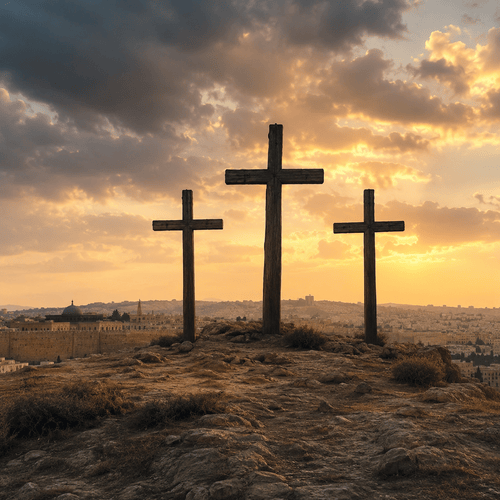
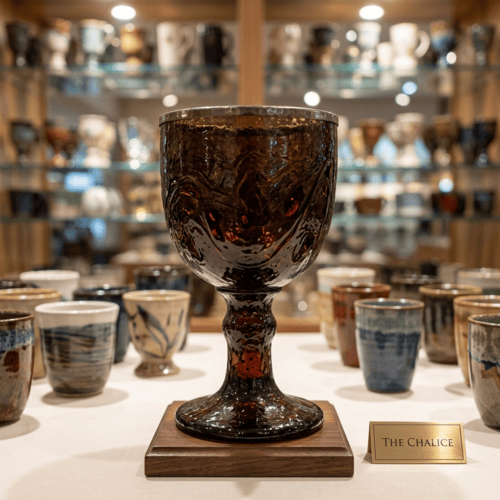
On the last night of His life, Jesus of Nazareth went into a garden and prayed a prayer that has puzzled readers ever since. He fell on His face, and Luke tells us His sweat became like great drops of blood. He asked His Father for one thing: “My Father, if it be possible, let this cup pass from me; nevertheless, not as I will, but as you will” (Matthew 26:39).
Notice the word. Not “let this pain pass”. Not “let this death pass”. But this cup.
Jesus wasn’t inventing an image. He was reaching for a picture the Old Testament had been building for a thousand years. Let’s explore what the cup is, whose hand holds it, who must drink it, and why the Son of God shrank back from it when nothing else could make Him flinch.
What the Bible means by “a cup”
In the ancient world, a cup was never just tableware. Three ideas cling to it.
- Your portion. At a meal the host filled each guest’s cup and handed it across. Your cup was your share, the amount measured out for you. That’s why Psalm 16:5 can lay three words side by side as near-synonyms: the Lord is “my chosen portion and my cup”, the one who “holds my lot”. A cup, then, is a destiny.
- A hand that gives it. Kings kept cupbearers (Genesis 40). A cup always came from someone. It could be handed to you in honour or in ruin, but it never simply appeared.
- Wine that overwhelms. Ordinary wine was watered down before drinking. Undiluted wine caused what the prophets keep describing—staggering, stripping, vomiting, collapse. That is why judgement is so often pictured as drunkenness. A nation under God’s hand reels like a drunk man, exposed and unable to stand.
Two further phrases sharpen the picture.
“To the dregs.” The dregs are the thick, bitter sediment that settles at the bottom of the jar. To drain a cup “down to the dregs” (Psalm 75:8) is to finish it entirely. Nothing is left over.
“Unmixed.” Revelation 14:10 speaks of wrath poured “full strength” into the cup. The Greek word is akratos, wine with no water added at all. The one drink the ancient world never diluted is the final anger of God.
The other cup
Not every cup in Scripture is terrible. The image cuts both ways, and the bright side matters for where this article ends.
| REFERENCE | THE CUP | WHAT IT MEANS |
|---|---|---|
| Psalm 16:5 | The Lord as “my portion and my cup” | God Himself is the believer’s assigned destiny |
| Psalm 23:5 | “My cup overflows” | Covenant generosity, more than enough |
| Psalm 116:13 | “The cup of salvation” | Thanksgiving lifted up for rescue |
| Jeremiah 16:7 | “The cup of consolation” | Comfort held out to mourners |
| 1 Corinthians 10:16 | “The cup of blessing that we bless” | Sharing in the blood of Christ |
| Luke 22:20 | “The new covenant in my blood” | The Lord’s Supper |
So the question is never whether you have a cup—for everybody has a portion measured out. The only question is which cup it is.
The cup of wrath across Scripture
- In the Psalms, God holds it. Psalm 11:6 names “fire and sulphur and a scorching wind” as “the portion of their cup”. Psalm 75:8 is the controlling verse of the whole theme: “For in the hand of the Lord there is a cup with foaming wine, well mixed, and he pours out from it, and all the wicked of the earth shall drain it down to the dregs.” Three verbs, and God is the subject of every one. He holds it, He mixes it, He pours it. Psalm 60:3 shows even God’s own people can be made to drink “the wine of staggering”.
- In Isaiah, it changes hands. Jerusalem has drunk “from the hand of the Lord the cup of His wrath” (Isaiah 51:17). Then comes a promise we will come back to, because the whole gospel is folded inside it.
- In Jeremiah, no nation escapes. The prophet is told to carry “this cup of the wine of wrath” to every nation—Egypt, Philistia, Edom, Moab, Ammon, Tyre, Arabia, Elam, and Babylon last of all (Jeremiah 25:15–29). And judgement begins, God says, “at the city that is called by my name”. Later, Jeremiah 51:7 turns the picture round: Babylon, the golden cup in the Lord’s hand, must herself drink.
- In Ezekiel, it’s horrifying. The cup is “deep and large”, “a cup of horror and desolation” (Ezekiel 23:32–33). The drinker doesn’t merely empty it. She gnaws its broken pieces.
- In the smaller prophets, it comes round. “The cup in the Lord’s right hand will come around to you” (Habakkuk 2:16). Obadiah 16 warns the nations will drink. And keep drinking.
- In the Gospels, Jesus takes it. “Are you able to drink the cup that I am to drink?” (Matthew 20:22). “Let this cup pass from me” (Matthew 26:39). “Shall I not drink the cup that the Father has given me?” (John 18:11).
- In Revelation, it is final. Whoever worships the beast “will drink the wine of God’s wrath, poured full strength into the cup of his anger” (Revelation 14:10). Babylon is made “to drain the cup of the wine of the fury of his wrath” (Revelation 16:19).
Six things the cup always means
Gather those passages together and six features appear every time.
- It’s personal. Someone holds the cup, and that someone is God. He calls it “the bowl of my wrath” (Isaiah 51:22). Wrath here isn’t the weather. It’s not bad luck catching up with bad people. It’s an act.
- It’s judicial. The cup answers specific sins the prophets name at length—idolatry, cruelty, injustice, innocent blood. It’s a sentence passed by a judge, never a fit of temper.
- It’s measured. It’s a cup, not an ocean. God repays “according to their deeds” (Jeremiah 25:14). Divine anger is calibrated exactly to what is deserved, which is what human anger never is.
- It’s exhaustive. It’s drunk to the dregs. God doesn’t pour half a judgement.
- It can be transferred. This is the astonishing one, and it needs its own section.
- It ends. Once a cup is drained, it’s empty. That fact carries much weight.
The verse where the cup changes hands
Isaiah 51 is the hinge of the whole doctrine. Jerusalem lies in the dust, having drunk to the dregs. Then God speaks:
“Thus says your Lord, the Lord, your God who pleads the cause of His people: Behold, I have taken from your hand the cup of staggering; the bowl of my wrath you shall drink no more” (Isaiah 51:22).
Read that slowly. The cup isn’t diluted, and not quietly poured away. It’s lifted out of one hand and pressed into another. The wrath is still real, still poured, still drunk. What changes is who drinks it.
That’s the shape of everything Jesus does. And it explains a strange line in Jeremiah 49:12, where God asks Edom: “If those who did not deserve to drink the cup must drink it, will you go unpunished?” The question hangs unanswered in the Old Testament. Who are these people who drink a cup they never deserved? A garden outside Jerusalem gives the answer.
Why did Jesus ask to be spared?
Here’s the difficulty. Thousands were crucified by Rome. Many of Jesus’s own followers later went to violent deaths singing. Socrates drank poison calmly. So why does Jesus, alone, fall to the ground and beg?
The answer is He wasn’t looking at the nails. He was looking at the cup of Psalm 75. Five lines of evidence make the case.
- The image was already fixed. Jesus didn’t coin the word. Anyone raised on the Psalms and the Prophets knew what a cup given by God meant. Had He simply meant “this ordeal”, He picked the one image in the Hebrew Bible most saturated with judgement, and picked it in front of men trained in those Scriptures.
- The Father is named as the giver. John removes all doubt: “the cup that the Father has given me” (John 18:11). Not the cup Caiaphas poured, or Pilate, or Judas, or Satan. Whatever Jesus dreaded came from the Father’s hand.
- His own martyrs died better than He did. John Calvin pressed this point hard, and John Stott restated it in the last century: if Jesus faced only what His followers later faced, then He faced it with less courage than they showed. That conclusion is unthinkable. Something categorically different is in view.
- He’d already settled on the cross. Luke 9:51 says He “set His face to go to Jerusalem”. He predicted His death repeatedly and rebuked Peter sharply for trying to talk Him out of it. The garden cannot be a last-minute loss of nerve about a death He’d been announcing for three years.
- The cry from the cross tells us what was inside the cup. “My God, my God, why have you forsaken me?” (Matthew 27:46). Nothing in the mechanics of Roman execution explains that sentence. It’s the language of judicial abandonment, of a man standing where the guilty were meant to stand.
Mark’s vocabulary supports all this. Jesus began to be “greatly distressed and troubled” (Mark 14:33), and the first verb, ekthambeisthai, is violent, closer to horror-struck than sad. Donald Carson notes the language is stronger here than anywhere else in the Gospels. Sinclair Ferguson observes what breaks over Jesus in the garden isn’t the fear of men but the anticipation of His Father’s face turned away.
Notice too how the prayer is fenced on both sides. “If it be possible” comes before, “not as I will, but as you will” comes after. This isn’t rebellion but a real human will recoiling from a real horror, yet submitting anyway. Hebrews 5:7 says He was heard. The cup wasn’t removed; He was carried through it and raised out of it, and that’s what being heard meant.
Guarding the doctrine
A serious objection appears here, and we should meet it squarely. Does this not give us a furious Father punishing an innocent Son? Steve Chalke famously called it cosmic child abuse. The charge sounds devastating until we look at the wiring underneath it.
The objection assumes three separate people—one angry, one innocent, one caught in between. Scripture gives nothing of the sort, but one God in three persons acting in a single purpose of love.
- The Father isn’t the obstacle to be talked round. He’s the source. “In this is love, not that we have loved God but that he loved us and sent his Son to be the propitiation for our sins” (1 John 4:10). Propitiation simply means the turning aside of wrath—and here the offended party provides it Himself, at His own cost.
- The Son is not a victim. “No one takes it from me, but I lay it down of my own accord” (John 10:18). And John 10:17 says the Father loves Him precisely for it.
- The Spirit is not absent. Christ offered Himself “through the eternal Spirit” (Hebrews 9:14).
Who must drink it?
Scripture is unusually direct. The cup is reserved for five sorts of drinkers.
- The nations, for their idolatry and violence (Jeremiah 25, Obadiah 16, Habakkuk 2).
- God’s own people, when they rebel—and first rather than last. “I begin to work disaster at the city that is called by my name” (Jeremiah 25:29). Peter agrees: judgment “begins at the household of God” (1 Peter 4:17). Nobody gets to feel comfortable here.
- The world system that intoxicates others. Babylon poured for everyone else and must drain her own cup (Revelation 16:19, 18:6).
- Every person who finally refuses to repent. Revelation 14:10–11 is among the most sobering passages in the New Testament, and its wine is unmixed.
- And, astonishingly, an innocent substitute. Jeremiah’s unanswered question finds its answer in a man on His face among the olive trees.
But there’s a group for whom the cup isn’t reserved, and the logic is worth stating plainly. If Christ drained a cup to the dregs, that cup is empty. John Owen turned this into an argument never satisfactorily answered: God doesn’t collect the same debt twice, first from the substitute and then from the sinner. So Paul can write there is “now no condemnation for those who are in Christ Jesus” (Romans 8:1), that Jesus “delivers us from the wrath to come” (1 Thessalonians 1:10), and that “God has not destined us for wrath” (1 Thessalonians 5:9). Isaiah had said it first: “you shall drink no more.”
How others read the cup
Not everyone reads these passages this way, and the alternatives deserve a fair hearing.
| VIEW | WHAT IT SAYS | WHERE WE THINK IT FALLS SHORT |
|---|---|---|
| Wrath as impersonal process (Charles Harold Dodd) | Wrath describes cause and effect in a moral universe, not an attitude in God | A process has no hand, and doesn’t say “the bowl of my wrath”. Leon Morris answers this at length. |
| Victory over evil powers alone (Gustaf Aulén) | The cross defeats Satan and death; it’s rescue, not payment | True but partial. Colossians 2:13–15 grounds the defeat of the powers in the cancelling of a legal debt |
| Moral government (Hugo Grotius) | The cross displays God’s seriousness about sin without being an exact penalty | A display cannot be drained to the dregs. Ezekiel’s shards describe exhaustion, not symbolism |
| The cup is simply death | Jesus feared dying, as any man would | Possible in isolation, impossible once John 18:11 names the Father as the giver |
| Healing rather than penalty | Wrath is how we experience God’s love against our corruption | The healing theme is real and welcome, but the cup is something God does, not only something we feel |
The exchange of cups
Put the two halves together and we have the sweetest structure in Scripture.
In the garden, Jesus took the cup of staggering, the one Isaiah described, and He drained it. At the table, He holds out something else entirely: “the cup of blessing that we bless” (1 Corinthians 10:16), “the new covenant in my blood” (Luke 22:20). It is the very cup the psalmist lifts: “I will lift up the cup of salvation and call on the name of the Lord” (Psalm 116:13).
He took one so we could take the other. That’s the gospel in a single image, and it’s why “It is finished” (John 19:30) is such a triumphant word. He’d reached the sediment at the bottom and found nothing left to drink.
Which leaves each of us with one question, and Paul asked it first: “You cannot drink the cup of the Lord and the cup of demons” (1 Corinthians 10:21). There are two cups on offer, and there has never been a third.
Tough Questions, Honest Answers
Is God’s wrath just a bigger version of human anger?
No, and the difference matters. Human anger is usually wounded pride, and it is almost never proportionate. God’s wrath is his settled, holy opposition to everything that destroys what he has made, and Scripture measures it out in cups rather than oceans precisely because it is exact. Herman Bavinck put it memorably: God’s anger isn’t the opposite of His love but the form His love takes when it meets what’s killing His creation. A God who felt nothing about cruelty and injustice would not be more loving than the God of the Bible. He would be less.
If Jesus drank the cup, why do Christians still suffer?
Because suffering and wrath are two different things. The New Testament calls the believer’s hardship discipline, training, or sharing in Christ’s sufferings, never punishment. Hebrews 12:6 says the Lord disciplines those He loves, and discipline is what a father does inside a relationship, not what a judge does at a sentencing. Thomas Schreiner notes the New Testament never once describes the sufferings of believers using the vocabulary of divine wrath. The pain can be severe, but its purpose is entirely different, and so is its end.
Was the Trinity broken apart on the cross?
No. If the Father, Son and Spirit could be separated, they were never one God to begin with. What happened at Calvary was judicial, not ontological—Christ experienced the forsakenness that belongs to the guilty, while still remaining every bit the beloved Son. Jeremy Treat helpfully observes the cry of dereliction quotes Psalm 22, a psalm that begins in abandonment and ends in worldwide worship. So even the darkest moment is spoken in the language of trust. The Son was under judgement as our substitute; yet, He was never outside the love of His Father.
Did Jesus really suffer eternal punishment in a few hours?
Not in duration, and duration was never the point. Human beings face endless punishment because finite creatures can never finish paying an infinite debt. Christ is a person of infinite dignity, so what He endured had a worth no length of time could add to. This is why the word ‘finished’ can be spoken from a cross at 3 in the afternoon. The sentence wasn’t shortened; it was absorbed by someone large enough to absorb it.
What’s the difference between Jesus’s cup and the cup James and John were promised?
Jesus told the two brothers they’d indeed drink His cup, and both suffered for it (Mark 10:39). But the definite article does a lot of work in the Gospels: there’s a cup Christ’s followers share, which is persecution and loss, and there’s the other cup, which is the wrath of God against sin. Disciples share in Christ’s sufferings. They never share His propitiation. The line between imitating Christ and being saved by Christ runs straight through those two verses.
Does “unmixed” mean there’s no mercy at all in the final judgement?
That is exactly what the word means, and it’s meant to shock. Every other cup of judgement in Scripture arrives mingled with warning, delay, prophets, and offers of return—God is famously slow to anger. Revelation 14:10 describes the one drink with nothing added, poured after every warning has been refused. The mercy isn’t absent from the story; it’s spread across the whole of history before that moment. Hell is what remains when a lifetime of it has been declined.
Can a person begin drinking the cup in this life?
Romans 1 suggests something close to it. Three times Paul says God gave them up, and that handing over is itself described as wrath revealed now, not later. Michael Horton describes this as judgement that looks like nothing at all happening—no lightning, simply God withdrawing His restraint and letting a person have exactly what they insisted on. It’s the quietest form the cup ever takes and the easiest to mistake for freedom. Which is why the only safe response to reading an article like this is to take the other cup in our hands—while it’s still on offer.
Related Reads
- Gethsemane’s Mystery: Why Did Jesus Sweat Blood?
- Was Jesus Abandoned by the Father on the Cross?
- Penal Substitutionary Atonement: The Heart of the Gospel Explained
- 5 Atonement Theories: Can Any Surpass Penal Substitution?
- What Does the Bible Say About Hell? The Case for Eternal Conscious Punishment
- The Mark of the Beast: What Revelation 13 Really Means by ‘666’
- Jesus in Nahum: The Judge Who Is Also Our Refuge
- Jesus in the Book of Habakkuk: 7 Ways the Prophet Sees Christ