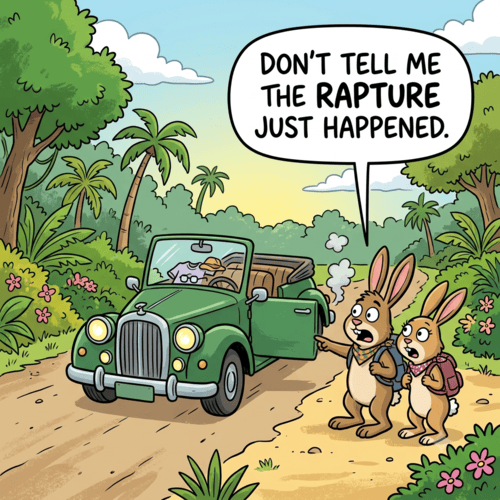
A car veers across the motorway with nobody at the wheel. A cot lies empty, the blanket still warm. An aeroplane loses half its passengers in mid-flight. If you’ve read the Left Behind novels or seen the films, you know the scene. 16 books, 60 million copies sold, and a generation of Christians who picture the end of the world in exactly this way.
Ask where the Bible teaches it, though, and the trail goes quickly cold. There’s a verse about being caught up (1 Thessalonians 4:17), and a line about one person taken and another left (Matthew 24:40). After that, silence.
This article claims the Left Behind scenario isn’t the teaching of Scripture. Read the passages in order, and you’ll agree.
First, the vocabulary
Four words do most of the work in this debate.
- Rapture comes from the Latin rapiemur, “we shall be caught up”, translating the Greek verb harpazo in 1 Thessalonians 4:17. The word is genuine; the timetable attached to it is disputed.
- Tribulation means severe trouble and persecution, here made into a fixed 7-year period.
- Millennium means “1000 years”, a phrase found in one Bible passage, Revelation 20:1-7.
- Dispensationalism divides history into eras, or dispensations, and holds Israel and the church as two permanently separate peoples of God.
What the novels actually teach
The books are fiction, but the doctrine underneath them is dispensational pretribulationism, which rests on five claims.
The five pillars of the system
- Two peoples of God. Israel and the church have permanently separate identities, promises and destinies.
- A postponed kingdom. Israel refused the kingdom Jesus offered, so the church age is a parenthesis, and the last of Daniel’s “70 weeks” (Daniel 9:24-27) is still waiting to begin.
- A 2-stage return. Christ comes secretly and at any moment to remove the church; seven years of tribulation follow; then He returns publicly.
- A literal earthly millennium centred on the nation of Israel, with a rebuilt temple in Jerusalem and animal sacrifices restored.
- Several resurrections and judgements, spread across the timeline rather than gathered on one day.
The novels then supply the pictures that did the actual teaching: driverless cars, vanished children, and main characters who come to faith after the rapture.
Where the idea came from
| PERIOD | DEVELOPMENT |
|---|---|
| 2nd-4th century | Some early Christians expect a future earthly reign of Christ. None teaches a secret removal of the church beforehand. |
| 1830s | John Nelson Darby, of the Plymouth Brethren, works out the sharp Israel/church distinction and a pretribulational rapture. |
| 1909 | CI Scofield prints the system in the notes of his Reference Bible, and it spreads worldwide. |
| 1924 onwards | Lewis Sperry Chafer founds Dallas Theological Seminary; John F. Walvoord later gives the position its scholarly defence. |
| 1970 | Hal Lindsey publishes The Late Great Planet Earth, selling tens of millions of copies. |
| 1995-2007 | Tim LaHaye and Jerry B. Jenkins publish the Left Behind series. |
Being new doesn’t make a doctrine false; the Reformers were once accused of novelty too. But a system that presents itself as the plain, obvious sense of the Bible has a problem if nobody noticed that sense for 18 centuries.
What each millennial view predicts
“Premillennial” means Christ returns before the thousand years; “amillennial” that the thousand years is the present church age; “postmillennial” that Christ returns after a coming era of gospel success.
| VIEW | COMINGS OF CHRIST | RAPTURE | TRIBULATION | MILLENNIUM | ISRAEL AND CHURCH |
|---|---|---|---|---|---|
| Dispensational premillennialism | Two stages | Secret, before the tribulation, at any moment | Seven years, church absent | Earthly reign, temple and sacrifices | Two peoples |
| Historic premillennialism | One, visible | Believers rise to meet the descending Christ, after the tribulation | Church passes through it | Earthly reign, no temple | One people |
| Amillennialism | One, visible | Same event as the return, no gap | Present and intensifying | The present age; Christ reigns now | One people |
| Postmillennialism | One, visible | Same event as the return | No fixed scheme | A coming age of gospel advance | One people |
Notice what the table shows. The secret rapture isn’t the premillennial position; it’s only one wing of premillennialism. George Eldon Ladd, the best known historic premillennialist of the last century, wrote The Blessed Hope, arguing the church will go through the tribulation, and Wayne Grudem and Douglas Moo agree. So this isn’t “Reformed people versus people who expect a millennium”. It’s one 19th-century innovation against almost everybody else.
Even within dispensationalism the ground has shifted. Craig Blaising, Darrell Bock and Robert Saucy, representing progressive dispensationalism, have softened the two-peoples framework, arguing the church already shares in Israel’s promises. That concession removes the main reason the secret rapture was ever needed.
What should a reader expect who has never thought about any of this?
Something very simple, and it’s what the ancient creeds say. The Apostles’ Creed confesses Christ shall come to judge the quick and the dead, and the Nicene Creed that He shall come again with glory. One coming. No 7-year gap, no rebuilt temple, no 2 stages. The Westminster Confession likewise describes one resurrection and one judgement day, and says nothing about a millennium. Read the New Testament without a system in hand and the same shape appears.
- One return, not two. Christ… will appear a second time (Hebrews 9:28). A second, not a second and then a third.
- A public return, not a secret one. He will come the same way as He ascended (Acts 1:11); as the lightning comes from the east and shines as far as the west (Matthew 24:27). You cannot miss lightning.
- One resurrection on one day. Four times in a single chapter Jesus promises to raise His people on the last day (John 6:39, 40, 44, 54). And an hour is coming when all in the tombs hear His voice and come out, those who did good and those who did evil together (John 5:28-29). One hour, both groups.
- One judgement, with the nations gathered once (Matthew 25:31-46; Revelation 20:11-15), and then the new creation (Romans 8:19-23; Revelation 21:1-5).
The case from Scripture
1 Thessalonians 4 is the loudest event in the Bible
This is the passage the whole theory rests on. The Lord Himself will descend from heaven with a cry of command, with the voice of an archangel, and with the sound of the trumpet of God (v. 16). A shout, an archangel and a trumpet. Whatever else this is, it’s not secret. Three Greek words settle the direction of travel:
- harpazo (v. 17), “caught up”, the source of the word rapture.
- parousia (v. 15), the ordinary Greek word for the official arrival of a king or governor at a city.
- apantesis (v. 17), “to meet”, the word for citizens going out of the gates to greet an arriving dignitary and escort him back in. Luke uses it that way in Acts 28:15, where Roman Christians walk out to meet Paul and accompany him into the city.
That reverses the Left Behind plot. Believers aren’t withdrawn from earth for 7 years; they rise to welcome the arriving King and come back with Him. Notice too why Paul wrote it: to comfort a church grieving over members who’d died. It’s a funeral text, not an evacuation plan.
Matthew 24 puts the gathering after the tribulation
Immediately after the tribulation of those days, Jesus says, the sun is darkened, the Son of Man appears, and He will send out His angels with a loud trumpet call, and they will gather His elect (Matthew 24:29-31). Trumpet, angels, gathering, full visibility: the same details as 1 Thessalonians 4, placed explicitly after the tribulation.
What about one will be taken and one left a few verses later? Jesus compares it to Noah’s flood, where those swept away were the ones under judgement, which turns the popular reading upside down. The verbs aren’t decisive on their own, but the timing in verse 29 is.
2 Thessalonians has rescue and judgement arriving together
The persecuted Thessalonians are promised relief when the Lord Jesus is revealed from heaven with His mighty angels in flaming fire (2 Thessalonians 1:7-8). One event: the church’s rest and the world’s judgement arrive together. Then Paul tells the church the day cannot come until the rebellion occurs and the man of lawlessness is revealed (2:1-8)—strange instruction for a congregation due to leave before either event.
Hebrews closes the temple for good
Christ appeared once for all… to put away sin by the sacrifice of Himself (Hebrews 9:26), and the old covenant is obsolete… ready to vanish away (8:13). A rebuilt temple with animal sacrifices restored, even as mere memorials, cannot be fitted into that. Here the disagreement stops being about diaries and starts touching the sufficiency of the cross.
Revelation 20 isn’t a blueprint for an earthly kingdom
- The binding of Satan has a stated purpose: so that he might not deceive the nations any longer (v. 3). Compare Matthew 12:29, Luke 10:18 and John 12:31, where Jesus speaks of Satan as already bound and falling. The millennium is the age of the gospel reaching the nations.
- John sees the souls of those who had been beheaded reigning with Christ (v. 4). Souls in heaven between death and resurrection, not an administration on earth.
- William Hendriksen and Gregory K Beale have shown Revelation circles back over the same period from different angles rather than marching forward in a straight line. Revelation 19:19 and 20:8 read like one final assault described twice.
- Method matters most. The thousand years appears once, in the most symbolic book of the Bible, where numbers regularly stand for something. Building a timetable on it means reading the clear letters in the light of the difficult vision, which is the wrong way round.
Daniel 9 needs no gap
The system inserts about 2000 years between the 69th and 70th weeks. Read without that insertion, the one who shall put an end to sacrifice and offering (Daniel 9:27) is the Messiah, whose death ended the sacrificial system, the torn temple curtain being the sign. Nothing in the text signals a pause.
The best arguments for a pretribulation rapture, answered
- “Kept from the hour of trial” (Revelation 3:10). The same Greek construction appears in John 17:15, where Jesus prays that His disciples be not taken out of the world but kept from the evil one. Preservation through danger, not removal from it.
- “We aren’t destined for wrath” (1 Thessalonians 5:9). True, but the wrath in view is God’s final judgement, not human persecution. Scripture promises the opposite of exemption from trouble: in the world you will have tribulation (John 16:33).
- “The church is absent from Revelation 4-18.” This is an argument from the absence of one word. Ekklesia normally means a local congregation, which is why it fills the letters in chapters 2-3 and not the visions. God’s people are plainly present as “the saints”, and the beast makes war on them (13:7; 14:12).
- “Watchfulness requires an any-moment rapture.” Expectancy is commanded (Titus 2:13), yet the same apostles expected events in between: Peter’s death (John 21:18-19), a great falling away (2 Thessalonians 2), the gospel preached to all nations (Matthew 24:14). Watchfulness is a posture of the heart, not a diary entry.
The real root of the disagreement
The secret rapture isn’t really a conclusion drawn from 1 Thessalonians 4. It’s a consequence of the two-peoples framework. If Israel and the church are permanently separate programmes, the church must be taken off the stage so God can resume His dealings with Israel. Hence a coming in two stages. Vern Poythress, in Understanding Dispensationalists, showed the timetable follows from the system, not the system from the timetable. Remove the two peoples and the rapture loses its reason to exist.
And that’s exactly where Paul aims. Christ Himself is our peace, who has made us both one and has broken down… the dividing wall of hostility, creating one new man in place of the two (Ephesians 2:14-15). If you are Christ’s, then you are Abraham’s offspring (Galatians 3:29). In Romans 11 Gentiles are grafted into one olive tree, not planted as a second tree alongside it.
Why any of this matters
- Escape replaces endurance. John calls himself a partner in the tribulation and the kingdom and the patient endurance that are in Jesus (Revelation 1:9). Believers in Nigeria, China and Iran have never had the option of expecting to skip suffering. A theology of evacuation is a comfortable doctrine held from a comfortable place.
- Failed dates cost the church its credibility. Every confident prediction that passes hands the sceptic his argument free of charge (2 Peter 3:4).
- A hint of second chances. The plot depends on people converting after the rapture, which undercuts now is the day of salvation (2 Corinthians 6:2).
- Fatalism about the world. “Why polish brass on a sinking ship” is memorable and wrong. Creation is to be renewed, not scrapped (Romans 8:19-23), and we are to seek the welfare of the city where we live (Jeremiah 29:7).
- The alternative is not gloom but confidence. Christ reigns now (Psalm 110:1; Ephesians 1:20-22). Anthony Hoekema, Kim Riddlebarger and Cornelis Venema all press the same point: the hope of a raised body in a restored world is richer than the hope of an early exit, not poorer.
Where to be firm and where to be gracious Pretribulationism is mistaken, not heretical. Charles Haddon Spurgeon, John Charles Ryle and Horatius Bonar all expected a future millennium, and no Reformed confession settles the millennial question. What deserves firm resistance is not the diary but the system’s tail end: animal sacrifices restored, set against the finished work of Hebrews, and a permanently divided people of God, set against Ephesians 2. Disagree about the thousand years by all means; do not divide the body of Christ in two.
The hope we actually have
The Bible’s ending is better than the novels’. There’s no secret exit, no second chance, but there’s a public, unmissable return of the King, one resurrection, one judgement, and then a renewed earth where God dwells with His people and death shall be no more (Revelation 21:4). Believers alive on that day will rise to meet Him in the air, not to be spirited away, but to escort their King home.
So we can watch, and not be afraid. Not because we’ll miss the storm, but because the One who walks with us through it has already conquered.
Tough Questions, Honest Answers
What happens to Christians who’re alive when Christ returns, if there is no rapture as the novels describe it?
They’re changed without dying. Paul says not all will sleep, but all will be transformed in the twinkling of an eye, at the last trumpet (1 Corinthians 15:51-52). Reformed writers don’t deny the catching up; they deny the seven-year gap and the secrecy. The event is glorious and instantaneous. It simply happens on the day Christ returns in public glory, not seven years earlier.
Does rejecting Left Behind theology mean the Jewish people have no future in God’s plan?
Not at all, and this is often misunderstood. Romans 11 anticipates a great ingathering, and many Reformed theologians, including Charles Hodge and John Murray, expected a future large-scale turning of Jewish people to Christ. What’s denied is a separate covenant programme running in parallel to the church, with its own temple and sacrifices. The promise is fulfilled by Jewish people coming to their own Messiah and being grafted back into the one olive tree, not by a second tree.
How should Christians view the modern state of Israel?
Three separate questions often get tangled together. First, whether a nation state has political legitimacy, which is a matter of history and law. Second, how all peoples living in that land should be treated, which is a matter of justice and mercy for everyone. Third, whether the events of 1948 fulfil biblical prophecy. Reformed writers differ on the third question, and holding a view on it isn’t a test of orthodoxy. The danger is allowing a prophetic chart to decide our ethics in advance.
Is the Antichrist a single individual still to come?
Scripture uses the language in more than one way. John says many antichrists were already present in his own day (1 John 2:18), while Paul describes a single man of lawlessness who is revealed before the end (2 Thessalonians 2:3-8). Historic Protestant confessions applied the figure to the papal office; contemporary Reformed writers vary considerably. The wise position is to expect both a recurring spirit of opposition and a final concentration of it, while remembering that confident identifications have an unimpressive track record.
Was the great tribulation of Matthew 24 fulfilled in AD 70, or is it still future?
Reformed interpreters genuinely differ here. Some read most of Matthew 24 as fulfilled in the fall of Jerusalem in AD 70, pointing to Jesus’ words that this generation would not pass away. Others see a pattern of trouble that intensifies through history towards the end. Many hold a combination, in which the fall of Jerusalem is a foreshadowing of a final crisis. All of them agree on the point that matters pastorally: the church is nowhere promised exemption from tribulation.
What about the 144,000, the two witnesses and the mark of the beast?
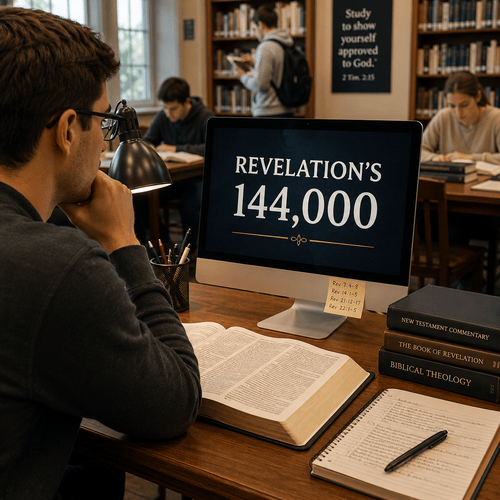
Revelation’s numbers and images signify rather than measure. The 144,000 is twelve times twelve times a thousand, a picture of the complete people of God, and John immediately identifies the same group as a great multitude that no one could number (Revelation 7:9), which rules out a literal headcount. The two witnesses recall Moses and Elijah, law and prophets, bearing testimony under persecution. The mark of the beast is a counterfeit of the seal on God’s people in chapter 7, marking ownership and allegiance. Read the symbols as symbols and most of the timetable simply dissolves.
How should I talk about this with a family member who loves these books?
Begin with what you share, which is a real longing for Christ to return and put the world right. Ask questions rather than making pronouncements: where does the Bible say the gap between the two stages is seven years, and who first taught this? Read 1 Thessalonians 4 and Matthew 24 together, out loud, and let the trumpet and the angels do their own work. Keep the tone warm, because this is a disagreement between brothers and sisters, not a test of salvation. And be patient, since a picture absorbed from novels isn’t usually dismantled in one conversation.
Related Reads
- The Rapture Debate: A Primer on End-Time Bible Prophecy
- What Is Dispensational Premillennialism? A Biblical Assessment
- Antichrist Alert: The Bible’s Chilling Portrait of the End-Time Figure
- What is the Great Tribulation? Understanding Bible End-Time Prophecy
- Israel in End-Time Prophecy: Exploring God’s Covenant Promises
- Will All Israel Be Saved? Reformed Views on Romans 11:26
- The Mark of the Beast: What Revelation 13 Really Means by ‘666’