Ask a room full of Christians what will happen when Jesus returns, and you may hear four different answers. Behind nearly all of them sits a single question: what are the thousand years that John describes in Revelation 20?
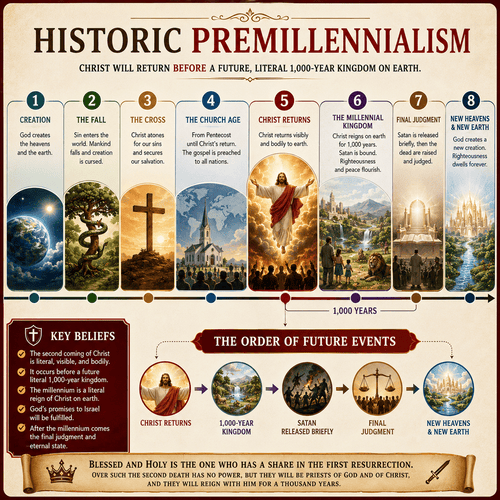
Historic premillennialism gives a straightforward answer. Christ returns first. Then He reigns on this earth for a thousand years. Then come the final judgement and the new creation. The word premillennial simply means “before the thousand years”—Christ comes back before the millennium, not after it. (Millennium is Latin for a thousand years; the older name for this view is chiliasm, from the Greek word for a thousand.)
This post explains the view, sets out the case for it, faces the hardest objections honestly, and shows where it parts company with the end-times teaching many readers have met in popular books and films.
Why it’s called “historic”
The word historic does two jobs.
First, it points back to the early church. A future earthly reign of Christ appears in the 2nd and 3rd centuries right across the Mediterranean world. Justin Martyr states it plainly in his Dialogue with Trypho, saying he and every fully orthodox Christian expect a thousand years in a restored Jerusalem. Irenaeus, whose teaching ran back through Polycarp to the apostle John himself, devotes the closing chapters of Against Heresies to it. Papias, Tertullian, Hippolytus, Lactantius and Victorinus of Pettau say much the same. Whatever else it is, this wasn’t a novelty invented by later enthusiasts. It was one of the oldest readings on the table, and it was held by men who lived close to the apostles and paid for their faith in blood.
Second, the label separates this view from dispensational premillennialism, a system that took shape in the 19th century and now dominates popular prophecy writing. The two are constantly confused. They shouldn’t be.
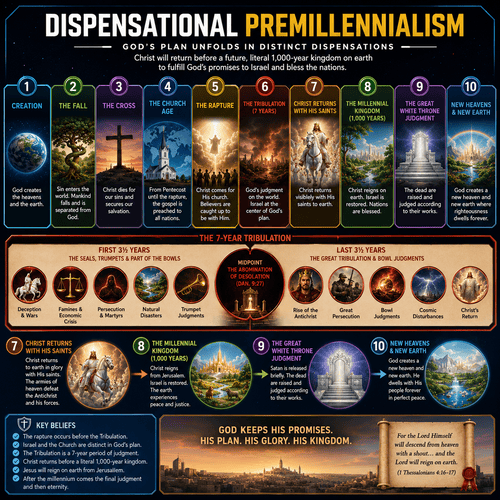
| Historic premillennialism | Dispensational premillennialism | |
|---|---|---|
| Israel and the church | One people of God in Christ | Two peoples with separate destinies |
| The rapture | At the visible return, in full view | A secret rapture years beforehand |
| The great tribulation | The church passes through it | The church is removed before it |
| Temple and sacrifices | Fulfilled and finished in Christ | Rebuilt temple, sacrifices resumed |
| The return of Christ | One event | Two stages |
| Origin | Second century | Nineteenth century |
If you grew up on the Left Behind novels, you were reading the second column, not the first.
The order of events
Set out as a timeline, the view runs like this.
- This present age—the gospel spreads to the nations while opposition to it hardens.
- The great tribulation—the Antichrist rises, and the church suffers under him rather than escaping him.
- The return of Christ—one visible, bodily, unmistakable coming.
- The first resurrection—believers are raised in glorified bodies (Revelation 20:4-6).
- The thousand years—Christ reigns openly on the earth, with Satan bound and unable to deceive the nations.
- The final rebellion—Satan is released, gathers the nations for one last assault, and is destroyed by fire (Revelation 20:7-10).
- The last judgment—the rest of the dead are raised and judged before the great white throne.
- The new heavens and new earth—God dwells with His people for ever.
Two features mark the view out. There’s one coming of Christ, not two. And there are two resurrections, separated by the thousand years.
How the four main views compare
It helps to see all four positions side by side before weighing the arguments.
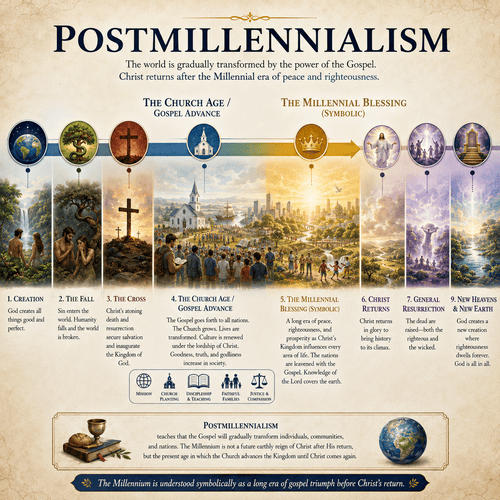
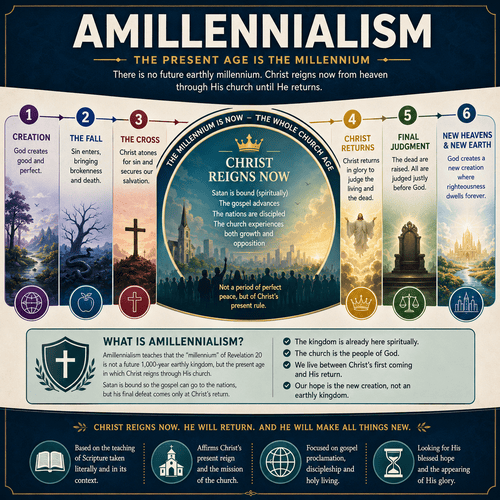
| HISTORIC PREMILL | DISPENSATIONAL PREMILL | AMILL | POSTMILL | |
|---|---|---|---|---|
| The millennium | Future, on earth, after Christ returns | Future, on earth, after Christ returns | The present church age | A future golden age before Christ returns |
| Christ’s return | One stage, after the tribulation | Two stages | One stage | One stage |
| Resurrections | Two, a thousand years apart | Two or more | One general resurrection | One general resurrection |
| Israel and the church | One people | Two peoples | One people | One people |
| Outlook on this age | Sober | Sober | Realistic | Optimistic |
The case from Revelation 20
Four arguments carry most of the weight.
John’s own sequence. From Revelation 19:11 onwards John strings his visions together with a repeated phrase: “then I saw”. Christ rides out to war in 19:11. Satan is bound in 20:1. The martyrs reign in 20:4. The great white throne appears in 20:11. The new creation arrives in 21:1. Read in the order John gives them, the thousand years follow the return of Christ. To put them before His return, you have to read the chapters backwards. That’s a heavy price to pay, and the text gives no signal we should.
One verb, two uses, one meaning. Revelation 20:4-5 says the martyrs came to life and reigned with Christ for a thousand years, and then that the rest of the dead did not come to life until the thousand years were ended. The same Greek verb carries both statements, one sentence apart. Nobody disputes the second use means a bodily resurrection at the last day. Henry Alford put the point in words that still sting: if the same word in the same passage means one thing in one clause and something quite different in the next, then there’s an end of all certainty in language. Two resurrections, separated by a long reign, is simply what the sentence says.
“Resurrection” is a bodily word. John calls it the first resurrection (20:5-6). Everywhere else in the New Testament the Greek word anastasis means bodies coming out of graves, not souls being converted or believers going to heaven. And to number something “first” implies a second of the same kind. If the first is spiritual and the second physical, they’re not first and second of anything.
Satan’s binding is far stronger than anything we see today. John piles up the images deliberately: an abyss, a great chain, a door shut and sealed, so that he might not deceive the nations any longer (20:3). Now set that beside the world the apostles actually describe. Peter says the devil prowls around like a roaring lion, seeking someone to devour (1 Peter 5:8). Paul calls him the god of this world, blinding the minds of unbelievers (2 Corinthians 4:4). John himself says he has come down in great wrath, knowing his time is short (Revelation 12:12). Those aren’t descriptions of a sealed prisoner. Something decisive did happen to Satan at the cross, and we gladly say so; but the chain and the seal describe a restraint this present age has plainly not yet seen.
The case from the rest of Scripture
Paul’s ranks of resurrection. In 1 Corinthians 15:23-26 Paul sets the resurrection out in order: Christ the firstfruits, then at His coming those who belong to Christ. Then comes the end. That final “then” translates a Greek word marking a further step in a sequence, and Paul immediately adds Christ must reign until He has put all His enemies under His feet, with death destroyed last of all. The reign begins at His coming and finishes with the abolition of death: this reading fits Revelation 20 remarkably well.
Prophecies that fit nowhere else. This is the quiet strength of the position, and it is often overlooked. The Old Testament prophets describe an age that matches neither the world we now live in nor the eternal state that follows.
- Isaiah 65:20—no one dies as an infant, and a man of a hundred is still reckoned young. Life is long, but death hasn’t yet been abolished.
- Zechariah 14:16-19—the surviving nations go up to Jerusalem year by year to worship the King, and those who refuse are punished with drought. Worship and rebellion existing side by side.
- Isaiah 2:2-4 and Micah 4:1-4—the Lord judges between the nations and settles disputes for many peoples, who then beat their swords into ploughshares. Nations still need a judge.
Neither the present age nor the new creation has room for these pictures. In the new heavens and new earth there’s no death at all, no drought, and no rebellion to punish. In our present age Christ does not visibly settle the quarrels of nations. Historic premillennialism gives these prophecies a place on the map instead of dissolving every one of them into figures of speech.
A public vindication in history. Christ was rejected publicly, in history, on a Roman cross, before watching crowds. There’s deep fittingness in His being honoured publicly, in history, on the same earth, before the curtain finally comes down. The world that saw the shame should see the glory.
Sin isn’t a problem of environment. The rebellion at the end of the 1000 years (20:7-10) is one of the most searching passages in Scripture. Under a perfect government, with Christ Himself visibly reigning, human hearts still turn against Him the moment the restraint is lifted. Eden taught that lesson in a garden. The millennium teaches it on a global scale. Sin isn’t caused by bad conditions, and it will never be cured by good ones. Nothing short of a new heart and a new creation will do. That’s a doctrine of grace preached by the calendar itself.
One people of God
Here historic premillennialism stands with the confessions and firmly against dispensationalism.
Paul’s picture in Romans 11:17-24 is one olive tree. Branches are broken off; wild branches are grafted in; natural branches can be grafted back again. One tree, one root, one people. Gentile believers aren’t a separate congregation running on a separate timetable, and they have not replaced anybody. They’ve been brought into the covenant family God has been gathering all along.
So this view expects no rebuilt temple, no resumed animal sacrifices, and no parenthesis in God’s plan. Christ Himself is the temple (John 2:19-21), and His people are being built together into a dwelling place for God (Ephesians 2:19-22). Hebrews is emphatic the sacrifices are finished for ever. What we look for is a reigning Christ, not a restored altar.
Through the tribulation, not out of it
Historic premillennialism is post-tribulational. The church walks through the great tribulation rather than being lifted out before it starts.
Jesus is explicit. Immediately after the tribulation of those days the sun is darkened, the Son of Man appears in the clouds, and only then are the elect gathered from the four winds (Matthew 24:29-31). The gathering follows the suffering; it doesn’t pre-empt it. John sees a great multitude who are coming out of the great tribulation, having washed their robes in the blood of the Lamb (Revelation 7:14). They came through it, not around it.
This matters pastorally, and it matters most where the church is weakest. A congregation taught that it will be evacuated before the trouble begins isn’t being prepared for trouble. Believers in places where following Christ costs a job, a family or a life have rarely found the secret-rapture timetable convincing, and Scripture never asks them to.
Facing the hardest objections
Underneath the whole debate lies a question about reading. Does Revelation move forward in time, or does it circle back and retell the same period from fresh angles? Everything turns on that. We hold Chapters 19 to 21 move forward, because John says so, and because the alternative asks us to place the binding of Satan before a battle he has already lost.
An honest case also names the strongest arguments on the other side. Four deserve an answer.
“The thousand years appear only once in the Bible.” That’s true, and it should keep us humble. Revelation 20 is the only passage that mentions them, and Revelation is a book of symbols. But rarity isn’t the same as unreliability. This is the last book of the canon, given to show God’s servants the things that must soon take place, and it is entitled to supply detail the earlier books didn’t. A doctrine God states once is still a doctrine God has stated.
“John sees souls in heaven, not a kingdom on earth.” John does see the souls of those who had been beheaded (20:4). But he then says they came to life—which is precisely what souls already in heaven have no need to do, since they’re alive with Christ. The verb marks a change: from disembodied souls to raised and reigning persons. And Revelation has already told us where that reign takes place. The redeemed sing that they shall reign on the earth (5:10).
“Scripture speaks of one resurrection day and two ages, not three.” This is the weightiest objection. The division between this age and the age to come is a broad contrast, not a detailed timetable; the millennium is best understood as the opening phase of the age to come, when Christ’s reign becomes visible before it becomes final. As for the one “hour” in which all the dead are raised (John 5:28-29), Jesus has just used the same word three verses earlier for a period stretching across the whole gospel age (5:25). In John’s writing an hour can be very long indeed. Revelation 20 tells us how long.
“”The later confessions condemn it.” A confession is an agreed summary of what a church believes and teaches. The Westminster Confession, written in the 1640s, says nothing at all about the millennium—and that silence was chosen on purpose, because some of the ministers who drafted it held this very view. It’s true certain confessions from the 1500s condemn something they call chiliasm (an old Greek word for belief in the thousand years). But look closely at what they were rejecting. Small radical groups of that period were promising the saints an earthly paradise of feasting, wealth and political power—a kingdom built for the appetites. That’s a world away from the sober hope of Justin Martyr and Irenaeus, and it’s not what is being defended here.
What all four millennial views confess
All four millennial positions confess the same non-negotiables: Christ will return bodily and visibly, the dead will be raised, every person will be judged, and the new creation will be eternal and unshakeable. The millennium is a question of arrangement within that shared hope. It is a family conversation, not a boundary line.
Godly men have landed in different places. George Eldon Ladd, Wayne Grudem, John Piper, Albert Mohler, Douglas Moo, Robert H Gundry and Grant R Osborne have all argued for historic premillennialism. Others we read with profit haven’t. Prophecy charts should never become a wall between believers who confess one Lord and one return.
Three misunderstandings worth clearing up
- It’s not Left Behind—there’s no secret rapture, no seven-year gap, no rebuilt temple and no two-track plan.
- It doesn’t set dates—the one thing Jesus said plainly about His return is that no one knows the day or the hour (Matthew 24:36). Any scheme producing a calendar has left the text behind.
- It’s not escapism—a church expecting to walk through tribulation has every reason to build, teach, give, plant and endure now.
Why this matters
The millennium isn’t a puzzle for specialists with charts. It answers a question that every suffering Christian eventually asks: will this world—the actual earth where the church was hunted, mocked, imprisoned and killed—ever see Jesus openly honoured?
Historic premillennialism answers yes. The same earth that watched Him die will watch Him reign. And when even that reign is met with rebellion, God will settle the matter for ever and make all things new.
Until then the church waits, works and endures. Not because it has decoded the timetable, but because it knows the King.
Tough Questions, Honest Answers
Did a church council ever condemn premillennialism?
You will often read the Council of Ephesus in AD 431 condemned chiliasm. The claim circulates widely, but the surviving canons of Ephesus deal with Nestorius, the person of Christ and the Pelagian controversy. They say nothing about the millennium. The view did decline in the West after Augustine of Hippo changed his mind and read Revelation 20 as the present church age, and after Constantine’s peace made an earthly reign of the saints look like something the empire had already delivered. But decline through changing fashion isn’t the same as condemnation by a council, and it’s worth being accurate about the difference.
Do the thousand years have to be exactly a thousand years?
No, and the case doesn’t depend on it. Numbers in Revelation frequently carry symbolic weight, and a thousand may well signify a long, complete and God-appointed period rather than a stopwatch measurement. What matters isn’t the arithmetic but the sequence: a real reign of Christ on earth, bounded at one end by His return and at the other by the last judgement. Interestingly, this is where the debate is often misframed. The question isn’t literal versus symbolic numbers, since every reader of Revelation takes some numbers symbolically. The question is whether the chapters run in order.
Is historic premillennialism the same thing as post-tribulationism?
They overlap but aren’t identical. Posttribulationism is a view about the timing of the rapture: believers are caught up to meet Christ at his single, visible return, after the tribulation, not before it. Historic premillennialism is a view about the timing of the millennium. Every historic premillennialist is a posttribulationist, but so are amillennial and postmillennial Christians, in the sense that they expect one return after tribulation. The label posttribulational mainly does its work in argument against the dispensational scheme.
Who lives in mortal bodies during the millennium, and what about children born then?
This is the sharpest question put to the view, and honesty requires admitting Revelation 20 doesn’t answer it directly. The usual reply is that not every unbeliever is destroyed at Christ’s return, and that survivors of the nations enter the millennium in ordinary bodies, marry and have children, while glorified saints reign with Christ. Those children hear the gospel under the best conditions the world has ever known and must still be born again. The final rebellion then shows what the human heart does with privilege. The answer is an inference rather than a statement of the text, and it should be held with a light hand.
Who are Gog and Magog in Revelation 20?
The names are taken from Ezekiel 38-39, where Gog of the land of Magog leads a coalition against God’s restored people and is destroyed by fire from heaven. John uses the names as a label rather than a nationality: Gog and Magog stand for the nations at the four corners of the earth, gathered by Satan for a final assault on the camp of the saints. Attempts to identify them with modern nations, Russia most famously, read newspapers into the text. Richard Bauckham’s reading of Revelation’s imagery is helpful here: John draws on the whole prophetic tradition to say something universal, not to encode a map.
What did Charles Spurgeon believe about the millennium?
Both sides claim him, which tells you something. Spurgeon spoke often of a personal, visible reign of Christ on the earth after His return, and preached with real warmth on the first resurrection, which puts him close to this view. He also spoke of the gospel triumphing among the nations in language that sounds postmillennial, and he refused to make any of it a test of fellowship. He mocked date-setting and prophetic charts throughout his ministry. The fairest summary is that he expected Christ to come and reign, held the details loosely, and preached the gospel rather than the timetable.
Does historic premillennialism teach replacement theology?
No, and neither does the historic Protestant tradition it stands in. Replacement theology, as usually defined, says the church has taken over from a rejected Israel. Romans 11 says something different and better: one olive tree, with branches broken off in unbelief, wild branches grafted in by grace, and natural branches able to be grafted back. Gentile believers are not a substitute people but latecomers to an old family, and Paul warns them sharply against arrogance. Nor does the view empty the Old Testament promises. It reads them as fulfilled in Christ, who is the true Israel, and expects a great ingathering of Jewish believers into the same tree. Sam Storms and Gregory K. Beale press this fulfilment case hardest, and even those who dispute their millennial conclusions owe them a debt for showing how thoroughly the New Testament reads the Old through Christ.
Metadata
Related Reads
- Christ’s Return: A Primer on the Four Millennial Views
- What Is Dispensational Premillennialism? A Biblical Assessment
- What Is Amillennialism? A Biblical Assessment
- What Is Postmillennialism? The Optimistic End-Times View Explained
- God’s Kingdom: What is the ‘Already but Not Yet’ Paradox?
- Signs of Christ’s Return: Are We in the Last Days?
- The Mark of the Beast: What Revelation 13 Really Means by ‘666’