Jude is a short letter—all of 25 verses, read in under four minutes. Sitting in the middle of the letter is one of the strangest sentences in the Bible.
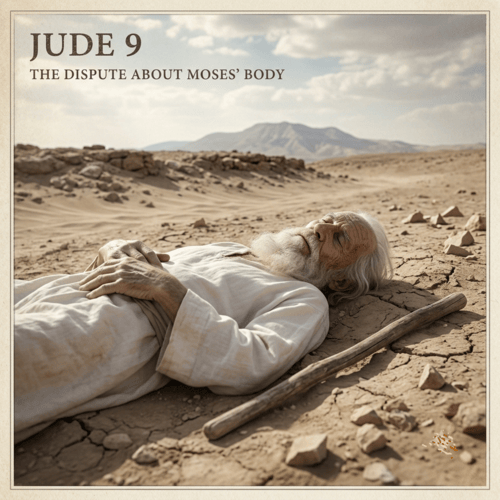
But when the archangel Michael, contending with the devil, was disputing about the body of Moses, he did not presume to pronounce a blasphemous judgement, but said, “The Lord rebuke you.” (Jude 9)
Nowhere in the Old Testament do we see the quarrel recorded. Moses died on Mount Nebo, God buried him, and nobody ever found the grave. Then, more than a thousand years later, Jude tells us there had been an argument over Moses’ body—between the highest-ranking angel in heaven and the devil himself.
Three questions follow. What were they arguing about? Where did Jude get the details from? And does it matter for a Christian today?
What Jude 9 actually says
Verse 9 isn’t stray trivia dropped into the letter. It’s the middle step of an argument, and the argument only works when we read Jude 8-10 together.
Jude is writing about false teachers who’d worked their way into the churches. In verse 8 he lists what they do: they rely on their dreams, defile the flesh, reject authority, and blaspheme “the glorious ones”. That last phrase translates the Greek word doxas, literally “glories”—almost certainly a reference to angelic beings. These men spoke about the unseen world with breezy confidence and no respect. Verse 9 is Jude’s counter-example, and verse 10 delivers the verdict: these people blaspheme all that they don’t understand.
THE SHAPE OF JUDE’S ARGUMENT
- The charge (v. 8): the false teachers casually insult spiritual powers.
- The example (v. 9): Michael, in a real confrontation with the devil, refused to do exactly that.
- The verdict (v. 10): their boldness isn’t courage. It’s ignorance.
Logicians call this an argument a fortiori—“from the stronger”. If the mightiest creature in God’s service, facing the devil in person, still wouldn’t pronounce his own verdict—then what business have these men, who’ve never glimpsed an angel, to sneer at powers they can’t comprehend?
Peter makes the identical point without the story: angels, though greater in might and power, don’t pronounce a blasphemous judgement before the Lord (2 Peter 2:11). Jude supplies the incident; Peter supplies the principle.
Where did Jude get this story?
Deuteronomy 34:5–6 gives us the bare facts. Moses died in the land of Moab. The LORD buried him in the valley opposite Beth-peor. And “no one knows the place of his burial to this day”. There’s not a word about a dispute.
The early church had an answer. Origen, writing around AD 230, said Jude was drawing on a Jewish book called the Assumption of Moses. Clement of Alexandria and Didymus the Blind said much the same. That book hasn’t survived intact. In 1861, Italian scholar Antonio Ceriani found a Latin manuscript of a closely related work, Testament of Moses, in Milan—but it breaks off before the ending, exactly where the dispute would have been told. Richard Bauckham, whose commentary on Jude remains the standard modern treatment, argues Jude used that lost conclusion.
But how did Jude know the story was true? There are three possible answers:
| EXPLANATION | WHAT IT CLAIMS | ASSESSMENT |
|---|---|---|
| Direct revelation | The Spirit disclosed the event to Jude, who used a story his readers half-knew. | Consistent with how prophecy works elsewhere. |
| Reliable tradition | A real incident preserved in Jewish memory outside the Old Testament. | Equally sound. Truth is still truth even if it’s outside the canon. |
| Illustration only | Jude borrows a story he knows to be fiction, because his opponents accepted it. | Weakest. Jude reports it as fact, and his rebuke collapses if it never happened. |
Douglas Moo puts the objection to the third option well: Jude isn’t scoring a debating point. He’s correcting men who endanger souls, and an invented example would leave that correction with nothing underneath it. Either of the first two preserves complete confidence in Scripture, and we don’t need to choose between them.
How the story reached us
- 1406 BC—Moses dies on Mount Nebo. God buries him, and hides the grave (Deuteronomy 34:5–6).
- Early first century AD—the Testament of Moses circulates among Jewish readers in Palestine.
- AD 65–80—Jude writes, referring to the dispute as something his readers already know.
- AD 230—Origen identifies Jude’s source by name.
- AD 325—Eusebius lists Jude among the disputed books, partly over this very issue.
- 1861—Ceriani finds the incomplete Latin manuscript in Milan, and the trail goes cold exactly where we want it to continue.
Does quoting a non-biblical book break the canon?
This objection genuinely unsettles people, and it deserves a straight answer. Jude does it twice: here in verse 9, and again in verses 14–15, quoting a prophecy from 1 Enoch, a Jewish work no Protestant church has regarded as Scripture.
The critic’s argument runs like this: either those books are inspired after all, or Jude was careless. Either way, the Bible we hold is less secure than we thought.
The reply rests on a distinction that, once seen, settles the matter.
THE DISTINCTION THAT RESOLVES IT
Inspiration guarantees the truth of what a biblical writer affirms. It doesn’t confer inspiration on the source he happens to quote. A true sentence in an uninspired book is still a true sentence.
And Jude is in good company. This happens repeatedly across both Testaments.
| PASSAGE | SOURCE QUOTED | WHAT IT SHOWS |
|---|---|---|
| Acts 17:28 | Aratus, a pagan Greek poet | Paul quotes a hymn to Zeus to preach the living God. |
| Titus 1:12 | Epimenides, a Cretan poet | Paul calls him a prophet and endorses his statement as accurate. |
| 2 Timothy 3:8 | Jewish tradition | Paul names Jannes and Jambres, who appear nowhere in Exodus. |
| Joshua 10:13 | The Book of Jashar | An Old Testament writer cites a book we no longer possess. |
Nobody concludes from Acts 17 that Greek mythology belongs in the Bible. The Westminster Confession of Faith (1.3) puts it plainly: the apocryphal books aren’t of divine inspiration, are no part of the canon, and carry no authority in the church. Jude’s one sentence doesn’t overturn that—any more than Paul’s line from Aratus canonises Greek astronomy.
One further point cuts the other way. The early church noticed this problem too. Jerome recorded the objection; Eusebius classed Jude among the books under discussion. And after weighing it, the church received the letter anyway. The church didn’t manufacture the canon; it recognised what God had given, and argued its way there in the open.
Who is Michael—and why he cannot be Jesus
Jude calls Michael “the archangel”. The Greek word archangelos appears only twice in the New Testament—here and in 1 Thessalonians 4:16. Michael appears in Daniel 10:13 and 12:1, and in Revelation 12:7, leading the armies of heaven.
A question then arises that matters more than it first appears. Is Michael another name for Jesus Christ before his incarnation?
The idea isn’t new, nor disreputable in origin. John Calvin, commenting on Daniel, was open to reading Michael as a title for the Son of God, and Matthew Henry and John Gill leaned that way at points. Their reasoning: the Michael of Daniel 12:1, who stands up to deliver God’s people, seems to do more than a creature could.
But the identification must be rejected, and Jude 9 is the reason. It’s also the verse on which the Jehovah’s Witnesses’ Christology stands or falls, since the Watchtower teaches Jesus is Michael—a created spirit being. Follow the argument, because it is airtight.
- Jude 9 itself. Michael “did not presume”. Jesus never holds back. “Be gone, Satan!” he says in the wilderness (Matthew 4:10), and he silences demons on his own authority (Mark 1:25). A Michael who cannot speak the way Jesus speaks cannot be Jesus.
- Hebrews 1:5–14. The whole chapter exists to deny this equation. To which of the angels did God ever say, “You are my Son”? Angels are commanded to worship Him, and He is addressed as God (v. 8). Michael is an angel; therefore Michael is not the Son.
- Daniel 10:13. Michael is “one of the chief princes”—one among several. The Son of God is never one among several of anything.
- Colossians 1:16. Every throne, dominion, ruler and authority in heaven was created by Him and for Him. Michael belongs to the category of created things; Christ created the category.
Michael is a creature of the highest rank, and Jude 9 shows him behaving exactly like one. That’s the whole point of the verse.
Why the body of Moses? Four readings
Now to the question everyone actually arrives with. What could the devil want with a dead body? Four explanations have been offered, and they’re not of equal weight.
| READING | THE ARGUMENT | WEIGHT |
|---|---|---|
| The hidden grave | God hid the burial place so Israel couldn’t make it a shrine. Satan wanted it found and venerated. | Strong. Explains why Deuteronomy stresses the unknown grave. |
| The accusation | Satan claimed a legal right to the body: Moses had killed an Egyptian, and had struck the rock in unbelief. | Strongest. Fits the devil’s known role as accuser. |
| The Zechariah echo | Michael’s exact words come from Zechariah 3:2, where Satan accuses the high priest and is silenced. | Decisive. Supplies the interpretive key. |
| The resurrection | Moses appears bodily at the Transfiguration, which may suggest his body was raised. | Speculative. Worth noting, not worth building on. |
The hidden grave
Calvin read the hiding of Moses’s grave as divine protection—God guarding His people from their own instincts. Israel’s record justifies the worry. Moses had made a bronze serpent at God’s command; centuries later the nation was burning incense to it, and Hezekiah had to smash it (2 Kings 18:4). Had the tomb of the man who spoke with God face to face been marked, it would have become a shrine within a generation.
The accusation
The devil’s title tells you his line of work. Diabolos means slanderer or accuser. In Job 1–2 he accuses a righteous man before God; in Revelation 12:10 he accuses the brothers day and night. On this reading, Satan claimed Moses’s corpse as rightfully his, on the ground of Moses’s real and undeniable sins. A murderer’s body. A disobedient prophet’s body. Hand it over.
The Zechariah echo—and why it settles the matter
Michael’s reply wasn’t improvised. It’s a quotation. In Zechariah 3, Joshua the high priest stands before the angel of the LORD in filthy garments, Satan at his right hand to accuse him. And the LORD says: “The LORD rebuke you, O Satan!” Joshua is then stripped of the filthy clothes and dressed in clean ones.
Once you see the parallel, the passage opens up. In both scenes the accuser presses a charge over something genuinely defiled. In neither is it answered by argument. In both, the accuser is silenced by the Lord Himself, and the accused is kept by grace rather than merit. Moses’s dead body is the filthy garment, and God doesn’t surrender it.
THE POINT BENEATH THE STRANGENESS
Satan’s accusations against God’s people are often factually correct. Moses had killed a man. Moses had rebelled at Meribah. The charge isn’t dismissed as false. It’s silenced because the Lord has decided otherwise—and that’s the only ground on which any Christian stands.
The resurrection possibility
Moses appears bodily at the Transfiguration (Luke 9:30–31), which has led some to suggest his body didn’t stay in the ground. Scripture does not say, so neither will we. But the direction it points is worth keeping: Christ came to destroy the one who has the power of death (Hebrews 2:14–15). Whatever claim the devil pressed over Moses’s body did not hold—and it will not hold over yours.
“The Lord rebuke you”—five words that change how you pray
Look closely at what Michael does and doesn’t do. He doesn’t rebuke Satan. He asks God to. In Greek the verb is a wish—a prayer, not a command. The archangel’s entire contribution is an appeal to higher authority.
This is where Jude 9 begins to make demands, because much modern Christian practice does precisely what Michael wouldn’t do.
- “I rebuke you, Satan.” Michael, who had actually met the devil, declined to use that sentence.
- “I bind you in Jesus’ name.” No apostle ever tells a believer to address the devil this way.
- Territorial spirits and spiritual mapping. An entire industry has now been built in spiritual warfare, while the archangel’s whole speech is five words of prayer.
So what does Scripture tell believers to do? “Submit yourselves therefore to God. Resist the devil, and he will flee from you” (James 4:7)—and note the order. Submission first, resistance second, and no script for talking to him. Ephesians 6:10–18 hands us armour, tells us to stand, and names the weapon: prayer. Paul’s promise in Romans 16:20 is carefully worded—the God of peace will crush Satan under our feet. He will. Not we.
Sinclair Ferguson observes Christians become preoccupied with the devil in exactly the measure that they lose sight of Christ’s finished victory. The believer’s safety was never personal authority over Satan. It’s that Christ “disarmed the rulers and authorities and put them to open shame” (Colossians 2:15). The battle we fear has already been fought by someone else, and won.
What Jude wants us to take away
It would be easy to leave the verse as a curiosity—an odd story about a quarrel over a corpse. Jude didn’t include it as a curiosity, but as a mirror.
The men he wrote against were confident, fluent and contemptuous. They spoke of things they’d never seen as though they had them mapped. Jude’s answer was to point at an archangel who knew far more. And yet, said far less.
That restraint is in short supply. Read the comments under any theological video and you will find Christians pronouncing verdicts on one another’s souls with a freedom Michael did not permit himself with the devil. Herman Bavinck argued the doctrine of angels exists to magnify God, not to satisfy curiosity—and the moment we treat the unseen world as material for our own cleverness, we’ve missed the point.
Where God has spoken, we speak. Where He is silent, we’re silent. And when there’s a verdict to be pronounced, we leave it where Michael left it.
IN ONE SENTENCE
If the mightiest creature in heaven wouldn’t pass judgement on the devil, but handed the matter to God in a five-word prayer, confident contempt isn’t strong faith. It’s a clear sign we’ve forgotten who we are.
Tough Questions, Honest Answers
Is the Assumption of Moses worth reading, and can I still get a copy?
You can read what survives of the closely related Testament of Moses in most collections of Old Testament pseudepigrapha. And it’s genuinely interesting as background to first-century Jewish thought. What it isn’t is Scripture. We can read it the way we’d read a letter of Ignatius or a Jewish commentary—as a window onto what people believed, never as a source of doctrine. The section Jude appears to have drawn on is missing from the surviving manuscript anyway, so it won’t tell us more about the dispute than Jude already has. If reading it would unsettle your confidence in the Bible rather than deepen your understanding of its world, leave it well alone; nothing necessary for faith is in there.
Did Moses go to heaven bodily, like Enoch and Elijah?
The Bible is clear he didn’t, at least not in the same way. Genesis 5:24 says Enoch was taken and didn’t see death, and 2 Kings 2:11 describes Elijah going up in a whirlwind. Deuteronomy 34:5 says plainly that Moses died, and verse 6 says he was buried. His appearance at the Transfiguration alongside Elijah proves he is alive with God, which every believer will be. But it doesn’t prove his body was raised in advance of everyone else’s. The safest conclusion is the one Scripture gives us: Moses died, God buried him, and he waits with all the saints for the resurrection at the last day.
Why would God care what happens to a dead body at all?
Because the body isn’t a disposable shell that the real person escapes at death. God formed Adam’s body before breathing life into it, Christ was raised bodily and remains so, and the creed confesses the resurrection of the body, not merely the survival of the soul. Scripture treats burial as an act of honour, and Psalm 116:15 says the death of God’s saints is precious in his sight. That’s why Christians have historically buried their dead with care rather than treating the remains as rubbish. A dispute over the body of Moses only sounds trivial to people who’ve absorbed the idea that matter doesn’t matter—an idea the Bible flatly denies.
Are Michael and Gabriel the only angels named in the Bible?
In the 66 books of the canon, yes. Names such as Raphael and Uriel come from Tobit and 1 Enoch, which the church has never received as Scripture. That silence is deliberate and instructive. God tells us what angels do rather than filling in a directory of who they are, because the moment we have names we start invoking them, and invocation is worship by another route.
Should Christians ask Michael for protection?
No, and Jude 9 is a clear reason why. In this very verse, Michael doesn’t act on his own authority; he asks God to intervene. Praying to him would mean asking a creature who prays to do for us what he himself asks God to do. Prayer is an act of worship, and worship belongs to God alone—which is precisely why the angel in Revelation 22:8–9 refuses John’s attempt to bow before him. Instead, we’re to ask God for protection, and we may be entirely confident He will send whatever help He pleases, angelic or otherwise.
Is it ever right to speak directly to the devil?
Jesus spoke to Satan in the wilderness, and he rebuked Peter with the words “Get behind me, Satan” in Matthew 16:23. So it’s not that addressing the devil is inherently forbidden. The difference is one of authority. Christ speaks as the Lord of heaven and earth; we don’t. Notice also what Jesus actually said in the wilderness: three quotations of Scripture and a command to depart, with no formulas, no repetition and no negotiation. If a Christian ever has occasion to say anything to the enemy, let it be brief, let it be Scripture, and let the substance of the encounter be prayer to God rather than conversation with the devil.
Where is Moses’ tomb said to be today, and are those claims credible?
A site called Nebi Musa, in the desert west of the Jordan on the road between Jerusalem and Jericho, has been shown as Moses’ tomb since the Mamluk period. A shrine was even built there in the 13th century. There’s no serious historical case for it. Deuteronomy places Moses’ death and burial on the eastern side of the Jordan, in Moab, and the same passage states nobody knows the location. Any identification of the grave, medieval or modern, is a claim to know what God specifically chose to hide—and the whole point of the concealment was to stop exactly this from happening.
Related Reads
- Are Demonic Strongholds Real? How Do We Overcome Them?
- Kinds of Spirits in the Bible—How Many Are There?
- Who Were the Nephilim in the Bible? Genesis 6 Explained
- The Deuteronomy 34 Mystery: Who Wrote Moses’ Obituary?
- Are Angels Real? Reformed Views on the Spirit Messengers
- What Roles Do Angels Play In God’s Providence? What The Bible Teaches
- What Is the Divine Council? Psalm 82 and the Unseen Realm
- Principalities and Powers: What Does the Bible Mean?