If They’re Only Wood and Stone, Why Is the Bible So Alarmed?
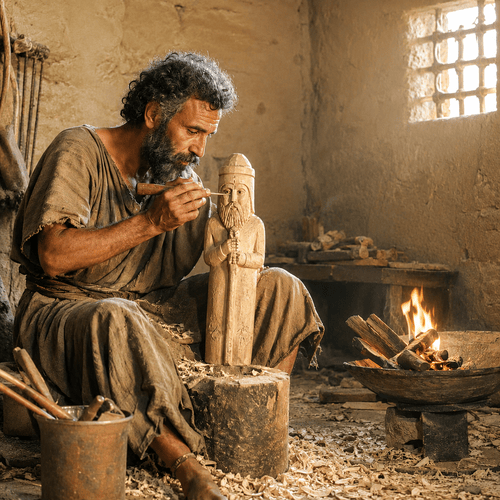
Walk through a market in almost any part of the world and you’ll pass them: carved figures, painted faces, garlanded stones. We may shrug. It’s only wood. Or stone. Someone shaped it with a chisel last Tuesday. And sold it for a fair price.
The Bible agrees. It says exactly that, with more force and more mockery than any sceptic ever has.
And yet the same Bible says people who sacrifice to these carved things are, in fact, sacrificing to demons.
That’s a startling claim, and it’s no slip of the pen. Both statements come from the same apostle, in the same letter—two chapters apart. So which is it? Is an idol nothing at all, or is there something dark behind it? Scripture gives a careful answer, and once we see it, much of the Old Testament falls into place.
Nothing—and Yet Not Nothing
Here are the two verses side by side. Paul’s writing to Christians in Corinth, a busy port city where temple meals were part of ordinary social life.
“An idol has no real existence, and there is no God but one.” (1 Corinthians 8:4)
“What pagans sacrifice they offer to demons and not to God.” (1 Corinthians 10:20)
The resolution is this. In terms of what actually exists, the idol is nothing. There’s no being answering to the name Zeus. There’s no Baal sitting somewhere in the sky. The god the worshipper imagines is fiction, and the statue is a piece of the created world, dressed up in paint.
But worship offered to what’s fiction doesn’t simply disappear. It’s intercepted. The worshipper aims at a phantom and hits a fiend. John Calvin makes precisely this point in his comments on 1 Corinthians 10: the idol is nothing in itself, yet Satan stands behind the deception and helps himself to what was intended for a god who never existed.
Think of a letter carefully written and posted to an address where no such person lives. The person is imaginary. The letter isn’t. Someone at that address opens it and reads it, and he was never the one you meant to write to.
That’s the biblical picture of idolatry. The god is imaginary. The devotion is real. And it’s intercepted by someone real—an unintended recipient.
“They Sacrificed to Demons”: The Old Testament Verdict
Paul didn’t invent this idea. He was reciting Moses.
“They stirred him to jealousy with strange gods; with abominations they provoked him to anger. They sacrificed to demons that were no gods, to gods they had never known.” (Deuteronomy 32:16–17)
Notice the deliberate self-correction in that sentence: demons that were no gods. Moses will not allow his readers to turn demons into a lower class of deity. The demon isn’t a small god. It’s a creature, a fallen spirit, a squatter in a house that was never his.
The Psalmist takes the same line and shows us where it ends:
“They served their idols, which became a snare to them. They sacrificed their sons and their daughters to the demons.” (Psalm 106:36–37)
That escalation matters. Idolatry doesn’t stay at the level of harmless folk custom. In Israel’s history it ended in blood.
The Hebrew vocabulary for idols is worth pausing over, because the words themselves carry the argument.
| HEBREW WORD | WHAT IT MEANS | WHERE IT APPEARS |
|---|---|---|
| elilim | Worthless things, nothings—a deliberate pun on elohim, “gods” | Leviticus 19:4; Psalm 96:5 |
| gillulim | Roughly “dung-pellets”; Ezekiel’s favourite word for idols | Ezekiel, around 39 times |
| shedim | Demons; related to the Akkadian shedu, the winged guardian spirit | Deuteronomy 32:17; Psalm 106:37 |
| se’irim | Goat demons, after whom Israel is said to have gone whoring | Leviticus 17:7; 2 Chronicles 11:15 |
| pesel | A carved thing—the word stresses that a man made it | Exodus 20:4; Isaiah 44:15 |
That third entry is striking. What Mesopotamia called protective spirits—the winged bulls guarding its palace gates—the Bible calls shedim, demons. The nations thought they were being guarded. Scripture says they were being farmed.
One more line seals the connection. Psalm 96:5 says “all the gods of the peoples are worthless idols”—and in the Greek version of the Old Testament that the first Christians read aloud in church, that word for “worthless idols” is translated daimonia, demons. Paul’s argument to the Corinthians was already ringing in their ears before he wrote it down.
Why the Bible Also Laughs at Idols
If we stopped there, we’d end up frightened of every carved object we passed. Scripture doesn’t allow that. Alongside the demon texts runs a second strand: sustained, deliberate mockery.
- Psalm 115:4–8 Idols have mouths but cannot speak, eyes but cannot see. Then comes the sting: “Those who make them become like them.”
- Isaiah 44:9–20 A man cuts down a tree, burns half of it to roast his dinner and warm his hands, and bows down to what’s left. The prophet lets the absurdity speak for itself.
- Jeremiah 10:1–5 Idols are scarecrows in a cucumber field. They cannot walk, so they must be carried. “Do not be afraid of them, for they cannot do evil, neither is it in them to do good.”
- 1 Samuel 5 Dagon is found face down before the ark of God, then found again with his head and hands broken off on the threshold.
- 1 Kings 18 On Mount Carmel the prophets of Baal call from morning to noon. “But there was no voice, and no one answered.” Elijah suggests, drily, their god may be relieving himself.
- Isaiah 46:1–2 Bel and Nebo are loaded onto weary animals as cargo, while the living God says of His people that He has carried them since birth.
Hold the two strands together and the balance is exact. There’s a demon standing behind Baal—and that demon couldn’t produce a single spark on Mount Carmel. Demons are parasites on false worship, not the powers their devotees imagine them to be.
Gregory Beale puts the whole matter in a memorable line: what people revere, they resemble, either for ruin or restoration. Idolatry isn’t merely a wrong opinion about the universe. It’s the slow transformation of the worshipper into the likeness of a lifeless thing.
Paul’s Ruling: Two Tables, Two Cups
Now let’s read 1 Corinthians 10:14–22 slowly. Paul is quoting Deuteronomy 32 throughout—including the warning about provoking the Lord to jealousy—and his argument moves in three steps.
First, he establishes what the Lord’s Supper is. The cup and the bread are a real participation (the Greek word is koinōnia, sharing or communion) in the blood and body of Christ. Believers are not merely remembering; they are feeding on Christ by faith and are joined to Him and to one another.
Second, he draws the parallel. If our table is real participation, then the pagan table is real participation too. The sacrificial meal in a temple is not a neutral social occasion. It joins the eater to something.
Third, he names what it joins them to. “I imply that food offered to idols is anything, or that an idol is anything? No, I imply that what pagans sacrifice they offer to demons and not to God.” The idol remains nothing. The transaction is not nothing.
THE HEART OF PAUL’S WARNING
“You cannot drink the cup of the Lord and the cup of demons. You cannot partake of the table of the Lord and the table of demons. Shall we provoke the Lord to jealousy? Are we stronger than he?” (1 Corinthians 10:21–22)
The sin Paul names isn’t primarily an intellectual mistake. It’s covenant adultery. The language of jealousy is marriage language, and it’s the wounded love of a husband, not the irritation of a tyrant.
The New Testament fuses both strands into a single verse near its close. Those who refuse to repent are described as continuing to worship “demons and idols of gold and silver and bronze and stone and wood, which cannot see or hear or walk” (Revelation 9:20). Demons behind them; blindness and deafness in them. Both true at once.
Four Things Demons Do With Idolatry
If demons don’t live inside statues, what exactly are they doing? Scripture describes four activities.
- They deceive. Every human being already knows God exists (Romans 1:19–21). The work of the deceiver isn’t to create atheism from nothing but to supply a plausible substitute object—something visible, manageable and undemanding—to a heart already looking for a way out.
- They receive. Worship stolen from God is worship gained by the thief. This was the very thing Satan asked of Christ in the wilderness: “All these I will give you, if you will fall down and worship me” (Matthew 4:9). The offer tells us what he wants.
- They counterfeit. Occasionally there is real power. The magicians of Egypt reproduced some of Moses’ signs. A slave girl at Philippi had a genuine spirit of divination and made real money for her owners (Acts 16:16–18). Not everything unexplained is a trick.
- They enslave. This is where idolatry always heads. Children burned to Molech. The prophets of Baal cutting themselves until the blood flowed. In Romans 1, the exchange of God’s glory for images is followed by moral disintegration. What begins as a shortcut ends as a chain.
Demons Are Creatures, Not Rivals
Because this subject attracts extremes, four boundaries need to be marked clearly.
| THE ERROR | WHAT IT CLAIMS | WHAT SCRIPTURE SAYS |
|---|---|---|
| There are many gods | This view says other gods are real, they’re just weaker | “Demons that were no gods” (Deuteronomy 32:17). Demons are fallen creatures, now in rebellion. |
| God and Satan are two equal powers | They’re locked in a fair fight | Satan needs permission before touching Job or sifting Peter (Job 1–2; Luke 22:31). There’s no contest. |
| There are spirits in objects | Evil forces inhabit matter and infect it; | Paul rules that the earth and everything in it belongs to the Lord (1 Corinthians 10:26). Matter isn’t haunted. |
| Demons are nothing but psychology | Idolatry is only culture and imagination | 1 Corinthians 10:20 refuses this flatly. Something real is being addressed and answered. |
Herman Bavinck insists the devil and his angels remain creatures under God’s complete government, able to act only within limits He sets. That’s why the Christian can take this subject seriously without becoming superstitious. We’re not looking at a rival kingdom of equal weight. We’re looking at defeated rebels who still recruit.
Idols of the Heart—How Far Does This Go?
So far we’ve spoken of carved images. But Scripture pushes the category further inward. God says of certain elders in Ezekiel’s day that “these men have taken their idols into their hearts” (Ezekiel 14:3). They had no statue in the room. They had one in the chest.
Paul does the same, calling covetousness idolatry outright (Colossians 3:5; Ephesians 5:5). Calvin’s famous summary is that the human heart is a perpetual factory of idols—always in production, never short of raw material. Timothy Keller drew on exactly this line in describing our modern counterfeit gods: money, achievement, romance, family, nation, and the self.
Puritan David Clarkson pressed hardest, arguing that soul idolatry—the inward giving of trust, love and fear to something other than God—is far more common than the outward kind and no less deadly.
But we must be careful here, and precision matters. Extending idolatry to the heart doesn’t mean every bad habit has a particular demon attached to it. The honest reading is this: disordered love serves the deceiver’s purposes and follows his logic, because he is the spirit now at work in the sons of disobedience (Ephesians 2:2)—without every case involving direct demonic activity. A man doesn’t need a demon to love money. He needs a fallen heart, and he already has one.
Food, Objects and Christian Freedom
This is where the doctrine meets daily life, especially for believers living among temples, shrines and festivals. Paul is remarkably practical, and his ruling isn’t what nervous Christians expect.
| THE SITUATION | SCRIPTURE | WHAT TO DO |
|---|---|---|
| Meat sold in the ordinary market, origin unknown | 1 Corinthians 10:25–26 | Buy it and eat it. Ask no questions. The earth is the Lord’s. |
| A host tells you the food was offered to an idol | 1 Corinthians 10:28–29 | Decline—not for your own conscience, but for his. The issue is witness, not contamination. |
| Idolatrous objects in your own home | Deuteronomy 7:25–26 | Remove them. The reason is allegiance and snare, not magic in the wood. |
| Occult books, charms and instruments | Acts 19:18–20 | Public renunciation as the fruit of repentance, not as a technique. |
| Fear of inherited curses from family idolatry | Ezekiel 18:20; Romans 8:1 | There’s no condemnation for those in Christ. Guilt isn’t inherited. |
Notice what Paul does not say: that the meat carries a spiritual residue to be cleansed. He says the opposite: the earth and its fullness belong to the Lord, so buy your dinner and eat with thanks. What he forbids is joining a rival table—sitting down as an act of devotion to something that isn’t God.
The difference between those two things is the difference between superstition and obedience.
Turning From Idols to the Living God
Paul once described the conversion of a whole congregation in a single sentence: they “turned to God from idols to serve the living and true God” (1 Thessalonians 1:9). Notice the order. The turning from follows the turning to. Nobody puts down an idol in a vacuum. An empty hand simply reaches for the next thing.
Notice also what’s absent here. There’s no ritual method, no formula of release, no specialist required. The risen Christ has already disarmed the rulers and authorities and made a public spectacle of them (Colossians 2:15). “He who is in you is greater than he who is in the world” (1 John 4:4). The way out of idolatry is repentance, faith, the preaching of the Word, the Lord’s Table and the ordinary life of a congregation—not a technique.
So, are idols demonic? Here is the whole answer in one breath. The idol is nothing. Its god doesn’t exist. And the devotion poured out before it is quietly collected by an enemy who cannot make fire fall on Carmel, cannot stand upright before the ark, and cannot hold a single soul that Christ has claimed.
That’s not a reason to be afraid of wood and stone. It’s reason to give our worship to the One who made both—and who is the only truth worth dying for.
Tough Questions, Honest Answers
Are Catholic and Orthodox statues and icons a form of idolatry?
This is a genuine and long-standing division, and it must be argued from Scripture rather than from suspicion. Rome and the Eastern churches distinguish between latria, the worship due to God alone, and dulia, the honour given to saints and images—and they insist the honour passes through the image to the person represented. The historic Protestant reply is that the second commandment forbids not only worshipping false gods but making and bowing before images in the worship of the true God, which is a separate prohibition. The Heidelberg Catechism adds a pastoral argument: God wills His people to be taught by the living preaching of His Word, not by lifeless images. Most confessional Protestants would also apply this to pictures of Christ used devotionally, since His two natures cannot be represented without misrepresenting Him. The charge here isn’t that Catholics secretly worship demons, but that a well-meant practice crosses a line God Himself drew.
Can a Christian own a Buddha or Ganesha figurine as decoration?
Nothing in the carving itself can harm a believer, since the earth and everything in it belongs to the Lord (1 Corinthians 10:26). But three questions should be asked honestly. Why do I want it—as art, as a souvenir, or as a hedge, a charm, a little insurance? What does it say to the neighbour, relative or house guest who sees it, particularly one who came out of that background at great cost? And would I be comfortable if a new believer, still shaking off old fears, saw it on my shelf? Deuteronomy 7:25–26 warns that such objects become a snare, and the wise course is usually to let them go. Freedom that damages another’s conscience isn’t freedom worth keeping.
Are the “gods” mentioned in Psalm 82 and Deuteronomy 32:8 real spiritual beings?
Interpreters differ, and both readings are held by orthodox believers. Calvin and many after him understood Psalm 82 as addressing human judges and rulers, who are called “gods” because they exercise God’s delegated authority and will be judged for abusing it—Jesus’ use of the psalm in John 10:34–35 fits this well. Others read these passages as describing created spiritual beings assigned over the nations, later rebelling, which harmonises neatly with Deuteronomy 32:17 and 1 Corinthians 10:20. What matters is that neither reading disturbs monotheism in the slightest. Isaiah 43:10 stands over the whole discussion: before God no god was formed, and none shall be after Him. Whatever those beings are, they’re creatures, and they aren’t to be worshipped.
Is astrology, tarot or reading a horoscope a form of idolatry?
Yes, and Scripture treats it seriously rather than dismissively. Deuteronomy 18:10–12 lists divination among the practices that made the nations detestable to God, and Isaiah mocks Babylon’s astrologers as unable to save even themselves from the coming fire. The sin isn’t simply believing something silly; it’s seeking guidance from a rival source of revelation, which is a quiet vote of no confidence in God’s providence and God’s Word. Many people begin with horoscopes as entertainment and end by arranging their decisions around them, which is exactly how a substitute god operates. God has told His people what they need to know and promised wisdom to those who ask for it (James 1:5). Anything that offers to peel back the future on our own terms is a counterfeit.
Can a Christian be cursed or oppressed because of ancestors’ idol worship?
The fear is real and widespread, and Scripture answers it directly rather than gently. Ezekiel 18:20 states plainly that the son shall not suffer for the iniquity of the father; guilt is not inherited down a bloodline. The warning in Exodus 20:5 about visiting iniquity to the third and fourth generation describes the pattern of sin repeated by those who continue to hate God, not a curse fastened onto innocent descendants. For anyone in Christ, Romans 8:1 is decisive: there is now no condemnation. What families do genuinely pass on is habit, expectation, fear and pressure—which is real, but is addressed by repentance, teaching and the support of the church, not by ritual. Renouncing former practices is a good and healthy thing to do, but it is a confession of faith, not a spiritual procedure that breaks a mechanism.
Is ancestor veneration or praying to the dead a form of idolatry?
Honouring parents and remembering the dead with gratitude is commanded and beautiful; addressing them, feeding them or seeking their help is another matter entirely. Deuteronomy 18:11 forbids enquiring of the dead, and the account of Saul at Endor in 1 Samuel 28 is presented as the final collapse of a rejected king, not as a model. Psalm 106:28 links Israel’s eating of sacrifices offered to the dead with joining themselves to Baal of Peor. The deepest issue is that Scripture gives one mediator between God and men, the man Christ Jesus (1 Timothy 2:5), and every additional channel quietly competes with Him. Believers in cultures with strong ancestral rites can usually find respectful ways to honour their families—attending, contributing, grieving, caring for the elderly while they live—without participating in the acts of devotion themselves.
When does something God Himself gave become an idol?
Alarmingly easily, and the Bible gives a clear case. The bronze serpent in Numbers 21 was made at God’s own command and used to save lives; seven centuries later, Hezekiah had to break it in pieces because Israel was burning incense to it, and he renamed it Nehushtan, “a piece of bronze” (2 Kings 18:4). The ark itself was carried into battle at Aphek as a talisman and Israel was slaughtered anyway (1 Samuel 4). The pattern is consistent: a good gift is detached from the Giver, treated as a source of power in its own right, and becomes a snare. This is worth applying to our own settings—a building, a ministry, a translation, a tradition, a revival memory, a leader. Anything we’d defend more fiercely than we’d defend Christ has already begun to shift.
Related Reads
- What Is the Divine Council? Psalm 82 and the Unseen Realm
- Kinds of Spirits in the Bible—How Many Are There?
- Curses, Hexes and Black Magic: Can These Impact the Christian?
- Did the Witch of Endor Actually Raise Samuel from the Dead?
- Standing Firm: A Biblical, Reformed View of Spiritual Warfare
- Are Demonic Strongholds Real? How Do We Overcome Them?
- Spiritual Warfare: A Believer’s Guide to Complete Battle Armour
- Letter of Jeremiah: Why Protestant Bibles Leave It Out