Sooner or later, anyone defending the Bible online meets this argument. It arrives with an air of triumph: “The Jewish scribes themselves admitted they altered the Old Testament in 18 places. It’s written in their own books.”
The technical name for those 18 places is tiqqunei sopherim—Hebrew for “corrections of the scribes”. The phrase sounds sinister, and it’s used that way: by Muslim apologists arguing for tahrif (the corruption of the earlier Scriptures), by sceptics, and by anyone looking for a quick way to unsettle a Christian’s confidence in the Bible.
So how serious is this? Have the scribes tampered with the Word of God?
The short answer: this argument falls apart the moment we examine it. The evidence doesn’t merely fail to prove the Bible was corrupted. It shows the opposite: the men who copied the Hebrew Bible were so careful they refused to hide even a rumour of a change.
What tiqqunei sopherim actually means
Tiqqun (plural tiqqunei) means a repair or a setting-right. Sopherim means “scribes”—the men who copied, counted and guarded the letters of the Hebrew text. Together the phrase means “the corrections of the scribes”.
The tradition claims in a few verses the wording was softened out of reverence for God. Three kinds of problem needed fixing:
- Undignified pictures of God—where God appears in a lowly position, such as standing and waiting before a man.
- Words that seemed to place God next to a curse—where a milder word was used to avoid writing the unthinkable.
- Statements that seemed to make God vulnerable—a phrase that could be read as “you shall not die”, as though dying were an option for God.
Notice carefully what the tradition doesn’t claim. Nobody suggests the scribes rewrote history, deleted episodes, invented laws, or bent prophecies. Every alleged change is a tiny matter of a pronoun or a polite substitution—usually a single word. That point will matter more as we probe deeper.
Where the tradition comes from
The first thing a careful reader wants to know is: who says so, and when? The list comes not from the Bible, nor from any ancient scribal record, but from rabbinic teaching literature—and it grows over time.
A timeline of the sources
- 2nd to 3rd century AD—Mekhilta de-Rabbi Ishmael. The earliest surviving witness, a running commentary on Exodus. It mentions roughly 11 examples.
- 2nd to 3rd century AD—Sifre Numbers. A commentary on Numbers, with a shorter list.
- 4th to 6th century—Midrash Tanhuma and Exodus Rabbah. Later collections of sermon material. The list is longer here.
- 9th to 11th century—the Masoretic lists. Works such as Okhlah we-Okhlah, and notes in the margins of Hebrew manuscripts, settle the number at 18.
- 13th century—Yalkut Shimoni. The fullest and latest version of the list.
Read that sequence again and something jumps out. The number keeps changing: across the sources you find 8, 11, 13, 15, 16 and finally 18. Not one tells us when the alleged corrections were made, or where, or by whom, or on whose authority.
WHY DOES THE NUMBER KEEP GROWING?
If the scribes had really made 18 changes, chances are the number would have been fixed from the beginning. A record of something that actually happened aren’t likely to gain new items century after century.
But a list of observations grows exactly like this. One teacher notices a striking phrase and mentions it. A later teacher notices two more and adds them. Century by century the collection gets longer—not because more changes were made, but because more people were reading closely.
A sample of the famous 18
Rather than list all 18, here are the most frequently cited, so you can see the size of what’s alleged.
| REFERENCE | THE TEXT AS WE HAVE IT | THE SUPPOSED ORIGINAL | WHAT DOCTRINE WOULD CHANGE |
|---|---|---|---|
| Genesis 18:22 | Abraham stood before the LORD | The LORD stood before Abraham | None. A face-to-face meeting either way. |
| Numbers 11:15 | Let me not see my wretchedness | …your wretchedness | None. Moses is at breaking point. |
| 1 Samuel 3:13 | His sons were blaspheming God | Same sense; Hebrew reads “for themselves” | None. Eli failed to restrain them. |
| Habakkuk 1:12 | We shall not die | You shall not die | None. God is declared everlasting. |
| Zechariah 2:8 | The apple of his eye | …my eye | None. God defends His people. |
| Malachi 1:13 | You snort at it | …at me | None. The offering insults God. |
| Job 32:3 | They had condemned Job | They had condemned God | None. Elihu is angry with the friends. |
| Lamentations 3:20 | My soul is bowed down within me | Your soul… | None. The lament stands. |
Now read the final column again. Suppose every one of these was a real change and every “supposed original” the true reading. What doctrine has moved? Not one. Not the Trinity, not creation, not sin, not the atonement, not the resurrection.
The alleged crime scene contains no body.
“Scripture used a euphemism”—the detail that changes everything
Here’s where the argument quietly collapses.
The earliest sources don’t say “the scribes corrected the text”. The oldest formula is kinnah ha-katuv—”Scripture used a euphemism”, or “the text spoke in a roundabout way”. A euphemism is a gentle expression used in place of a blunt one, the way English speakers say someone “passed away” rather than “died”.
This is what modern scholarship has concluded. Carmel McCarthy’s detailed study of the whole list remains the standard treatment, and her verdict is that the tradition is largely a matter of interpretation and preaching rather than a record of editing. Dominique Barthélemy reached broadly the same conclusion. Emanuel Tov, the leading textual scholar of the Hebrew Bible, allows a handful may reflect genuine alteration—1 Samuel 3:13 is his strongest candidate—while rejecting the rest.
There’s a further clue. Saul Lieberman showed that the rabbis had borrowed the vocabulary of Greek scholarship. The word tiqqun matches diorthosis, the technical term used by the scholars of Alexandria for their work on the text of Homer. The rabbis weren’t writing a confession. They were using the ordinary academic label of their day for an unusual reading they’d noticed.
What the manuscripts actually show
Traditions can be tested. If 18 verses were altered, the evidence should be easy to find. Here’s what happens when we look.
- The ancient translations refuse to co-operate. The Old Testament was translated into Greek (the Septuagint) from the 3rd century BC, and later into Aramaic, Syriac and Latin. If scribes changed the Hebrew afterwards, these older translations should preserve the original wording. For almost every one of the 18, they agree with the Hebrew text we hold today.
- The Dead Sea Scrolls refuse to co-operate. The scrolls found at Qumran push our Hebrew manuscript evidence back roughly a thousand years, to before the time of Christ. Where they preserve these verses, they support the reading we have. The supposed “unedited” Bible has never been found.
- The tradition reports itself. This ought to settle the matter. Censorship that publishes a numbered index of its own censorship isn’t censorship. Imagine a forger who signs each forgery and files a public register of them. The existence of the list is evidence of honesty, not concealment.
- The censor would have to be hopelessly incompetent. If scribes were removing undignified pictures of God, they made an extraordinary mess of it. Our Hebrew Bible still says that the LORD regretted that he had made man on the earth, and it grieved him to his heart (Genesis 6:6). It still has God saying you shall see my back, but my face shall not be seen (Exodus 33:23). It still gives God nostrils, an outstretched arm, and the aching heart of a betrayed husband in Hosea.
- Nothing whatever depends on them. As the table showed, grant every alleged change and the Christian faith is untouched. An argument that wins nothing for the man making it isn’t much of an argument.
The scribal rule: annotate, never alter
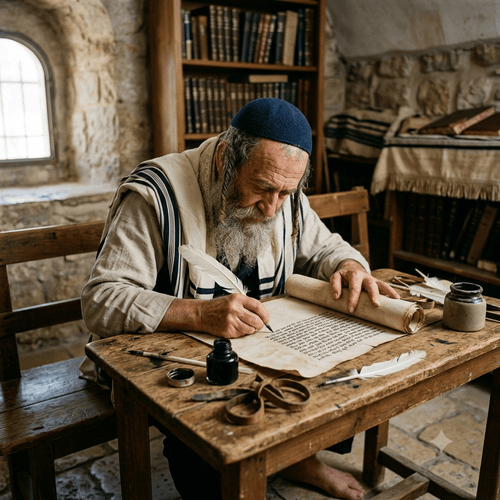
To understand why the 18 aren’t frightening, you need to know how Jewish scribes worked. Their instinct was never to tidy the text but to leave it alone and write a note in the margin. The Masoretes—the scribal families who preserved the Hebrew text through the medieval centuries—built an entire system for this.
FOUR EXAMPLES OF THE MARGINAL HABIT
Kethiv and qere. Where a written word seemed odd or indelicate, the scribes left it untouched in the text (kethiv, “what is written”) and placed the word to be read aloud in the margin (qere, “what is read”). Thousands exist. Not one written word was removed.
The extraordinary points. 15 times, dots are placed above letters to flag a scribal doubt—yet the letters remain.
The inverted nuns. Around Numbers 10:35–36 the letter nun is written backwards to mark a difficulty about where the passage belongs. The passage stays exactly where it is.
The suspended nun of Judges 18:30. A letter is raised above the line, turning “Moses” into “Manasseh”, apparently to spare Moses the shame of an idolatrous grandson. Yet the scribes left the raised letter visible, so every reader can see exactly what was done and why.
That last example is the whole story in miniature. Here’s a change made for reverence—advertised in the manuscript itself, so that nobody could be deceived by it. These men would not delete. They could only annotate. That’s the tradition from which the 18 come.
Copies, originals, and the providence of God
Now to the theology, because the objection is finally theological: if copyists could slip, how can the Bible be the Word of God?
Christian teaching distinguishes the original manuscripts from the copies made from them. Inspiration—the act of God by which the text was breathed out—belongs to the originals. What belongs to the copies is providence: God’s continual, wise governing of history so that His Word reached His people intact.
The Westminster Confession of Faith states it precisely. The Scriptures were kept pure in all ages by God’s singular care and providence (1.8). Read that carefully. It’s a claim about the outcome across the whole stream of manuscripts, not a claim that any single copy was flawless. The Second London Baptist Confession says the same, and the Belgic Confession assumes it.
Francis Turretin faced our exact question in the 17th century, when Roman Catholic controversialists argued the Hebrew text was corrupt and the church therefore needed an infallible interpreter. His answer was measured and confident: copyists’ slips can occur, and they’re correctable by comparing manuscripts; but a corruption that was universal, or that destroyed any doctrine, hasn’t occurred and can’t occur, because God has bound Himself to preserve the book of the covenant.
Richard Muller has shown at length this was the settled position of the older orthodoxy, not a modern retreat invented under pressure. They built the doctrine of preservation with that knowledge already in hand.
THE POINT IN ONE LINE
Providence doesn’t mean God shielded copyists from being human. It means God so governed the copying—through thousands of manuscripts, across scattered countries, in several languages, guarded by men who counted letters—that no error could survive undetected and no doctrine be lost.
A lesson from history
Ancient Hebrew was written with consonants only. The vowels weren’t marked at all. Much later, Jewish scribes added small dots and dashes around the letters to show the vowel sounds. These marks are called the vowel points.
In 1659 John Owen wrote Of the Integrity and Purity of the Hebrew and Greek Text, defending Scripture against the new textual scholarship of his day. One of his arguments was that the vowel points were as old as the Hebrew text itself. Louis Cappel had said they were added centuries later.
Cappel was right. The points are a late addition.
Now notice what happened next: nothing. Owen had tied his defence of the Bible to a claim the doctrine never needed. The claim fell, and the doctrine didn’t even wobble. The Bible was exactly as authoritative on the day Owen was proved wrong as on the day before.
That’s where our confidence lies. We can follow the evidence wherever it leads, because we know who has been keeping the book.
What Christ did with the text He had
One fact settles this for the Christian conscience. Jesus never held an original manuscript. Every scroll He opened in the synagogue was a copy of a copy—produced by the very scribal tradition now under suspicion.
And what did he call it? Opening an argument with the Sadducees about the resurrection, He said, have you not read what was said to you by God (Matthew 22:31)—of a copied text, in a public building. He said Scripture cannot be broken (John 10:35). He rested a whole argument on a single word in a psalm.
He never hesitated to criticise the scribes when criticism was due. He told them they were making void the word of God by your tradition (Mark 7:13). Their teaching He attacked without mercy. Their text He never questioned once. And Paul, in the middle of an argument about Jewish unfaithfulness, still grants that the Jews were entrusted with the oracles of God (Romans 3:2)—a verdict on their custodianship delivered by a man in no mood to flatter.
Where reverence flinched, revelation went further
The impulse behind the tiqqunei sopherim tradition, real or imagined, is protective. God must not be pictured waiting on a man. God must not be spoken of in the same breath as dying. The scribes, or the preachers, flinched on God’s behalf.
But the gospel overturns that instinct completely. The God who will not be embarrassed by lowliness took human flesh. He was born in a feeding trough. He knelt and washed the feet of men who would abandon Him. He stood before Pilate and said almost nothing. He died between two criminals, stripped and mocked.
Where human reverence flinched, divine revelation went further than anyone dared imagine. The Bible we hold doesn’t need protecting from its own boldness. It needs reading.
Tough Questions, Honest Answers
What is the difference between tiqqunei sopherim and the kethiv/ readings?
The two are often confused, but they work in opposite directions. Kethiv/qere is a live, visible system inside the manuscript: the written word stays in the text, and the word to be spoken aloud is printed in the margin, so the reader can see both at once. The tiqqunei sopherim, by contrast, are a claim about something that supposedly happened before the manuscript was written, with no alternative reading preserved anywhere in the text itself. That difference is telling. Where scribes genuinely wanted to guide a reader away from a difficult word, they did it openly and left the original in place. The absence of any such mechanism for the eighteen is a strong hint that no alteration ever took place.
What are the itture sopherim, the sebirin and the extraordinary points?
These belong to the same family of scribal notes and are worth knowing about. The itture sopherim (“omissions of the scribes”) concern a handful of places where the little Hebrew word for “and” is absent; the sebirin are marginal notes warning the reader that an expected word is not the one actually written, so that he does not “correct” the text by mistake; the extraordinary points are dots placed above letters to flag a doubt. Every one of these devices does the same thing: it draws attention to a difficulty while leaving the text untouched. Far from suggesting a loose attitude to Scripture, they reveal a body of men who treated each letter as something they had no authority to remove. For the Christian who believes God preserved his Word through ordinary means, this is precisely the sort of instrument we should expect providence to have used.
Did Jewish scribes deliberately alter messianic prophecies such as Psalm 22:16 or Isaiah 7:14?
This charge is sometimes made by Christians, and it should be resisted, because the evidence does not support it and the accusation is unjust. Psalm 22:16 is a genuine textual question—the Hebrew tradition reads “like a lion” where the Greek and a fragment from the Judean desert support “they pierced”—but a difference between manuscript families is not proof of malice, and the pierced reading is preserved for us in the very tradition we can still consult. Isaiah 7:14 is not a textual problem at all but a translation question about the range of the Hebrew word almah, and it was Jewish translators who chose the Greek word for “virgin” long before Christ was born. A Christian who claims the Jews scrubbed the Messiah out of the Old Testament has to explain how Psalm 22, Isaiah 53 and Daniel 9 all survived intact in their custody. The far more honest conclusion is the one Paul reached: they were entrusted with the oracles of God, and they kept them.
Why do the genealogies of Genesis 5 and 11 give different totals in the Hebrew, Samaritan and Greek texts?
This is a real and well-documented divergence: the Masoretic Text, the Samaritan Pentateuch and the Septuagint give systematically different ages for the patriarchs, producing different totals from creation to Abraham. The pattern of the differences suggests deliberate adjustment by one or more of the traditions, most likely for chronological or apologetic reasons in the centuries before Christ. It shows the tiqqunei sopherim argument is aimed at the wrong target: where a genuine textual difference exists, we can see it plainly by comparing the witnesses, which is exactly how providence has equipped the church to detect variation. The Masoretic Text has the strongest claim here, being internally consistent and supported by the shape of the narrative. None of this touches the doctrine of creation, the historicity of Adam, or the reality of the flood; it affects only the arithmetic of the interval, and the comparison itself is the safeguard.
Do any modern English Bibles actually follow a supposed pre-correction reading?
Yes, and this is worth seeing for yourself. At 1 Samuel 3:13 the ESV reads that Eli’s sons were blaspheming God, following the Greek, whereas the Hebrew as pointed reads more like “bringing a curse on themselves”. Several other modern versions do the same, and the footnotes usually say so. Notice what this demonstrates: translators are not hiding anything, the alternatives are printed at the bottom of the page for any reader to weigh, and the sense of the verse—Eli’s sons behaved appallingly and Eli failed to restrain them—is identical either way. This open, footnoted handling of variants is what a confident doctrine of preservation looks like in practice, and it is available to anyone with an ordinary study Bible.
Why does Chronicles call Saul’s son Esh-baal while Samuel calls him Ish-bosheth?
This is a favourite example in discussions of scribal reverence, and it’s instructive. Chronicles preserves the name Esh-baal, which contains the element baal (“lord”, but also the name of the Canaanite god), while Samuel gives Ish-bosheth, where bosheth means “shame”. The same pattern appears with Jerubbaal and Jerubbesheth, and with Merib-baal and Mephibosheth. Something clearly happened here—but observe that both forms survive in our Bible, side by side, in books that sit a few pages apart. If there had been a policy of silently cleaning up the text, one of the two forms would have vanished. Instead the tradition preserved the awkwardness, which is exactly the behaviour we have seen throughout: annotate and preserve, never delete.
Are there comparable disputed passages in the New Testament?
Yes, and the same principles apply. The best-known are the longer ending of Mark (16:9–20), the account of the woman caught in adultery (John 7:53–8:11), and the trinitarian addition at 1 John 5:7 found in a few late manuscripts. These are widely discussed, clearly marked in modern Bibles, and universally known—which is the point: nothing is concealed, because with over five thousand Greek manuscripts nothing can be. The doctrine of the Trinity never rested on 1 John 5:7; it rests on the whole shape of the New Testament, and it stood firm when that verse was set aside. Here too the sheer abundance of evidence, scattered across centuries and continents, is the instrument God has used to keep his Word pure in all ages.
Related Reads
- The Comma Johanneum: Does It Undermine Bible Reliability?
- Who Wrote 2 Peter? Why Do We Affirm It Was Indeed Peter?
- Does Jude Belong in the Bible?
- Shouldn’t the Book of Enoch Be In the Bible? Why Isn’t It?
- Nag Hammadi Texts: Secret Gospels or Ancient Heresies?
- Rylands Papyrus P52: Why This Tiny Fragment Still Matters
- Apple of God’s Eye: Who Does Scripture Say That Is?