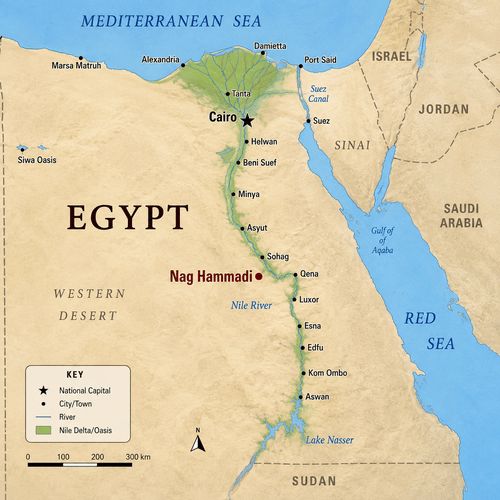
In December 1945, an Egyptian farmer, Muhammad Ali al-Samman, went out to dig. He was looking for soft soil for his fields, near the town of Nag Hammadi, about 500 kilometres south of Cairo.
The spade hit something hard: a clay jar, sealed shut, almost a metre tall. He stopped. A jar like that might hold an evil spirit. It might also hold gold. He broke it open.
There was no gold. Inside were 13 books, bound in leather and written by hand on papyrus. Nobody in the village could read a word of them.
Those books, now called the Nag Hammadi library, have for 80 years, been sold with one exciting headline: these are the lost gospels the church tried to bury. There was another kind of Christianity, we’re told—gentler, more mystical, kinder to women—and powerful bishops sought to crush it.
That story is wrong at almost every point. And we don’t have to take the church’s word for it. We only have to read the books in Nag Hammadi collection.
This article makes one simple case. Nag Hammadi didn’t weaken the Bible. It helped it. These writings aren’t secret. They’re not gospels. And what they teach isn’t a lost form of Christianity. It’s the error the apostles warned about while they were still alive.
What was actually found
- 13 codices. A codex is a book with pages, like the ones we use today, rather than a rolled-up scroll.
- 52 writings, making about forty-five works. More than 40 were unknown before 1945.
- Written in Coptic, the last form of the ancient Egyptian language, written with Greek letters. Nearly all these works are translations from Greek.
- The copies are from the 4th century. We know because the covers were stiffened with waste paper, including dated receipts from the 340s and 350s.
- Their Greek originals were written between about AD 150 and 250.
That last point matters most. Every book of the New Testament was written in the 1st century, while people who’d seen Jesus were still alive. These works come a 100 years or more later. There’s no race here.
Who buried the jar? Nobody knows. A monastery stood nearby, and Frederik Wisse suggested that monks hid the books after Athanasius of Alexandria wrote a letter in AD 367 listing the 27 books of the New Testament. A good guess, but still a guess.
No secret at all: the witness of Irenaeus
If the church tried to hide these books, it did a poor job. A bishop in France described what was in them, in detail, around AD 180.
His name was Irenaeus of Lyons (about AD 130 to 202). As a young man he listened to Polycarp of Smyrna, and Polycarp had listened to the apostle John. He was two steps from a man who walked with Jesus.
His book, usually called Against Heresies, has a longer title: Detection and Overthrow of Knowledge Falsely So-Called. The phrase comes from 1 Timothy 6:20, where Paul warns Timothy about what is falsely called knowledge. The Greek word for knowledge is gnosis, which gives us the word Gnostic.
For a long time, historians said Irenaeus had twisted his opponents’ views. Nag Hammadi ended that argument. We can now hold his summaries beside the real thing.
- Irenaeus names them as a work by the followers of a teacher called Valentinus, nothing like the Gospels of the apostles. A text of that description sits in the first Nag Hammadi codex.
- He describes a strange creation story that matches the Apocryphon of John so closely that most scholars think he had that book, or its source, on his desk. Sit with that: a bishop in France, writing about AD 180, correctly describing a book pulled out of an Egyptian cliff in 1945.
- He sets out the whole system of Valentinus—the higher world, the fall of Wisdom, the lesser god who makes matter. The Nag Hammadi texts match him.
This is rare in ancient history: an enemy’s report is checked against the sources, and found accurate. If the early church leaders reported their opponents honestly, why assume they lied about what the churches received?
He also answered the claim about secret teaching, and his answer still works. If the apostles had hidden knowledge, they’d have given it to the men they chose to lead the churches. Instead, the public teaching in every church founded by an apostle said the same thing. A secret chain of teaching cannot be checked by anybody—which is exactly why it suits the person who claims to hold it.
One more detail. Irenaeus argues there must be four Gospels because there are four winds. Sure, the argument is weak, but look at what it shows: he’s not choosing four gospels, he’s telling us he has been given four gospels. As Charles E Hill argues in Who Chose the Gospels?, the number was settled long before anyone had to defend it.
The God of the Old Testament as the villain
Here the popular story collapses. People imagine these texts offer a softer, kinder faith. That is, until they open them.
In the Apocryphon of John and books like it, a heavenly being called Wisdom acts on her own and gives birth to a deformed child. His name is Yaldabaoth. He is also called Saklas, meaning fool, and Samael, the blind god. He has the face of a lion and the body of a snake, and he knows nothing of the world above him. He makes the material universe, then announces: I am God and there is no other beside me.
Stop there. That sentence quotes Isaiah 45:5 and 46:9. It’s the God of Israel saying who He is. Here it’s used as proof that He is proud and ignorant, and a voice from above corrects him: You are mistaken, Samael.
So the God who made the world, called Abraham and gave the law is the villain. Everything else follows.
| Question | The Nag Hammadi picture | What the Bible teaches |
|---|---|---|
| Who made the world? | A lesser being, by mistake | The one true God, on purpose (Genesis 1:1) |
| Is matter good? | A prison for the divine spark | Very good, as God made it (Genesis 1:31) |
| What is our problem? | Ignorance, and being trapped in a body | Sin: rebellion against a holy God (Romans 3:23) |
| Who is Jesus? | A messenger who only seemed human | The Word made flesh (John 1:14) |
| How are we saved? | By secret knowledge | By grace, through faith (Ephesians 2:8) |
| Who can be saved? | Only those born with the spark | Whoever calls on the Lord (Romans 10:13) |
The rewriting is deliberate. In another text the snake in Eden becomes the hero who brings knowledge. This isn’t a different reading of the Bible. It’s the Bible turned inside out on purpose.
Look at the cross. In one text, Simon of Cyrene is nailed up in Jesus’ place while the real Christ stands by and laughs. If the body is a prison, no body can be a sacrifice. John was already writing against this: every spirit that confesses that Jesus Christ has come in the flesh is from God (1 John 4:2).
One row deserves a second look. These systems divide people into fixed groups from birth: some have the spark and are saved by nature, others can’t be saved at all. Critics sometimes say the Bible’s teaching on election looks similar. It’s the opposite. Nobody is born spiritual—we are all by nature children of wrath (Ephesians 2:3). This teaching rescues a better class of people. Grace rescues people who’ve nothing to offer.
How the find actually helps the Bible
So far this may sound like defence. It’s not: the library gives real support to the Bible.
- The fakes prove the standard. These books borrow the names of John, Thomas, Philip, Peter and James. Nobody forges a worthless signature. The false names show apostolic authorship was already the test, long before any council met.
- They live off the New Testament. They quote it, rewrite it and turn it upside down. You cannot copy a book that does not exist yet. Simon Gathercole and Mark Goodacre show the Gospel of Thomas even copies the small editing touches of Matthew and Luke.
- They are not gospels. Thomas is a list of sayings, Philip a scrapbook of ideas, The Gospel of Truth a long meditation. None tells the story of a real life, a real death and a real rising, because their teaching doesn’t need one.
- They don’t have a rival Bible. No list, no fixed collection, nothing read out in churches. The Apocryphon of John even begins after the crucifixion, as a sequel to Gospels its readers already knew.
- The manuscripts speak. Thomas survives in three small Greek scraps and one Coptic copy; John survives in dozens. And the oldest Christian manuscripts ever found in Egypt are pieces of the four Gospels.
One thing must be said plainly. None of this makes a book Scripture. Evidence supports; it doesn’t create. A book is Scripture because God breathed it out (2 Timothy 3:16). That would be true if every scrap of papyrus in Egypt had rotted away.
Was early Christianity a free-for-all?
The bigger claim is there was no right teaching at the start—only many Christianities, one of which won and wrote the history. Walter Bauer argued this in 1934, and Elaine Pagels and Bart D Ehrman made it famous. Four replies.
- The dates. 1st-century apostles against 2nd-century imitators isn’t a fair fight, and the imitators lose it.
- The map. Bauer said error came first in Egypt and Syria. Andreas J Köstenberger and Michael J. Kruger show, in The Heresy of Orthodoxy, this rests mostly on silence—and Egypt’s oldest Christian manuscripts are from our Bible.
- The label. Michael Allen Williams and Karen L King argue “Gnosticism” is a modern word, too loose to name one movement. There was no single rival Christianity to crush.
- The creed. 1 Corinthians 15:3–5 quotes a summary of the gospel older than the epistle itself, going back to within a few years of the cross. Larry W Hurtado spent a career showing the highest view of Jesus is the earliest view, not a later one.
Was there variety? Of course. But the apostles were already calling much of it error: empty philosophy at Colossae, endless family trees at Ephesus, men teaching the final resurrection had already happened. Jude tells his readers to fight for the faith that was once for all delivered to the saints. We cannot deliver what does not yet exist.
Yes, the winners write the history. But we now hold the losers’ books, and having read them, the church’s decision looks less like censorship and more like good judgement.
Why our Bibles don’t depend on a spade
Suppose another farmer opens another jar tomorrow. Should we be worried?
Michael J Kruger, in Canon Revisited, sets out three ways of answering the canon question—how we know which books belong in the Bible. Some say the church decides; some say historians decide. The third answer, and the right one, is that Scripture proves itself. God gave the books, kept them, and gave His people the discernment to know them.
That happens through three things at once. God made sure the church could get hold of the books He gave. The books carry the marks of God: the Westminster Confession speaks of the heavenly quality of the message and the power of the teaching, along with apostolic origin and the agreement of the churches. And the Holy Spirit convinces the reader. John Calvin put it well: Scripture no more needs an argument than light needs one to show it isn’t darkness.
Now apply that. The Nag Hammadi books were never received by the churches, and there’s no time when the church accepted them and later changed its mind. They carry apostles’ names, but no apostle wrote them. And when you read them, the marks of God are simply absent. Jesus said, My sheep hear my voice (John 10:27). Sheep also know a voice that’s not their shepherd’s.
Is that circular? Every final authority has to speak for itself. We cannot prove reason works without using reason. That’s not a trick; it’s what “final” means. And faith isn’t blind: the evidence is real and anyone may test it. It’s simply not the ground we stand on.
The comfort here is enormous. If our Bible rests on history books, every new discovery is a threat, and our confidence is only as strong as the newest study. If Scripture proves itself, a find like Nag Hammadi shows us where to place them. A believer in a village church who has never heard the name Yaldabaoth isn’t one bit less sure of her Bible than a professor of Coptic.
Jesus and Mary Magdalene
The Gospel of Thomas is often praised as the free and inclusive one. Read its last saying. Peter tells Jesus that Mary should leave, because women aren’t worthy of life. Jesus replies he will make her male, because every woman who makes herself male will enter the kingdom. Now read Paul: there is neither male nor female, for you are all one in Christ Jesus (Galatians 3:28).
The Gospel of Philip is said to prove Jesus married Mary Magdalene. It says he loved her more than the others and used to kiss her on the—and there the page is torn. The missing word is missing. The word often translated “companion” means partner, not wife. In 2012 a scrap quoting Jesus about “my wife” made news around the world, then proved to be a modern forgery.
A short timeline
- AD 30–33 — The crucifixion and resurrection.
- AD 40s–90s — The New Testament is written.
- AD 150–180 — Valentinus and others teach; these works are written.
- AD 180 — Irenaeus publishes Against Heresies.
- AD 367 — Athanasius lists the twenty-seven New Testament books.
- 1945 — The jar is opened at Nag Hammadi.
The oldest lie in a new accent
So: where do we place them? Secret gospels, or ancient heresies?
They’re not secret: Irenaeus described them openly, and today anyone can read them free online. They’re not gospels, because there is no good news in them—no real body, no death for sin, no empty tomb, and no hope for anyone outside a small circle of the enlightened.
What’s left is a very old offer. The snake in Eden didn’t begin with pleasure or power. He offered knowledge: you will be like God, knowing good and evil (Genesis 3:5)—secret understanding that lifts you above your Maker and above ordinary people. That’s what these books sell, and it’s still on sale today: the spark of God inside you, the true self waiting to be found.
Against it stands a message that was always public. The God who made matter came into matter. He died in a real body, under a named governor, on a known day, and rose in that same body. He saves the unworthy, not the clever, and He does it by grace.
The buried books weren’t the road the church failed to take. They were the road the apostles warned us about. The church read them and said no. 80 years on, we can read them for ourselves. And come to very much the same conclusion.
Tough Questions, Honest Answers
Are the Nag Hammadi texts the same as the Dead Sea Scrolls?
No, though the two are constantly mixed up. The Dead Sea Scrolls were found from 1947 near Qumran, by the Dead Sea. They are Jewish, mostly in Hebrew and Aramaic, and they include the oldest known copies of Old Testament books. The Nag Hammadi library was found in 1945 in Egypt, is written in Coptic, and holds no Old Testament manuscripts at all. The Scrolls show us how carefully the Hebrew Scriptures were copied over a thousand years. The Nag Hammadi texts show us what some second-century groups outside the church believed. Different find, different country, different language, different religion.
Can I read the Nag Hammadi texts myself, and where?
Yes. Full English translations have been in print since 1977, and good versions are free online, along with photographs of the pages. This is worth thinking about. A set of writings that is supposedly being hidden has been published, translated into many languages and studied in universities for fifty years. Anyone who tells you the church is still keeping these books from you is asking you not to check something that takes thirty seconds to check.
Is the Gospel of Judas part of the Nag Hammadi library?
No. It comes from a different manuscript, called Codex Tchacos, which was published with great excitement in 2006. Headlines said Judas was really Jesus’ closest friend, acting under orders. The scholar April D. DeConick then argued that the translation had gone badly wrong, and that the text actually calls Judas a demon and gives him a wretched end. The lesson is not that scholars are dishonest. It is that first reports are often overstated, and it pays to wait.
Did the church burn Gnostic books to silence them?
There is no evidence of an organised burning campaign, and Nag Hammadi points the other way. If monks buried these books instead of destroying them, the books survived because somebody protected them. What did happen is that churches stopped reading such works aloud and leaders warned people about them. That is what any church does with teaching it believes to be false, and it is care, not censorship. The apostles did exactly the same in writing, and named names while doing it.
Should a Christian read these texts at all?
A settled believer may read them with profit, as Irenaeus did, in order to understand what the early church faced and to answer what people say today. Paul tells us to test everything; hold fast what is good (1 Thessalonians 5:21), and testing means looking. But nobody is obliged to read them. A new or struggling believer would gain far more from another hour in John’s Gospel. Read them as history, not as devotion, and read them after you know your Bible well, not before.
Do these old ideas still appear today?
Often, though rarely under the old names. Whenever you hear that a divine spark is sleeping inside you, that your true self is already perfect, that the body is something to rise above, or that special knowledge unlocks a life ordinary believers never reach, the shape is the same. The psychiatrist Carl Gustav Jung was so drawn to one of these codices that it was named after him. The words change with every generation. The offer does not.
If these texts are so weak, why do they keep making headlines?
Because a conspiracy sells better than a catechism. A story about hidden books and powerful men makes the reader feel like an insider and asks nothing of him. There is also real academic interest, because these are genuine second-century sources and valuable ones. Christians can hold both things at once: the library is a treasure for historians, and it is no threat at all to the faith. The right response is confidence, not worry. We have read the alternative, and it has nothing to say to a dying person.
Related Reads
- The Biblical Canon: The Journey from Scrolls to Scripture
- The Truth About Apocryphal Books: Why They’re Not in the Bible
- New Testament Reliability: Debunking Myths and Lies
- Is the Biblical Canon Self-Authenticating?
- What Do the Dead Sea Scrolls Prove? The Case for Bible Reliability
- Rylands Papyrus P52: Why This Tiny Fragment Still Matters
- Scribal Corrections: How Big a Threat Are They to Bible Integrity?
- Why Didn't the Gnostic Gospels Make the Cut Into the Canon?