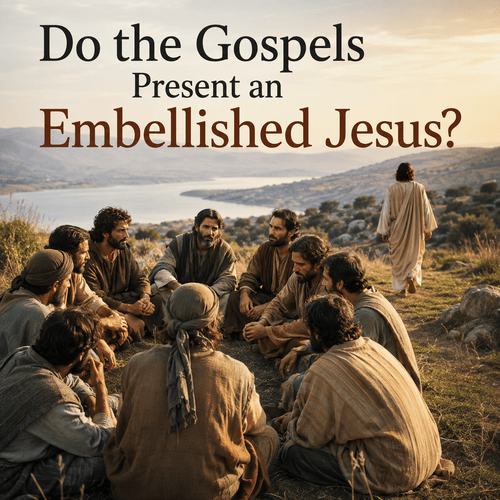
It’s the kind of argument we encounter in documentaries. And debates. The theory that the real Jesus was only a village carpenter’s son, an itinerant teacher from Galilee. His followers loved Him. They missed Him. And so, over the years they made Him bigger and bigger. First they made Him a prophet. Then the Messiah. Then the Son of God. Finally, even God Himself.
The theory, however, remains just that—a theory. On careful probing, the evidence, we discover, doesn’t merely fail to support the theory. It points firmly in the opposite direction.
What Exactly Is Being Claimed?
Notice the claim comes in two forms.
The popular form is simple. Mark wrote first, and his Jesus is modest. John wrote last, and his Jesus says things like “before Abraham was, I am” (John 8:58). So the divine Jesus must be a late addition. Legend grew, as legends do.
The scholarly form is more careful, and it has a long history.
| WHO MADE THE CLAIM | WHEN | WHAT THEY ARGUED |
|---|---|---|
| David Friedrich Strauss | 1835 | The Gospels are myth. Not deliberate lying, but stories that grew naturally around a remembered teacher. |
| Wilhelm Bousset | 1913 | Jewish believers had a low view of Jesus. Only when the faith moved into Greek cities did Jesus become a divine “Lord”. |
| Rudolf Bultmann | 1920s onwards | The Gospels tell us about the needs of the early church, not about what Jesus actually said and did. |
| The Jesus Seminar | 1985 onwards | Scholars voted on the sayings of Jesus. Almost everything in John was the church’s invention, rather than Jesus’s own words. |
| Bart Ehrman | 2014 onwards | The most widely read popular version today, in books such as How Jesus Became God. |
Two terms will help us on the way.
- Christology simply means what a person believes about who Jesus is. A “high” Christology says He is truly God. A “low” Christology says He is only a man.
- The Synoptic Gospels are Matthew, Mark and Luke. “Synoptic” means “seeing together”, because these three cover much of the same ground in much the same order. John stands somewhat apart.
So the theory says: low Christology first, high Christology later. That’s a historical claim. And historical claims can be tested.
The First Problem: The Timeline Runs Backwards
Here’s the fact that quietly destroys the whole theory.
The Gospels aren’t the earliest Christian documents we possess. Paul’s letters are. And Paul’s letters already contain the highest view of Jesus in the entire New Testament.
THE REAL ORDER OF THE EVIDENCE
AD 30–33—The crucifixion and resurrection.
AD 33–36—The creed later quoted in 1 Corinthians 15:3–7 is already being taught and memorised.
AD 48–62—Paul writes his letters. Galatians, 1 Thessalonians, 1 and 2 Corinthians, Romans, Philippians.
AD 55–70—Mark, and probably Matthew and Luke.
AD 85–95—John.
The point is simple. If Jesus grew more divine over time, the earliest documents should show the lowest view of him. They show the highest.
Look at what Paul is writing in the AD 50s and early 60s.
- Philippians 2:6–11. Jesus was “in the form of God” and “did not count equality with God a thing to be grasped”. Most scholars, including sceptical ones, believe Paul is quoting an existing hymn here rather than composing it. That pushes this belief back into the AD 40s, within roughly fifteen years of the crucifixion. And it was not a private opinion. It was being sung in church.
- 1 Corinthians 8:6. This is perhaps the most remarkable verse in the New Testament, and most readers walk past it. Every Jew recited the Shema daily: “Hear, O Israel: The LORD our God, the LORD is one” (Deuteronomy 6:4). Paul takes that sentence and opens it up: “yet for us there is one God, the Father, from whom are all things and for whom we exist, and one Lord, Jesus Christ, through whom are all things and through whom we exist.” He does not place Jesus beside God. He places Jesus inside the confession of Israel’s one God.
- 1 Corinthians 15:3–7. Paul says he is passing on what he himself “received”. This is a fixed, memorised summary of the faith. Even Gerd Lüdemann, who does not believe in the resurrection, dates its formation to within two or three years of the crucifixion.
Scholar Richard Bauckham calls this pattern “divine identity Christology”. He argues the first Christians didn’t add a second god to Judaism. They recognised Jesus within the identity of the one God of Israel. Larry Hurtado described the same thing as a “big bang” of devotion to Jesus, exploding within the first 20 years. Martin Hengel put it most sharply of all: more happened in Christian thinking about Jesus in the first 20 years than in the following 7 centuries.
ONE ARAMAIC WORD THAT UNDOES THE THEORY
At the end of 1 Corinthians, Paul writes a phrase in Aramaic to a Greek-speaking church and doesn’t translate it: Marana tha, “Our Lord, come” (1 Corinthians 16:22).
Aramaic was the everyday language of Jesus and the first believers in Palestine. Greek was the language of the wider empire.
So this prayer wasn’t invented later by Greek converts who’d forgotten their Jewish roots. It was already a settled prayer among Aramaic-speaking Jews in Palestine. It was so familiar that Paul could quote it untranslated and expect it to be understood.
The theory claims devotion to Jesus began in Greek cities. This one word, however, proves it began in Jewish Palestine, immediately.
The Second Problem: Mark’s Isn’t Low Christology
The theory claims Mark presents a merely human Jesus. Read Mark slowly, and he does nothing of the sort.
| WHERE IN MARK | WHAT HAPPENS | WHY IT IS A CLAIM TO DEITY |
|---|---|---|
| 1:2–3 | Mark quotes Isaiah 40:3, “prepare the way of the LORD”, and applies it to preparing the way for Jesus. | In Isaiah, that road is being prepared for God himself. Mark makes this claim in his first three verses. |
| 2:5–10 | Jesus tells a paralysed man his sins are forgiven. | The scribes object: “Who can forgive sins but God alone?” Jesus doesn’t correct them. He proves the claim instead. |
| 2:28 | Jesus calls Himself “lord even of the Sabbath”. | The Sabbath was God’s own institution. Only its Author may claim authority over it. |
| 4:39 | He commands the storm and it obeys. | Psalm 107:29 says this is what God does. No prophet in the Old Testament ever commands the sea. |
| 6:48–50 | He walks on the water and “meant to pass by them”, saying “It is I” (in Greek, egō eimi, “I am”). | Job 9:8 says God treads on the waves. “Passing by” is the language of God revealing Himself to Moses and Elijah (Exodus 33:19–22; 1 Kings 19:11). |
| 14:61–64 | Asked if he is the Christ, Jesus answers by combining Psalm 110:1 and Daniel 7:13. | The verdict is blasphemy and the sentence is death. Claiming to be a prophet, or even the Messiah, wasn’t a capital offence. Something far greater was heard. |
Matthew is no different. Jesus is worshipped and doesn’t refuse it (Matthew 14:33; 28:9, 17). He gives one name shared by Father, Son and Holy Spirit (28:19). He promises, “where two or three are gathered in my name, there am I among them” (18:20). Only God can be everywhere at once.
And then there’s a verse in Matthew and Luke together, which sounds exactly like John: “no one knows the Son except the Father, and no one knows the Father except the Son and anyone to whom the Son chooses to reveal him” (Matthew 11:27; Luke 10:22). One 19th-century scholar called it a meteorite that had fallen from the Johannine sky. It was meant as a complaint. The supposed dividing line between John and the Synoptics isn’t really there.
The Third Problem: John Isn’t What the Theory Needs Either
Yes, John sounds different from what the claim suggests.
John gives us the most human Jesus of the four Gospels. He is tired and sits down at a well (4:6). He weeps at a grave (11:35). He is troubled in soul (12:27). He says, “I thirst” (19:28). The famous prologue doesn’t end at “the Word was God”. It moves on to its real climax: “the Word became flesh and dwelt among us” (1:14).
John also keeps the hard sayings an inventor would have deleted. “The Father is greater than I” (14:28). “The Son can do nothing of His own accord” (5:19). Someone freely creating a divine Jesus does not leave those lines lying in the text.
And the “I am” sayings are Hebrew, not Greek. Critics say they show Greek philosophy creeping in. In fact they come straight out of the Old Testament: God’s name given to Moses at the burning bush, “I AM WHO I AM” (Exodus 3:14), and God’s repeated self-declaration in Isaiah, “I am he” (Isaiah 41:4; 43:10, 25). The very passages said to prove Greek influence are the ones most soaked in the Hebrew Scriptures.
So why does John read differently? The reasons have nothing to do with invention.
| THE DIFFERENCE | WHAT THE CRITIC CONCLUDES | WHAT ACTUALLY EXPLAINS IT |
|---|---|---|
| John records long discourses; the Synoptics record short sayings and parables. | John made up speeches for Jesus. | John states his purpose openly: he selected from far more material than he used (John 20:30–31; 21:25). Choosing isn’t inventing. |
| John focuses on Jerusalem and the feasts; the Synoptics on Galilee. | John invented a different ministry. | Jesus spoke most openly about Himself when confronting the temple authorities and when alone with the 12. Those are exactly the settings John covers. |
| John’s wording sounds like John’s own letters. | John put his own words in Jesus’s mouth. | Jesus taught in Aramaic. Every Greek word attributed to him in all four Gospels is already a translation. Ancient biography aimed at the authentic voice, not a court transcript. |
| John is the last Gospel written. | Later means less reliable. | Later can mean more reflective. The early church called John “the spiritual gospel”, written to fill out what was already widely known. |
WHAT ABOUT JOHN’S HISTORY? THE SPADE KEEPS ANSWERING
For a long time John was treated as a theological essay with little real history in it. Then archaeologists started digging.
The Pool of Bethesda (John 5:2). John says it had five roofed porches. This was dismissed as symbolism, until excavation uncovered a pool with five porches.
The Pool of Siloam (John 9:7). Uncovered in Jerusalem in 2004, exactly where John places it.
The Stone Pavement, called Gabbatha (John 19:13), Jacob’s well, and Cana likewise fit the ground rather than the imagination.
A writer freely inventing a Jesus two generations later, far from Palestine, doesn’t get the drainage of Jerusalem right casually.
The Fourth Problem: Legends Need Room to Grow
Suppose we still wanted to argue the church invented all this. Four things stand in the way.
- Communities don’t write books. People do. Richard Bauckham’s work has taken apart the old assumption that the Gospel stories floated around anonymously for decades. Named eyewitnesses were still alive and still known, and they functioned as the living guardians of what had happened. The Gospels present themselves not as folklore but as testimony.
- The time is far too short. AN Sherwin-White, writing as a Roman historian rather than a theologian, argued even 2 generations isn’t enough for legend to wipe out a solid historical core. Back in 1844, Julius Müller challenged the scholars of his day to produce one clear example, anywhere in history, of legend growing at this speed while eyewitnesses were still alive. The challenge has never been met.
- The “telephone game” comparison doesn’t fit. In that game, one person whispers privately to the next, nobody may correct anyone, and the whole point is that the message degrades. First-century Jewish teaching worked in the opposite way. It was public, communal, repeated aloud, deliberately memorised, and corrected on the spot by hearers who knew it. Jesus taught as a rabbi, and rabbis trained their disciples to remember.
- Hostile witnesses were in the room. These claims were first preached in Jerusalem, in the same city, within weeks of the execution, in front of the very men who’d arranged it.
There’s one more test, and it’s the most telling of all. Ask yourself what a group busy improving its founder’s reputation would quietly remove.
THINGS AN EMBELLISHER WOULD HAVE DELETED—AND NOBODY DID
Jesus submits to a baptism of repentance at the hands of John (Mark 1:9). Why would God’s Son need that?
“Why do you call me good? No one is good except God alone” (Mark 10:18). A gift to every critic, and it stayed in.
“Concerning that day or that hour, no one knows… nor the Son, but only the Father” (Mark 13:32).
“My God, my God, why have you forsaken me?” (Mark 15:34). The cry of dereliction is not good publicity.
His own family thought he was out of his mind (Mark 3:21).
He “could do no mighty work” in his home town (Mark 6:5).
Peter, the leading apostle, denies him three times.
Women are the first witnesses of the resurrection, in a culture that placed little weight on the testimony of women.
A crucified Messiah, which Paul admits was foolishness to Greeks and a scandal to Jews (1 Corinthians 1:23).
Legends move towards glory. This tradition kept the shame.
The Fifth Problem: The Later Gospels Prove the Opposite
Here is a test the theory sets for itself and then fails.
If the tradition really drifted from ordinary man to divine being, then the later writings should be the most extravagant, and the earlier ones the most human and most Jewish. So look at the second and third-century texts: the Gospel of Thomas, the Gospel of Judas, the Gospel of Philip.
They give us a Jesus who is less physical, less Jewish, and less crucified. He becomes a floating teacher of secret knowledge, barely touching the earth at all.
So the real direction of travel is the reverse of what we were told. It runs from a solid, bleeding, thoroughly Jewish Messiah towards vague spiritual abstraction. The four Gospels sit at the concrete end of that line, not the fantastical end. They are the earthy ones.
Answering the Stronger Version of the Objection
Serious critics know all this, and their argument has changed. Bart Ehrman now concedes a divine view of Jesus existed within a couple of decades. His revised case is that there were two stages:
- Exaltation Christology. Jesus was an ordinary man whom God promoted to divine status at the resurrection.
- Incarnation Christology. Only later did Christians say He had existed with God beforehand and had come down to us.
It’s a tidy argument. It still doesn’t work, for one reason: the two supposed stages sit side by side in the earliest material we have.
- Philippians 2 contains both in a single hymn. He comes down, and He is exalted. One passage, both ideas. In the AD 40s.
- Romans 1:3–4 says the Son was “descended from David according to the flesh” and “declared to be the Son of God in power” by the resurrection. Note the verb. He was declared to be what He already was. Announcing a king at his coronation isn’t the same as creating one.
- 1 Corinthians 8:6 already has Jesus present at creation, with all things existing “through” Him. That’s pre-existence in the earliest layer of all.
But Didn’t Scribes Change the Text Later?
This is the follow-up question. Here’s a straight answer.
- We know about the variations because we have so many manuscripts, not because we have too few. A text nobody copied would have no variants at all. Riches create bookkeeping.
- The genuinely disputed passages are printed openly in every modern Bible, with footnotes. The main ones are 1 John 5:7, the account of the woman caught in adultery (John 7:53–8:11), and the longer ending of Mark. Nothing is hidden.
- No doctrine about Christ depends on a disputed reading. Remove every contested verse and Philippians 2, Colossians 1, Hebrews 1, John 1 and 1 Corinthians 8 all remain exactly as they were.
- The oldest copies already have the highest Jesus. Our earliest substantial manuscripts of John date to around AD 200, and a fragment of John 18 to around AD 125. There’s no earlier layer of manuscripts showing a merely human Jesus who was later upgraded. That layer has never been found, because it never existed.
Reformed apologist James White has made this point repeatedly in public debate.
Why This Matters More Than an Argument
It would be easy to treat this as a debating point. It isn’t.
The Westminster Larger Catechism asks why the Mediator had to be both God and man. The answer is beautifully practical. He had to be man so He could genuinely stand in our place, obey in our nature, and suffer for us. He had to be God so His obedience would have infinite worth, and He could bear the full weight of the wrath due to sin and not be crushed by it.
WHAT’S ACTUALLY AT STAKE
If Jesus isn’t God:
The cross is a tragedy rather than a rescue, because no mere man can carry the sins of the world.
Every Christian who has ever prayed to Him has been an idolater.
Thomas was wrong to fall down and say “My Lord and my God!” (John 20:28), and Jesus was wrong to accept it.
This isn’t a doctrine we could quietly set aside and carry on. Remove it and there’s nothing left to carry.
So we return to the question with which we began. Did the disciples invent Jesus’s divinity?
They couldn’t have. The window was too narrow, the eye witnesses too many, the earliest documents too high, the embarrassing details too well preserved, and the later legends too obviously different in flavour. The men who wrote these books were not building a legend. Several of them died rather than take back what they had written. People don’t suffer martyrdom for what they know they invented.
They weren’t inventing. They were remembering, and the Spirit was helping them remember rightly.
Frequently Asked Questions
Did the Council of Nicaea in AD 325 vote to make Jesus divine?
No. Nicaea didn’t invent the deity of Christ; it defended a belief the church already held against a new denial of it. Arius taught the Son was a created being, however exalted, and the council met to answer him. The vote itself wasn’t close: of roughly 300 bishops, only two refused to sign. What Nicaea supplied was precise vocabulary, chiefly the word homoousios, “of the same substance”, to close a loophole Arius had been using. Reformed Christians receive the creed gladly, but we receive it as a faithful summary of Scripture, not as an authority above it. The bishops didn’t create the doctrine. They fenced it.
Did Constantine decide which books went into the Bible?
There’s no historical evidence that Constantine chose the canon. In fact, there’s considerable evidence against it. The four Gospels were already functioning as Scripture in churches long before he was born, as Irenaeus shows around AD 180, and lists such as the Muratorian Fragment point the same way. Michael Kruger has argued at length the canon wasn’t so much imposed as recognised. The church received the books that bore the marks of apostolic authority. This fits what Reformed Christians confess: God’s people don’t confer authority on Scripture, they acknowledge the authority it already has. The sheep recognise the Shepherd’s voice. Constantine’s role in this story is a modern invention, largely popularised by fiction.
Was Jesus’s divinity copied from pagan gods like Mithras, Osiris or Horus?
This claim collapses under examination, which is why it has almost no support among historians of any faith or none. The alleged parallels are usually built by describing pagan myths in deliberately Christian language, and by drawing on sources written after the New Testament. Osiris is reassembled in the underworld, not raised bodily into this world; Mithras has no death and resurrection at all in the surviving evidence. More decisively, the first Christians were Jews who regarded pagan worship with horror and would have been the least likely people on earth to borrow from it. The real background of the New Testament isn’t Egyptian or Persian myth but the Hebrew Scriptures, quoted on almost every page.
Did Paul invent Christianity and turn a Jewish rabbi into a divine saviour?
Paul himself makes this impossible. He repeatedly says he is passing on what he received rather than what he composed (1 Corinthians 15:3), and he quotes hymns and creeds that were already in circulation before his letters. He also tells us he met Peter and James in Jerusalem and the leaders there added nothing to his message (Galatians 1:18–2:10). This is a checkable claim, made to people who could check it. If Paul had been inventing a new religion, the Jerusalem apostles were exactly the people positioned to expose him. Paul isn’t the founder of a new faith but the Spirit-taught interpreter of the one gospel promised beforehand in the prophets (Romans 1:1–4).
Does the Gospel of Thomas give us an earlier, less embellished Jesus?
Almost no specialist dates Thomas earlier than the mid-second century, well after the four Gospels. Its Jesus isn’t more human but far less so: he has no birth, no cross, no resurrection, and offers secret sayings rather than a saving death. That’s the opposite of a low, human Jesus who was later exalted; it’s a Jesus so spiritualised that he barely touches the ground. Thomas therefore illustrates the very point we’ve made: that the drift over time ran away from earthy Jewish reality, not towards it. Reformed Christians also note the deeper problem: Thomas offers salvation through hidden knowledge, whereas the gospel offers salvation through a public death and a bodily resurrection announced to the world.
Why do Jehovah’s Witnesses translate John 1:1 as “the Word was a god”?
Their translation rests on the absence of the Greek definite article before theos in the final clause, which they take to mean “a god”. But Greek regularly drops the article before a noun placed ahead of the verb without making it indefinite, and John’s own Gospel does this many times, including in verses where the Witnesses themselves translate it as definite. The context settles it: John 1:3 says all things were made through him, which leaves him outside the category of created things altogether. Thomas then addresses him directly as “My Lord and my God!” (John 20:28), and Jesus commends him rather than correcting him. The translation is driven by the doctrine rather than the doctrine by the translation.
Does the Muslim claim the original Injil was corrupted hold up historically?
The difficulty is that the claim has no manuscript evidence behind it. We possess thousands of Greek manuscripts, early translations and quotations from the church fathers, spread across many countries and centuries, and they show no lost original with a merely human Jesus. Any corruption would have had to occur before our earliest copies, be adopted simultaneously in Egypt, Syria, Rome and North Africa, and leave no trace of protest anywhere. The Qur’an itself speaks of the Gospel as available and to be judged by in its own day (Surah 5:47), which raises an obvious question about when this corruption is supposed to have happened. Reformed Christians respond to Muslim friends not with hostility but with an invitation to read the documents themselves, trusting that God preserves his Word.
Related Reads
- Is Jesus God? The Biblical and Historical Case for the Deity of Christ
- Did Jesus Really Exist? The Historical Evidence Sceptics Can’t Ignore
- Is Jesus a Mere Copy of Pagan Gods?
- Is the Shroud of Turin Real or Fake? The Evidence Weighed
- Son of God: What Did This Title Mean to Jews in Jesus’ Day?
- Why do We Affirm Jesus is Truly God and Truly Man?