
Late on the evening of 28 May, 1898, Italian lawyer, Secondo Pia stood in his darkroom waiting for a photograph to appear. Pia took pictures only as a hobby, but he’d been given a rare honour: permission to photograph an old linen cloth kept in the cathedral of Turin. For centuries people had claimed the cloth was the burial sheet of Jesus Christ. To the naked eye it wasn’t much to look at—faint brownish stains which some said formed the shape of a man.
Then the image came up on his glass plate, and Pia nearly dropped it.
To see why, you need one fact about old photography. A camera didn’t first produce a normal picture. It produced a negative, in which everything is reversed: what’s dark in life appears light, and what’s light appears dark. Yet Pia’s negative wasn’t reversed. It showed a clear, calm, lifelike face of a bearded man. Somehow, on linen made long before cameras existed, the light and dark were the wrong way round.
That night began the modern argument about the Shroud of Turin. Since then the cloth has been scanned, chemically tested, carbon dated and, most recently, genetically sequenced. It has been called the most examined object on earth. And people still cannot agree about it.
What the Shroud Actually Is
Before we argue about the Shroud, we should be clear about what it is.
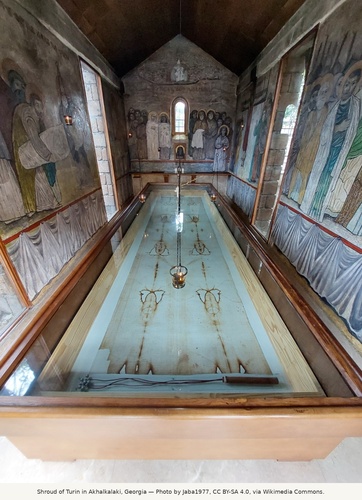
- The cloth. A single sheet of linen, roughly 4.4 metres long and just over a metre wide—about the size of a long dining table. It’s woven in herringbone twill, meaning the threads cross in slanting rows, giving a ridged, zig-zag texture.
- The image. Two faint, straw-yellow figures of a naked adult man, one showing the front of the body and one the back, laid head to head. That is what you would expect if a body had been placed on one half of a long sheet and the other half folded back over the top of it.
- The wounds. The figure carries marks of terrible violence: dozens of small wounds across the back and legs, as if from a whip; a wound in the side; injuries at the wrists and feet; and bleeding around the scalp. Anyone who knows the Gospel accounts will recognise the pattern at once.
- The damage. In 1532 a fire broke out in the chapel at Chambéry in France, where the cloth was then kept, and molten silver from its container burned holes right through the folded linen. Nuns patched the damage; the patches were largely removed again in 2002.
- The home. Since 1578 the cloth has been kept in the Cathedral of St John the Baptist in Turin, where it now lies flat in a sealed case and is shown to the public only very rarely.
Why Many Claim It’s Genuine
Serious scientists have looked closely at this cloth and come away puzzled. Here are their strongest points.
- There’s no paint on it. In 1978 about two dozen scientists, the Shroud of Turin Research Project (STURP), examined the cloth directly for 5 days. Their conclusion surprised many: the image isn’t painted. It’s a very thin discolouration of the outermost fibres of each thread, as if only the surface had been faintly scorched. There’s no pigment, no glue, no brush strokes. In a painting the colour soaks down into the cloth; here it sits on top, no deeper than a single hair.
- The image seems to contain depth. John Jackson and Eric Jumper examined the image with a machine built to read satellite photographs, which turns brightness into height, rather like turning a map into a model of the hills. Fed an ordinary photograph of a face, it produces a distorted mess; fed the Shroud image, it produced a recognisable three-dimensional shape. The darkness seems to vary with how far the cloth would have been from the body: closer means darker, further means fainter. Normal pictures carry no such information.
- The body is anatomically correct where medieval art was wrong. In the Shroud image the nails pass through the wrists, not the palms. That’s medically correct: the flesh of the palm would tear under a body’s weight, while the wrist can bear it. Yet almost every medieval crucifix shows nails through the palms, and a forger would have copied the art around him. A second detail: the thumbs aren’t visible—and a nail through the wrist damages a nerve, folding the thumb inward. A medieval artist would not know that.
- The stains look like real blood. Chemists John Heller and Alan Adler argued the marks are real blood, containing unusually high levels of bilirubin, which the body produces under extreme stress or injury. If they’re right, this isn’t red paint but blood from a man who suffered badly before dying.
- The tested corner may not be original cloth. Raymond Rogers, a chemist who had worked with STURP, argued in 2005 the corner cut off for carbon dating was chemically different from the rest of the sheet, having been mended with newer thread dyed to match. If so, the laboratories tested a repair, not the original cloth. In 2019 Tristan Casabianca and others obtained the raw laboratory figures and argued the three results varied too widely for one confident date.
- There may be a trace of the cloth before the carbon date. A Hungarian manuscript of about 1192, the Pray Codex, shows the burial of Christ. Its burial cloth appears to have a herringbone weave, and four small circles in an L-shape match holes on the Shroud made long before the 1532 fire. If the artist was copying the Turin cloth, it existed a century earlier than the carbon dating allows.
- New DNA points towards the Middle East. In 2026 a team led by Gianni Barcaccia of the University of Padua published genetic testing on samples taken in 1978. They found human DNA of types common in the Near East, and organisms that survive only in extremely salty conditions, of the sort found around the Dead Sea.
Why Many People Believe It’s Medieval
Now the argument from the other side. It’s at least as strong, and in several places, even stronger.
- Three laboratories tested it and agreed. In 1988 pieces of the cloth went to three laboratories—Oxford, Zurich and Arizona—none knowing what the others were finding. Each used radiocarbon dating, which measures a form of carbon that slowly breaks down after a living thing dies and so can estimate age. All three gave roughly the same answer: the linen dates from between 1260 and 1390. The result was published in the journal, Nature. The agreement of three independent laboratories isn’t easy to brush aside.
- Where was the shroud for 13 centuries? Imagine owning what you believed to be the burial cloth of the Son of God, bearing His image. Would you keep it quiet? Yet there’s no clear record of this cloth from before the 1350s, when it appears in a small French village called Lirey, held by a knight named Geoffroi de Charny. Supporters suggest it was hidden, or known by another name in the city of Edessa. That’s possible, but it’s a guess offered to fill the gap, not evidence.
- A bishop of the time investigated and reported a confession. In 1389 Pierre d’Arcis, Bishop of Troyes, wrote to the pope about this very cloth. His predecessor, he reported, had investigated, concluded the image was painted, and found the artist, who confessed. The pope allowed the display to continue only if the cloth was announced as a representation, not the true burial sheet of Christ. This isn’t a modern sceptic but a churchman of the period, writing while the events were fresh.
- The blood doesn’t flow the way blood flows. In 2019 the forensic scientists Matteo Borrini and Luigi Garlaschelli studied the direction of the blood trickles. Blood obeys gravity, so its path tells you which way a body was leaning. They concluded the rivulets do not all fit one body in one position: some suit a man hanging upright, some a man lying flat. Garlaschelli had earlier, in 2009, produced an image broadly like the Shroud using only materials available in the 14th century—not an identical copy, but enough to remove the claim that no human being could have made such a thing.
- The shape of the body is wrong. This is the newest argument and the sharpest. In 2025, Brazilian digital designer Cícero Moraes published a study in Archaeometry asking a simple question: what happens when cloth is draped over a real human body? Using modelling software, he laid a virtual cloth first over a full three-dimensional figure and then over a shallow carving, the sort of low relief you see on a church wall. Cloth over a real body wraps round the sides, so flattened out the image comes wide and stretched. The Shroud shows no such widening; its figure has natural proportions. The carving matched it far better than the body did.
- The DNA cuts both ways. The same 2026 study also found traces from all over Europe and the Mediterranean, including cultivated plants, farm animals and red coral. The researchers said plainly that their work cannot date the cloth or settle its authenticity. Any object handled by thousands of people across many countries and centuries picks up traces from everywhere. Middle Eastern DNA tells us the cloth has been near the Middle East, or near people from there. It does not tell us who was wrapped in it.
A Word About Carbon Dating
Some people try to discredit the 1988 result by saying carbon dating is simply unreliable. That argument doesn’t quite work here. Here’s why.
- First, this is exactly the range where the method works best. Across the last few thousand years, radiocarbon results can be checked against things whose age we already know: tree rings, dated documents, coins, objects from datable tombs. Within that window the method performs well, and a first-century linen sheet sits comfortably inside it. The serious debates concern dates tens of thousands of years back, where nothing can check the assumptions. That’s a different discussion.
- Second, the usual objection would push the date the wrong way. Second, the usual objection would actually make the cloth appear older, not younger. If there was less carbon-14 (C14) in the atmosphere in the past, a sample would appear to have lost more C14 and would therefore test as older than it really is. However, in this case, less C14 would actually make the Shroud look more recent than 1260, not first-century. So this objection doesn’t support an earlier date.
- Third: the strongest criticism concerns the sample, not radiocarbon dating itself. Only a small corner of a heavily handled cloth was tested. It may have been repaired or contaminated by centuries of handling, smoke or fire. This is a fair concern, and it remains unresolved because further testing has not been done.
What the Gospels Actually Describe
One more piece of evidence rarely gets any attention, and it comes from the Bible. Read the burial and resurrection accounts slowly, and the details don’t fit the Shroud comfortably.
| What the Gospels say | What the Shroud is |
|---|---|
| Jesus was bound in linen cloths, in the plural, along with the spices (John 19:40). There were several, not one. | One single large sheet |
| A separate face cloth lay folded up in a place by itself (John 20:7) | One unbroken image running right over the head |
| About 34 kilograms of myrrh and aloes were used in the burial (John 19:39) | No report of matching residue or staining from spices |
| No Gospel writer mentions any image on the cloth | The image is the whole reason anyone cares |
Let’s be fair about the first two rows. Matthew, Mark and Luke use a Greek word meaning a single sheet, so one large sheet with binding strips and a separate face cloth is quite possible; the accounts harmonise without strain. Donald Carson, in his commentary on John, notes the quiet detail that the face cloth was found folded and set apart by itself—a sign of calm and order. Grave robbers do not tidy up.
But the last row of that table is the loudest fact in the discussion. Four men wrote accounts of the empty tomb, and two of them, Peter and John, stood inside it and looked at the grave clothes with their own eyes. John tells us he saw the linen lying there and the face cloth folded separately. He is describing the scene in detail.
And not one of the four says a single word about a picture of Jesus on the linen.
Had the burial cloth carried a permanent image of the crucified and risen Lord, it would have been an extraordinary evidence in human history. The apostles would have preached it. Paul would have argued from it. The early church, which argued about circumcision and food and spiritual gifts, would have argued about it. Instead, we have complete silence.
Where Scripture Puts Our Confidence
Now the question that matters most. Suppose every scientific objection collapsed tomorrow, and new tests proved beyond doubt that this is first-century linen from Judea, wrapped round a man who was scourged and crucified. What then? This is where most discussions stop. It’s where the discussion ought to begin.
Calvin got there first
In 1543 John Calvin wrote a short, sharp book about relics—objects said to be connected with Christ and the saints and treated as holy. He dealt with burial shrouds directly, and his arguments haven’t aged. The Gospel writers, he pointed out, describe linen cloths and a separate head napkin, not one great imaged sheet. Had the cloth carried a miraculous likeness of the Saviour, the apostles wouldn’t have failed to mention it. And he noted, drily, that in his own day several European towns were displaying the true shroud at once, each attracting pilgrims and the money pilgrims bring.
That last observation isn’t cynicism but arithmetic. The relic trade existed because relics were profitable, and a market that can supply four true shrouds can just as easily supply five.
The bronze serpent settles it
Here’s the argument that decides the whole question, and the beauty of it is that it depends on no laboratory result at all.
In Numbers 21, God told Moses to make a serpent of bronze and lift it on a pole, so that anyone bitten by the snakes in the wilderness could look at it and live. There’s no question about whether that object was genuine. God himself commanded it, and people who looked at it were healed. It could hardly have a better pedigree.
Now move forward roughly 700 years. King Hezekiah is reforming the worship of Israel, and we read this: he broke in pieces the bronze serpent that Moses had made, for until those days the people of Israel had made offerings to it (it was called Nehushtan) (2 Kings 18:4).
Read that again slowly. Hezekiah took an authentic, God-commanded, miracle-working relic and smashed it to pieces—and Scripture records this among his good deeds, in a passage praising him. The nickname he gave it, Nehushtan, means roughly “that lump of bronze”. Why did he do it? Not because the object was fake, but because the people had started burning incense to it. A thing God had given for their good had become a thing they worshipped, and so it had to go.
The Principle: Being Genuine Gives an Object No Right to Our Devotion
Even if the Shroud of Turin were proved beyond all doubt to be the true burial cloth of Jesus Christ, a Christian’s duty towards it would not change by a single degree. It would be a very interesting piece of very old linen. Nothing more.
The second commandment isn’t an objection to bad art
The Heidelberg Catechism asks whether images might at least be allowed in churches as books for people who can’t read. It answers that we must not try to be wiser than God, who will have his people taught, not by dumb images, but by the lively preaching of His word. The Westminster Larger Catechism is blunter still. It forbids the making of any representation of God, of all or of any of the three persons, whether inwardly in the mind or outwardly in an image.
James Packer put the reasoning plainly in Knowing God: images always misrepresent God, because anything we can carve or paint or photograph is smaller and less than He is; and since Jesus Christ is God the Son, pictures of Jesus fall under the same warning. Kevin DeYoung adds the commandment is aimed not at clumsy artwork but at the human instinct to make God manageable, to bring Him within reach of our hands and eyes.
Christians who love and honour Scripture have disagreed over whether the human nature of Christ may be depicted at all. But the direction of our confessions is clear, and it should make us cautious about a cloth whose whole attraction is that it offers us a face to gaze at.
God preserved a book, not a museum
Now look at what God has chosen not to keep.
- The ark of the covenant. The holiest object in Israel’s worship, made at God’s own command and holding the tablets of the law. Gone, and nobody knows where.
- The cross. The instrument of our salvation. Gone, whatever medieval Europe claimed to own.
- The grave of Moses. God buried him Himself, and Deuteronomy 34:6 says no one knows the place to this day. That looks like deliberate prevention.
This isn’t carelessness but design. What God has carried safely through fire, invasion, empire and persecution is His Word. That is where He has invested His protection, and Paul tells us why:
So faith comes from hearing, and hearing through the word of Christ (Romans 10:17).
Sinclair Ferguson has often pressed the point that faith is created and kept alive by the Word preached, not by anything we can inspect or hold. Michael Horton adds God comes to us through the apparent weakness of words rather than the spectacle of sight, and that this isn’t an accident but a mercy.
A Dead Man’s Image, a Living Saviour
There’s one last problem with the Shroud, and it’s the deepest of all. At its very best, the image is of a corpse: a man beaten, pierced and killed, lying still. The Christian message is about someone alive.
Paul writes that even though we once regarded Christ according to the flesh, we regard Him thus no longer (2 Corinthians 5:16). Peter writes warmly of believers who love a Saviour they’ve never seen with their eyes (1 Peter 1:8).
And Jesus Himself answered this question. To Thomas, who’d insisted on seeing and touching, He said: Blessed are those who have not seen and yet have believed (John 20:29). He had already given the harder version of the same truth in a parable: If they do not hear Moses and the Prophets, neither will they be convinced if someone should rise from the dead (Luke 16:31).
RC Sproul distinguished carefully between evidence and assurance. Evidence can persuade the mind that something happened. Only the Spirit of God convinces the heart to trust the person it happened to. A photograph wouldn’t have saved Thomas. A word did.
There’s also a practical reason to keep our defence of the faith away from this cloth. In two years, one peer-reviewed study concluded the image cannot have come from a human body, while another traced DNA on it to the Near East. Headlines went one way, then the other. If your confidence in the resurrection rises and falls with each new paper, that confidence isn’t in Christ; it’s in the current state of research.
And we don’t need it. The case for the resurrection stands on its own: the early summary of eyewitnesses Paul quotes in 1 Corinthians 15, an empty tomb no one could refute by producing a body, named witnesses still alive to be questioned, frightened men transformed into people who would die rather than withdraw their testimony, and a church growing in the very city where the body had been buried.
So, Real or Fake?
Weighing everything, the balance tips towards a medieval origin. The carbon dating remains the most direct physical test ever performed, and three independent laboratories agreed. The written record begins in the 14th century and not before. A bishop of that very period recorded an investigation and a confession. The newest modelling suggests the image never touched a human body. On the other side, the objections are real, some remain unanswered, and no one has given a fully convincing account of how the image was made.
But notice something. An unsolved puzzle isn’t the same as a miracle. “We don’t yet know how this was done” is honest. “Therefore God did it” is a leap, and one we would not accept from anyone arguing for a rival religion’s relic.
So the honest answer is this: probably not genuine, though the question is far from finally closed. And the far more important answer is this: it doesn’t matter nearly as much as we’ve been told.
Christ didn’t leave His church a photograph. He left a book to be read and preached, a table to gather round, a baptism to mark His people, and a commission to carry His gospel to the ends of the earth. Hezekiah smashed a relic God Himself had commanded, and Scripture calls it obedience. We may look at Turin with curiosity, even with wonder at a puzzle no one has solved. We must not look at it for assurance, because our assurance was never kept there.
It’s kept in a word that will outlast every piece of linen on earth.
Tough Questions, Honest Answers
What’s the Sudarium of Oviedo, and does it support the Shroud?
The Sudarium is a bloodstained cloth kept in Oviedo, Spain, with a documented history reaching back further than the Shroud’s. Supporters argue its stain patterns and blood group match the Turin cloth, which would push the Shroud’s history back centuries. Critics reply the Sudarium bears no image, that the claimed matches are subjective, and that carbon dating placed it around the 7th century. Even taken at its strongest, the argument would only establish that two old cloths are related, not that either touched Jesus. And the same principle applies: a cloth with an unbroken pedigree would still be a cloth.
Does the Shroud tell us what Jesus really looked like?
It cannot, and we should be glad of that. Scripture gives us no physical description of Jesus whatsoever—no height, no colouring, no face. That silence is not an oversight in a book that describes Esau’s hairiness and Eglon’s size. God has deliberately withheld the one thing that would most tempt us to venerate an image. Isaiah 53:2 tells us only that there was nothing in his appearance that would make us desire him, which is roughly the opposite of a devotional portrait. Every artistic Jesus, including the one on the Shroud, is a guess.
Is it wrong to have pictures of Jesus in children’s Bibles?
Christians who take the second commandment seriously have landed in different places on this, and it deserves a careful answer rather than a slogan. The historic confessions say no, on the ground that the person depicted is God the Son, and no picture of Him can be anything but false. Others distinguish between an illustration used to tell a story and an image used in worship, and allow the first while forbidding the second.
What does the Roman Catholic Church officially teach about the Shroud?
Less than most people assume. Rome has never declared the Shroud authentic and has no doctrine requiring anyone to believe it is. Recent popes have described it as an icon, a mirror of the Gospel, and have explicitly said the church has no special competence to settle scientific questions about it, leaving those to researchers. Devotion to it is permitted, not commanded. This is worth remembering in conversation: a Catholic friend who venerates the Shroud is going further than his own church requires, and a sceptic who thinks Rome has staked its credibility on the cloth has misread the situation.
Are any other relics of Christ genuine, such as the True Cross or the Holy Grail?
There’s no good evidence for any of them, and considerable evidence against. John Calvin observed the fragments of the true cross scattered around Europe would have filled a ship, and that Christ was reportedly buried in several shrouds at once. The Grail is a medieval literary invention rather than a historical claim; the Veil of Veronica rests on a legend that appears centuries after the events. The medieval relic trade was an economy, and economies meet demand. More importantly, the New Testament shows no interest at all in the objects Jesus touched—no apostle preserves the cup, the manger or the nails.
What happened to the actual burial cloths mentioned in John 20?
Nobody knows, and Scripture never tells us. The cloths appear in the narrative for one reason only: they’re evidence the tomb wasn’t robbed. John records he saw the linen lying there and the face cloth folded separately, and that he believed. Then the cloths disappear from the story entirely. The apostles went out and preached a risen Christ; they didn’t carry his laundry from city to city. That editorial decision by the Holy Spirit is itself instructive about how much attention burial cloths deserve.
Can I visit the Shroud of Turin?
Not usually. The cloth is kept sealed in a climate-controlled case in the Cathedral of St John the Baptist in Turin and is displayed publicly only on rare occasions, announced years in advance, with millions applying for time slots. The cathedral itself is open, and a high-quality replica is normally on view there. If you go, go as a tourist rather than a pilgrim. Looking at an old and puzzling artefact is a perfectly good use of an afternoon; looking at it for spiritual benefit is asking a piece of cloth to do what only Christ can do.
Related Reads
- Do Christians Need Holy Shrines? Why the Reformed Answer Is No
- Did Jesus Rise from the Dead? The Historical Case for the Resurrection
- The Resurrection Of Jesus: Historical Evidence That Even Sceptics Accept
- The Empty Tomb: Did the Disciples Steal Jesus’ Body?
- Was Jesus Really Crucified? Evidence from History and Scripture
- The Burial of Jesus: Is Joseph of Arimathea’s Tomb Real History?
- Did the Disciples Invent Jesus's Divinity?
- How Did Jesus Die? What Doctors Say About the Cross