It’s a passage critics love to bring up: Numbers 15:32-36.
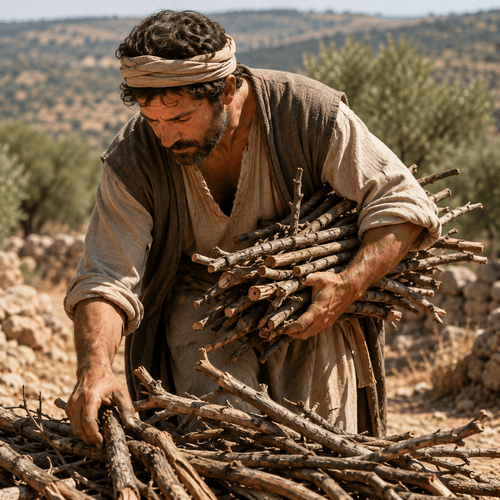
The story in brief: a man is found collecting firewood on the Sabbath, the weekly day of rest God had given Israel. He’s arrested. God tells Moses the man must die. The whole community takes him outside the camp and stones him.
Five verses. The man’s never named. He doesn’t get to state his case.
So what’s the cruel stoning—of a man over collecting firewood—really all about?
Two details are worth noticing before we go further. The people didn’t act on impulse; they arrested the man. And waited. Until they were told what to do with him. And God Himself gave the ruling. We cannot blame the mob, or even Moses for the cruelty. So was God having a bad day, perhaps? Or being a capricious tyrant?
The big mistake: starting at verse 32
Almost every weak treatment of this passage begins at verse 32, with the man and his sticks. That’s where the misunderstanding starts. Numbers 15 isn’t a set of laws with a shocking story dropped into the middle. It’s a carefully built unit of 4 panels:
- Here’s sin that can be covered (Numbers 15:1-29)
- Here’s sin that can’t be covered (Numbers 15:30-31)
- Here’s what uncovered sin looks like and how you deal with it (Numbers 15:32-34), and
- Here’s how to avoid it (Numbers 15:35-42)
And our story is Panel 3.
| VERSES | WHAT IT CONTAINS | WHAT IT’S DOING |
|---|---|---|
| Numbers 15:1-21 | Offering laws for “when you come into the land” | Grace first. Israel has just been condemned to die in the wilderness; God’s next word promises their children the land. |
| Numbers 15:22-29 | Sin committed unintentionally | Break God’s law by mistake and you may bring a sacrifice and be forgiven. |
| Numbers 15:30-31 | Sin committed “with a high hand” | Deliberate, open defiance. No sacrifice is offered. The person “has despised the word of the LORD” and is cut off. |
| Numbers 15:32-36 | The man gathering sticks | The living illustration of verses 30-31: the principle stated, then shown in real life. |
| 15:37-41 | Tassels on the corners of garments | The remedy. A visible reminder, so Israel would follow God’s commands rather than their own heart and eyes. |
Notice the frame, too. Chapters 13-14 are about the rebellion of the spies; Chapter 16 is the rebellion of Korah. So our passage sits between two national mutinies.
What the man actually did
The phrase in verse 30 for the defiant sinner’s hand is the key. The Hebrew is beyad ramah, literally “with a raised hand”. Picture a clenched fist lifted in the air. It doesn’t describe a person who slips up, but one who knows the rule, sees the Lawgiver, and raises his fist anyway. Jacob Milgrom, among the most careful modern commentators on these chapters, reads the phrase as brazen defiance rather than ordinary disobedience. Gordon Wenham adds that the story is placed here deliberately: the man isn’t a random unlucky Israelite. He’s the case study attached to the statute.
“He only picked up a few twigs.” That sentence does a great deal of work in the objection, and the text doesn’t allow it.
- The law was public. The Sabbath command was one of the 10 Commandments, given to the whole nation at Sinai. Nobody in camp could plead ignorance.
- The death penalty was already on the books. Exodus 31:14-15 and 35:2 attach death to deliberate Sabbath-breaking. God did not invent a punishment on the spot.
- This exact activity was named. Exodus 35:3 forbids kindling a fire in any dwelling on the Sabbath. Collecting fuel isn’t a grey area at the edge of the law; it’s the one thing the law had singled out.
- The Hebrew describes sustained work. The word used for his gathering sticks carries the sense of repeated, ongoing action. This isn’t a man absent-mindedly stooping once. It’s just him being him on a Saturday.
Add one more detail: he was found. In the open, in daylight, in a camp where everyone else had stopped. Israel’s law required two or three eyewitnesses before any capital conviction, and here there were witnesses because he made no attempt to hide. The description in verses 30-31 fits him exactly. Known law. Public act. No concealment. A raised fist.
The Sabbath was a signature, not a schedule
Here’s where most readers misjudge the offence. We hear “Sabbath” and think of a day off. Israel heard something far bigger.
A covenant is a binding agreement sealed with promises and a sign. Marriage is a covenant, and the ring is its sign. God made a covenant with Israel at Sinai, and Exodus 31:13 and 31:17 name its sign: the Sabbath. It marked this nation as belonging to this God, as circumcision had marked Abraham’s family.
So the man wasn’t skipping a rest day. He was publicly tearing up the signature on the national contract with God. In a nation whose King was God Himself, that’s treason against the throne. Open defiance.
WHY THIS OFFENCE CARRIED WEIGHT: 3 LAYERS AT ONCE
Layer 1—the day. The Sabbath pointed back to God finishing creation and rescuing Israel from Egypt. Resting was a weekly confession that God is our Maker and Rescuer.
Layer 2—the sign. It was the visible badge of the covenant. Publicly rejecting it was publicly rejecting the covenant itself.
Layer 3—the manna. These people ate bread that appeared on the ground each morning. In Exodus 16, gathering manna on the seventh day was the first Sabbath sin recorded, and God had provided double on the sixth.
The result. A man surrounded by daily proof that God fed him went out to collect his own fuel on the day God told him to stop. It wasn’t as if he and his family would be hungry that day if he didn’t bring in the firewood. His hands were preaching against God who was keeping him alive.
Why then did they not know what to do with him?
This is the sharpest question in the passage, and most answers skip it. If Exodus had already commanded death, why did the people hesitate? Because the penalty was settled but the procedure was not. Exodus said such a person must die; it didn’t say how, where, or by whom. In Numbers 15:35, God supplies all 3: by stoning, outside the camp, by the whole congregation. Timothy Ashley notes how episodes like this function as case law—a situation arises that the statute doesn’t cover, it’s referred to God, and His ruling then becomes standing precedent.
And here’s the detail that quietly demolishes the “capricious tyrant” picture. Numbers records 4 hard cases referred to God for ruling.
| THE CASE REFERRED TO GOD | WHERE | HOW GOD RULED |
|---|---|---|
| Men made unclean by a corpse, who couldn’t keep Passover | Numbers 9:6-14 | Mercy. A second Passover date is created so they don’t miss out. |
| The man gathering sticks on the Sabbath | Numbers 15:32-36 | Judgement. He is to be stoned outside the camp. |
| Zelophehad’s daughters, left with no inheritance because he had no sons | Numbers 27:1-11 | Mercy. Daughters are granted inheritance rights, and this then becomes permanent law. |
| Manasseh, worried that inheriting daughters would move land between tribes | Numbers 36:1-12 | Mercy. A workable arrangement is provided that protects every party. |
Sit with this: 3 of the 4 cases end in mercy and enlarged provision. Only one ends in death, and it’s the single case of deliberate, public defiance. That’s not God looking for an excuse to play tyrant.
“The punishment doesn’t fit the crime”
This is another strong objection. Notice what it measures. It weighs the offence by the object—the sticks—and finds it trivial. No legal system works that way. Guilt is measured by the person wronged, not only by the item involved. Shouting an insult at a stranger and shouting it at a judge in his own courtroom are the same words with very different consequences. The second attacks the authority of the court itself.
Jonathan Edwards pressed this point in the 18th century: because God is infinitely worthy of obedience, contempt shown to Him isn’t a small thing that happens to involve a great Person. It is a great thing.
So our reaction is itself worth examining. When we say “Surely that’s too much for sticks”, we quietly report how lightly we hold God’s honour. The passage is a mirror before it’s a problem.
This is a sample judgement, not God’s normal practice
God doesn’t strike down every defiant sinner—at first instance of sin—on the spot. Scripture shows a pattern instead. At the opening of each new stage in God’s dealings with His people, one public example is made, so everyone understands what’s at stake.
- Nadab and Abihu (Leviticus 10) die as tabernacle worship begins.
- The man gathering sticks (Numbers 15) dies as life under the law in the wilderness is established.
- Achan (Joshua 7) dies as the conquest of the land begins.
- Uzzah (2 Samuel 6) dies as the ark is brought to Jerusalem.
- Ananias and Sapphira (Acts 5) die as the church is born.
Read that list again and notice the last entry. The pattern doesn’t stop when we reach the New Testament. It runs straight through it.
Outside the camp, outside the gate
Now we come to the heart of it. “Outside the camp” isn’t merely a location. In Israel’s law it was the place of uncleanness and curse: where the carcass of the sin offering was burnt, where those with infectious skin disease had to live, where the condemned were taken to die. To be put outside the camp was to be shut out from God’s presence and His people. The man died there, cut off, under God’s curse, for despising God’s word. Now turn to Hebrews 13:11-13, where the writer tells us Jesus suffered outside the gate, and calls believers to go out to Him there, bearing His reproach.
THE PATTERN THE NEW TESTAMENT WANTS US TO SEE
The man was accused of breaking the Sabbath. So was Jesus, repeatedly—in Mark 2 over the grainfields, in John 5 over a healing.
The man carried wood on the day of rest, and was taken outside the camp to die. Jesus carried His own cross outside the city wall to Golgotha, and died on it.
The man died as a defiant sinner. Jesus died as no sinner at all, in the place of defiant sinners.
The point. The Lord of the Sabbath was condemned as a Sabbath-breaker and executed in the place of the cursed. Iain Duguid, writing on Numbers, presses the connection: the God who judged the wood-gatherer went on to take his sentence Himself.
This is why the passage is in your Bible. It isn’t there to make you uneasy about God. It’s there so when you reach Golgotha you understand what’s happening outside the gate. And understand who is standing in whose place.
Does this law apply today?
A fair and urgent question. If God commanded death for Sabbath-breaking then, should any government do so now? No—and the reason must be given carefully. Scripture’s law for Israel is helpfully understood in three parts.
| KIND OF LAW | WHAT IT GOVERNED | ITS STATUS NOW |
|---|---|---|
| Moral | Permanent right and wrong, summarised in the Ten Commandments | Binding on everyone, everywhere. God’s character has not changed. |
| Ceremonial | Sacrifices, priesthood, festivals, clean and unclean | Fulfilled and finished in Christ, the true sacrifice and true priest. |
| Judicial (civil) | Israel’s criminal and civil code as a nation-state with God as King | Expired with that nation-state. It binds no country today, except as its principles of justice still instruct us. |
The death penalty for Sabbath-breaking belongs to the third category. It was the criminal law of one nation, at one moment in history, whose constitution was a treaty with God. When that arrangement ended, the sanction ended with it. The Westminster Confession of Faith (19.3-4) says as much: Israel’s judicial laws expired with that state and oblige no one now beyond their general equity.
The commandment itself hasn’t expired. Christopher JH Wright argues Israel’s laws were never meant to be copied mechanically by other nations, but to display God’s priorities so every society could learn from them. The fourth commandment still teaches that rest is a gift, that people aren’t machines, and that God has a claim on our time. What has gone is the penalty, not the principle.
The nation that ended up outside its own camp
There’s a final turn that most treatments miss entirely. One man was put outside the camp for despising the Sabbath. Centuries later, the whole nation was.
- Jeremiah warned them. In Jeremiah 17:19-27 he stands at the gates of Jerusalem and says their treatment of the Sabbath will decide whether the city stands or burns.
- Nehemiah named the cause. In Nehemiah 13:15-18, watching traders work on the Sabbath, he tells the nobles that this was the very sin that ruined their ancestors and their city.
- The chronicler drew the conclusion. In 2 Chronicles 36:21 the land enjoys its rests through the 70 years of exile—catching up on the Sabbaths the nation refused to keep.
Israel was carried to Babylon: out of the land, away from the temple, outside its own camp. The wood-gatherer was a warning the nation read and then ignored.
God wasn’t harsher with the wood-gatherer than with anyone else. The man was simply first in a long list of offenders.
Why this passage is in your Bible
So where does this leave us? With a God who takes His own word seriously, in a way that startles us precisely because we do not. With a warning that defiance is never a clever idea. And with the fact that the New Testament, far from softening this, speaks more severely still. Hebrews 10:26-31 argues from the smaller to the greater: if rejecting the law of Moses brought death without mercy, how much worse to trample on the Son of God.
But it leaves us with something else, and this is the last word. If you’ve ever knowingly done what God forbids—not by accident, not in ignorance, but knowing exactly what you were doing—the wood-gatherer in Numbers 15 is a portrait of a fellow offender. The only real difference is the timing of the verdict.
And the answer to that portrait is a hill outside a city wall, where a Man carried wood on His back, was counted among the defiant, and died in the place of curse so those who deserved to be outside could be brought in. Read Numbers 15 that way, and it’s no longer a passage that makes us doubt God’s goodness. It’s the passage that shows us the cost of sin. And God’s loving remedy.
Tough Questions, Honest Answers
Who was the man? Does the Bible give his name?
The Bible deliberately leaves him anonymous, and that silence is probably intentional—he stands as an example rather than as an individual with a biography. Later Jewish tradition, recorded in the Talmud, speculated he was Zelophehad, whose daughters appear in Numbers 27. There’s no evidence for this in the text itself, and other rabbis in the same discussion rejected the identification. You’ll see the claim repeated confidently online, so it’s worth knowing where it comes from. The safest conclusion is the one Scripture gives us: we’re not told. And we don’t need to know.
Was anyone else in the Bible executed for breaking the Sabbath?
No other individual case is recorded anywhere in Scripture. That fact is often raised as an objection—why only him?—but it actually supports the reading given above. Israel’s law required 2 or 3 eyewitnesses for a capital conviction, and it distinguished sharply between accidental and defiant sin, so cases meeting that standard would have been extremely rare. Later Sabbath-breaking in Israel was widespread, but it was answered nationally through exile rather than individually through the courts. One recorded execution across the entire history of the nation is evidence of God’s restraint, not of bloodthirstiness.
Is the Christian day of rest Saturday or Sunday?
The commandment sets apart one day in seven; it does not tie God’s people permanently to the seventh day of the Jewish week. From the very beginning the New Testament church gathered on the first day of the week, the day Jesus rose from the dead—you can see this in Acts 20:7 and 1 Corinthians 16:2, and John calls it the Lord’s Day in Revelation 1:10. The change of day is not a downgrade but a marker of something enormous. The old rest looked back to a finished creation; the new one looks back to a finished redemption. So Christians rest and worship on Sunday, celebrating a work that is already complete.
Is it a sin for a Christian to work on a Sunday?
The commandment forbids treating the Lord’s Day as an ordinary working day, so a settled habit of ignoring it is not something to shrug off. But Jesus Himself made clear that works of necessity and works of mercy are entirely appropriate on that day. Doctors, nurses, farmers with livestock and emergency workers serve their neighbours precisely by working, and Scripture nowhere condemns them for it. The question to ask is not “did I technically do any work?” but “am I ordering my week so this day is genuinely given to God and to rest, as far as my situation allows?” Where employment makes Sunday worship impossible, that is a real burden worth praying about and, where you can, changing.
Didn’t Jesus break the Sabbath?
He broke the rules the religious leaders had built around the Sabbath, but never the commandment God actually gave. By the first century a large body of man-made regulations had grown up around the fourth commandment, and Jesus walked straight through them—healing, and letting His disciples pluck grain as they walked. His defence was not that the Sabbath had stopped mattering. It was that the Sabbath had always been a gift to human beings rather than a cage for them, and that He Himself is its Lord. That last claim is why the leaders reacted so violently; He was not loosening a rule but claiming authority over it.
Is “sinning with a high hand” the same as the unforgivable sin?
They are related but not identical, and confusing them causes real distress. Sinning with a high hand describes an attitude—open, deliberate contempt for God’s word—and a believer can fall into serious deliberate sin and still be restored, as David was after his adultery and murder. The unforgivable sin of Mark 3:29 is a settled, final rejection of the Holy Spirit’s testimony to Christ, in which a person calls the work of God the work of the devil and never turns back. The practical test is simple and very reassuring: someone who has committed it has no desire to repent and no fear of having committed it. If you are worried that you have, that worry is itself strong evidence that you have not.
Was the man’s soul lost for ever?
Scripture does not say, and we should not pretend otherwise. It is important to see that execution under Israel’s civil law settled a person’s standing in the nation, not his standing before God for eternity. The Bible shows us people who died under judgement and yet appear to have died repentant: Achan confessed before he was stoned, and the criminal crucified beside Jesus received a promise of paradise in his final hour. What passed between this man’s arrest and his death is known only to God. The passage is given to warn us while we still have time, not to invite us to pronounce on where he is now.