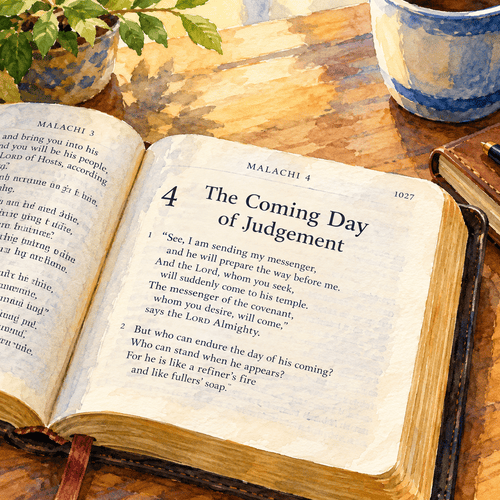
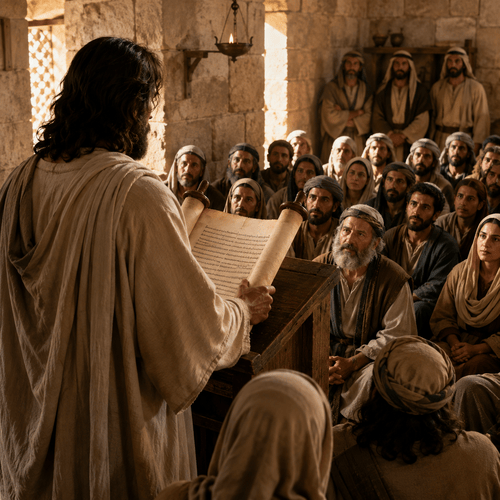
It’s an ordinary Saturday morning in a small, unimportant town. The place is Nazareth, in the north of Israel. A synagogue—where Jewish people gathered each Sabbath to hear the Scriptures read and explained.
Almost everyone in the room knows the young man who stands up. They’ve perhaps watched him grow up, and know his family.
Someone hands him a scroll—a long roll of leather or papyrus, wound around two wooden rods. It is the book of Isaiah. He unrolls it, hunts for one particular place, and reads five lines about a man anointed by God’s Spirit. Then He rolls the scroll back up, hands it to the attendant, and sits down.
Luke tells us “the eyes of all in the synagogue were fixed on him” (Luke 4:20). Then comes one sentence: “Today this Scripture has been fulfilled in your hearing” (Luke 4:21).
In minutes, the same neighbours are dragging him towards a cliff.
Something enormous has happened in the room. Three questions unlock it.
- Why does Jesus select this passage, out of the whole Old Testament?
- Why does He stop reading mid-sentence?
- And why does He do all of this at the very beginning of His public work, before a single miracle?
The Scroll He Chose—and How We Know He Chose It
Luke writes Jesus “unrolled the scroll and found the place where it was written” (Luke 4:17). The word translated “found” means to search for something and locate it. A scroll has no page numbers and no chapter headings. Finding one short passage in a book the length of Isaiah takes deliberate effort. This wasn’t a random opening.
Some readers assume the passage was simply the set reading for that Sabbath. But the evidence for a fixed, published cycle of prophetic readings in the first century is thin, and it comes mostly from later sources. Kenneth Bailey, who spent decades studying the Gospels in their Middle Eastern setting, points out the readings from the Prophets allowed a reader far more freedom than readings from the Law. The reader could select, and even join related passages together.
Two small physical details carry weight in the scene:
- He stood up to read. Standing showed honour to the written Word of God. The text is above the reader.
- He sat down to preach. In that culture, a teacher sat to teach with authority. Before Jesus said a single word of His sermon, his body had already claimed the seat of the authorised teacher.
“The Spirit of the Lord Is upon Me”—What the Anointing Means
To anoint people meant to pour olive oil over their heads as a public sign God was appointing them to office. Prophets, priests and kings were anointed. The Hebrew word for “anointed one” is Messiah. The Greek word is Christos. So “Jesus Christ” isn’t a first name plus a family name. It’s a name plus a claim.
Read the passage He chose with that in mind, and the first line is a self-introduction. Luke has been building towards it for two chapters.
Table 1: How Luke traces the Spirit from the Jordan to the Nazareth synagogue
| REFERENCE | WHAT HAPPENS | WHAT IT SHOWS |
|---|---|---|
| Luke 3:22 | The Spirit descends on Jesus at His baptism in bodily form, like a dove | The public moment of appointment to office |
| Luke 4:1 | Jesus, full of the Holy Spirit, is led into the wilderness and tested | The appointed one is proved before He is deployed |
| Luke 4:14 | He returns to Galilee in the power of the Spirit | The appointment is now active and working |
| Luke 4:18 | He reads: the Spirit is upon me, because He has anointed me | He tells the room what the earlier events meant |
This is why the choice of Isaiah 61 is so exact. The reading interprets the baptism. What happened at the Jordan river wasn’t a private religious experience. It was ordination to the office of Messiah.
The historic teaching of the church has summarised that office under 3 heads. The Heidelberg Catechism asks why He is called Christ, and answers He was ordained by the Father and anointed by the Holy Spirit to be our chief Prophet, our only High Priest, and our eternal King.
John Calvin quotes Isaiah 61 at exactly this point in his Institutes when he explains the prophetic office. Herman Bavinck later worked the same 3 offices through the whole of Christ’s work. Isaiah 61 is the herald’s commission—but announcing a Jubilee was also a royal act and a priestly one.
DID HIS HEARERS KNOW ISAIAH 61 WAS ABOUT THE MESSIAH? YES.
The Dead Sea Scrolls are a library of Jewish documents copied before and around the time of Christ. They were discovered near the Dead Sea from 1947 onwards. They tell us what ordinary Jews of that period expected.
11QMelchizedek takes Isaiah 61:1–2 and reads it together with the Jubilee law of Leviticus 25, expecting a heavenly deliverer to announce release at the end of the age.
4Q521 lists what the Messiah will do when He comes: heal the wounded, give life to the dead, and preach good news to the poor—the language of Isaiah 61.
This matters enormously. Jesus wasn’t inventing a category. He was stepping into a slot His hearers already knew existed, and saying: That’s Me. At least some in the synagogue recognised the claim when they heard it. That’s precisely why the response was so violent.
The Line That’s Not in Isaiah 61
Now compare what Isaiah wrote with what Luke records Jesus reading. Most readers never do this, and it’s the key to the whole passage.
Table 2: Isaiah 61:1–2 compared with the words Luke records (both ESV)
| ISAIAH 61:1–2 | LUKE 4:18–19 | WHAT CHANGED |
|---|---|---|
| The Spirit of the Lord GOD is upon me, because the LORD has anointed me to bring good news to the poor | The Spirit of the Lord is upon me, because he has anointed me to proclaim good news to the poor | Essentially the same |
| He has sent me to bind up the brokenhearted | — absent — | Luke doesn’t tell us if this line was read |
| to proclaim liberty to the captives, and the opening of the prison to those who are bound | to proclaim liberty to the captives and recovering of sight to the blind | Follows the wording of the ancient Greek Old Testament |
| — not in Isaiah 61 — | to set at liberty those who are oppressed | This line is brought in from Isaiah 58:6 |
| to proclaim the year of the LORD’s favour | to proclaim the year of the Lord’s favour | Same—and this is where He stops |
| and the day of vengeance of our God; to comfort all who mourn | — not read — | He rolls up the scroll mid-sentence |
Three things are happening here, and each is significant.
- One line is passed over. “To bind up the brokenhearted” doesn’t appear in the earliest manuscripts of Luke. Some later copies add it back, which is exactly what we’d expect a well-meaning scribe to do when he noticed the gap.
- One line is imported. “To set at liberty those who are oppressed” comes from Isaiah 58:6, a completely different chapter. In the ESV, Isaiah 58:6 reads “to let the oppressed go free”—the same idea, translated with different English words.
- The wording follows the Greek Old Testament. The Septuagint was the Greek translation of the Hebrew Scriptures, widely used across the ancient world. Where the Hebrew of Isaiah 61 speaks of opening a prison, the Greek speaks of sight for the blind. Luke follows the version his readers would recognise.
So why reach across 3 chapters to pull in a line from Isaiah 58? Because of a single word.
ONE WORD, TWO WORLDS: APHESIS
Aphesis is the Greek word behind “liberty” in Luke 4:18 and behind “go free” in Isaiah 58:6. It means release—a letting-go, an untying, a cancellation.
In the Greek Old Testament, aphesis is the technical term for the Jubilee of Leviticus 25: the 50th year, when debts were cancelled, slaves went home, and family land was returned to its original owners.
In Luke and Acts, the very same word is the standard term for the forgiveness of sins (Luke 1:77; 24:47; Acts 2:38; 5:31).
Joining Isaiah 61 to Isaiah 58 on this shared word is a recognised Jewish method of interpretation: link 2 passages through a word they hold in common, and let each one throw light on the other. Isaiah 58 is the chapter where God says the fasting He actually wants is the loosening of unjust burdens. So the splice ties the Jubilee announcement to genuine worship.
This is where 2 opposite mistakes are usually made. One flattens the passage into economics and social programmes, as though Jesus came chiefly to reorganise property. The other empties it of any earthly consequence at all, as if “poor” and “captive” were only poetic images. Luke won’t allow either. He uses one word for both the cancelled debt and the cancelled sin, and he means us to see that the second is the greater debt and the deeper prison. Darrell Bock, in his large commentary on Luke, argues this sermon functions as the programme for everything Jesus goes on to do—and everything He goes on to do includes both preaching and mercy, in that order and without separation.
“Today”—Luke’s 4 Great Moments
The first word of the sermon is the loudest. The Greek word is sēmeron, “today”. Luke uses it at 4 hinge points in his Gospel, and together they form a line running from the manger to the cross.
A timeline of Luke’s “today”
- Luke 2:11—the birth: unto you is born this day a Saviour, who is Christ the Lord.
- Luke 4:21—the synagogue: today this Scripture has been fulfilled in your hearing.
- Luke 19:9—the tax collector’s house: today salvation has come to this house.
- Luke 23:43—the cross: today you will be with me in paradise.
Promise doesn’t merely get explained in Luke’s Gospel. It gets inhabited. And notice how the book is framed: it opens with Jesus reading the Old Testament and saying it’s about Him, and it closes the same way. After the resurrection, on the Emmaus road, “beginning with Moses and all the Prophets, He interpreted to them in all the Scriptures the things concerning Himself” (Luke 24:27). The first sermon and the last lesson make the same point. The Scriptures have a centre, and the centre is Him.
Where He Stopped—and Why It Wasn’t Editing
Now to the moment everyone asks about. Isaiah 61:2 is one sentence: “to proclaim the year of the LORD’s favour, and the day of vengeance of our God”. Jesus reads the first half and stops. He rolls up the scroll before the sentence is finished.
A popular reading online says Jesus was quietly deleting the angry God of the Old Testament, and that we should learn to filter our Bibles the same way. It’s a tidy story. It’s, however, impossible to sustain from Luke’s own text.
A YEAR AND A DAY: THE ASYMMETRY IS ISAIAH’S, NOT JESUS’S
Look carefully at Isaiah’s own wording. Favour gets a year. Vengeance gets a day. The prophet himself has already set the two in proportion, long before Jesus opens the scroll. Jesus isn’t correcting Isaiah. He’s standing inside Isaiah’s sentence, at the comma, and telling the room which half—the Favour—has now arrived.
4 things make this the only reading that holds:
- Luke keeps the warnings. The same Gospel records Jesus pronouncing woe on unrepentant towns (Luke 10:13–15), warning of a judgement to fear (12:4–5), calling for repentance or perishing (13:3–5), weeping over the coming destruction of Jerusalem (19:41–44), and describing armies surrounding the city (21:20–24).
- This very sermon ends in judgement. 9 verses later, Jesus tells His neighbours God passed over the many needy people of Israel to show mercy to 2 foreigners. That’s a judgement oracle, and it’s why they try to kill Him.
- The mission comes in two visits, not one. Geerhardus Vos taught a generation to see what the prophets saw as a single horizon, the New Testament divides into two comings—a present age in which the kingdom is truly here, and an age to come in which it is here completely. Herman Ridderbos called this the kingdom that has arrived and is still arriving. What we now call the “already and not yet” is visible in miniature at Isaiah 61:2, in the gap between a clause read aloud and a clause left in silence.
- He didn’t remove the words. The scroll still said them. Jesus simply didn’t read them, because the day they describe hadn’t come. The scroll He rolled up that morning, He will one day unroll again.
An Acceptable Year, an Unacceptable Prophet
There’s wordplay in this passage that rarely survives translation. But it’s worth recovering because it’s the sharpest thing in the chapter.
The phrase in verse 19 is, literally, “the acceptable year of the Lord”. The Greek word for “acceptable” is dektos—welcome, received, warmly accepted. 5 verses later Jesus uses the identical word: “no prophet is acceptable in his hometown” (Luke 4:24).
The acceptable year walks into Nazareth, and Nazareth finds the herald unacceptable. That’s the tragedy of the scene stated in one repeated adjective. God’s welcome arrives; the welcome isn’t returned.
It begins politely enough. “All spoke well of him and marvelled at the gracious words that were coming from His mouth” (Luke 4:22). And then comes the sentence that sours everything: “Is not this Joseph’s son?” They can’t get past the ordinariness of him. Isaiah had said of the Servant He had no form or majesty that we should look at Him.
The prophecy was being fulfilled in the room. By the very people complaining about it.
Elijah, Elisha, and a Grace That Chooses
What turns admiration into murderous rage isn’t the claim to be the Messiah. It’s what Jesus says next.
He gives them two stories from their own Scriptures. In the days of Elijah, when famine gripped the land, there were many widows in Israel—and God sent His prophet to none of them, but to a foreign widow in Zarephath, in the territory of Sidon. In the days of Elisha, there were many lepers in Israel—and not one of them was cleansed, but only Naaman, a commander in the Syrian army (Luke 4:25–27).
Read the 2 sentences slowly. The emphasis doesn’t fall on the foreigners. It falls on the word “many”. Many widows. Many lepers. And God, who owed mercy to none of them, freely gave it to 2 outsiders instead—rather than to Jews.
WHY THIS IS THE MOST OFFENSIVE PARAGRAPH IN THE SERMON
The people of Nazareth could have coped with a local boy claiming a great destiny. What they couldn’t tolerate was the suggestion that God’s mercy is God’s to give—that it isn’t owed to them by birth, geography or religious pedigree, and that He is free to give it to non-Jews—to a Sidonian widow and a Syrian soldier.
John Calvin, commenting on this passage, observes God is under no obligation to any of us, and that his freedom in bestowing mercy is precisely what makes it mercy. Take away the freedom, and grace becomes wages.
This is Romans 9 told as a story rather than argued as a doctrine. And notice the response it provokes.
There’s a second thing in these two examples. A widow of Sidon and a soldier of Syria are both Gentiles—non-Jews. At the very opening of his Gospel, Luke has planted the seed of the book he will write next. In Acts, the pattern of this morning repeats city after city: the good news is proclaimed, many of the covenant people refuse it, and the messengers turn to the nations (Acts 13:46–47). Nazareth is the first instance when we see a pattern that will fill a second volume. David Pao has shown in detail how the language of Isaiah runs like a spine through the whole of Acts; it actually starts here.
From the Brow of the Hill to Golgotha
The congregation rises. They drive Him out of town and bring him “to the brow of the hill on which their town was built, so that they could throw Him down the cliff” (Luke 4:29). And then Luke writes one of the quietest, strangest sentences in the Gospel: “But passing through their midst, He went away” (Luke 4:30).
No struggle is described. No miracle is announced. He simply walks out through a crowd that wants him dead. The point isn’t that He escaped, but that His death was never theirs to schedule. He will die on a hill, driven out of a city, by the will of God and at the hour of God. But not this hill. And not this morning.
Everything about the shape of the cross is already here in Chapter four: the rejection by His own people, the expulsion outside the town, the hill, the sovereign control of the timing. Luke’s readers are being taught how to read the rest of the book before the book has properly begun.
Why This Sermon Had to Come First
This brings us back to the timing. Why open a public ministry this way?
- Because appointment comes before announcement. The Spirit descends, the Son is tested in the wilderness and proved faithful where the first Adam and the nation of Israel both failed, and only then does He speak. The order is deliberate.
- Because the word comes before the works. The healings and exorcisms of Luke 4:31 onwards follow the sermon; they don’t replace it. Jesus begins His ministry not with a sign but with a text and an exposition. That order has shaped Christian worship ever since.
- Because Luke is arranging his material to teach. Luke tells Theophilus he is writing an orderly account (Luke 1:3). Orderly doesn’t have to mean strictly chronological; it means arranged so as to be understood. The Nazareth sermon is placed at the front because it’s the keynote for everything that follows.
- Because the rest of the Gospel keeps pointing back to it. When John the Baptist sends messengers to ask whether Jesus is the one, the answer is a list drawn straight from Isaiah, ending with “the poor have good news preached to them” (Luke 7:22). Years later, Peter summarises the whole ministry of Jesus in a single sentence built from the same passage: God “anointed Jesus of Nazareth with the Holy Spirit and with power” (Acts 10:38).
Everything Jesus does for the next 3 years is a footnote to 5 lines read aloud in a village synagogue.
Those Who Share His Anointing
This passage isn’t merely interesting history.
The Heidelberg Catechism, having explained why Jesus is called the Anointed One, immediately asks a second question: why are you called a Christian? The answer is that by faith you’re a member of Christ and so share in His anointing. The Spirit who rested on the Head without limit is poured out on the body. Luke 4 flows into Acts 2. Sinclair Ferguson has written movingly about this: the Spirit given to Christ for His work is the same Spirit given to Christ’s people for theirs. The church’s life isn’t an imitation of Jesus from a distance but a participation in what He has already received.
Which is why the church can never be embarrassed about preaching, and can never be indifferent to poverty or rejection. Both belong to the anointing. Both were in the scroll.
And it’s why the passage searches every reader. The categories Jesus read out that morning aren’t a description of an unfortunate minority somewhere else. Poor, captive, blind, oppressed—this is the human condition as God diagnoses it, and none of us can announce our own release. Someone has to come and proclaim it over us.
Someone did. He stood up in a small town, in front of people who’d known Him since He was a boy, and He told them the wait was over.
Tough Questions, Honest Answers
Is Isaiah 61 really about the Messiah, or is the prophet simply speaking about himself?
The speaker in Isaiah 61 isn’t named, and some interpreters have taken him to be Isaiah describing his own calling. But the chapter sits in the closing section of Isaiah, where the Servant of chapters 42, 49, 50 and 53 dominates the landscape, and the speaker of chapter 61 does what that Servant does: He is Spirit-anointed, sent to the broken, and commissioned to bring in a new age. No prophet before Christ ever inaugurated a Jubilee. The Dead Sea Scrolls show the Jews of the period were already reading Isaiah 61 as a description of an end-time deliverer, not as autobiography. Above all, Jesus settled the question by claiming it, and the congregation understood Him perfectly—which is why they reacted as they did.
Did Jesus read in Hebrew or Greek—and can we trust a quotation that differs from our Old Testament?
The scroll in a Galilean synagogue would have been Hebrew, and the reading was very likely followed by an oral rendering into Aramaic, the everyday language. Luke, writing in Greek for a Greek-speaking readership, gives the sense of what was said using the wording of the Septuagint, the standard Greek translation his readers knew. This isn’t a copying error; it’s normal ancient practice, and the New Testament does it constantly. The differences between Luke 4:18–19 and Isaiah 61 are meaningful choices—a line drawn in from Isaiah 58, a stopping point chosen deliberately—not slips of memory. A quotation that interprets as it cites is exactly what we should expect from an inspired author summarising a sermon.
Does Luke contradict Matthew and Mark about when Jesus was rejected at Nazareth?
Matthew 13:54–58 and Mark 6:1–6 place a rejection at Nazareth later in the ministry, and Luke places this one at the start. 2 reasonable answers exist. Some hold Jesus visited His hometown more than once, which is entirely natural, and that the accounts describe different visits. Others note Luke tells Theophilus he is writing an orderly account, which needn’t mean a strictly datebook order—and Luke 4:23 has Jesus referring to things already done in Capernaum, which Luke only narrates afterwards. On either view there’s no contradiction, only a writer arranging true events so his readers grasp their meaning.
Is there a real cliff at Nazareth, and how did Jesus escape the crowd?
Nazareth sits on a hillside, and there are steep drops both at the edge of the ancient village and at Mount Precipice a little to the south, which tradition later associated with the event. Luke doesn’t tell us which. As for the escape, Luke describes it with striking restraint: Jesus passed through the middle of them and went away. He doesn’t call it a miracle, and he doesn’t explain it. What the sentence establishes is control—Jesus’s life wasn’t taken from Him by an angry mob any more than it would later be taken from Him by Rome. He would lay it down at the appointed hour. And this wasn’t that hour.
Does “the year of the Lord’s favour” mean Jesus’s ministry lasted only one year?
Some early writers did take the phrase that way, and it produced a long-running theory of a one-year ministry. But John’s Gospel mentions at least three Passovers, which points to a ministry of roughly three years. More importantly, the phrase isn’t a stopwatch. It’s Jubilee language borrowed from Leviticus 25, where the 50th year was the year of release. Isaiah uses it to describe an age of favour, not a period of 12 months, and Jesus applies it to the whole era His coming has opened.
When Jesus promises sight to the blind, does He mean physical or spiritual blindness?
Both, and Luke refuses to let us choose. Jesus really did open the eyes of blind men, and Luke records it (Luke 18:35–43). But the same Gospel repeatedly describes people who can see perfectly well and still cannot see Him—the Nazareth congregation being the first example. Physical healings in the Gospels are not merely kindnesses; they are visible signs of what is being done invisibly, samples of a restored creation. To read the promise as only physical is to shrink it; to read it as only spiritual is to make it a metaphor Jesus never treated as one.
Why is “to bind up the brokenhearted” missing from Luke’s quotation?
The line stands in Isaiah 61:1 but is absent from the earliest and best manuscripts of Luke. Some later copies include it, which is easily explained: a scribe familiar with Isaiah noticed the gap and filled it in. As to why Luke omits it, the most likely reason is the theme he is tracing. His quotation is organised around the word release—release for captives, release for the oppressed—and the line about the broken-hearted does not carry that word. Nothing in the omission suggests that Jesus is uninterested in the broken-hearted; the rest of the Gospel makes the opposite abundantly clear.