For more than 700 years, choirs have sung words from Zephaniah at funerals. The old Latin hymn begins Dies irae, dies illa—“Day of wrath, that day”. Those words come from Zephaniah 1:15. Mozart put them to music. So did Verdi.
But here’s the surprise. The same little book that gave the world its most famous song about God’s anger ends with a very different song. And the singer isn’t a choir or an angel. It’s God Himself.
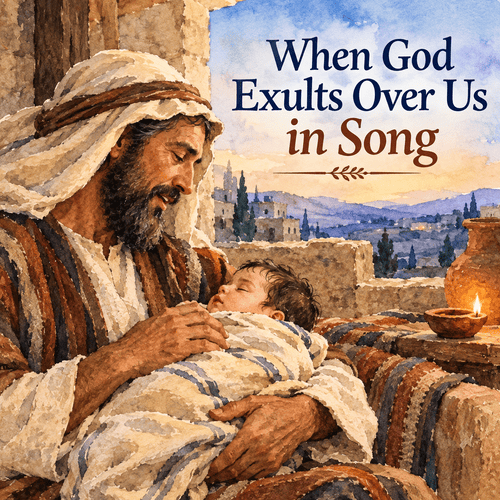
“The LORD your God is in your midst, a mighty one who will save; he will rejoice over you with gladness; he will quiet you by his love; he will exult over you with loud singing.” (Zephaniah 3:17)
How does the God of the “day of wrath” become the God who sings over His people? Zephaniah doesn’t give the full answer. The New Testament does, and the answer has a name: Jesus.
Let’s be honest: Zephaniah never names the Messiah (the promised King God would send). Yet it shows us something even bigger. It shows us who He really is: the LORD Himself, coming to live among His people as King, Judge and Saviour.
Jesus in the Old Testament — Book 36 of 39
This post is the 36th instalment in our series tracing Christ through every book of the Old Testament. See the full series index.
Zephaniah at a Glance
Table 1: The book of Zephaniah in brief
| QUESTION | ANSWER |
|---|---|
| Who wrote it? | Zephaniah, a prophet (someone who speaks God’s message). His family goes back to Hezekiah, most likely King Hezekiah (1:1). |
| When? | About 630–620 BC, under King Josiah of Judah (1:1). |
| What does his name mean? | “The LORD has hidden” or “The LORD treasures”. |
| Big theme | The Day of the LORD: judgement first, then joy. |
KEY TERM: WHAT IS “THE DAY OF THE LORD”?
It is the time when God steps into history to put things right. He punishes evil and rescues His people.
Some of these “days” came soon, like the fall of Jerusalem in 586 BC. But all of them point to one final day at the end of history.
Can We Honestly Find Jesus in Zephaniah?
Zephaniah has no “Branch”, as in Jeremiah, and no ruler from Bethlehem, as in Micah. So some say Christians are reading Jesus into the book.
But Jesus Himself taught us to look for Him in all the Prophets (Luke 24:27). John Calvin, the sixteenth-century French pastor and Bible teacher, put it this way in his comments on John 5:39: “We ought to read the Scriptures with the express design of finding Christ in them.”
The Old Testament shows Jesus in two ways. Sometimes it promises a person, like a King or Servant. At other times it shows the LORD Himself coming to His people. Zephaniah uses the second way: the LORD will be “in your midst”.
Edmund Clowney, the American pastor and teacher, often showed that the Old Testament builds to one surprise: God does not just send help; He comes Himself. And the New Testament calls Jesus “Lord”, using words the Old Testament uses for the LORD (Romans 10:9–13; Philippians 2:10–11). So when Zephaniah shows the LORD coming as King and Saviour, we are looking at Jesus.
THREE RULES WE FOLLOW IN THIS SERIES
Let the New Testament lead. We look first for places where it quotes or points back to Zephaniah.
Read the whole book. We follow Zephaniah’s own story from judgement to joy.
Be honest about how sure we are. Some links are certain, some likely, a few only possible. We tell you which is which.
1. The Day of Wrath—and Who It Fell On
Zephaniah starts like a storm. God will sweep away people, animals, birds and fish (1:2–3)—the order of Genesis 1 backwards. Sin undoes creation.
“The great day of the LORD is near, near and hastening fast… A day of wrath is that day, a day of distress and anguish… a day of darkness and gloom.” (Zephaniah 1:14–15)
Jesus claims this day as His own
In 1:3 God promises to sweep away “the rubble with the wicked”. The Hebrew word means “things that make people stumble”, like stones on a path. Jesus picks up this very idea:
“The Son of Man will send his angels, and they will gather out of his kingdom all causes of sin and all law-breakers.” (Matthew 13:41)
The Greek word for “causes of sin” is skandala—stumbling blocks. In Zephaniah, the LORD removes them. In Matthew, Jesus does. Jesus calmly takes the LORD’s role on the Day of the LORD. No ordinary prophet would dare to do that.
Zephaniah 1:7 adds a shock: “the LORD has prepared a sacrifice.” Judah thought they were the guests at God’s feast. In fact, they were the sacrifice. Later God prepared another: “the Lamb of God” (John 1:29). This link is only possible, as no quotation is involved.
The judgements taken away
In 3:8 God says He will pour out “all my burning anger”. Then, in the very next verse, everything changes (3:9). A few verses later we read:
“The LORD has taken away the judgements against you; he has cleared away your enemies.” (Zephaniah 3:15)
How can a holy God take judgements away? The judgement must fall somewhere. On the cross it fell on Jesus. At midday “there was darkness over all the land” (Matthew 27:45). Zephaniah’s “day of darkness and gloom” came down on one Man. That is why “there is therefore now no condemnation for those who are in Christ Jesus” (Romans 8:1).
Geerhardus Vos, the Dutch-American Bible scholar at Princeton, showed that the New Testament sees the “last days” arriving in stages. Zephaniah’s Day works the same way.
Timeline: The Day of the LORD in stages
- 612 BC—Nineveh falls. Zephaniah said God would make Nineveh “a desolation” (2:13). Within a few years, it happened.
- 586 BC—Jerusalem falls. Babylon destroys the city and temple, as Zephaniah warned (1:4–13).
- About AD 30—the cross. The darkness and wrath of the Day fall on Jesus in His people’s place.
- The Last Day—Jesus returns. He comes to judge the world and gather His people home (3:19–20).
2. The King of Israel in Your Midst
“Sing aloud, O daughter of Zion… The King of Israel, the LORD, is in your midst; you shall never again fear evil. On that day it shall be said to Jerusalem: ‘Fear not, O Zion…’” (Zephaniah 3:14–16)
Notice: this “King of Israel” is not a human king. It is “the LORD”, and He is “in your midst”.
About 650 years later, Jesus rides into Jerusalem on a donkey:
“Hosanna! Blessed is he who comes in the name of the Lord, even the King of Israel!”… “Fear not, daughter of Zion; behold, your king is coming, sitting on a donkey’s colt!” (John 12:13, 15)
John is quoting Zechariah 9:9. But Zechariah begins, “Rejoice greatly, O daughter of Zion!” It does not say “Fear not”. So where did John get those words? Most likely from Zephaniah 3:16. Donald Arthur Carson suggests exactly this in his well-known commentary on John. John has joined two prophets together.
Table 2: How John joins Zephaniah and Zechariah
| WHAT IS SAID | ZEPHANIAH 3:14–16 | ZECHARIAH 9:9 | JOHN 12:13–15 |
|---|---|---|---|
| “Fear not” | “Fear not, O Zion” | Not there | “Fear not” |
| Title of the King | “The King of Israel, the LORD” | “your king” | “the King of Israel” |
| How He comes | “in your midst” | “mounted on a donkey” | Jesus sits on a donkey’s colt |
Why does this matter? Zephaniah’s “King of Israel” is the LORD Himself, so John is quietly telling us who Jesus is. As John says at the start of his Gospel, “the Word became flesh and dwelt among us” (John 1:14). That is Zephaniah’s “in your midst” in human flesh.
At the cross, the religious leaders mocked Him: “He is the King of Israel; let him come down now from the cross” (Matthew 27:42). They spoke the truth without knowing it. And He stayed on the cross so that the LORD could “take away the judgements” against His people.
3. The Mighty One Who Saves—and Sings
In Zephaniah 3:17, God does five things.
5 THINGS GOD DOES IN ZEPHANIAH 3:17
He is present. “In your midst.” Jesus is “Immanuel”, meaning “God with us” (Matthew 1:23).
He saves. The Hebrew verb for “save” is yasha. The name Jesus (Yeshua) comes from the same root and means “the LORD saves” (Matthew 1:21).
He rejoices. Jesus said there is “joy in heaven over one sinner who repents” (Luke 15:7).
He quiets. The Hebrew can mean “He will be silent in His love”—a love so deep it needs no words.
He sings. Very few verses in the whole Bible picture God singing.
John Calvin explained God speaks here in a human way, like a man delighted with his bride. God has no body or voice, but He uses these pictures so that fearful, guilty people will dare to believe He truly delights in them. O Palmer Robertson, a modern Old Testament scholar, notes how surprising this is after chapter 1. Nothing has changed in God. What has changed is that the judgements have been taken away (3:15).
Where does Jesus sing?
- On the night before the cross. “When they had sung a hymn, they went out to the Mount of Olives” (Matthew 26:30). Jesus walked towards the day of wrath singing.
- In the middle of His people. Hebrews 2:12 puts Psalm 22 on Jesus’ lips: “in the midst of the congregation I will sing your praise.” Zephaniah said the LORD would be “in your midst”. Hebrews shows Jesus singing there.
4. Babel Turned Upside Down
“For at that time I will change the speech of the peoples to a pure speech, that all of them may call upon the name of the LORD and serve him with one accord.” (Zephaniah 3:9)
Go back to Genesis 11. At the Tower of Babel, proud people joined together to make a name for themselves, so God confused their language. The Hebrew word for “language” there is literally “lip”. Zephaniah 3:9 uses the same word. God promises to undo Babel.
This happened at Pentecost, when people from many nations each heard the good news “in his own language” (Acts 2:6). And who is the LORD they call on? Paul says, “if you confess with your mouth that Jesus is Lord… you will be saved”, because “everyone who calls on the name of the Lord will be saved” (Romans 10:9, 13). To call on the LORD is to call on Jesus.
Even Moses Maimonides, the great twelfth-century Jewish scholar, linked Zephaniah 3:9 to the Messiah’s age. We agree—and believe the Messiah has come.
The next verse promises worshippers “from beyond the rivers of Cush” (3:10), the land south of Egypt. In Acts 8, one of the first non-Jewish believers in Jesus is “an Ethiopian”, an official from that very region.
5. The Humble Remnant—and the One Truly Humble Man
A remnant is a small group left over after a disaster. Zephaniah promises that God will keep one:
“But I will leave in your midst a people humble and lowly… they shall do no injustice and speak no lies, nor shall there be found in their mouth a deceitful tongue.” (Zephaniah 3:12–13)
Zephaniah called “all you humble of the land” to seek the LORD (2:3). Jesus blessed exactly such people: “Blessed are the meek, for they shall inherit the earth” (Matthew 5:5).
But who has ever lived with no lies at all? Only one Man: “He committed no sin, neither was deceit found in his mouth” (1 Peter 2:22). Jesus is the true remnant—the one faithful Israelite when all others failed. And Revelation 14:5 uses Zephaniah’s words for His people: “in their mouth no lie was found”. The remnant becomes like its King.
Hidden in Christ
Zephaniah’s name means “the LORD has hidden”, and his great call is, “Seek the LORD… perhaps you may be hidden on the day of the anger of the LORD” (2:3). The Hebrew words differ, but the theme is the same. Where can a sinner hide on the day of wrath? “Your life is hidden with Christ in God” (Colossians 3:3). The only safe hiding place is a Person.
7 Pointers to Jesus in Zephaniah
Table 3: Pointers to Jesus in Zephaniah
| PASSAGE | WHAT ZEPHANIAH SHOWS | HOW JESUS FULFILS IT | HOW SURE? |
|---|---|---|---|
| Zephaniah 1:3; 1:14–18 | The LORD judges on His Day | Jesus removes the “stumbling blocks” (Matthew 13:41) | Strong |
| Zephaniah 1:7 | God prepares a sacrifice | Jesus, the Lamb of God (John 1:29) | Possible |
| Zephaniah 3:8, 15 | Judgements taken away | Wrath falls on Jesus at the cross (Romans 8:1) | Solid |
| Zephaniah 3:14–16 | The King of Israel, the LORD, in your midst | Jesus enters Jerusalem as King (John 12:13–15) | Strong |
| Zephaniah 3:17 | The Mighty One who saves and sings | Jesus saves (Matthew 1:21) and sings (Hebrews 2:12) | Solid |
| Zephaniah 3:9–10 | Pure speech; nations call on the LORD | Pentecost; calling on Jesus (Acts 2; Romans 10:13; Acts 8) | Strong |
| Zephaniah 2:3; 3:12–13 | A humble remnant with no deceit | Jesus the sinless One, and His people (1 Peter 2:22; Revelation 14:5) | Strong |
Key: Strong means the New Testament quotes or clearly echoes the verse. Solid means a clear line of teaching across the Bible. Possible means worth thinking about, but we do not build on it.
Answering the Objections
- “Christians are reading Jesus into a Jewish book.” Jesus and the apostles read the Prophets this way (Luke 24:27). Even Maimonides read Zephaniah 3:9 as a promise for the Messiah’s age.
- “The Day of the LORD was only about 586 BC.” Prophets often saw near and far events together, like mountain peaks seen from far away. But Zephaniah also speaks of the whole earth and all nations (1:2–3; 3:8–9). That’s bigger than one city.
- “The happy ending in chapter 3 was added later.” No manuscript of Zephaniah lacks it. Judgement followed by hope is the normal pattern in the prophets (Amos 9; Micah 7), and Robertson argues the book is one planned message.
- “The God of chapter 1 is too harsh.” The God who judges in chapter 1 sings in chapter 3. At the cross His justice and love meet. He did not ignore sin; He carried it.
What This Means for You
Zephaniah’s call is simple: “Seek the LORD” (2:3). Now, because the Day is near. If you’re hidden in Christ, 3 things are true. Your judgements have been taken away. Your King is in your midst by His Spirit. And—hard as it is to believe—He rejoices over you with singing. Not because you’re impressive, but because Jesus has made you His own.
Conclusion: Two Songs
For centuries choirs have sung Dies irae—the day of wrath. They’re right: that day is real. But for everyone who trusts in Jesus, the day of wrath has already fallen—on Him, at the cross.
So there’s another song to wait for. It comes at the end of Zephaniah, and the King of Israel Himself sings it. He’s in your midst. He’s mighty to save. And He sings.
Tough Questions, Honest Answers
Does God really sing? Why do some Bibles say “renew you” in Zephaniah 3:17?
Yes, Zephaniah really does picture God singing, though in human language, because God doesn’t have a body. The harder phrase is “He will quiet you by His love”. The Hebrew text literally says “you will be silent in His love”. The old Greek translation, called the Septuagint, reads “He will renew you in His love”, and some modern Bibles follow it. The ESV and most translations keep the Hebrew and explain it as quieting or resting. Either way, the meaning is warm: God’s love is so settled and deep it calms His people.
Was Zephaniah an African prophet?
Zephaniah 1:1 calls him the “son of Cushi”. The name Cushi can mean “a Cushite”, a person from the land south of Egypt, so some believe Zephaniah had African roots. We can’t be certain, because Cushi may simply be a personal name. We do know his family line goes back to Hezekiah, most likely King Hezekiah, so he was probably a relative of King Josiah. If he did have African roots, it fits beautifully with his promise about worshippers from beyond the rivers of Cush (Zephaniah 3:10). Either way, the Bible has always said the gospel is for every nation.
Is the “pure speech” of Zephaniah 3:9 the Hebrew language?
Some groups teach that in the end everyone will speak Hebrew, and they use this verse to prove it. But “pure” here means clean from idol worship, not a special language. Just before this, Zephaniah condemns people who swore by the false god Milcom (Zephaniah 1:5). The “pure lip” is a mouth that calls on the true God alone. At Pentecost God did not make everyone speak Hebrew; He let each person hear the gospel in their own language (Acts 2:6–11). So no one needs to learn Hebrew to worship God in a pure way.
Did Zephaniah’s preaching lead to King Josiah’s reforms?
Zephaniah preached “in the days of Josiah” (1:1). He attacked the worship of Baal and “the host of the heavens” (Zephaniah 1:4–5), which Josiah later removed in his great reform of 622 BC (2 Kings 23:4–5). Many scholars think Zephaniah preached before the reform and helped prepare hearts for it. The Bible does not say this directly, so we hold it lightly. The main cause of the reform was the Book of the Law found in the temple (2 Kings 22:8–13). Sadly, the reform did not last, and after Josiah died Judah went back to its idols. Outward change without a new heart is never enough, which is why we need the new covenant Jesus brings.
Does Zephaniah 3:20 predict the modern State of Israel?
Some Christians believe Zephaniah 3:19–20 came true when Israel became a nation in 1948. Zephaniah’s first hearers saw an early fulfilment when the Jews returned from exile in Babylon after 538 BC. But the New Testament shows that God’s final gathering happens in Christ, as He gathers “into one the children of God who are scattered abroad” (John 11:52). Zephaniah links this gathering to a pure speech and a humble people who call on the LORD—spiritual marks, not borders. God still has a gracious purpose for the Jewish people (Romans 11:25–29), but it comes through faith in Jesus. So we should be careful not to read news headlines into this verse.
What does Zephaniah mean by people who’re “complacent” (1:12)?
In 1:12 God says He will search Jerusalem “with lamps” and punish those who’re “complacent”. The Hebrew picture is of wine left too long on its dregs (the thick bits at the bottom of a jar) until it turns thick and lazy. These people said, “The LORD will not do good, nor will he do ill.” They did not deny God with their lips, but they lived as if He did nothing. This is sometimes called practical atheism, and it is common today, even in churches. The cure is to remember God is alive and active—He judges and He saves—and to seek Him while there is time (2:3).
Why does Zephaniah announce judgement on nations like Moab and Assyria?
Chapter 2 announces judgement on Philistia to the west, Moab and Ammon to the east, Cush to the south and Assyria to the north. It is like God drawing a circle around Judah. This shows that He is not a small local god but the Judge of the whole earth. Moab and Ammon are condemned especially for their pride and for mocking God’s people (2:8–10). Yet the same chapter says the nations will one day bow to the LORD (2:11). Judgement on the nations is never God’s last word; the good news of Jesus goes to them too.
Related Reads
- Jesus in the Old Testament: Where He Appears In All 39 Books
- Jesus in the Book of Habakkuk: 7 Ways the Prophet Sees Christ
- Jesus in Haggai: How a Rebuilt Temple Points to the Coming King
- The Day of the Lord: What It Means, When It Comes, and Why It Matters
- At Pentecost: God Fulfils Covenant and Reverses Babel