It’s the afternoon of the first Easter: 2 heartbroken men are walking home. A stranger joins them on the road. They tell Him, with great sadness, they’d hoped Jesus of Nazareth was the one who’d rescue Israel—but He’d been killed three days earlier.
The stranger was Jesus. And His reply wasn’t gentle.
“O foolish ones, and slow of heart to believe all that the prophets have spoken!” (Luke 24:25)
Notice what He didn’t say. He didn’t say, “You could not have known.” He said they should have known—from books that were already old when they were born. Then He did something we’d give almost anything to have a recording of:
“And beginning with Moses and all the Prophets, he interpreted to them in all the Scriptures the things concerning himself.” (Luke 24:27)
That was the most important Bible study in history, and nobody wrote it down. We have no transcript. We have no notes. What we do have is the claim underneath it—that every part of the Hebrew Scriptures is, in some real way, about Him.
This series is an attempt to walk that road again, book by book, all 39 of them. Before we start, we owe you an honest account of what we’re doing and why.
This page indexes our full 40-part series: one post per Old Testament book, tracing how each points to Christ. New instalments are added as they publish — start with Book 1: Jesus in Genesis.
First, the case against us
Many thoughtful people—Jewish readers, sceptics, and quite a few Christian scholars—think finding Jesus in the Old Testament is a mistake. Here’s their case.
- The books weren’t written to us. The Old Testament was written in Hebrew, by Jews, for Jews, over roughly a 1000 years, and finished centuries before Jesus was born. Its first hearers weren’t waiting for Nazareth. They were worried about drought, exile and enemy armies.
- Some famous “prophecies” look strained in context. Hosea 11:1 says, “Out of Egypt I called my son.” Read it in Hosea and it’s plainly about Israel coming out of Egypt in the past. Matthew applies it to the child Jesus returning from Egypt. To a critic, that’s not fulfilment. That’s reuse.
- If you can find Christ anywhere, you can find Him everywhere. Some preachers have said the scarlet cord Rahab hung from her window is the blood of Christ, and that the two sticks the widow of Zarephath gathered are the cross. That’s not interpretation. That’s imagination with a Bible open.
- It reverses the proper direction of reading. Good interpretation asks what a text meant to the person who wrote it and the people who first heard it. Reading Jesus back into it, however, starts with the answer and hunts for the question. Scholars have a word for this: eisegesis, which means reading meaning into a text rather than drawing meaning out of it.
That’s a serious charge. Reading meaning into a text is sin. The question is whether that’s what we’re doing here.
FOUR WORDS YOU WILL MEET ALL THE WAY THROUGH THIS SERIES
Type. A real person, event or object in the Old Testament that God designed to work like a picture of something greater. The Passover lamb is a type.
Antitype. The greater reality the type was pointing to. Christ is the antitype of the Passover lamb.
Typology. The study of those God-designed patterns. It is not the same as allegory, which finds hidden meanings the author never intended and the text never signals.
Christophany. An appearance of the Son of God in visible form before He was born in Bethlehem. From two Greek words meaning “Christ” and “appearing”.
4 ways Jesus appears in the Old Testament
When we say Jesus is in the Old Testament, we’re not saying 1 thing. We’re saying 4, and they work differently from one another. The table below is the framework the whole series runs on.
| THE WAY HE APPEARS | WHAT THIS MEANS, IN PLAIN ENGLISH | A WORKED EXAMPLE |
|---|---|---|
| Promise | God says in plain words what He is going to do. A prophet announces a person who has not come yet. You do not need a code to read it; you just need to wait. | Micah 5:2 names the town a future ruler will be born in. Seven hundred years later, Jesus is born there. |
| Pattern | God builds a real person, event or object into history so that it works like a picture of Christ in advance. The picture is real in its own right, and it is also designed to point beyond itself. | The Passover lamb in Exodus 12 really did save real households. It also taught Israel what a substitute is, long before the cross. |
| Presence | The Son of God appears in person before Bethlehem. In several places a figure called “the angel of the LORD” speaks as God, is worshipped as God, and yet is distinct from God the Father. | In Genesis 16, Hagar meets “the angel of the LORD” in the desert and then says she has seen God and lived. |
| Purpose | The whole storyline of God’s binding promises leans forward. Each covenant leaves something unfinished, and the next one picks it up, until only one person can finish it. | The promise of Genesis 3:15 is narrowed to Abraham, then to David, then reshaped in Jeremiah 31 as a covenant written on the heart. |
Keep those 4 apart in your mind and a great deal of confusion clears up. A promise is checked by asking whether the words match the event. A pattern is checked by asking whether the shape matches and whether Scripture itself draws the line. A presence is checked by asking whether the figure is treated as God. A purpose is checked by tracing the storyline. Different claims need different kinds of evidence.
Now, the case for reading the Old Testament this way
Here’s why we think the critic’s objection, serious as it is, doesn’t finally hold. There are 5 steps, and each one leans on the one before it.
1. Jesus made the claim Himself
This is the point people usually skip. The idea that the Old Testament is about Christ wasn’t invented by later Christians who needed a proof text. It comes from Jesus, repeatedly, and He treats it as obvious.
- To religious leaders who searched the Scriptures carefully: “it is they that bear witness about me” (John 5:39).
- About Moses in particular: “he wrote of me” (John 5:46).
- After the resurrection: everything written about Him “in the Law of Moses and the Prophets and the Psalms” had to be fulfilled (Luke 24:44) — that is, in all three sections of the Hebrew Bible, not a few selected verses.
So the first question isn’t “may Christians read the Old Testament this way?” It is “was Jesus right about His own Bible?” That’s a much bigger question, and a much more interesting one.
2. The Old Testament has an Author—as well as authors
This is the hinge of the whole argument.
Every book in the Old Testament has a human writer, working in a real time and place, with real limits on what he knows. We take that seriously; this series will spend a lot of time on historical context. But Scripture also claims a second and deeper authorship. Peter says the prophets searched their own writings, trying to work out what “the Spirit of Christ in them” was pointing to, and were told they were serving a later generation (1 Peter 1:10–12).
Think of how a good novelist works. In Chapter 2 she places a detail that seems ordinary—a scar, a song, a name. Nothing in Chapter 2 announces its importance. The character certainly doesn’t know. But in Chapter 10 it turns out to be the key to everything, and when you reread Chapter 2 you see that the meaning was really there, planted, waiting. We’re not adding it. We’re simply catching up.
If God is the author of the whole of Scripture, this is exactly what we should expect. A human writer may say more than he understands, because the One directing him understands all of it. Theologian Geerhardus Vos described revelation as growing the way a seed grows into a tree—the tree isn’t something foreign glued onto the seed, but what the seed was always going to become.
READING IN VS READING FORWARD
Reading meaning into a text means importing something the text doesn’t contain. Reading forward means noticing what a text genuinely contains but doesn’t yet complete.
The difference shows up in a simple test: can you explain the passage’s own logic, in its own setting, without mentioning Jesus at all? And does that explanation leave something unfinished? If yes, the forward reading is working with the text. If you can only make the link by ignoring what the passage actually says, you have crossed into allegory.
3. The Old Testament openly admits it isn’t finished
This is the part critics tend to underrate. The forward lean isn’t something Christians bolt on from outside. It’s built into the books themselves, and it’s one of their most striking features.
- The sacrifices never stop. Leviticus sets up a system that runs every single day, for centuries, without ever reaching a final “done”. A solution that has to be repeated for ever is announcing it isn’t the solution.
- Every king disappoints. The books of Samuel, Kings and Chronicles are, among other things, a long record of failure. David commits adultery and murder. Solomon’s heart turns. Hezekiah’s reforms don’t outlive him. And yet the promise of an everlasting throne is never withdrawn. Something has to give.
- The prophets keep pointing past their own lifetimes. Jeremiah doesn’t say the old covenant needs better enforcement. He says God will make a new one, of a different kind, written inside people (Jeremiah 31:31–33). Ezekiel promises hearts of flesh in place of hearts of stone.
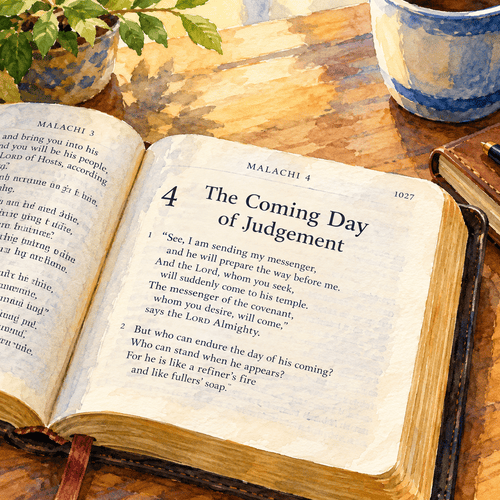
- The last book ends by looking up the road. Malachi closes the Hebrew Scriptures with a messenger still to come and a sunrise still to happen. It isn’t an ending. It’s waiting.
A book that keeps saying “not yet” is telling you how it wants to be read.
4. The apostles show us the method, not just the conclusions
Remember the critic’s complaint about Hosea 11:1. It’s a fair complaint, and it deserves a real answer rather than a shrug.
Matthew isn’t confused about what Hosea meant. He is making a claim about who Jesus is: Jesus is Israel, gathered into one person, doing what the nation failed to do. Israel came out of Egypt and then rebelled in the wilderness. Jesus comes out of Egypt and then stands in the wilderness for 40 days and does not fall. Matthew is not saying “Hosea predicted this trip”. He is saying “the pattern of the son called out of Egypt reaches its true form here”. That is typology, used deliberately, and Matthew’s Gospel tells you so on nearly every page.
Edmund Clowney, who wrote more carefully about this than almost anyone, warned preachers against the opposite errors of missing Christ where the Old Testament genuinely points to Him and inventing Him where it doesn’t. Sidney Greidanus mapped out several distinct legitimate roads from an Old Testament text to Christ—promise, type, analogy, longitudinal themes, New Testament references, and contrast precisely so preachers wouldn’t use one road for every journey.
5. The covenants hold the whole thing together
If you want one thread that runs from Genesis to Malachi, it’s the covenants. A covenant is a binding, sworn relationship that God establishes on His own terms; O Palmer Robertson memorably defined it as “a bond in blood sovereignly administered”. It’s not a negotiation between equals. God sets the terms and God guarantees them.
Follow the thread and the direction is unmistakable:
- After the fall, a promise that the woman’s offspring will crush the serpent (Genesis 3:15)—broad, but with no name attached.
- With Abraham, the promise narrows to one family, and widens in scope: through him all nations will be blessed.
- At Sinai, a nation is given a law, a priesthood and a sacrificial system—and immediately shows it cannot keep any of them.
- With David, the promise narrows again to one royal line and one everlasting throne.
- Through Jeremiah, God announces a covenant of a different order: sins forgiven, hearts rewritten, everyone knowing Him directly.
Each stage leaves an unpaid bill. A blessing for all nations, through one family. A perfect law, given to people who cannot keep it. An eternal throne, promised to a line of mortal men. By the time Malachi puts down his pen, the Old Testament has written a job description that no one in it can fill.
The rules we’re binding ourselves to
A method this powerful needs limits, or it becomes a licence to say anything. Here are the 4 rules every post in this series will follow.
4 RULES FOR HOUSEKEEPING
Historical meaning first, always. Before we ask what a passage means for us, we ask what it meant then—who wrote it, to whom, in what crisis. A reading that requires us to skip this step is disqualified.
Follow the New Testament’s lead. Where an apostle draws a line from an Old Testament text to Christ, we follow it with confidence. Where none does, we may still argue from the same principles, but we will hold the conclusion more loosely and say so.
Go for the author’s point, not a stray detail. The Passover lamb points to Christ because substitution is the whole point of the passage. Rahab’s scarlet cord is a signal agreed in advance, and the text makes nothing of its colour. One is a type. The other is a coincidence with a good imagination attached.
Distinguish certain from likely. Micah 5:2 and Bethlehem is certain. Whether Joseph’s life is a type of Christ is likely but arguable. Whether the tabernacle curtain’s exact colours carry meaning is speculation. We will label these differently and never build doctrine on the third kind.
All 39 books, at a glance
Here’s the map for the whole series. Each line is a starting point, not a summary—every one of these books will get a post of its own, and several of them contain far more than a single line can hold. Use this table as a way in, and as a place to come back to.
| BOOK | HOW JESUS APPEARS IN IT | A KEY TEXT TO START WITH |
|---|---|---|
| The Pentateuch—the five books of Moses (Genesis to Deuteronomy) | ||
| Genesis | The offspring of the woman who will crush the serpent’s head, and the ram caught in a thicket that dies in Isaac’s place | Genesis 3:15; 22:13 |
| Exodus | The Passover lamb whose blood turns away judgement, and the leader who brings slaves out into freedom | Exodus 12:13 |
| Leviticus | Both halves of the sacrificial system at once: the spotless victim that dies, and the high priest who carries the blood in | Leviticus 16:15–16 |
| Numbers | The bronze serpent lifted up on a pole, so that dying people only have to look in order to live | Numbers 21:8–9 |
| Deuteronomy | The prophet like Moses whom God promises to raise up, and to whom the people must listen | Deuteronomy 18:15 |
| The historical books—Israel’s story from the land to the exile and back (Joshua to Esther) | ||
| Joshua | The commander of the LORD’s army, who receives worship and leads His people into their rest | Joshua 5:13–15 |
| Judges | The deliverer God keeps raising up for a people who keep turning away, but a deliverer who finally does not fail | Judges 2:16–19 |
| Ruth | The kinsman-redeemer: the near relative who pays the full price to bring a poor outsider into the family | Ruth 4:9–10 |
| 1 Samuel | The anointed shepherd chosen by God when everyone else was looking for someone taller and stronger | 1 Samuel 16:7, 13 |
| 2 Samuel | The son of David whose kingdom and throne God promises to establish for ever | 2 Samuel 7:12–13 |
| 1 Kings | A wisdom that draws the nations, and a temple where heaven and earth meet — both of which Jesus says He exceeds | 1 Kings 8:27; 10:24 |
| 2 Kings | The prophet who touches the unclean without becoming unclean, feeds crowds and raises the dead | 2 Kings 4:42–44; 5:14 |
| 1 Chronicles | The son of David traced patiently through long lists of ordinary names — God keeping a promise through unremarkable people | 1 Chronicles 17:11–14 |
| 2 Chronicles | The true temple. Solomon asks how God could ever live in a house; the answer finally walks into one | 2 Chronicles 6:18 |
| Ezra | The one who brings His people home from exile and rebuilds what their own sin pulled down | Ezra 1:2–3 |
| Nehemiah | The builder of a city with walls that can never be broken and gates that never need to be shut | Nehemiah 2:17–18 |
| Esther | The advocate who steps between a condemned people and the law that has sentenced them, at the risk of His own life | Esther 4:16 |
| Poetry and wisdom—songs, laments and hard questions (Job to Song of Solomon) | ||
| Job | The mediator Job cries out for — someone who can lay a hand on both God and man at once — and the living Redeemer he believes will stand on the earth | Job 9:33; 19:25 |
| Psalms | The King who is abandoned and then vindicated, and the priest-king seated at God’s right hand — the two psalms the New Testament quotes most | Psalm 22:1; 110:1 |
| Proverbs | The wisdom of God, which the New Testament says is not finally a principle but a person | Proverbs 8:30; 1 Corinthians 1:30 |
| Ecclesiastes | The answer to a life “under the sun” that otherwise runs out into dust: the one who brings every deed into judgement and gives life back | Ecclesiastes 12:13–14 |
| Song of Solomon | The bridegroom whose love for His bride is stronger than death — the marriage picture the rest of Scripture keeps using for God and His people | Song of Solomon 2:16; 8:6 |
| The Major Prophets—the long books (Isaiah to Daniel) | ||
| Isaiah | The child born and the son given; the servant pierced for our transgressions and crushed for our iniquities | Isaiah 9:6; 53:5 |
| Jeremiah | The righteous branch called “The LORD is our righteousness”, who makes a new covenant written on hearts rather than stone | Jeremiah 23:5–6; 31:33 |
| Lamentations | The man of sorrows who sits and weeps over a ruined city — exactly what Jesus does over Jerusalem | Lamentations 1:12; 3:22–23 |
| Ezekiel | The one shepherd who searches for scattered sheep, and the glory of God that leaves the temple and one day returns | Ezekiel 34:23–24 |
| Daniel | The son of man who comes with the clouds of heaven and is given a kingdom that will never be destroyed | Daniel 7:13–14 |
| The Minor Prophets—the twelve short books (Hosea to Malachi) | ||
| Hosea | The faithful husband who goes to the market and buys back his own unfaithful wife | Hosea 3:1–2 |
| Joel | The one who pours out God’s Spirit on all flesh — the promise Peter says is being fulfilled at Pentecost | Joel 2:28–29 |
| Amos | The rebuilder of David’s fallen tent, so that the nations may be brought in | Amos 9:11–12 |
| Obadiah | The saviour on Mount Zion; the one in whose hands the kingdom finally rests | Obadiah 21 |
| Jonah | Three days and three nights in the deep, and a prophet sent to the people he least wants to save — the one sign Jesus says He will give | Jonah 1:17; Matthew 12:40 |
| Micah | The ruler born in Bethlehem, small among the clans, whose origins are from ancient days | Micah 5:2 |
| Nahum | The feet on the mountains bringing good news, and the stronghold for those who take refuge in Him | Nahum 1:7, 15 |
| Habakkuk | The righteousness that is received by faith rather than achieved — the verse that shaped Romans, Galatians and Hebrews | Habakkuk 2:4 |
| Zephaniah | The King standing in the middle of His people, who quiets them by His love and rejoices over them with singing | Zephaniah 3:15, 17 |
| Haggai | The one who fills a plain, disappointing second temple with a glory greater than the first | Haggai 2:7–9 |
| Zechariah | The humble King riding on a donkey, the shepherd who is struck, and the one they have pierced and will mourn for | Zechariah 9:9; 12:10; 13:7 |
| Malachi | The messenger of the covenant who comes suddenly to His temple, and the sun of righteousness who rises with healing | Malachi 3:1; 4:2 |
How to read this way without forcing it
If you want to try this for yourself, here is the habit we would recommend. It is four questions, in this order, and the order matters.
- What is actually happening here? Read the passage in its own setting first. Who is speaking, to whom, and what is at stake for them? Do not move on until you could explain it to someone who had never heard of Jesus.
- What does this passage leave unfinished? Look for the gap. A sacrifice that has to be repeated. A rescuer who dies. A promise that outruns the person it was made to. The gap is usually the doorway.
- Does the New Testament pick this up? Use a cross-reference Bible. If an apostle has already drawn the line, follow it — and notice how he does it, because that teaches you the method.
- What kind of connection is this? Promise, pattern, presence or purpose? Naming it keeps you honest, because each kind has to be defended differently.
One warning. Reading the Old Testament this way should make the Old Testament bigger, not smaller. If your conclusion is that Leviticus is just a long wait for something better, you have lost the book. Herman Bavinck insisted that grace does not destroy nature but restores it, and something similar is true here: Christ does not cancel these books, He completes them. The Passover is not less interesting once you see the cross behind it. It is more.
What’s coming in this series
In this series we shall work through the Old Testament in order, one post per book, plus a set of supporting articles on the questions that cut across all of them.
- The book studies. 39 posts, following the order of the table above: the Pentateuch, the historical books, the poetry and wisdom books, the major prophets, and the 12 minor prophets.
- The supporting articles. Longer pieces on the covenants, on how typology differs from allegory, on messianic prophecy and the honest questions around it, on the appearances of the angel of the LORD, and on Luke 24:27 as the charter for the whole project.
If we claim a connection, we will show our working. If a reading is disputed, we will tell you it is disputed, and give you the other side. And if we get something wrong, we’d genuinely like to hear about it.
2 men walked 7 miles to Emmaus and arrived with their Bibles on fire. That’s the walk we’re inviting you on. It takes rather longer than 7 miles, but the road’s the same one.
Tough Questions, Honest Answers
Were Old Testament believers saved in the same way we are?
Yes, though they knew far less. Nobody has ever been saved by keeping the law perfectly, because nobody has ever managed it. Abraham believed God and it was counted to him as righteousness (Genesis 15:6)—which is exactly the example Paul reaches for when he explains how anyone is justified. The difference between an Old Testament believer and us is not the ground of salvation but the clarity of the view. They trusted a promise they could not see the shape of; we look back at a person with a name and a face. Same Saviour, same faith, different amount of light.
Why do Jewish readers reject these interpretations?
Because they are reading the same texts within a different framework, and it is a coherent one that deserves respect rather than caricature. Traditional Jewish interpretation reads the servant of Isaiah 53 as the nation of Israel suffering among the nations, reads messianic promises as awaiting a future king who has not yet come, and points out that the world Isaiah 11 describes—no war, no harm, universal knowledge of God—has plainly not arrived. The New Testament’s answer is that the Messiah comes twice, and that the first coming deals with sin while the second completes the restoration. That is a real disagreement about real evidence, not a misunderstanding, and it should be conducted with courtesy.
Is the “over 300 fulfilled prophecies” figure you see online reliable?
Treat it with caution. The number varies wildly between sources because there is no agreed method for counting, and the lists usually mix three very different things: plain predictions, typological patterns, and verses that the New Testament applies to Jesus in ways that require argument. Some entries on the popular lists are genuinely strong. Others will not survive five minutes with a critic who reads the original context. It is better to know ten examples well enough to defend them than to quote a large number you have never checked. This series will look closely at the strong cases and will not pad the list.
Is the “angel of the LORD” really Jesus, or is that speculation?
It is a reasonable reading, though we would not put it in the same certainty bracket as Micah 5:2. The reasons for it are these: this figure speaks as God in the first person, receives worship that angels elsewhere refuse, and is yet spoken of as sent by God. That combination is difficult to explain on any other view. Christian interpreters from the second century onwards have identified Him with the Son. The honest caveat is that the Hebrew word simply means “messenger”, and not every occurrence carries this weight, so each passage has to be argued on its own.
Does this approach make the Old Testament less valuable on its own terms?
It should do the opposite, and if it does not, something has gone wrong with the method. The Old Testament is where we learn what holiness is, what covenant faithfulness costs, how God deals with nations, and what it feels like to pray in despair. The Psalms are not a waiting room; they are the church’s prayer book. Reading these books with Christ in view is like learning the destination of a journey—it doesn’t make the landscape along the way less worth looking at. It makes you notice more of it.
What about the parts that seem to have nothing to do with Jesus—the genealogies, the building measurements, the food laws?
Not every verse contains a hidden portrait of Christ, and pretending otherwise is how this method gets a bad name. Some passages relate to Him at the level of the whole book rather than the individual line. The genealogies matter because they show a promise surviving through generations of unremarkable people. The tabernacle measurements matter because they teach that approaching God is not something you improvise. The food laws matter because they train a nation in the idea of holiness as separation. The connection is real, but it runs through the purpose of the passage, not through a code hidden in the numbers.
Should Christians still call it the “Old” Testament?
The word “old” here means earlier, not expired. 2nd-century teacher Marcion argued the Hebrew Scriptures belonged to a lesser god and should be dropped, and the church rejected him firmly—one of the most important decisions it ever made. Jesus said He came to fulfil the Law and the Prophets, not to abolish them (Matthew 5:17), and every writer in the New Testament quotes them as the word of God. Some prefer “Hebrew Scriptures” or “First Testament” to avoid the implication of obsolescence. The label matters far less than how you treat the books it names.
Related Reads
- Christ Foreshadowed: Promises, Prophecies and Types in the Old Testament
- Boaz the Kinsman Redeemer: A Type of Christ
- How the Torah Points to Christ: Prophecies, Patterns, Promises…
- Christophany Unveiled: Who is The Angel in Zechariah 3?
- The Old Testament in the New: Which Interpretive View Fits Best?
- Jesus in Genesis: The Promised Seed Who Crushes the Serpent
- Jesus in Exodus: Did Moses Write About Christ?
- Jesus in Leviticus: Our Priest, Sacrifice and Mercy Seat
- Jesus in Numbers: The Serpent, the Rock and the Rising Star
- Jesus in Deuteronomy: Prophet, Covenant-Keeper, Curse-Bearer
- Jesus in Joshua: 9 Ways the Book Points to Christ
- Jesus in Judges: How the Book Points to the True Deliverer
- Jesus in the Book of Ruth: Redeemer, Bridegroom, Son of David
- Jesus in 1 Samuel: Prophet, Priest and King Foreshadowed
- Jesus in 2 Samuel: The King Whose Throne Lasts Forever
- Jesus in 1 Kings: The Greater Solomon and the True Temple
- Jesus in 2 Kings: 7 Ways the Book Points to Christ
- Jesus in 1 Chronicles: How David’s Story Points to Christ
- Where Is Jesus in 2 Chronicles? 10 Clear Signposts
- Jesus in Ezra: How the Return from Exile Points to Christ
- Jesus in Nehemiah: The Greater Builder of God’s City
- Jesus in Esther: Finding Christ Where God Is Hidden
- Jesus in Job: The Redeemer Job Longed to See
- Jesus in the Psalms: The King, the Sufferer, the Song
- Jesus in Proverbs: Christ, the Wisdom of God
- Jesus in Ecclesiastes: Finding Christ, the Greater Solomon
- Jesus in the Song of Songs: The Bridegroom Who Loves His Bride
- Jesus in Isaiah: The Old Testament’s Portrait of the Coming Messiah
- Jesus in Jeremiah: The Righteous Branch and the New Covenant
- Jesus in Lamentations: The Man of Sorrows Foreshadowed
- Jesus in Ezekiel: 8 Pointers to Christ
- Jesus in the Book of Daniel: A Chapter-by-Chapter Guide
- Jesus in Hosea: The Husband Who Buys Back His Bride
- Jesus in the Book of Joel? 9 Clear Connections
- Jesus in the Book of Amos: 7 Clear Signs of Christ
- Jesus in Obadiah: The Saviour Who Conquers Edom
- Jesus in Jonah: The Storm, the Fish and the Saviour
- Jesus in the Book of Micah: 7 Pointers to Christ
- Jesus in Nahum: The Judge Who Is Also Our Refuge
- Jesus in the Book of Habakkuk: 7 Ways the Prophet Sees Christ
- Jesus in Zephaniah: The King Who Sings Over His People
- Jesus in Haggai: How a Rebuilt Temple Points to the Coming King
- Jesus in Zechariah: The Priest-King Foretold 500 Years Early
- Jesus in the Book of Malachi: The Old Testament’s Final Promise
- Exegesis vs Eisegesis: What Do the Two Terms Really Mean?