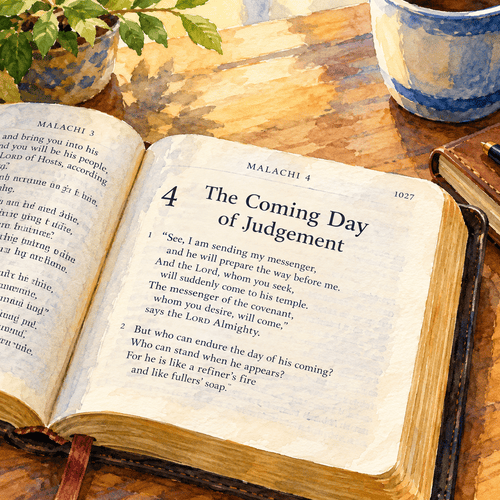
Turn to the last page of the Old Testament. Read the very last line. It isn’t a happy ending. The book of Malachi ends with a warning God might come and strike the land “with a decree of utter destruction” (Malachi 4:6).
That’s how the Old Testament closes—with the word “destruction.” Then, for about 400 years, no new prophet speaks.
Did God give up on His people?
Not at all. Hidden inside these 4 short chapters is one of the clearest promises of Jesus in the whole Old Testament. Malachi doesn’t only say God will send help. He says God Himself will come. He will come to His temple like a refining fire, and rise like the sun after a long night.
Let’s walk through Malachi slowly and see why the last promise of the Old Testament could only be kept by one person: Jesus Christ.
Jesus in the Old Testament — Book 39 of 39
This post is the 39th and final instalment in our series tracing Christ through every book of the Old Testament. See the full series index.
Who Was Malachi, and What Was Going On?
Malachi was a prophet. A prophet is a person who carries God’s message to people. His name means “my messenger” in Hebrew. Keep that word “messenger” in mind. It is the key word of the whole book.
Malachi spoke about 100 years after the Jews came home from exile in Babylon. (Exile means being forced to live far from your home country.) The temple in Jerusalem had been rebuilt. But the people’s hearts had grown cold. The priests offered sick and blind animals to God. Men broke their marriage promises. Worst of all, the people doubted that God loved them.
The book is written as six arguments. God makes a statement. The people answer back, “How?” Then God explains.
| MALACHI AT A GLANCE | DETAILS |
|---|---|
| What the name means | “My messenger” |
| When he spoke | About 460–430 BC, around the time of Nehemiah |
| Where | Jerusalem, when the Persian Empire ruled the land |
| The problem | Cold hearts, careless worship and broken promises |
| The style | Six arguments between God and His people |
| Its place in the Bible | The last book of the Old Testament in English Bibles |
| The key promise | “The Lord whom you seek will suddenly come to his temple” (3:1) |
How Do We Find Jesus in an Old Testament Book?
Some people say Christians “force” Jesus into the Old Testament. But Jesus Himself taught us to look for Him there:
And beginning with Moses and all the Prophets, he interpreted to them in all the Scriptures the things concerning himself. (Luke 24:27)
A famous summary of Augustine of Hippo’s teaching says: “The New is in the Old concealed; the Old is in the New revealed.” To be careful, we sort Malachi’s links to Jesus into three kinds:
| KIND OF LINK | WHAT IT MEANS | EXAMPLE IN MALACHI |
|---|---|---|
| Clear promise | The New Testament says plainly that this verse is fulfilled in Jesus or in the one who prepares His way. | The messenger and the Lord (3:1); Elijah (4:5) |
| Strong link | The words point clearly to Christ, and the New Testament picks up the same picture. | The sun of righteousness (4:2) |
| Echo | A picture or pattern that finds its fullest meaning in Christ. | The spotless offering (1:6–14) |
Our case stands on the first kind. The other two add colour and depth.
The Lord Who Suddenly Comes to His Temple
Malachi’s people asked a bitter question: “Where is the God of justice?” (2:17). In other words, “Why doesn’t God do something?” God answers:
Behold, I send my messenger, and he will prepare the way before me. And the Lord whom you seek will suddenly come to his temple; and the messenger of the covenant in whom you delight, behold, he is coming, says the LORD of hosts. (Malachi 3:1)
This one verse is the heart of the book. A covenant is a binding promise-relationship that God makes with His people. So “the messenger of the covenant” is the one who brings God’s promise and makes it real. But who exactly is coming?
Step by Step: Who Is Coming?
- God is speaking. “The LORD of hosts” says the messenger prepares the way “before me.” So the one who comes after the messenger is God Himself.
- He is called “the Lord.” In Hebrew this is ha’adon. In the Old Testament, this title with “the” is used for God (see Exodus 23:17 and Isaiah 1:24), not for an ordinary man.
- He comes to “his temple.” The temple was God’s house. No prophet, priest or king could call it “his” temple. Only God could.
- “The Lord” and “the messenger of the covenant” are one person. Hebrew writers often say the same thing twice in two ways. Here both lines share one action: “he is coming.”
John Calvin noticed the same thing. Because the prophet calls it “his temple,” Calvin argued that the one who comes must be God Himself. Yet this same person is called a “messenger”—someone sent. Who can be both God and sent by God? Only the eternal Son.
Four Messengers in One Small Book
| MESSENGER | WHERE | WHO IT IS |
|---|---|---|
| The prophet | 1:1 (“Malachi” means “my messenger”) | Malachi himself |
| The priest | 2:7 (“he is the messenger of the LORD”) | Every true priest who teaches God’s word |
| The forerunner | 3:1a (“my messenger”) | John the Baptist (Matthew 11:10) |
| The messenger of the covenant | 3:1b | The Lord Himself—Jesus Christ |
The first three messengers point the way. The fourth one is the way.
The Surprise in the Gospels: “Me” Becomes “You”
When Jesus quotes Malachi 3:1, He changes one small word. Look closely:
| MALACHI 3:1 SAYS… | JESUS SAYS IN MATTHEW 11:10… |
|---|---|
| “He will prepare the way before me.” | “Who will prepare your way before you.” |
| God speaks about Himself. | God speaks to someone else. |
Why does this matter? Jesus reads the verse as God the Father speaking to God the Son. The coming of the Son is the coming of God. Here we see the Trinity—one God in three Persons—already at work in the Old Testament.
Ernst Wilhelm Hengstenberg, the great nineteenth-century Old Testament scholar, showed that this “messenger of the covenant” is the same as the “angel of the LORD” who led Israel through the desert. God said of that angel, “Behold, I send an angel before you… my name is in him” (Exodus 23:20–21). Herman Bavinck also taught that this angel was no ordinary angel but God Himself making Himself known. The Lord who led Israel out of Egypt is the Lord who came to His temple.
What About the Jewish Reading?
Some Jewish teachers say the messenger of the covenant is Elijah or an angel. But the verse separates two people. First comes “my messenger,” who prepares the way. Then comes “the Lord,” who arrives. And Malachi 4:5 says Elijah comes before the great day. So Elijah is the one who prepares. He is not the one who arrives.
THE TEMPLE DEADLINE
Malachi says the Lord will come to His temple. So the temple had to be standing when He came.
The Romans destroyed that temple in AD 70. It has never been rebuilt. This means the Lord had to come before AD 70.
Jesus fits exactly. He was brought to the temple as a baby (Luke 2:22–38), taught there and cleansed it (John 2:13–22). Haggai 2:9 and Daniel 9:26 point to the same window of time.
The Refiner’s Fire and the True Priest
The people wanted God to come. But were they ready?
But who can endure the day of his coming, and who can stand when he appears? For he is like a refiner’s fire and like fullers’ soap. (Malachi 3:2)
A refiner melts silver or gold in a very hot fire. The dirt rises to the top, and he removes it. What is left is pure metal. Fullers’ soap was a strong soap for cleaning cloth. Both pictures mean the Lord will make His people clean—and cleaning can hurt.
John the Baptist used this very picture about Jesus: “He will baptise you with the Holy Spirit and fire” (Matthew 3:11). Malachi says the Lord “will purify the sons of Levi” (3:3). The sons of Levi were the priests. In the New Testament, every believer becomes part of “a holy priesthood” (1 Peter 2:5).
Malachi also paints a picture of the perfect priest:
True instruction was in his mouth, and no wrong was found on his lips. He walked with me in peace and uprightness, and he turned many from iniquity. (Malachi 2:6)
Israel’s priests failed this test badly (2:8). But Hebrews tells us that in Jesus “we should have such a high priest, holy, innocent, unstained, separated from sinners” (Hebrews 7:26). He is the only priest who never failed.
The Sun of Righteousness Rises
Malachi’s final chapter describes the Day of the LORD—the day when God comes to judge. For the proud, that day will burn “like an oven” (4:1). But for God’s people, the same day will feel like sunrise:
But for you who fear my name, the sun of righteousness shall rise with healing in its wings. You shall go out leaping like calves from the stall. (Malachi 4:2)
Righteousness means being right with God and doing what is right. The “wings” are the sun’s rays, spreading out like the wings of a bird.
The New Testament shines this light straight onto Jesus. Zechariah, the father of John the Baptist, sang that “the sunrise shall visit us from on high to give light to those who sit in darkness” (Luke 1:78–79). Jesus said, “I am the light of the world” (John 8:12). On the mountain, “his face shone like the sun” (Matthew 17:2). And everywhere He went, He healed.
Christians have sung this truth for centuries. Charles Wesley’s Christmas hymn of 1739 says: “Hail the Sun of Righteousness! Light and life to all He brings, Ris’n with healing in His wings.”
Elijah, Moses and a Mountain
Malachi’s last words name two great men. First, “Remember the law of my servant Moses” (4:4). Then:
Behold, I will send you Elijah the prophet before the great and awesome day of the LORD comes. And he will turn the hearts of fathers to their children and the hearts of children to their fathers. (Malachi 4:5–6)
From Malachi to the Mountain: A Timeline
- Malachi’s day (about 430 BC): God promises to send Elijah before the great day.
- The quiet years (about 400 years): No new prophet speaks. God’s people wait.
- Before John’s birth: An angel tells Zechariah that his son will go “in the spirit and power of Elijah, to turn the hearts of the fathers to the children” (Luke 1:17).
- John’s preaching: John appears in the desert dressed like Elijah (Matthew 3:4; 2 Kings 1:8).
- Jesus’s verdict: “He is Elijah who is to come” (Matthew 11:14).
- The Transfiguration: On a mountain, Jesus shines with glory, and Moses and Elijah appear, talking with Him (Matthew 17:3).
Moses stands for the Law—God’s commands. Elijah stands for the Prophets—God’s messengers. The Old Testament ends by naming these two men. Then, in the Gospels, the same two men stand beside Jesus. And God the Father says, “Listen to him” (Matthew 17:5). The Law and the Prophets were signposts pointing to Jesus.
God’s Love and Worship Among the Nations
Malachi opens with four tender words: “I have loved you” (1:2). But the people reply, “How have you loved us?” God points to His free choice of Jacob over his twin brother Esau. The apostle Paul quotes this verse in Romans 9:13 to show that God’s saving love rests on His own choice, not on our goodness. And the greatest answer to “How have you loved us?” is the cross, where God “sent his Son to be the propitiation for our sins” (1 John 4:10). Propitiation means a sacrifice that turns away God’s anger.
Then Malachi looks far beyond Israel:
For from the rising of the sun to its setting my name will be great among the nations, and in every place incense will be offered to my name, and a pure offering. (Malachi 1:11)
The nations are the peoples of the world who are not Jewish. Matthew Henry saw this verse as a promise that the gospel would go out to them. Today, every Sunday, worship moves from the Pacific across Asia, Africa and Europe to the Americas. From sunrise to sunset, Jesus is praised.
DOES MALACHI 1:11 SUPPORT THE MASS?
At the Council of Trent (1562), the Roman Catholic Church used this verse to teach that the Mass is a real sacrifice offered again and again.
But Hebrews says, “by a single offering he has perfected for all time those who are being sanctified” (Hebrews 10:14). Christ’s sacrifice was once for all.
The Westminster Confession of Faith (1646) says the Lord’s Supper is “only a commemoration of that one offering up of Himself.” Our “pure offering” today is praise (Hebrews 13:15), prayer (Revelation 5:8) and lives given to God (Romans 12:1).
More Pictures of Jesus in Malachi
One of the most moving pictures is in Malachi 3:17. God says of His faithful people, “I will spare them as a man spares his son who serves him.” But how can a holy God spare sinners? Paul gives the answer: God “did not spare his own Son but gave him up for us all” (Romans 8:32). We are spared because Jesus was not.
Behind every promise stands the God who says, “I the LORD do not change” (3:6). Charles Haddon Spurgeon preached on this verse in 1855 and said, “the proper study of a Christian is the Godhead.” Here are more echoes worth studying:
| PICTURE IN MALACHI | VERSE | HOW IT POINTS TO JESUS |
|---|---|---|
| The spotless offering | 1:6–14 | Priests offered blind and sick animals. Jesus is “a lamb without blemish or spot” (1 Peter 1:19). |
| “Where is the God of justice?” | 2:17 | At the cross, God punished sin and saved sinners. He is both “just and the justifier” (Romans 3:26). |
| The faithful husband | 2:10–16 | God hates broken marriage promises. Christ is the faithful husband who gave Himself for His bride, the church (Ephesians 5:25). |
| The God who does not change | 3:6 | “Jesus Christ is the same yesterday and today and forever” (Hebrews 13:8). |
| The book of remembrance | 3:16 | God writes down the names of those who fear Him. Compare “the Lamb’s book of life” (Revelation 21:27). |
From Curse to Christ
We began with the Old Testament’s last, frightening words: “utter destruction.” Now turn just one page. The New Testament opens: “The book of the genealogy of Jesus Christ” (Matthew 1:1).
Malachi asked, “Who can stand when he appears?” The honest answer is: no one can stand on their own. But everyone who trusts in Jesus can stand, because “Christ redeemed us from the curse of the law by becoming a curse for us” (Galatians 3:13). He took the fire so that we could walk in the sunrise.
The Lord whom Malachi’s people sought has come. The only question left is whether you will seek Him too.
Tough Questions, Honest Answers
Do Christians have to tithe, as Malachi 3:8–10 says?
The tithe (one tenth) was part of the Old Testament system that supported the priests, the Levites and the temple. Since Christ has fulfilled the temple and the priesthood, the New Testament never gives Christians a fixed percentage. Instead, it calls us to give regularly, generously and gladly: “God loves a cheerful giver” (2 Corinthians 9:7). Many believers find a tenth a helpful starting point, and that is wise. But the real question Malachi asks is about the heart. “Robbing God” begins when we treat what He gave us as if it were only ours.
Does Malachi 3:10 promise that God will make me rich if I give?
No. In Malachi 3:10–11, God promised Israel rain, good crops and protection from pests in their land, under the old covenant. It is not a money formula for today. The “prosperity gospel” treats God like a machine: put money in, get more money out. But God’s greatest blessing is not wealth; He “has blessed us in Christ with every spiritual blessing” (Ephesians 1:3). God does provide for His children, but some of His most faithful people are poor.
Does God hate divorce, according to Malachi 2:16?
Older Bibles translate this verse, “He hates divorce.” The ESV reads it differently: “the man who does not love his wife but divorces her… covers his garment with violence.” Either way, the point is clear. God hates it when a husband breaks his marriage promise and throws his wife away. Jesus allowed divorce in cases of sexual unfaithfulness (Matthew 19:9), and Paul allowed it when an unbelieving partner leaves (1 Corinthians 7:15). If you are divorced, there is full forgiveness and a warm welcome in Christ.
Why is Malachi the last book of the Old Testament?
English Bibles follow the order of the ancient Greek translation of the Old Testament. That order groups the books by type: law, history, poetry, then prophets. The Hebrew Bible uses a different order and ends with 2 Chronicles. The order of the books is not inspired by God, but both endings look forward. Chronicles ends with a call to build God’s house, and Malachi ends with the Lord coming to His house. Both point to Jesus, who called His own body the temple (John 2:19–21).
What happened in the “400 silent years” between Malachi and Matthew?
No new prophet wrote Scripture in those years; even the Jewish book of 1 Maccabees mentions that prophets had stopped appearing. But God was not idle. The Persian Empire gave way to the Greeks and then the Romans. Greek became a common language across the world, the Old Testament was translated into Greek, and Roman roads linked the nations. Paul says that “when the fullness of time had come, God sent forth his Son” (Galatians 4:4). The silence was God setting the stage.
Will Elijah come back before Jesus returns?
Some Christians expect Elijah to return in person before the Second Coming, sometimes as one of the two witnesses in Revelation 11. But Jesus said plainly, “Elijah has already come, and they did not recognise him” (Matthew 17:12), and His disciples understood He meant John the Baptist. When John said, “I am not” Elijah (John 1:21), he meant he was not Elijah come back to life. He came in Elijah’s spirit and power, as the angel said. Jesus is the best interpreter of Malachi, so we need not wait for another Elijah.
Who was Malachi? Is “Malachi” even a real name?
Since “Malachi” means “my messenger,” some have wondered if it is a title rather than a name. The ancient Greek translation reads Malachi 1:1 as “by the hand of his messenger,” and one old Jewish tradition even linked the book to Ezra. But the other prophetic books open with the prophet’s real name, so it is most natural to see Malachi as a real man. We know almost nothing else about him. That seems fitting: a true messenger points away from himself to the One who is coming.
Related Reads
- Jesus in the Old Testament: Where He Appears In All 39 Books
- Jesus in Zechariah: The Priest-King Foretold 500 Years Early
- Malachi’s Closing Prophecy: Who Is the Promised Elijah?
- More than Tithing: How Grace Motivates Sacrificial Giving
- Mountaintop Moments: The Transfiguration’s Timeless Truths
- Jesus in Genesis: The Promised Seed Who Crushes the Serpent