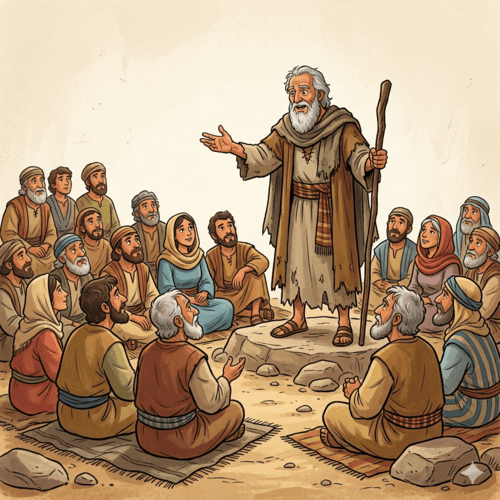
Imagine a prophet standing in Jerusalem around 700 BC, naming—with no natural means of knowing—the exact monarch who’d liberate the Jewish people from Babylonian captivity more than a century later. That’s precisely what Isaiah did. By name. With specific detail. Generations before Cyrus the Great had been born, let alone crowned king of Persia.
Of all the Bible’s predictive prophecies, this one stands in a category all its own. It’s specific, verifiable, and historically confirmed. And it demands a reckoning.
The Prophecy Itself—Isaiah Speaks Cyrus’s Name
The passage in question is Isaiah 44:28-45:1, written during Isaiah’s ministry (approximately 740–700 BC):
“Who says of Cyrus, ‘He is my shepherd, and shall fulfil all my purpose’; saying of Jerusalem, ‘She shall be built,’ and of the temple, ‘Your foundation shall be laid.'” (Isaiah 44:28)
“Thus says the Lord to his anointed, to Cyrus, whose right hand I have grasped, to subdue nations before him and to loose the belts of kings, to open doors before him that gates may not be closed…” (Isaiah 45:1)
These verses don’t hint at a future deliverer in vague terms. They name him. Cyrus. By name. And they describe his role precisely: he’d subdue nations, open closed gates, and issue the decree for Jerusalem’s restoration. At the time of writing, no such person existed—and no human intelligence could have foreseen him.
The Astonishing Detail—Named 150 Years Before His Birth
Why is the naming of Cyrus so remarkable? Because Isaiah ministered approximately 740–700 BC, and Cyrus the Great wasn’t born until around 600 BC and did not conquer Babylon until 539 BC. The prophecy was therefore written roughly 150 years before Cyrus was born—and close to 200 years before the events it describes came to pass.
At the time Isaiah wrote, Persia was a minor vassal state. Babylon had not yet risen to the dominance that would produce the Jewish exile. The name “Cyrus” meant nothing to any living Israelite. There was no political, military, or cultural basis on which any human being could have named this particular king, in this particular role, with this particular precision.
Consider the comparison: it would be like a writer in 1875 naming—by name—a world leader who’d rise in 2025 and specifying exact policy decisions. No human foreknowledge could account for it.
The Historical Fulfilment
The prophecy was fulfilled in striking detail. In 539 BC, Cyrus the Great conquered Babylon—not by siege, as the city’s walls were considered impregnable, but by diverting the Euphrates and marching his troops under the river gates under cover of night. The imagery of Isaiah 45:1—”to open doors before him that gates may not be closed”—maps precisely onto this historical account.
Following his conquest, Cyrus issued a remarkable decree, recorded in Ezra 1:2–3:
“Thus says Cyrus king of Persia: The Lord, the God of heaven, has given me all the kingdoms of the earth, and he has charged me to build him a house at Jerusalem, which is in Judah. Whoever is among you of all his people, may his God be with him, and let him go up to Jerusalem in Judah and rebuild the house of the Lord…”
The fulfilment was not approximate. A pagan king, named by a Jewish prophet generations before his birth, issued the very decree Isaiah had foretold.
The Sceptic’s Objection—Was Isaiah Written After the Fact?
The most common sceptical response is the “Deutero-Isaiah” theory: the proposal that chapters 40–66 of Isaiah were not written by the eighth-century prophet at all, but by an unknown author during or after the Babylonian exile—making the “prediction” of Cyrus a contemporary or retrospective description rather than a genuine prophecy.
This objection is worth examining closely.
- First, the argument is circular. It begins by assuming genuine predictive prophecy is impossible, then uses the Cyrus passage as evidence that chapters 40–66 must have been written later. The conclusion is smuggled into the premise.
- Second, the manuscript evidence doesn’t support a division. The Great Isaiah Scroll discovered among the Dead Sea Scrolls—dated to approximately 125 BC—shows no break, no gap, and no change of scribal hand between chapter 39 and chapter 40. The Jewish community that copied the scroll treated it as a single, unified text.
- Third, the New Testament consistently attributes both halves of Isaiah to one author. In John 12:38–41, the Apostle John quotes from Isaiah 53 and Isaiah 6 in the same sentence, explicitly attributing both to “Isaiah.” Jesus himself quoted from both sections (Matthew 12:17–18 from Isaiah 42; Luke 4:17–19 from Isaiah 61). If the Deutero-Isaiah theory requires that Jesus and the Apostles were all mistaken about the book’s authorship, the burden of proof lies heavily with the sceptic.
Archaeological Confirmation—The Cyrus Cylinder
In 1879, archaeologist Hormuzd Rassam, excavating in Babylon, unearthed a small clay barrel covered in cuneiform script. Now housed in the British Museum, the Cyrus Cylinder records—in Cyrus’s own words—his conquest of Babylon and his policy of allowing exiled peoples to return to their homelands and restore their sacred sites.
The cylinder reads in part: “I returned to these sacred cities on the other side of the Tigris, the sanctuaries of which have been in ruins for a long time… I also gathered all their former inhabitants and returned them to their habitations.”
This is the broader royal policy behind the specific decree recorded in Ezra 1. The cylinder doesn’t name the Jewish people specifically, but it corroborates the biblical portrait of Cyrus as a king who did precisely what Isaiah foretold—restoring displaced peoples to their homelands and their places of worship. It’s one of the most significant pieces of ancient Near Eastern evidence to confirm the historical setting of the biblical narrative.
What This Prophecy Proves About Scripture
The Cyrus prophecy isn’t merely an impressive historical curiosity. It’s a fingerprint. It establishes that the God who speaks through Isaiah isn’t a god of vague impressions and spiritual generalities, but the sovereign Lord of history—one who “declares the end from the beginning and from ancient times things not yet done” (Isaiah 46:10).
If one prophecy of this specificity has been demonstrably fulfilled, it demands we take the rest of Scripture with the same seriousness. The God who named Cyrus before his birth is the same God who speaks across every page of the Bible. That isn’t a claim that can be dismissed lightly—by honest sceptic or careless believer alike.
Tough Questions, Honest Answers
Who was Cyrus the Great in the Bible?
Cyrus the Great (c. 600–530 BC) was the founder of the Achaemenid Persian Empire and one of the most celebrated rulers of the ancient world. In Scripture, he is chiefly significant for conquering Babylon in 539 BC and issuing the decree that permitted the Jewish exiles to return to Jerusalem and rebuild the Temple. The Bible presents him as an instrument in God’s sovereign hand—chosen not because he was a believer, but because God works through whomever He wills to accomplish His purposes, even pagan kings (Isaiah 45:4–5). Josephus records that when Cyrus was shown the scroll of Isaiah containing his own name, he was moved to issue the decree as a direct response.
How many years before his birth was Cyrus named in Isaiah?
Isaiah’s ministry ran approximately 740–700 BC; Cyrus was born around 600 BC and conquered Babylon in 539 BC. The prophecy was therefore written roughly 100–150 years before Cyrus’s birth and approximately 160–200 years before the fulfilment described in Ezra 1. The post title’s figure of “150 years” is a conservative and accurate representation of the gap between the prophecy and the birth of its named subject—itself an extraordinary span of foreknowledge.
What does Isaiah 44:28 say about Cyrus?
Isaiah 44:28 reads: “Who says of Cyrus, ‘He is my shepherd, and shall fulfil all my purpose’; saying of Jerusalem, ‘She shall be built,’ and of the temple, ‘Your foundation shall be laid.'” The verse is remarkable for its precision on three counts: the liberator is named, his role as the one who authorises Jerusalem’s rebuilding is specified, and the Temple’s restoration is foretold. Each element was historically fulfilled exactly as described, as the accounts in Ezra 1–6 confirm.
What does Isaiah 45:1 say about Cyrus?
Isaiah 45:1 reads: “Thus says the Lord to his anointed, to Cyrus, whose right hand I have grasped, to subdue nations before him and to loose the belts of kings, to open doors before him that gates may not be closed.” The language of “opening doors” and “gates not closed” has fascinated historians, as the ancient accounts of Babylon’s fall describe Cyrus’s troops entering the city through its river gates—gates that, by oversight or divine providence, were left open on the night of the attack. The correspondence between the prophetic imagery and the historical record is striking.
Did Jeremiah also prophesy about Cyrus?
Jeremiah prophesied about the fall of Babylon and the end of the exile (Jeremiah 29:10; 51:11), but he did not name Cyrus specifically—that precision belongs uniquely to Isaiah. Jeremiah’s prophecy fixed the duration of the exile at seventy years, while Isaiah named the agent of restoration. Together, they form a complementary prophetic witness: one specifying the timeframe, the other the instrument. Both were fulfilled when Cyrus conquered Babylon in 539 BC and issued the decree recorded in Ezra 1, approximately seventy years after Nebuchadnezzar’s first deportations from Jerusalem.
What is the Cyrus Cylinder and why does it matter?
The Cyrus Cylinder is a clay barrel discovered in Babylon in 1879 and now on permanent display in the British Museum. Written in cuneiform on behalf of Cyrus, it records his conquest of Babylon and his policy of restoring displaced peoples and their religious sanctuaries to their homelands. Although it does not name the Jews specifically, it corroborates the biblical account in Ezra 1:1–4—confirming that Cyrus operated exactly the policy the Bible describes. It is one of the most important pieces of archaeological evidence for the historical credibility of the Old Testament narrative, confirming not just the existence of Cyrus but the nature of his imperial policy.
Why do sceptics argue Isaiah could not have predicted Cyrus?
Sceptics who hold that predictive prophecy is impossible conclude that Isaiah 44–45 must have been written after Cyrus’s rise—a position known as the Deutero-Isaiah theory. However, this argument is circular: it rules out the prophecy’s genuineness because it assumes in advance that prophecy cannot work, rather than examining the evidence on its own terms. The manuscript evidence (the Great Isaiah Scroll, c. 125 BC, showing no textual break between chapters 39 and 40), the New Testament’s consistent attribution of the whole book to one Isaiah, and the internal theological unity of the book all challenge this conclusion. Genuine intellectual honesty requires that the possibility of divine foreknowledge at least be considered—rather than defined away before the evidence is weighed.
Related Reads