Pick up almost any popular book on religion and you’ll meet the same claim sooner or later: the Bible’s a collection of pious legends—beautiful, perhaps, but no more historical than Greek myth. Stories were told, embellished, and finally written down centuries after the events by people with a point to prove. It’s a confident charge, and it sounds reasonable.
The trouble is it keeps colliding with the evidence. When we ask about the historicity of the Bible something surprising happens. Spade after spade of archaeology, shelf after shelf of ancient manuscripts, and a string of fulfilled predictions all point the same way. The interesting thing isn’t that believers say the Bible is reliable. It’s that the ground, the libraries, even the historical record increasingly say so too.
This article walks through four tests anyone can apply:
- The archaeological test (does the spade confirm the text?)
- The manuscript test (is the Bible we read the Bible that was written?)
- The coherence test (does a book by 40 authors hang together?) and
- The prophecy test (did it call events before they happened?)
None of this asks you to believe anything in advance. It asks a simpler question: when we put the Bible’s historical claims to the test, how do they fare?
What Does “Historicity of the Bible” Actually Mean?
It helps to be clear about what we’re asking—and what we aren’t. Historicity is the question of whether the people, places, and events a text describes actually existed and happened. It’s a historian’s question, answered with a historian’s tools: inscriptions, ruins, coins, and the cross-checking of independent sources.
That’s a different question from inspiration—the theological claim that God Himself stands behind the text. Archaeology can tell you a King David existed and that a man named Pontius Pilate governed Judaea. But it cannot, by digging, tell you the Bible is the word of God. Confusing the two helps no one. So this article makes the narrower, testable claim and leaves the larger one where it belongs.
Why does the narrower claim matter so much? Because the sceptic’s objection depends on it. If the Bible were shown to be riddled with people who never lived and cities that never stood, its credibility on everything else would rightly collapse. The honest way to answer the charge isn’t to insist on the Bible’s authority up front, but to ask what the evidence shows—and then to follow it.
The Archaeological Test: What Does the Ground Tell Us?
For much of the 19th century, confident scholars treated the Bible as guilty until proven innocent. Whole peoples and figures it named were dismissed as invention—until the archaeologists turned up. The pattern is repeated so often it has become almost predictable: the text is doubted, the ground is dug, and the text is vindicated. A handful of the headline cases:
- The Merneptah Stele. Carved around 1208 BC to commemorate an Egyptian pharaoh’s campaigns, this granite stela contains the earliest known mention of “Israel” outside the Bible — proof a people by that name were already established in Canaan by the late 13th century BC, just as the historical books assume.
- Jericho: Excavations at Tell es-Sultan, the mound that covers ancient Jericho, uncovered collapsed city walls and a settlement destroyed by fire. John Garstang in the 1930s and the later, more sceptical Kathleen Kenyon both confirmed a violent, fiery destruction. They disagreed sharply over its date, and that debate continues—but that Jericho was a real, fortified city which met a fiery end is no longer in dispute.
- The Hittites. The Old Testament mentions the Hittites dozens of times, yet for centuries no trace of them survived outside its pages, and critics offered them as proof of biblical fiction. Then, from 1906, excavations at Boğazköy in modern Turkey uncovered the capital of a vast Hittite empire, archives and all. A people written off as legend had ruled much of the ancient Near East.
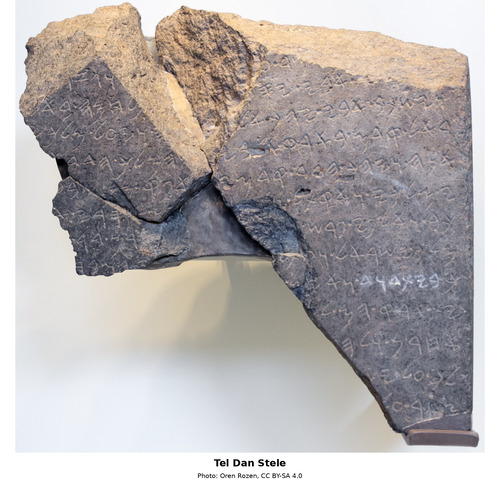
- King David. In 1993, archaeologists at Tel Dan in northern Israel found a fragment of a victory monument—a stele, meaning an inscribed standing stone—bearing the phrase “House of David”. It’s the earliest reference to David outside the Bible, and it quietly ended the once-fashionable theory that he was a folk hero with no more substance than King Arthur.
- Pontius Pilate. Until 1961, the only evidence for Pilate was literary, and a few doubted he existed at all. That year a block of limestone reused in a theatre at Caesarea was found carrying his name and his title—prefect of Judaea, a prefect being the Roman governor of a minor province. The Gospels had his office exactly right.
- Caiaphas: In 1990, a burial cave in Jerusalem yielded an ossuary—a stone box used to store bones once the flesh had decayed—inscribed with the name of Joseph, son of Caiaphas. This is almost certainly the high priest who, the Gospels say, presided over the questioning of Jesus before his crucifixion.
None of these is a one-off. Each represents a whole category—cities, empires, kings, officials—where the Bible kept naming names and the evidence kept catching up.
Several of these threads have posts of their own on this site, from the ruins of Babylon to Hezekiah’s stand against Assyria and the Babylonian names given to Daniel and his friends; you will find them in the Related Reads below.
The Manuscript Test: Is the Bible We Have the Bible That Was Written?
Suppose the events are real. A second objection remains: even if the original writers got their facts right, hasn’t the text been copied, recopied, and corrupted so badly down the centuries that we can no longer know what they actually wrote? The original documents—what scholars call the autographs—are long gone, lost to damp and time. So the question is fair. How close is the text in your hands to the text that left the writers’ hands?
For the Old Testament, the decisive evidence came out of the ground near the Dead Sea between 1947 and 1956. Before that, the oldest complete Hebrew manuscripts we possessed—the Masoretic texts, named after the medieval Jewish scribes who preserved them—dated from around AD 1000. The Dead Sea Scrolls pushed that back by roughly a thousand years. The natural worry was that a millennium of hand-copying would have introduced wholesale change. It hadn’t. When the great scroll of Isaiah from the caves was set beside the medieval text, the two matched closely; the differences were overwhelmingly matters of spelling and word order, with nothing that altered the meaning. A thousand years of copying had changed remarkably little.
The New Testament stands in a category of its own. Over 5,800 Greek manuscripts survive, with thousands more in Latin, Syriac, Coptic and other ancient languages, and the earliest fragments reach back to within roughly a century of the events—one scrap of John’s Gospel dates to the first half of the second century. The point lands hardest by comparison. Set the New Testament beside the most respected works of the classical world:
- Caesar’s Gallic War. Historian FF Bruce counted only nine or ten reliable early manuscripts, and the oldest among them was copied some 900 years after Caesar wrote.
- Homer’s Iliad. The best-attested work of Greek antiquity survives in fewer than 2,400 manuscripts.
- The New Testament. Over 5,800 in Greek alone, the earliest within a century or two of composition, plus tens of thousands more in other languages.
No one questions whether Caesar wrote his account of the Gallic war, or treats Homer as unrecoverable. By any standard applied to other ancient books, the New Testament is the best-attested text to survive from antiquity—and by a wide margin. That doesn’t make its claims true on its own. What it does is remove the idea that the message was hopelessly garbled in transmission.
The Internal Coherence Test: 40 Authors, 1,500 Years, One Unified Story
Step back from the individual finds and consider the book as a whole. The Bible isn’t one book but a library—66 of them—written by roughly 40 authors over something like 1,500 years, in three languages, across cultures as different as a Bronze Age shepherd and a first-century Roman citizen. Its writers include kings and prisoners, fishermen and physicians, most of whom never met and couldn’t possibly have coordinated their work.
You’d expect such a collection to be a patchwork of competing ideas. Instead, it tells a single, developing story: a good creation, a catastrophic human rebellion, and a long rescue that runs through a covenant people towards a promised deliverer, ending in a renewed creation. Themes raised in the opening chapters—a sacrifice that covers guilt, a coming king, a suffering servant—are picked up, deepened, and resolved hundreds of years later by writers who could not have read one another’s work.
No editorial committee planned this; there was no committee. For a sceptic, that unity is a genuine puzzle to explain. For the Christian, it’s exactly what we’d expect if a single mind stood behind the many hands—if, beneath 40 human authors, there was one Author at work.
The Prophecy Test: Predictions Made Centuries Before the Events
The final test is the boldest, because it’s by far the easiest to fail. Anyone can claim wisdom after the event. Prophecy claims to call the event before it happens—and that can be verified. Three examples carry the weight.
- Isaiah and the suffering servant. Around 700 BC, prophet Isaiah described a servant who’d be despised and rejected, wounded for the sins of others, silent before His accusers, buried with the rich, and yet vindicated beyond death (Isaiah 53). Read alongside the Gospel accounts of the crucifixion, the fit is uncomfortably exact—so exact that some have argued the passage must have been written afterwards. The Dead Sea Scrolls have closed that door: a complete copy of Isaiah from the caves predates the events by well over a century, ruling out any back-dating.
- Cyrus, named before his birth. Isaiah also names a foreign king, Cyrus, as the one who’d set God’s exiled people free to rebuild Jerusalem (Isaiah 44:28)—and does so more than a century before Cyrus was born. The Jewish prophet even got the Persian name right. When Cyrus the Great of Persia did precisely that, his own decree of release was recorded; the famous Cyrus Cylinder, now in the British Museum, confirms his policy of returning displaced peoples to their homelands. A king called by name, generations early, isn’t the sort of thing legend usually risks.
- The fall of Babylon. Babylon was the superpower of its age, yet Isaiah declared it would become a permanent ruin, never to be resettled (Isaiah 13:19-20). Great cities are usually rebuilt; Babylon wasn’t. Its remains, near modern Hillah in Iraq, have lain largely desolate for centuries—a prediction left hanging over the ages and, against the odds, fulfilled.
What this Evidence Does—and Doesn’t—Prove
It’s worth being plain about the limits of all this, because overstating the case does the truth no favours. Archaeology, manuscripts, and fulfilled prophecy can establish a great deal: that the Bible’s world is the real world, that its people lived and its cities stood, that its text has reached us intact, and that some of its claims outran the knowledge of their day. Now that’s a substantial result. It dismantles, completely, the charge that the Bible is mere legend with no footing in history.
What this evidence cannot do is prove, on its own, that the Bible is the word of God. Confirming that Pilate governed Judaea doesn’t by itself show the Gospel written about his most famous prisoner is true in its deepest claims. Evidence can clear away objections and show faith is reasonable rather than reckless; it can carry us to the door. The conviction that Scripture is God speaking is something the evidence supports but doesn’t manufacture—it comes, finally, as the text does its own work on the reader.
So the honest conclusion is also the confident one. The Bible has been tested as no other ancient book has been tested, and it has held. The objection that it’s a tissue of myths was never well-founded, and it looks weaker with every excavation season. That’s precisely the ground on which a thoughtful person can take its larger claims seriously.
Tough Questions, Honest Answers
Doesn’t archaeology contradict parts of the Bible?
In a few areas the relationship between text and trowel is genuinely debated—the date and scale of the Exodus and the conquest of Canaan are the usual examples, where the evidence is patchy and scholars disagree. Some point to the ancient Nile Delta site of Qantir — identified by many archaeologists with the store-city of Rameses that Exodus 1:11 names — where excavations have uncovered Asiatic workers’ quarters and administrative texts referring to Semitic labourers, and take that as consistent with a Hebrew presence in Egypt. Others read the same finds more cautiously: they show Semitic labourers in the eastern Delta without confirming the specific biblical population, numbers or departure the text describes. It’s fair to say the picture there is unsettled rather than closed. But “contradiction” overstates it. The broad trend of two centuries of archaeology has been confirmation, not refutation, and several cases once thought to be losses for the Bible—the Hittites, King David—later turned into wins.
Does the Bible’s historical accuracy make it divinely inspired?
No—and it matters to say so. Historical accuracy and divine inspiration are different claims; a history book can be accurate without being inspired. What accuracy does is remove a major obstacle: you can’t dismiss the Bible as fiction once its history checks out. It earns the Bible a serious hearing for its larger claims, which then rest on more than archaeology.
Why do some scholars still doubt the Bible’s reliability?
For a mix of reasons. Some disputes are genuinely about evidence, as with the Exodus. Others flow from prior assumptions—rule out the miraculous before you begin and you’ll read every text through that lens. Scholarship is also a human enterprise with its fashions and reputations. Honest doubt exists; so does doubt that owes more to its starting point than to the data.
Hasn’t the Bible been copied so many times that the original is lost?
This is the most common worry, and the manuscript evidence answers it directly. We don’t have the originals, but we have thousands of early copies—over 5,800 in Greek for the New Testament alone—from multiple independent lines. When copies from different times and places are compared, scribal slips show up clearly and can be corrected. We aren’t guessing at the original; we’re reconstructing it from an embarrassment of riches.
What about the contradictions people say the Bible contains?
Most alleged contradictions are differences of perspective or emphasis—the kind you’d expect from independent witnesses describing the same event, which courts treat as a mark of authenticity rather than collusion. Many dissolve on a closer reading of the language or context. A few remain genuinely difficult, and honest readers say so—but a handful of hard cases is a long way from the claim that the book collapses under its own inconsistencies.
Is the New Testament unreliable because believers wrote it?
Every account is written by someone with a viewpoint—secular histories included. The question isn’t whether the writers cared, but whether they were in a position to know and willing to tell the truth. The Gospel writers reported events within living memory, named real officials and places that can be checked, and recorded details that embarrassed their own leaders—hardly the habit of people inventing a flattering myth.
Where can I explore the archaeological evidence further?
Start with the Related Reads below. There are dedicated posts on the ruins of Babylon, Hezekiah’s defiance of Assyria, the Babylonian renaming of Daniel and his friends, the Siloam Dam discovery, and the Dead Sea Scrolls—each taking one thread of the argument and following it all the way to the ground.
Related reads
- Babylon Archaeology: How the Ruins Confirm Bible Accounts
- Hezekiah and Assyria: 7 Archaeological Discoveries Confirm Scripture
- Daniel and Friends: What Their Babylonian Names Mean
- Why Did Saul Change His Name to Paul? What the Bible Actually Says
- What Does the Siloam Dam Discovery Reveal About Judah’s Kings?
- What Do the Dead Sea Scrolls Prove? The Case for Bible Reliability
- The Destruction of Tyre: How Ezekiel’s Prophecy Was Fulfilled, Stone by Stone
- Did the Hittites Exist? How Archaeology Vindicates the Bible
- The Ketef Hinnom Scrolls: The Oldest Biblical Text Ever Found
- Is Jehovah a Copy of Other Ancient Gods?
- Where Is Mount Sinai? Weighing the Candidates
- Caiaphas Ossuary: How the Finds Back Bible Reliability
- Nineveh Archaeology and the Bible: What the 2026 Digs Found
- Sodom and Gomorrah: New Evidence That Backs the Bible
- Evidence King David Existed: Three Inscriptions, Five Sites