A Question That Would Not Wait
Around AD 49, a group of men travelled from Judea to Antioch in Syria. They told the young church there something that shook it to the core. Their message was blunt: Unless you are circumcised according to the custom of Moses, you cannot be saved (Acts 15:1).
A word first about terms. Torah is the Hebrew word for the law of Moses—the instruction God gave Israel through Moses in the first five books of the Bible. It runs from the Ten Commandments to the sacrifices, festivals, food rules and circumcision. So the question was whether a Greek shopkeeper who’d come to trust Christ must shoulder all of that as well.
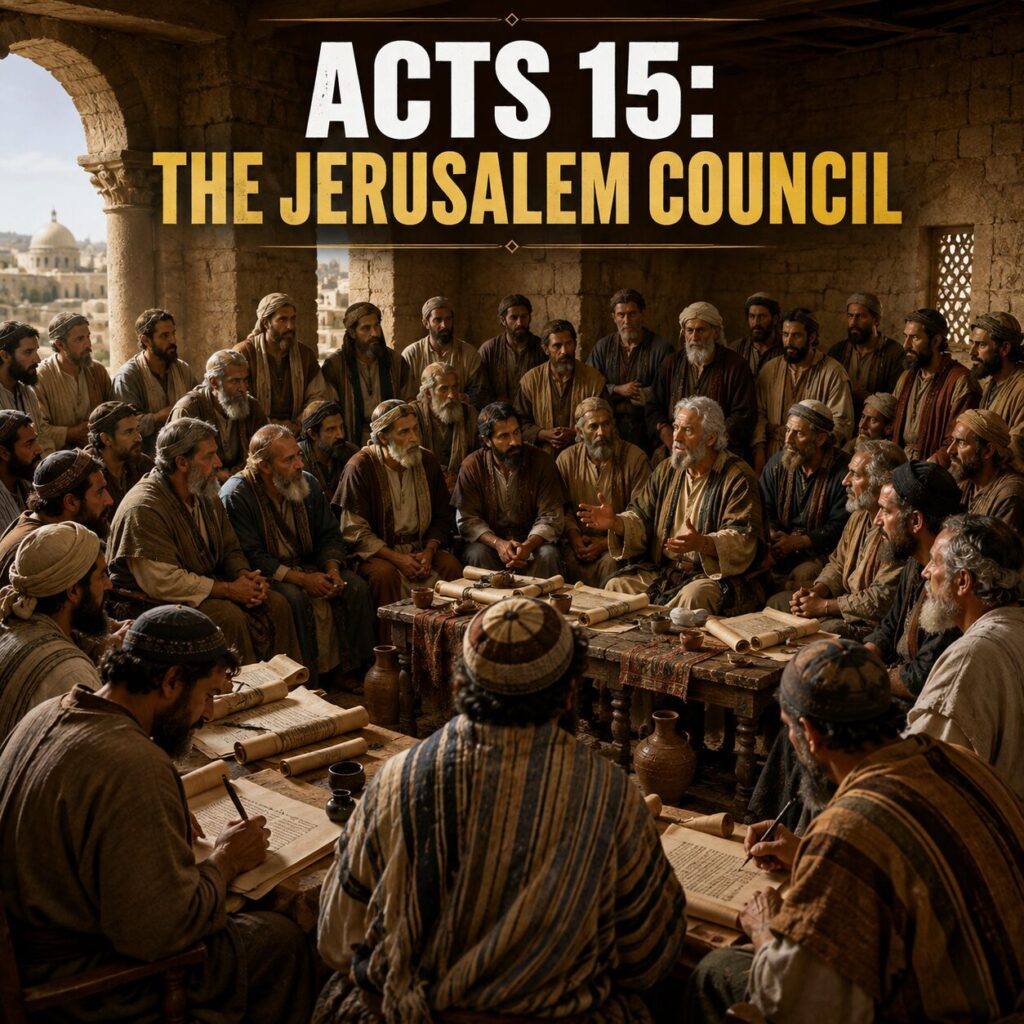
The dispute went up to Jerusalem. What happened there—at what’s been called the Jerusalem Council—is recorded in Acts 15. It settled the shape of the church for ever.
The short answer is no. The apostles didn’t require Gentiles to keep the Torah. But the reasons matter, because this chapter gets misread in two opposite directions—by those who want to put Christians back under Moses, and by those who use it to argue Christians are under no law at all.
Two claims, not one
Read the chapter slowly and you notice the trouble arrived in two waves, and they’re not the same complaint.
- The first claim was about salvation. Verse 1: circumcision is necessary in order to be saved.
- The second claim was about obedience. Verse 5, from believing Pharisees: It’s necessary to circumcise them and to order them to keep the law of Moses.
The first says you cannot be saved without this. The second allows Gentiles may be saved by faith but insists they must then live as Jews. The Council rejected both—Peter the first, James the second. Holding them apart is the key to the chapter, because movements today that press Torah-keeping almost always surrender the first claim while quietly reviving the second.
Peter: The Spirit Came Before the Law Was Kept
After a long debate Peter stood up (Acts 15:7-11). He argued not from theory but from something everyone in the room knew had happened. In the house of Cornelius, a Roman army officer, God had poured out the Holy Spirit on uncircumcised Gentiles—and He made no distinction between us and them, having cleansed their hearts by faith (15:9).
Follow the steps, because the logic is devastating:
- God gave the Spirit. The Spirit is God’s own seal of ownership, the mark that a person belongs to Him.
- He gave it before any law-keeping. Cornelius was uncircumcised, kept no festivals and followed no food rules.
- Therefore God has already answered. To demand circumcision now is to put God on trial: Why are you putting God to the test by placing a yoke on the neck of the disciples that neither our fathers nor we have been able to bear? (15:10).
Then comes the sentence that ends the argument: But we believe that we will be saved through the grace of the Lord Jesus, just as they will (15:11). Read it twice. Peter doesn’t say Gentiles may be saved the way Jews are. He says Jews are saved the way Gentiles are—by grace, with nothing added. The whole Judaizing programme dies in that half-sentence.
A Necessary Guard
Peter’s “yoke” isn’t an insult aimed at God’s law. Paul calls the law holy and righteous and good (Romans 7:12). The unbearable yoke is when the law is turned into a ladder—a way of climbing up to God’s acceptance, attempted by people who never manage a single rung. The fault lies in the sinner, not in the statute.
James: The Verdict Comes From Scripture
Peter supplied the evidence of what God had done, and Barnabas and Paul added their testimony of signs among the Gentiles. But the verdict wasn’t reached by counting experiences. James stood and said, And with this the words of the Prophets agree (15:15), quoting Amos 9:11-12: God will rebuild the fallen tent of David that the remnant of mankind may seek the Lord, and all the Gentiles who are called by my name.
The point is precise. Amos didn’t promise Gentiles would be turned into Israelites. He promised David’s restored kingdom would stretch over the nations, and that the nations would be called by God’s name while remaining nations. Gentiles come in as Gentiles. To require them to become Jews would contradict the very prophecy being fulfilled.
A textual question worth facing
Sceptics often comment James’s quotation doesn’t match our Hebrew Old Testament. The Masoretic Text says Israel will possess the remnant of Edom; James follows the Greek Septuagint, which reads the remnant of mankind may seek the Lord. The difference is two tiny variations in unpointed Hebrew consonants: it’s adam not Edom, and it’s yidreshu (seek) not yireshu (possess).
This is less alarming than it sounds. Either reading yields the same theology: David’s restored house extend over the nations, and the nations are gathered in. Richard Bauckham has argued James isn’t quoting carelessly but reading Amos with great care alongside related texts, and the Dead Sea Scrolls confirm the “tent of David” passage was already read as messianic before Christ was born.
The Four Prohibitions: What They Are and Aren’t
The Council did lay four things on Gentile believers (15:20, 29). Abstain from:
- What has been polluted by idols
- Sexual immorality,
- What has been strangled, and from
- Blood.
If the apostles freed Gentiles from the law, why four rules? This is where the argument is won or lost, so here are the main explanations side by side.
| Reading | The Claim | Assessment |
|---|---|---|
| The laws of Noah | Some say the four rules match a short list of basic laws that later Jewish teachers said God gave the whole world through Noah—long before Moses. | This claim is the weakest. Those Jewish lists were written down centuries after Acts, and the items don’t line up with the four. |
| Leviticus 17-18 | Others say these are the very rules Moses gave to foreigners living among the Israelites, and they appear in almost the same order. | The strongest case. It also explains why James mentions Moses is read aloud in the synagogues every week (verse 21). |
| Pagan temple | Some argue all four laws describe what went on at an idol’s shrine: meat offered to the idol, blood poured out, and sex as part of the worship. | Plausible and helpful, and probably part of the answer. New believers were being told to make a clean break with their old religion. |
| Table manners | These were the four habits most likely to upset a Jewish believer sitting down to eat with a Gentile one. | Fits the crisis exactly. The problem at Antioch was that the two groups could no longer share a table in peace. |
The Leviticus reading carries most weight, and explains a verse that otherwise looks like a stray remark: For from ancient generations Moses has had in every city those who proclaim him, for he is read every Sabbath in the synagogues (15:21). Gentile converts shared cities with Jewish brothers who heard Moses read aloud every week, and these four points were often the flashpoints.
Now notice what’s absent from the four:
- No circumcision.
- No Sabbath.
- No festivals, tithes, priesthood or sacrifices, and
- No dietary code other than blood.
Sit with that: had the Council meant to hand Gentiles a shortened Torah, this is an extraordinary set of items to omit. So the list isn’t a summary of the law. Instead, it names the things that would otherwise have made shared tables impossible.
Charity, Not a Lighter Torah
John Calvin, in his commentary on Acts, draws a distinction within the four that has shaped Protestant reading ever since. Idolatry and sexual immorality belong to the moral law and bind all people in every age. Blood and strangled meat are in themselves matters of indifference—neither commanded nor forbidden by God’s abiding moral law—and were enjoined for peace and the weaker conscience.
That carries a consequence Calvin stated openly: when the offence ceased, the obligation ceased. A rule given for love’s sake expires when love no longer requires it. This isn’t the apostles smuggling the Torah back through a side door. It’s Romans 14 and 1 Corinthians 8 in action, where the strong limit their liberty for the weak.
The Principle in One Line
The Council didn’t reduce the law for Gentiles. It restrained Gentile freedom for the sake of Jewish conscience. Those are two different things, and confusing them is the commonest mistake made with this chapter.
So What Are Christians Bound To?
Here the answer becomes two-sided, and this is where Acts 15 is most often abused. Freedom from Moses isn’t freedom from God.
The Westminster Confession of Faith, Chapter 19, draws a threefold distinction within the law that clears up most of the confusion.
| Kind of Law | Examples | Status Now |
|---|---|---|
| Ceremonial | Sacrifices, festivals, clean and unclean food, circumcision | This kind of law is fulfilled in Christ and can therefore be set aside |
| Judicial | Israel’s civil penalties and case laws | Expired with the nation; only the general equity remains |
| Moral | The Ten Commandments | Binds every person in every age |
So why does the moral law continue when the rest don’t? Because it didn’t begin with Moses. The Confession grounds its authority in the authority of God the Creator who gave it. Murder was wrong long before Sinai and remains wrong after Calvary. The Ten Commandments are God’s character published in words, and that does not expire with a change in administration.
The ruling, then, is no lowering of the standard. Gentile believers walked out of Acts 15 free from circumcision and festivals, and bound more deeply than ever to love God and neighbour. Calvin called this the third use of the law: it’s not a way of earning salvation, or merely a restraint on wickedness. Rather, it’s a guide for the grateful.
One Covenant, Two Administrations
Behind the decision stands a bigger picture. A covenant is a binding relationship God establishes with His people, with promises attached. Scripture presents one covenant of grace running from Genesis 3:15 to the last page of Revelation, administered in two ways.
- Before Christ—sacrifices, circumcision, temple and priesthood: signs pointing forward to someone not yet come.
- After Christ—the substance has arrived, and the signs are laid down.
Circumcision is the test case. Paul never calls it a mistake; he says it has been fulfilled: In him also you were circumcised with a circumcision made without hands… having been buried with him in baptism (Colossians 2:11-12). The sign has changed because the thing signified has come.
This is why Paul can call Gentiles wild branches grafted into Israel’s own olive tree (Romans 11), fellow heirs, members of the same body (Ephesians 3:6), with the dividing wall of hostility broken down in his flesh (Ephesians 2:14-16). To rebuild the wall would be to undo the cross. The ruling was no diplomatic compromise. It was a necessity.
Why This Was No Small Matter
The letter to the Galatians is the engine room of this question. Whether Galatians 2:1-10 describes the Council or an earlier visit is debated—Frederick Fyvie Bruce argued for the famine visit of Acts 11:30—but Paul’s tone is unmistakable either way.
If you accept circumcision, Christ will be of no advantage to you… You are severed from Christ, you who would be justified by the law; you have fallen away from grace (Galatians 5:2-4).
Why such severity over a small surgical rite? Because of what the demand claimed. Circumcision as a custom was nothing; as a requirement for acceptance it declared Christ’s work insufficient.
- Justification—God’s legal verdict declaring a sinner right with him—is by faith alone, or it is not by grace at all.
- The moment one work is required, the whole law is required (Galatians 5:3). There is no partial system.
- Therefore a small addition is in fact a different gospel, and Paul places it under a curse (Galatians 1:6-9).
The Hard Cases
Three passages are regularly raised against this reading. Each, examined closely, strengthens it.
Timothy circumcised, Titus not
In Acts 16:3 Paul circumcises Timothy. In Galatians 2:3-5 he refuses to let Titus be circumcised. A contradiction? No. Timothy’s mother was Jewish, so he was reckoned a Jew, and Paul acted for the sake of open doors in the synagogues (1 Corinthians 9:20). Titus was a Gentile, and there the demand was pressed as a principle. The rule is sharp: a thing indifferent in itself stops being indifferent the moment somebody makes it a condition of salvation.
Paul and the Nazirite vows
In Acts 21:20-26 Paul pays for the purification rites of four men, and James restates the decree. But the Council never forbade Jewish believers their ancestral customs; it refused to impose them on Gentiles. Hebrews shows where that road ends: the old order is becoming obsolete and growing old and ready to vanish away (Hebrews 8:13).
“I have not come to abolish”
Matthew 5:17-19 is the favourite text of those who argue for Torah observance. But Christ came to fulfil. The ceremonies reached their goal in him, and the moral commands He didn’t soften but intensified—from murder to anger, from adultery to the look.
Why It Still Matters
The blood prohibition had a long afterlife, and its history illustrates Calvin’s principle.
- 2nd and 3rd centuries—Tertullian and others record that Christians still refused to eat blood.
- 5th century—Augustine of Hippo treats the rule as belonging to its own moment; the West lets it lapse.
- AD 692—the Council in Trullo reaffirms it in the East, where it is observed to this day.
- 16th century—Calvin states the reasoning plainly: the reason ceased, therefore the obligation ceased.
The question is very much alive. Hebrew Roots teachers, some Messianic congregations and sabbatarian groups argue that Gentile Christians should keep the festivals, food laws and seventh-day Sabbath. Acts 15 is the wall that argument runs into: the apostles had every opportunity to require exactly that, and did the opposite.
Another challenge comes from a school of thought called the New Perspective on Paul, associated with James Dunn and NT Wright. They argue Paul was attacking badges of Jewish identity, such as circumcision and food rules, rather than the idea of earning salvation. There is something real in that, and Acts 15 shows it plainly: these practices really did mark out who was in and who was out. But it can’t be the whole story. Paul’s conclusion isn’t simply that badges divide people. It’s that by works of the law no human being will be justified in God’s sight (Romans 3:20). That’s a verdict about what human beings can do, not about which group they belong to.
There’s a second edge to the ruling, just as important. Freedom from Moses has never meant lawlessness. Antinomianism—from the Greek anti, against, and nomos, law—is the error of treating grace as permission to sin, and the four prohibitions rule it out. Two are plain moral commands. The Council that refused to bind Gentiles to the ceremonies didn’t hesitate to bind them to purity.
So Acts 15 gives the church two gifts at once. It kills legalism at the root, declaring that nothing whatever may be added to the grace of the Lord Jesus as a condition of salvation. And it refuses antinomianism in the same breath, binding the freed conscience to the God who freed it. The Gentile believer isn’t a second-class Jew. He’s a full heir on the same ground as Peter, saved in exactly the same way—and called, for that reason, to a holiness the law could describe but never produce.
Tough Questions, Honest Answers
Does Acts 15:29 forbid blood transfusions?
No, and the argument rests on a category mistake. The decree concerns eating—it stands in a list of food and table matters, and its background in Leviticus 17 is about the blood of slaughtered animals being poured out rather than consumed. A transfusion isn’t a meal; it’s the transfer of living tissue to save a life, closer to a graft than to a dinner. Even if one held the prohibition to be permanently binding, it wouldn’t reach the operating theatre. And the deeper principle cuts the other way: Christ Himself taught the Sabbath law bends to preserve life (Mark 3:4), so a food rule given to protect reverence for life can hardly be used to end one.
Can Christians eat black pudding or a rare steak?
Yes. The apostles didn’t impose a permanent dietary code, and the reason for the blood restriction was the conscience of Jewish believers who heard Moses read every Sabbath. Where that occasion no longer exists, the restriction no longer binds—this was Calvin’s conclusion and Augustine of Hippo’s before him. Protestant churches have therefore never bound the conscience on this point, and no confession lists it among Christian duties. Paul’s own rule governs the exception: if eating would wound a brother whose conscience is genuinely troubled, love says put the plate down (Romans 14:15). Liberty is real, but it is never the highest consideration at the table.
If the Council said nothing about the Sabbath, why do Christians not keep Saturday?
The silence is itself significant. Sabbath observance would have been the single most visible point of friction between Jewish and Gentile believers, and the Council doesn’t mention it—which fits poorly with the idea that Gentiles were expected to keep it. Historic Protestant teaching holds that the fourth commandment is moral and perpetual in requiring one day in seven set apart for God, while the particular day was ceremonial and has changed. The apostolic church gathered on the first day of the week, the day of the resurrection (Acts 20:7; 1 Corinthians 16:2), which John calls the Lord’s day (Revelation 1:10). Paul treats those who insist on particular days as men to be borne with rather than obeyed (Romans 14:5; Colossians 2:16-17).
Does Paul contradict the decree in 1 Corinthians 8-10?
He doesn’t, once you see what each text is doing. Paul grants in principle that an idol is nothing and that meat isn’t defiled by a pagan ritual (1 Corinthians 8:4-8), yet he tells the Corinthians to refuse it whenever conscience is at stake and to flee outright from participation at the idol’s table (10:14-22). That’s exactly the decree’s own logic: some things are indifferent in themselves and become forbidden by their setting and their effect on others. The Council addressed churches living beside synagogues; Corinth was a different situation with the same principle applied. Paul isn’t relaxing the ruling—he’s showing why it was given.
Why does Paul never quote the Apostolic Decree in his letters?
Three things account for it. First, the letter was addressed to a defined region—the brothers who are of the Gentiles in Antioch and Syria and Cilicia (Acts 15:23)—and Paul wrote mostly to churches outside that circle. Second, if Galatians was written before the Council, as Frederick Fyvie Bruce and others argue, the silence in his sharpest letter on the subject is simply a matter of date. Third, Paul doesn’t argue from apostolic decisions at all; he argues from the gospel itself, which is why he can rebuke even Peter to his face (Galatians 2:11-14). His teaching on idol meat and sexual purity in fact matches the decree closely without citing it.
Did James outrank Peter at the Council?
The text will not carry that much weight in either direction. James speaks last and frames the resolution, which fits his position as the leading elder of the Jerusalem congregation where the meeting was held—a chairman’s role rather than a superior office. His words my judgement is (Acts 15:19) express a considered opinion offered to the assembly, and the final decision is issued corporately: it seemed good to the Holy Spirit and to us (15:28). Peter’s speech supplies the theological substance, but the verdict belongs to the whole council, not to any one man. Acts 15 is therefore poor ground for building a case for supremacy, whether for James or for Peter.
Is Acts 15 a model for how churches should make decisions today?
Presbyterian church government has always looked here for its pattern, and with good reason. A local dispute that could not be settled locally was referred upward to an assembly of apostles and elders; the matter was debated openly, decided from Scripture, and the ruling was sent back to the churches in writing and received as binding. That is the shape of a court of the church rather than a conference of opinions. But the authority such assemblies carry is ministerial and declarative, not absolute—they bind the conscience only insofar as they rightly declare what God has already said. The Westminster Confession makes the qualification explicit: councils may err, and many have, so their decisions are to be received as agreeable to the Word rather than as a rule of faith in themselves.
Related Reads
- Which Old Testament Laws Must Christians Keep?
- Old Covenant Vs New: The Shadow Becomes Substance, and How!
- How Does Jesus Fulfil the Law, and NOT Abolish It?
- Circumcision and Baptism: Are the Parallels Legitimate—or Forced?
- The Christian Sabbath: Why Did Sunday Replace Saturday?
- How the Torah Points to Christ: Prophecies, Patterns, Promises…