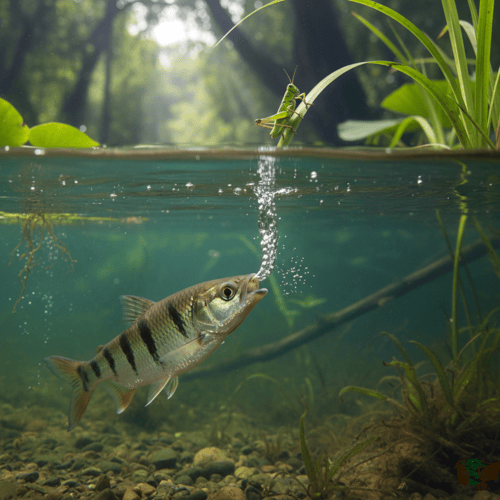
Beneath the murky surface of a Southeast Asian mangrove stream, an archerfish (Toxotes jaculatrix) hovers motionless. Its eyes have locked onto a grasshopper perched on a branch three meters above the waterline. The fish subtly adjusts its position, tilts its body at a calculated angle, then fires.
A pressurised water jet streaks upward through the air, arcing perfectly to compensate for gravity, distance, and the optical distortion created by light refraction at the water-air interface. Direct hit. The insect tumbles into the water, and the fish claims its meal with surgical precision. This isn’t luck or trial-and-error—this is marksmanship: bang on target, almost every time.
THE INTEGRATED SYSTEMS PROBLEM
The archerfish presents science with a profound challenge: how did such integrated complexity arise? The remarkable hunter employs multiple sophisticated systems working in perfect coordination, each essential to the others’ function.
The Ballistic Computer: Inside the archerfish’s compact brain operates what can only be described as a biological ballistics calculator. Research by Schuster et al. (2006) published in Current Biology demonstrates archerfish achieve over 90% accuracy on their first shot—a success rate that requires real-time physics calculations. The fish must compensate for refraction distortion that makes objects appear approximately 25% closer and higher than their actual position, adjust for projectile drop over distance, and even predict the trajectory of moving targets with appropriate lead time. Studies by Rossel et al. (2002) reveal archerfish accurately correct for the angular displacement caused by viewing prey through the water-air boundary—a computational feat requiring processing of complex optical physics.
The Precision Water Gun: The archerfish’s mouth represents a masterpiece of bioengineering. Its grooved tongue and palate form an adjustable barrel, while specialised gill covers compress to generate substantial pressure—sufficient to propel water jets up to five meters. But distance alone isn’t impressive; it’s the modulation that astonishes. The fish adjusts jet power, water volume, and velocity based on target distance and size, demonstrating fine motor control that rivals precision manufacturing.
The Visual System to Match: Despite having wide-set eyes, archerfish possess effective binocular vision capable of processing the challenging underwater-to-air visual information. This system must interpret distorted images, calculate actual positions, and enable split-second target acquisition and tracking—all while the fish itself remains submerged in a different optical medium than its prey.
Behaviour Integration: Perhaps most remarkably, research by Schlegel and Schuster (2008) shows juvenile archerfish hunt successfully without training or observation of adults. The complete behavioural package—target selection, position calculation, power modulation, and competitive prey claiming—appears innately programmed. This isn’t learned behavior refined over a lifetime; it’s pre-loaded software running on first boot.
THE IRREDUCIBLE COMPLEXITY ARGUMENT
The archerfish hunting system presents a textbook case of irreducible complexity—a coordinated system where removing any component renders the entire mechanism useless.
Consider the all-or-nothing nature of this design: visual compensation for refraction without the water cannon means no food acquisition. A functioning water gun without ballistic calculation ability results only in wasted energy and missed targets. Ballistic computational skills without integrated prey recognition leads to misdirected efforts at inappropriate objects. Natural selection, which can only preserve traits that provide immediate survival advantages, faces an insurmountable obstacle: how can it maintain intermediate stages that provide no functional benefit?
The coordination challenge deepens the problem. Multiple body systems must work in perfect synchronisation, with neuromuscular timing precision measured in milliseconds. The brain, eyes, mouth, and gills must operate in coordinated concert—each system somehow “knowing” what the others are doing. This raises a fundamental question for evolutionary explanations: how do random, undirected mutations produce coordinated complexity across multiple organ systems simultaneously? Mutations affecting the visual cortex cannot “know” that mutations are also needed in mouth musculature, gill compression mechanics, and behavioural programming.
Then there’s the information problem. The genetic code for refraction compensation must be pre-programmed—the fish cannot learn physics through trial and error when failure means starvation. Physics calculations require encoded algorithms written into the genome. But specified, functional information of this calibre, in our uniform experience, originates only from intelligent sources. Where does such information come from without intelligence?
EVOLUTIONARY EXPLANATIONS FALL SHORT
Standard evolutionary responses to the archerfish challenge prove inadequate upon examination.
- The “gradual improvement” narrative fails immediately: 50% accuracy provides no competitive advantage when other fish species successfully employ proven, simpler feeding methods. A partially effective hunting system that works half the time cannot be naturally selected for when reliable alternatives exist.
- Appeals to “exaptation”—where existing structures are co-opted for new functions—remain purely speculative. There is no fossil evidence of transitional forms, and no living relatives possess intermediate features that might suggest a stepwise path. The mathematical timing problem compounds these difficulties: the simultaneous coordination of multiple precise mutations within evolutionary timeframes strains statistical credulity.
- Moreover, there’s a selection pressure paradox. Archerfish inhabit environments with abundant alternative food sources. There is no survival necessity driving the development of such sophisticated technology. Fish thrive in these ecosystems using conventional feeding strategies. Why would natural selection invest in the biological equivalent of smart weapons when simple methods suffice?
- The convergent evolution problem further highlights the difficulty. If this system evolved once through naturalistic processes, why hasn’t it evolved repeatedly in similar environments? Numerous fish species occupy comparable ecological niches, yet no other species developed anything approaching the archerfish’s capabilities.
DESIGN INFERENCE
The archerfish exhibits all the hallmarks of intelligent design. It displays specified complexity—the system performs a specific function requiring precise calibration of multiple parameters. It demonstrates integrated functionality, with multiple subsystems purposefully coordinated toward a unified goal. The performance optimization exceeds minimum survival requirements, suggesting intentional engineering rather than minimal sufficiency. And the front-loaded information evident in innate juvenile competence indicates pre-programmed capability rather than accumulated learning.
Consider the parallel to human engineering. Military and aerospace targeting systems require physics modelling, sensory input processing, ballistic computation, and precision actuation. The archerfish possesses the biological equivalent of all these components in remarkably compact form. When engineers design such systems, they must pre-calculate all variables, integrate multiple technologies, and program decision-making algorithms. The archerfish arrives with all this complexity fully operational from birth.
Our uniform experience teaches that when we observe specified complexity achieving functional outcomes through integrated systems, intelligence is the cause. Design detection isn’t religious reasoning—it’s the same methodology employed in archaeology, forensics, and the Search for Extraterrestrial Intelligence (SETI). We recognise design by its signature: information-rich, functionally integrated, goal-directed complexity.
FOLLOWING THE EVIDENCE
Science advances when researchers follow evidence wherever it leads, unconstrained by philosophical preferences. Design detection represents valid scientific methodology, applied consistently across multiple disciplines. The archerfish exhibits engineering signatures identical to those we recognise in sophisticated human technology—with one crucial difference: it’s more sophisticated, more compact, and more efficient than anything we’ve designed.
The intellectual challenge is straightforward: if we infer design from far less sophisticated human artefacts, intellectual honesty requires we apply the same reasoning to superior biological systems. The archerfish doesn’t just hunt with precision—it testifies to a Precision Designer whose engineering capabilities exceed our own.
The evidence speaks clearly. Whether we listen depends not on the data, but on our willingness to follow it.
ARCHERFISH: UNDERWATER PRECISION SHOOTER—RELATED FAQs
Can’t the archerfish’s ability be explained by simple learning through practice over its lifetime?
No, because juvenile archerfish demonstrate immediate hunting competence without observation or practice (Schlegel & Schuster, 2008). Evolutionists may argue “instinctive behaviours” can evolve gradually, but this sidesteps the core issue: the genetic encoding of complex physics algorithms requires massive specified information arising simultaneously. Natural selection cannot preserve partially-formed instincts that don’t produce successful feeding outcomes.
Don’t other animals use water jets, suggesting a gradual evolutionary pathway?
Some marine animals expel water for locomotion or defence, but none combine this with precision targeting, refraction compensation, and predictive ballistics. Evolutionists point to “pre-adaptations” like basic water expulsion, but this is like claiming a garden hose represents a step toward a computerized fire suppression system. The gap between expelling water and calculating three-dimensional ballistic trajectories with optical corrections is unbridgeable by incremental mutations.
How do archerfish handle different lighting conditions and water turbidity that affect refraction?
Research shows archerfish successfully adjust their aim across varying light conditions and water clarity, suggesting sophisticated real-time sensory processing and adaptive algorithms. Evolutionists propose that “neural plasticity” allows learning adjustments, but this actually strengthens the design argument: the fish possess flexible programming capable of handling multiple variables simultaneously—something requiring meta-level algorithmic sophistication far beyond simple stimulus-response mechanisms.
Could group hunting behavior explain how less-accurate individuals still survived while the trait “evolved”?
Archerfish are actually competitive, not cooperative hunters—the first fish to reach downed prey claims it. Evolutionists might argue that even occasional success could be selected for, but this ignores energetics: frequent misses mean wasted energy in an environment where conventional feeding methods (surface feeding, substrate grazing) provide reliable alternatives. A marginally functional hunting system cannot outcompete established, reliable feeding strategies.
What about the claim that the archerfish’s brain is relatively simple, making this less impressive?
The simplicity argument actually backfires on evolutionary explanations. If a small, “simple” brain can execute complex ballistic calculations, refraction compensation, and predictive targeting, this reveals incredibly efficient information encoding—the hallmark of masterful engineering, not undirected processes. Evolutionists emphasising neural simplicity inadvertently highlight the improbability that random mutations could produce such optimized, information-dense programming in minimal neural architecture.
ARCHERFISH: UNDERWATER PRECISION SHOOTER—OUR RELATED POSTS
- The Hummingbird Miracle: 5 Scientific Facts That Defy Evolution
- Butterflies Don’t Use GPS: The Monarch Migration Miracle
- The Emperor Penguin: Designed to Thrive in Extreme Climates
- The Pelican: Precision-Engineered Fishing Vessel
- Explosive Evidence: How the Bombardier Beetle Demolishes Darwinism
- Nature’s Puzzle: The Platypus as Evidence of Divine Engineering
- Bats: How Nature’s Flying Marvels Defy Evolution
- Tadpole to Frog: How Metamorphosis Reveals Divine Programming
- Honeybees: 5 Ways Nature’s Unsung Architects Point to the Creator
- Testament to Design: The Engineering Marvel of Elephants
- Blue Whales: Mammoth Icons of Intelligent Design
- The Woodpecker’s Design: How Nature’s Headbanger Defies Evolution
- Too Perfect to Be Random: The Giraffe’s Remarkable Design