
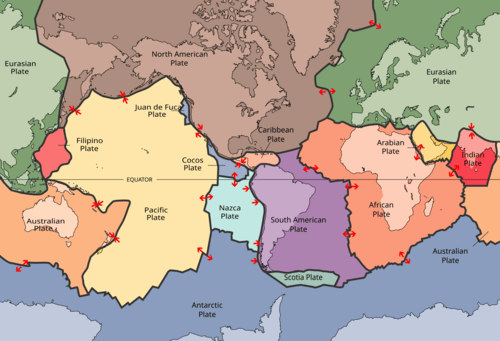
When Alfred Wegener first proposed that continents had once fit together like puzzle pieces, the scientific community scoffed. Today, plate tectonics is geological bedrock—accepted science taught in every classroom. But here’s what might surprise you: the same evidence mainstream geologists use to argue for an ancient Earth actually supports a young Earth timeline.
Young Earth Creationists accept plate tectonics wholeheartedly. We simply reject the assumption that today’s slow rates have always applied. The evidence suggests something far more dramatic: Earth’s plates raced across the globe during a catastrophic event—Noah’s Flood—accomplishing in months what conventional geology claims took hundreds of millions of years.
THE CATASTROPHIC PLATE TECTONICS MODEL: A BIBLICAL FIT
Standard geology suggests tectonic plates crawl along at fingernail-growth rates—of a few centimetres per year. At this pace, separating the continents requires vast ages. But what if the process was once exponentially faster?
The Catastrophic Plate Tectonics (CPT) model, developed by geophysicist Dr John Baumgardner and colleagues, proposes Earth’s pre-Flood ocean floor rapidly plunged into the mantle—the thick layer of hot, semi-solid rock beneath Earth’s crust. This triggered runaway subduction, where tectonic plates don’t just move. They sprint.
Here’s how it works: When cold, dense oceanic plates began sinking into the hot mantle, they created a feedback loop. The descending slabs pulled more plate material down behind them, generating friction and heat. This heat reduced the mantle’s thickness (viscosity), allowing plates to sink even faster. This, in turn, generated more heat, reducing viscosity further. Like a snowball rolling downhill, the process accelerated dramatically.
The biblical connection is striking. Genesis describes the Flood beginning when “the fountains of the great deep burst forth.” This imagery perfectly matches massive seafloor rifting—the ocean floor splitting apart as plates diverged at incredible speeds. In mere months, continents that once formed a supercontinent separated by thousands of miles, ocean basins deepened catastrophically, and mountain ranges thrust upward as plates collided.
COLD SLABS IN THE MANTLE: EVIDENCE OF RECENT RAPID SUBDUCTION
Modern seismic tomography—essentially a CT scan of Earth’s interior using earthquake waves—reveals something unexpected: massive slabs of colder, denser rock extending deep into the mantle beneath subduction zones.
Here’s the problem for old-Earth geology: these slabs shouldn’t still be cold.
If these slabs have been sitting in the mantle for tens of millions of years, as conventional dating suggests, the surrounding heat should have warmed them to equilibrium temperatures long ago. The mantle reaches temperatures of thousands of degrees. Heat transfer is relentless and predictable. Yet these slabs remain detectably colder than the surrounding mantle.
Think of dropping ice cubes into hot water. Shortly after, they’re still cold and identifiable. Leave them for hours, and they’ve completely melted and dispersed. The fact that we can still detect these cold slabs suggests they’re geologically young—they descended recently and rapidly, within thousands rather than millions of years.
The CPT model explains this perfectly: rapid subduction during the Flood means these slabs plunged into the mantle just thousands of years ago. They haven’t had time to thermally equilibrate. What old-Earth geologists see as ancient features are actually evidence of recent catastrophe.
OCEAN FLOOR PATTERNS AND MAGNETIC REVERSALS: SIGNS OF SWIFT SPREADING
At mid-ocean ridges—underwater mountain ranges where plates pull apart—new ocean floor forms as volcanic rock wells up from below. As this rock cools, it records Earth’s magnetic field direction like a frozen compass needle.
Geologists have discovered symmetrical “stripes” of alternating magnetic polarity spreading outward from these ridges. The rocks alternate between normal polarity (matching today’s field) and reversed polarity (opposite direction). The conventional interpretation: these formed slowly over millions of years as Earth’s magnetic field occasionally flipped.
But there’s compelling evidence that magnetic reversals can happen rapidly—in days or weeks, rather than millennia. Thin lava flows in Oregon and Iceland show multiple reversals recorded within single cooling events. The molten rock couldn’t have stayed liquid for thousands of years, so these reversals must have occurred rapidly.
If reversals happen quickly and seafloor spreading during the Flood was catastrophically fast, the observed stripe patterns could form in a compressed timeframe. Rapid plate divergence at mid-ocean ridges, combined with fast magnetic reversals, would produce exactly what we observe.
Here’s another intriguing fact: the oldest ocean floor is allegedly only 200 million years old—a tiny fraction of Earth’s supposed 4.6-billion-year age. If Earth is truly ancient, where’s the old ocean crust? The YEC answer: it doesn’t exist because the ocean floor itself is young, formed during and after the Flood.
ANSWERING KEY OBJECTIONS
“Heat from rapid tectonics would melt the crust” This is the most serious challenge to CPT, and young Earth scientists acknowledge it directly. Runaway subduction would generate enormous heat—potentially enough to vaporise the oceans and melt the crust.
However, several mechanisms could have dissipated this heat. Massive volcanic activity during the Flood would have vented heat into the oceans and atmosphere. Ocean water circulating through extensive fractures in the crust could have provided powerful cooling. Some YEC scientists also propose that God supernaturally managed heat distribution—no different than miraculously sustaining life aboard the Ark. This remains an active research area.
“Radiometric dating proves old ocean crust” Young Earth scientists question radiometric dating’s fundamental assumptions: constant decay rates, closed systems, and known initial conditions. The RATE (Radioisotopes and the Age of The Earth) research project uncovered evidence suggesting decay rates weren’t constant. Helium retention in zircon crystals, radiohalos in granite, and carbon-14 in diamonds all point toward accelerated nuclear decay during catastrophic events.
If decay rates were dramatically faster during the Flood, rocks yielding “200-million-year” dates could actually be thousands of years old. The same catastrophic processes driving rapid tectonics may have accelerated radioactive decay.
“We don’t see plates moving that fast today” Exactly right—and we wouldn’t expect to. The catastrophic phase was a unique, one-time event triggered by specific conditions at the Flood’s onset. What we observe today is the “winding down” phase. Plates still move, but far slower, like a spring gradually unwinding after being released.
Current slow rates don’t prove past rates were always slow. That’s a uniformitarian assumption—the idea that “the present is the key to the past.” But catastrophic events, by definition, operate outside normal parameters. Finding a car wreck doesn’t mean the collision is still happening in slow motion.
CONCLUSION
The Catastrophic Plate Tectonics model demonstrates that young Earth scientists do engage seriously with geological evidence. Rather than ignoring plate tectonics, we’ve developed a framework integrating modern discoveries with biblical history. Cold mantle slabs, magnetic reversal patterns, and the absence of ancient ocean floor all fit comfortably within a young Earth timeline when catastrophic processes are considered.
Questions remain—particularly regarding heat dissipation—and research continues. But the evidence suggests Earth’s geological features weren’t shaped by slow processes over vast ages, but by rapid, catastrophic movements during a global Flood thousands of years ago. The same rocks tell very different stories depending on which assumptions we bring to them.
RELATED FAQs
Would the continents really fit together as one landmass?
Yes, the fit is remarkably precise—especially along the continental shelves rather than just coastlines. When you match the actual edges of the continental platforms (the submerged extensions), continents like South America and Africa align with stunning accuracy. Young Earth Creationists identify this original supercontinent as the pre-Flood world, which rapidly fragmented during the catastrophic events of Noah’s Flood.
How could animals migrate to different continents after the Flood if the continents separated so quickly?
The CPT model suggests that while plates moved rapidly during the Flood itself, significant separation may have continued for centuries afterward at decreasing rates. Land bridges likely persisted for some time after the Flood, allowing animal migration before continents reached their current positions. Additionally, lower post-Flood sea levels would have exposed more continental shelf area, creating additional migration routes that are now underwater.
What about the ring of volcanoes around the Pacific—the “Ring of Fire”?
The Ring of Fire marks subduction zones where oceanic plates plunge beneath continental plates—exactly what the CPT model predicts as an aftermath of catastrophic plate movement. These zones remain geologically active today as plates continue their post-Flood slowdown. The intense volcanic and seismic activity around the Pacific rim is consistent with relatively recent, massive tectonic reorganization rather than steady-state processes operating for hundreds of millions of years.
If the Flood caused rapid plate tectonics, why don’t we find human fossils mixed with dinosaur fossils?
Fossil distribution reflects both pre-Flood ecology and Flood burial sequences, not evolutionary time periods. Humans likely lived in higher elevations and smaller populations than dinosaurs, making fossilisation less likely. Additionally, humans would have sought high ground as floodwaters rose, making them among the last to be buried, while marine and lowland creatures were entombed first. Hydrological sorting during the Flood would naturally separate organisms by size, density, and habitat.
What formed the mid-Atlantic ridge, and is it still growing?
The mid-Atlantic ridge formed when the pre-Flood supercontinent rifted apart during catastrophic plate divergence—the “fountains of the great deep” breaking open. Yes, it’s still spreading today, but at dramatically reduced rates (about 2-3 cm per year) compared to the proposed Flood-time speeds. This ongoing, slow spreading represents the final stages of the catastrophic event winding down, much like aftershocks following a major earthquake can continue for years.
How do ice cores showing hundreds of thousands of layers fit with a young Earth?
Ice core dating assumes one layer equals one year, but multiple layers can form in a single year through various weather events and seasonal temperature fluctuations. Studies of ice cores from known historical periods have documented multiple layers forming within single years. Additionally, post-Flood climate chaos—including an Ice Age triggered by warm oceans and volcanic cooling—could have produced rapid ice accumulation with numerous layers in a compressed timeframe.
Could the rapid plate movement have triggered the Ice Age?
Absolutely—this is a key component of young Earth Ice Age models. Catastrophic plate tectonics would have warmed the oceans significantly through underwater volcanic activity, while massive volcanic eruptions filled the atmosphere with reflective aerosols, cooling the continents. Warm oceans plus cool continents equals perfect Ice Age conditions: enhanced evaporation, increased snowfall at high latitudes, and glacial growth. This post-Flood Ice Age would have peaked within centuries, not tens of thousands of years.
OUR RELATED POSTS
- Does Ocean Salt Content Prove a Young Earth?
- Can a Young Earth Explain Impact Craters? Evidence Says Yes
- The Sun’s Age: Is It Really A Showstopper for A Young Earth?
- Age of the Earth Discussions: How’s Helium a Gamechanger?
- 6000 Years Or 4.5 Billion: How Old is the Earth Really?
- Do Tree Rings Really Prove the Earth Is Old?
- Mt St Helens: How One Volcano Challenges Geological Timescales
- Population Math: The Overlooked Evidence for a Young Earth