
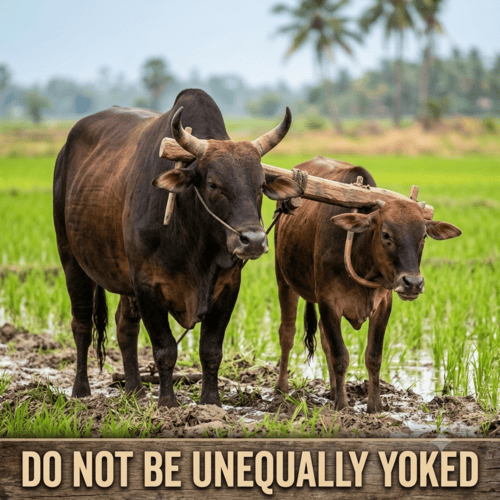
The concept of being “unequally yoked” comes from 2 Corinthians 6:14, where the Bible warns believers against binding themselves together with unbelievers. The Greek word used here refers to an “unequal” or “different” yoking of animals such as oxen—mismatching them in terms of size and strength would make life and workload difficult for both.
When it comes to marriage, being unequally yoked refers to a Christian being married to a non-Christian. The Bible instructs Christ-followers to avoid spiritually mismatched unions (being unequally yoked) because of the inevitable tensions, conflicts, and risks of compromise that will arise. This isn’t a modern reading into the text, either—the Westminster Confession of Faith codifies the same principle directly: “it is the duty of Christians to marry only in the Lord… neither should such as are godly be unequally yoked, by marrying with such as are notoriously wicked.”
Why the Prohibition? Marriage is a profound, sacred covenant that God intended to be a spiritual and physical union (Genesis 2:24). When a believer marries a non-believer, the spiritual disconnect can cause significant strain and challenges for both parties:
- Differing Worldviews & Values: As a Christian married to a non-Christian, you will have fundamentally different beliefs, priorities, and moral/ethical foundations underpinning your life philosophies. This clash of worldviews will inevitably lead to conflicts on various issues.
- Challenges in Raising Children: When you’re blessed with children, you as parents will have divergent views on how to raise and spiritually nurture them. Disagreements over matters such as discipline, moral training, and religious instruction will be a constant battleground.
- Spiritual Intimacy Challenge: Marriage is meant to be a holy, intimate relationship that reflects Christ’s union with the Church (Ephesians 5:31-32). An unequally yoked marriage lacks the spiritual intimacy and shared spiritual walk that believers yearn for and should have.
- Compromise Risks: The unbelieving spouse may subtly (or overtly) encourage compromises in the Christian’s faith over time. There is a risk of being spiritually pulled away from a vibrant relationship with Christ.
- Short-term Union: Ultimately, unless both spouses are believers, the family cannot experience the fullness of being united in Christ for eternity. Death will tragically part them forever if one spouse remains an unbeliever.
The Bible’s wisdom here is clear—being unequally yoked will inevitably produce avoidable strife, conflict, spiritual decline, and eternal separation. While God can certainly overcome such marital divides through supernatural grace, the instruction to not enter into such an unequal spiritual bond remains paramount.
The “Missionary Dating” Fallacy: Some believers may rationalize being unequally yoked, with thoughts such as “Wouldn’t it actually help enlarge God’s Kingdom if I marry an unbeliever and eventually win him/her over to Christ?” This mindset—sometimes called “missionary dating”—is well-meaning, but is often misguided folly.
The unfortunate reality is the spiritual “traffic” is frequently in the opposite direction. Rather than the unbelieving spouse being won over, it’s more likely you as a Christian spouse will forever be pulled away from fervent faith.
After all, if you’re already compromising on the clear Biblical directive against being unequally yoked at the very start, it reveals a willingness to overlook Scripture’s authority so you can have your own desires. This spiritual compromising heart-posture then becomes fertile ground for further backsliding once marriage strains arise.
When two are unequally yoked, it’s typically the Christian who does most of the continual compromising on matters of faith, ethics, priorities and values to avoid constant conflict. The tragic regression often causes believers to get spiritually malnourished and paralyzed in being salt and light. So while the noble aim is to see your spouse radically transformed by the gospel, the more likely outcome is fielding years of spiritual attack, drift and weakening of your own convictions. You may be entering into an unequal yoke with good intentions, but remember, you’re doing so at great expense: one of clear disobedience.
Sobering Consequences: Wilfully disobeying Scripture’s clear teaching by marrying an unbeliever often carries severe spiritual consequences. Beyond the marital strains, it puts one’s walk with Christ at risk and can lead to a gradual hardening of one’s spiritual sensitivity and convictions over time.
The grave error unravels relationships—with the Lord, one’s Christian family/community, and even one’s own children who may be drawn from the faith. While God’s mercy abounds, repeated conscious defiance can ultimately lead to spiritual shipwreck (1 Timothy 1:19).
Avoiding the Pitfall: The wisest path is to heed Scripture’s warnings against being unequally yoked from the start. If you’re a single believer, seriously consider marital relationships only with those who share your faith and commitment to Christ. Lay this godly foundation from the outset.
However, if you have entered an unequally yoked marriage before knowing better, take courage! This is a different pastoral situation from choosing to enter one with eyes open—Scripture speaks directly to it in 1 Corinthians 7:14, and while immensely challenging, some have witnessed the amazing testimony of their unbelieving spouse being drawn to Christ through years of steadfast prayer, love and Christlike witness (1 Peter 3:1-2).
Ultimately, the principle is clear—being equally yoked spiritually is critical for a marriage to glorify God and withstand life’s inevitable storms united in faith. Hold fast to this timeless wisdom when looking out for your future spouse. Your obedience will be honoured, and your marriage blessed.
Tough Questions, Honest Answers
I’m already married to a non-Christian—does this mean I should leave?
No. This warning is directed at believers considering marriage, not at those already married. Scripture is explicit on this point: 1 Corinthians 7:12-14 instructs a believer married to an unbeliever to remain in the marriage if the unbeliever is willing to stay, since the believing spouse’s presence has a sanctifying effect on the household. Leaving isn’t the biblical response to a marriage already entered—faithfulness within it is.
Doesn’t 1 Corinthians 7:14 contradict the command not to be unequally yoked?
No—the two passages address different moments. 2 Corinthians 6:14 is preventative counsel for believers who haven’t yet married, warning against entering a spiritually mismatched union. 1 Corinthians 7:14 is pastoral counsel for believers already in one, usually because they married before conversion or before understanding this principle. One is about the decision to marry; the other is about faithfulness after the fact.
What exactly is “missionary dating,” and why is it risky?
Missionary dating is entering a relationship with a non-believer specifically hoping to evangelise and eventually marry them once converted. It’s risky because it inverts the biblical pattern: rather than shared faith being the foundation for the relationship, conversion becomes a hoped-for outcome of it—and in practice, the spiritual “pull” more often runs from the believer toward the world than the reverse.
Does the “unequally yoked” principle apply to dating, or only to marriage?
It applies with even more force to dating, since dating is the stage where the decision to marry is actually formed. Waiting until engagement or marriage to take the principle seriously is usually too late—by then, emotional investment has already made the “clear-eyed” evaluation this passage calls for much harder to do honestly.
What if my spouse becomes a Christian after we’re already unequally yoked?
This is a genuine answer to prayer and exactly the outcome 1 Peter 3:1-2 anticipates—a spouse won over “without a word” by consistent godly conduct. The marriage becomes equally yoked at that point, though both spouses may still need time to grow into shared spiritual practices and priorities that weren’t there before.
Is a Christian who married an unbeliever living in ongoing sin?
The decision to marry outside the Lord’s counsel was a specific act of disobedience, but the marriage itself, once entered, is a real and binding covenant that Scripture calls believers to honour, not exit (1 Corinthians 7:10-14). Continuing in a marriage isn’t itself sinful; the original choice to enter it against Scripture’s counsel is the thing to bring to God in repentance, while the marriage itself is to be kept faithfully going forward.
What should I do if my unbelieving spouse wants a divorce?
1 Corinthians 7:15 addresses this directly: if the unbelieving spouse chooses to leave, the believer is not bound to fight to keep the marriage together against their will—”God has called you to peace.” The believer isn’t the one initiating separation on spiritual grounds in that scenario; they’re responding to a decision made by the other party.