In a world where the ruthless seem to do all the winning, what can this beatitude even mean?
“Blessed are the meek, for they shall inherit the earth.”
How do we—who keep watching the unscrupulous grab what isn’t theirs—even begin to make sense of the third beatitude?
The joke assumes Jesus is being naive, or offering consolation prizes to people who’ve already lost it all. He’s doing nothing of the kind. He’s making a property claim, and He borrows the wording from a psalm that exists specifically to answer the question the joke is asking: why do the ruthless appear to win?
The Word Meant Something Harder Than We Think
Before it appeared in any Christian vocabulary, praus and its related noun had a settled place in Greek moral philosophy. , and that placement is illuminating.
Aristotle used the term to name a specific virtue: the correct disposition regarding anger. He arranged it, as he arranged every virtue, as a mean between two failures. On one side sits the person who’s quick-tempered, angry at the wrong things and for too long. On the other sits a person Aristotle regarded with something close to contempt—the man who doesn’t get angry at all, who absorbs insult and injustice without reaction. And Aristotle considered the latter a fool rather than a saint.
The virtue lies between them. The praus person does become angry, but at the right things, toward the right people, in the right manner and for the right length of time. Anger isn’t eliminated. It’s governed.
Aristotle’s Spectrum
| DEFICIENCY | THE MEAN | EXCESS |
|---|---|---|
| No anger at all | Praotēs — meekness | Quick-tempered rage |
| Absorbs insult without reaction | Anger at the right things, rightly aimed | Anger at the wrong things, wrongly aimed |
| Regarded as servility, not virtue | Strength under government | Force without government |
This background disposes of the most common misunderstanding in a single stroke. Whatever meekness is, it isn’t inability to be provoked. A person with no capacity for anger hasn’t achieved this virtue; he has failed to reach it from the other direction.
The New Testament confirms the point from another direction. The same word appears in Paul’s list of the fruit of the Spirit, usually translated gentleness (Galatians 5:23). That placement is significant. Fruit isn’t manufactured by the tree that bears it; it’s the visible result of a life already running through the branch. Meekness in the Christian sense is therefore not a technique of anger management but a by-product—which explains why attempts to acquire it directly so reliably produce something else.
What Jesus adds to Aristotle is the crucial question of who does the governing. For Aristotle, the meek man regulates his own anger by reason. In the Sermon on the Mount, the governing hand belongs to God, and that shifts the virtue from an achievement of character into an act of trust.
The Two Men Scripture Calls Meek
Only 2 people in the whole Bible are described this way, and neither of them was mild.
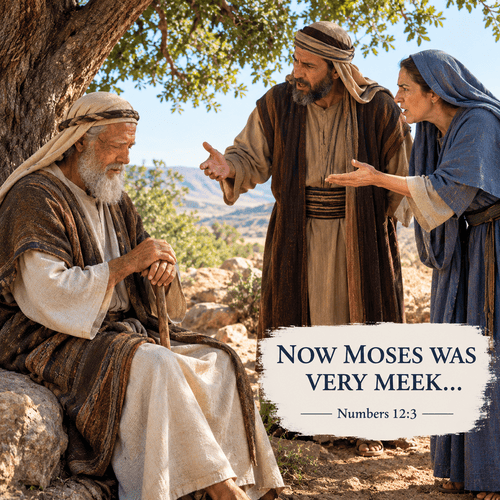
- Moses. “Now the man Moses was very meek, more than all people who were on the face of the earth” (Numbers 12:3). This is the man who confronted Pharaoh, smashed the tablets and once killed an Egyptian with his bare hands. The verse appears in a specific setting: Miriam and Aaron have just challenged his authority and questioned his marriage. Moses says nothing in his own defence. God answers for him.
- Jesus. “Take my yoke upon you, and learn from me, for I am gentle and lowly in heart” (Matthew 11:29). Matthew later applies Zechariah’s prophecy of a king arriving humble and mounted on a donkey to His entry into Jerusalem (Matthew 21:5). This is the same man who drove the traders out of the temple and called the religious establishment whitewashed tombs to their faces.
The Zechariah quotation Matthew applies to the triumphal entry deserves a moment on its own. It’s a deliberate piece of political theatre. A conquering king returning in victory rode a war horse; a king arriving in peace rode a donkey. Zechariah had prophesied a king who would come humble and mounted on a donkey, and Jesus arranged the animal in advance. The meekness on display that day wasn’t diffidence. It was a claim to kingship, made in a form that announced what kind of king had arrived.
Set the 2 lives beside the popular definition and the definition collapses. Neither Moses nor Jesus avoided confrontation. Neither was temperamentally soft. Neither could be described as passive about injustice.
What they share is narrower and far more demanding. In both cases, the meekness appears precisely at the point where a personal defence was available and was declined. Moses had a case against Miriam and Aaron; he didn’t press it. Peter describes the pattern in Christ with unusual precision: “When He was reviled, He did not revile in return; when He suffered, he did not threaten, but continued entrusting himself to him who judges justly” (1 Peter 2:23).
That last clause is the definition. Meekness isn’t the absence of a case. It’s the refusal to prosecute your own, on the grounds that the verdict has been assigned to someone better qualified to reach it.
THE DEFINITION IN ONE LINE
Meekness isn’t the absence of a case. It’s the refusal to prosecute one’s own case, and the entrusting of the same to God instead.
What Meekness Isn’t
With that in hand, 5 common substitutes can be set aside quickly.
- Not weakness. The two men Scripture names were among the most forceful figures in it. Weakness has no strength to govern; meekness has strength and governs it. The distinction is not subtle, though the English word obscures it.
- Not niceness. Conflict avoidance is frequently self-protection wearing a pleasant expression. Declining a confrontation because it would be unpleasant for you is not the same as declining one because you have entrusted the outcome to God.
- Not temperament. Some people are constitutionally placid and some aren’t. Neither condition is a spiritual attainment. A naturally calm person may never have surrendered a single thing to God. A naturally combustible one may have surrendered everything.
- Not silence about injustice to others. This distinction matters enormously and is routinely missed. Moses was meek in Numbers 12 and ferocious before Pharaoh in Exodus 5, and there’s no contradiction: meekness governs the defence of self, not advocacy for others. Using this beatitude to silence someone speaking up for the wronged inverts it.
- Not indifference to sin. The temple cleansing is in the same Gospel as this beatitude, written by the same author, about the same person. Whatever meekness means, it must be compatible with that.
Psalm 37 and Where the Promise Comes From
The second half of the beatitude is very nearly a direct quotation. In the Greek Old Testament, Psalm 37:11 reads almost word for word as Matthew 5:5 does, and Jesus’ hearers would have recognised it immediately.
That matters, because quoting a line imports the argument around it. Psalm 37 is a wisdom psalm devoted to a single problem: the apparent success of people who deserve none. It opens by naming the temptation directly—“Fret not yourself because of evildoers; be not envious of wrongdoers!”—and then works patiently through the reasons not to.
The Psalm’s Argument in 4 Stages
- The observation. The wicked genuinely do prosper, and the psalm doesn’t pretend otherwise. It doesn’t deny evidence its readers can see.
- The time frame. What it disputes is the timescale. The evildoers will fade like grass; the question isn’t if they’ll succeed now, but how long the success lasts.
- The instruction. Wait for the LORD, and refrain from anger. The psalm treats the surrendering of one’s own vindication as an act of faith, not resignation.
- The refrain. 5 times over, the psalm returns to the same promise: those who wait for the LORD shall inherit the land (vv. 9, 11, 22, 29, 34). Repetition is the psalm’s way of making an argument stick.
It’s worth noticing how unsentimental the psalm is about the cost of it all. It doesn’t tell the reader the wicked are secretly miserable, or that virtue brings its own immediate reward. It concedes the ground entirely and rests the whole argument on a single claim about the future. Anyone who finds meekness difficult isn’t misunderstanding the instruction; they’re feeling exactly what the psalm expects them to feel, which is why it repeats itself so often.
So when Jesus blesses the meek, He isn’t introducing a new ethic. He’s telling His hearers the psalm was right after all, and that the wait it counselled is nearly over. Meekness, on this reading, is simply the practical posture of someone who has settled in advance the question of who ends up owning everything.
What Inherit the Earth Actually Promises
Two errors bracket this phrase, and both are common.
The first evaporates it. On this reading, inheriting the earth is a poetic way of saying ‘going to heaven’: the promise concerns a destination elsewhere. But the word is gē—land, earth, ground. In Psalm 37 it means the land of Canaan, a specific territory with borders. Jesus widens the scope without changing the category. Paul does the same when he describes the promise to Abraham as being that he would be heir of the world (Romans 4:13). The inheritance isn’t somewhere else. It’s here, remade—the new heavens and new earth in which righteousness dwells (2 Peter 3:13).
The second error materialises it. On this reading, the verse guarantees present prosperity to the sufficiently humble. The psalm itself refutes this reading, and the lives of most believers would embarrass. The promise is future, and its future tense is doing deliberate work: the first beatitude promises the kingdom now, this one promises an inheritance later.
The word inheritance is the key to holding both together. An inheritance isn’t wages and can’t be seized; it comes by relationship, and it comes at the appointed time. That’s why this promise can be made to the meek without contradiction. They’re precisely the people who’ve stopped trying to take things.
Why Meekness Comes Third
The progression has been running along a consistent line. Poverty of spirit is the recognition that we have nothing to bring to God. Mourning is the grief that follows that recognition. Both are vertical, transacted between a person and God with nobody else necessarily aware of them.
Meekness is where the vertical turns horizontal. It’s the first beatitude that other people can see, and the logic connecting it to the previous two is tight. A person who has genuinely abandoned self-defence before God finds the grounds for self-defence before other people quietly removed. If I concede I have no case at the only tribunal that finally matters, the energy I was spending on smaller ones begins to look misdirected.
John Stott observed this ordering is what keeps the beatitudes from being a list of admirable traits: each one is produced by the one before it. Meekness can’t be adopted directly. Attempted on its own, it becomes either performance or repression—and both eventually fail, usually at the worst moment.
What Meekness Looks Like on a Weekday
Meekness is rarely tested in dramatic moments. More often, it shows up in small situations—usually when things happen quickly and we barely have time to think.
When we’re misrepresented. The question isn’t whether it hurts, but what we do next. Meekness may mean resisting the urge to correct every misunderstanding or defend ourselves immediately.
When someone else snatches the credit. The desire to set the record straight is surprisingly strong—and it often disguises itself as a concern for accuracy.
In arguments we could win. Meekness doesn’t mean we must lose arguments. It means being genuinely willing to lose them. Those are very different things.
Online. Social media makes self-defence almost effortless. Few things reveal more quickly how much we care about controlling our reputation.
With people who can’t fight back. This is perhaps the clearest test. How we treat people who have no power over us—staff, children, the elderly, or strangers behind a counter—shows what our meekness toward equals is really made of.
There’s something uncomfortable about this list: none of these situations can be mastered simply by trying harder when they arise. By the time we feel the urge to defend ourselves, the deeper instinct is already there.
Meekness isn’t built in the moment we’re provoked. Provocation reveals if it’s there. It’s built beforehand, through the settled conviction that God sees, God judges justly, and God can be trusted with our case. That’s what makes surrendering our right to defend ourselves an act of faith rather than recklessness.
Blessed Are the Meek: Meaning for Today
Every culture rewards self-assertion, and ours has simply made the rewards faster and more visible. The third beatitude, on the other hand, proposes something that looks like unilateral disarmament: stop defending yourself, stop pressing your case, stop managing the record.
It only makes sense on one condition. If nobody is keeping account, meekness is exactly the naivety the joke assumes—a strategy for being taken advantage of by people. But if there is a God who judges justly, declining to prosecute our own case isn’t surrender. It’s the transfer of a matter to a higher court, by someone who expects a hearing.
That is what Moses did when his siblings came for him, and what Christ did when the charges were false and the outcome fatal. Neither man lost the case. Both simply declined to argue it themselves.
The meek shall inherit the earth. Not the leftovers. The earth. All of it.
Tough Questions, Honest Answers
Isn’t meekness just weakness by another name?
No, and the Greek makes this unusually clear. Aristotle placed the word between two vices, and the deficiency he named—the man who cannot be roused to anger at all—he regarded as a failure rather than a virtue. Meekness presupposes strength that could be exercised but isn’t. The two men Scripture calls meek, Moses and Jesus, were among the most forceful figures in the Bible. Weakness has nothing to restrain.
Does this mean Christians should never defend themselves?
It means personal vindication is entrusted to God rather than seized. That is not the same as never speaking. Paul appealed to Caesar and asserted his Roman citizenship when it served the gospel; Jesus questioned the legality of the officer who struck Him. The distinction is one of motive and object: meekness governs the defence of one’s own honour, not the pursuit of justice, the protection of others, or truthful correction of the record when something more than pride is at stake.
What does “inherit the earth” actually mean—heaven, or this planet?
This planet, renewed. The word means land or earth, and in Psalm 37, which Jesus is quoting, it refers to the land of Canaan. Jesus widens the scope from a territory to the whole earth without changing the category, and Paul describes Abraham as heir of the world on the same logic (Romans 4:13). The destination Scripture describes isn’t an escape from creation but its restoration—a new heavens and new earth in which righteousness dwells.
How can Jesus be meek if He cleared the temple and denounced the Pharisees?
Because meekness was never defined as the absence of anger. Note what the two episodes have in common: in both, the offence was against God and against the vulnerable, not against Jesus personally. When the injury was His own—false accusation, mockery, an unjust trial—He was silent. The pattern is consistent throughout His life and it is exactly the distinction Peter draws in 1 Peter 2:23.
Is meekness the same as humility?
They’re closely related but not identical. Humility concerns one’s estimate of oneself; meekness concerns what one does with power and provocation, particularly when wronged. A person can hold an accurate low view of himself and still fight ferociously for his own interests. Meekness is humility that has reached the hands—the point at which a right assessment starts governing behaviour under pressure.
Is the horse-and-bridle illustration accurate?
Partly. The word group was used in Greek of tamed animals, so the general picture has a real basis. The elaborated version common in preaching—a war horse specifically, broken for battle, its power now answering to the rider—is homiletical development rather than lexical fact. It remains a serviceable illustration provided it is offered as an image rather than as evidence, and the argument does not depend on it.
How is this different from the world’s idea of being the bigger person?
Being the bigger person is usually a form of victory. It preserves the moral high ground, and it often carries a quiet satisfaction in having risen above someone. Meekness surrenders the scoreboard entirely, which is harder and considerably less gratifying. The difference shows in what happens afterwards: rising above tends to produce a story worth telling, while genuine meekness leaves a person with nothing much to report.
Related Reads
- The 9 Beatitudes Meaning: The 9 Marks of Those Jesus Calls Blessed
- Blessed Are the Poor in Spirit: Meaning of Matthew 5:3
- Matthew 5:4: What ‘Blessed Are Those Who Mourn’ Truly Means
- ‘Hunger and Thirst for Righteousness’: What Matthew 5:6 Means
- Matthew 5:7: What Does ‘Blessed Are the Merciful’ Mean?
- ‘Blessed Are the Pure in Heart’: Meaning of Matthew 5:8
- Blessed Are the Peacemakers: Meaning of Matthew 5:9
- Matthew 5:10: What Does ‘Blessed Are Those Who Are Persecuted’ Mean?
- ‘Blessed Are You When People Revile You’: What Does Jesus Mean?